
BrainsWay Presents Positive Data from Largest Real-World Study of Deep TMS™ in Patients with Comorbid PTSD and Major Depressive Disorder
BrainsWay (NASDAQ:BWAY) reported positive real-world data from the largest analysis of Deep TMS in patients with comorbid PTSD and major depressive disorder.
Sentiment and the balance of points
Rhea-AI Sentiment reads the wording of the document, how positive or negative its language is on a 1 to 5 scale. The balance of points shown with the takes weighs what the document actually discloses, so the two can disagree, for example when a trial that missed its main goal is described in upbeat language.
Rhea-AI Summary
BrainsWay (NASDAQ:BWAY) reported positive real-world data from the largest analysis of Deep TMS in patients with comorbid PTSD and major depressive disorder.
The retrospective study of 462 patients showed 83.5% PTSD response, 66.6% depression response, 27.3% remission, and around 50% average symptom reductions. Deep TMS is not FDA-cleared for PTSD and findings are preliminary.
Positive
- Real-world study included 462 comorbid PTSD and MDD patients across 11 clinical sites
- PTSD response rate of 83.5% with mean 52% reduction in PCL-5 scores
- Depression response rate of 66.6% and 27.3% remission rate
- Average 50% reduction in PHQ-9 depression scores following Deep TMS treatment
Negative
- Deep TMS not FDA-cleared for PTSD or comorbid PTSD and MDD
- Study is retrospective real-world data and remains subject to peer review
Details
News Market Reaction – BWAY
On Jun 29, the day this news came out, BWAY closed 4.77% above the previous close.
Data tracked by StockTitan Argus for the Jun 29 session.
Key Figures
- Study size
- 462 patients
- Real-world Deep TMS study in comorbid PTSD and MDD
- Clinical sites
- 11 sites
- Real-world Deep TMS study network
- Minimum treatment sessions
- 20 Deep TMS sessions
- Per patient in real-world study
- PTSD response rate
- 83.5%
- Patients with ≥50% PTSD symptom reduction (PCL-5)
- PTSD symptom reduction
- 52% reduction
- Average PCL-5 score change after Deep TMS
- Depression response rate
- 66.6%
- Patients with ≥50% reduction in depression symptoms (PHQ-9)
- Depression remission rate
- 27.3%
- Remission in PHQ-9 among comorbid PTSD/MDD patients
- Depression score reduction
- 50% reduction
- Average PHQ-9 score change after Deep TMS
Historical Context
-
Expanded U.S. policy coverage lifting Deep TMS access to over 57M lives.
-
New 12‑month durability data for SWIFT accelerated Deep TMS in MDD.
-
Minority‑stake investment in Hopemark Health to expand Deep TMS access.
-
Q1 2026 results with 35% revenue growth and higher profitability metrics.
-
Announcement of upcoming Q1 2026 earnings release and conference call.
24h Move is the share-price change in the day after each event; other market factors may also have contributed.
Key Terms
deep tms medical
pcl-5 medical
phq-9 medical
h-coil technology technical
AI-generated analysis. How Rhea-AI works. Not financial advice.




Nearly half of individuals diagnosed with PTSD also meet criteria for major depressive disorder (MDD), making comorbid depression one of the most common and clinically significant complications of PTSD
~
Results presented at a recent leading industry conference
BURLINGTON, Mass. and JERUSALEM, June 29, 2026 (GLOBE NEWSWIRE) -- BrainsWay Ltd. (NASDAQ & TASE: BWAY) (“BrainsWay” or the “Company”), a global leader in advanced noninvasive brain stimulation technologies, today announced the presentation of positive new real-world data demonstrating significant improvements in patients with comorbid post-traumatic stress disorder (PTSD) and Major Depressive Disorder (MDD) treated with Deep Transcranial Magnetic Stimulation (Deep TMS™). The findings were recently presented in a poster, titled “Safety and Efficacy of Deep TMS in Comorbid MDD and PTSD: Real-World Data Analysis,” by Colleen Hanlon, PhD, Vice President of Medical Affairs for BrainsWay, at a recent leading industry conference.
This real-world data collection study evaluated the efficacy of Deep TMS as a tool to improve both PTSD and MDD symptoms in patients with comorbid disease. All 462 patients in the retrospective study, from 11 clinical sites, were diagnosed with both MDD and PTSD, received at least 20 Deep TMS treatment sessions using BrainsWay's H1 or H7 coils. Outcomes included changes in the PTSD Checklist for DSM-5 (PCL-5) and the Patient Health Questionnaire-9 (PHQ-9) before and after treatment. Of these patients,
Figure 1
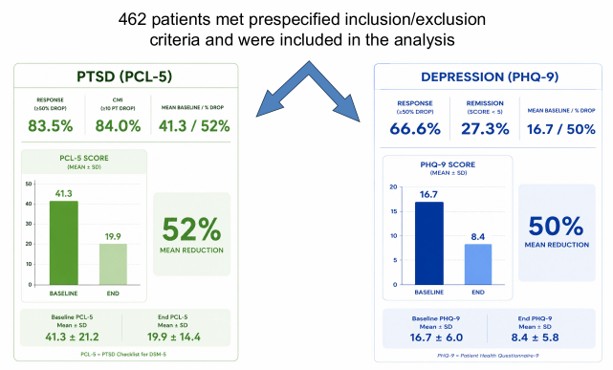
Caption: Analysis of data demonstrate significant improvements in patients with comorbid post-traumatic stress disorder (PTSD) and Major Depressive Disorder (MDD) treated with Deep Transcranial Magnetic Stimulation (Deep TMS™).
“This study represents the largest real-world analysis of Deep TMS in patients with comorbid PTSD and major depressive disorder to date,” said Colleen Hanlon, Ph.D., Vice President of Medical Affairs at BrainsWay. “Given the significant burden associated with these co-occurring conditions, it is encouraging to see meaningful improvements in both PTSD and depression symptoms across a large and diverse patient population. These findings further strengthen the growing body of evidence supporting Deep TMS in complex psychiatric disorders.”
“Patients living with both PTSD and depression often experience more severe symptoms and fewer effective treatment options,” said Toby Marton, M.D., Chief Medical Officer at Mindful Health and a lead contributor to this study. “The promising outcomes observed across multiple clinical sites highlight the potential of Deep TMS to deliver meaningful benefits and support its role as potential treatment option for this challenging patient population.”
Deep TMS is not currently cleared by the FDA for the treatment of PTSD and/or comorbid PTSD and MDD, and the preliminary findings from the real-world study remain subject to peer review analysis. BrainsWay continues to lead the field with its proprietary H-coil technology, robust clinical research, and ongoing collaboration with providers and policymakers to expand access to care and improve the lives of patients.
About BrainsWay
BrainsWay is a global leader in advanced noninvasive neurostimulation treatments for mental health disorders. The Company is boldly advancing neuroscience with its proprietary Deep Transcranial Magnetic Stimulation (Deep TMS™) platform technology to improve health and transform lives. BrainsWay is the first and only TMS company to obtain three FDA-cleared indications backed by pivotal clinical studies demonstrating clinically proven efficacy. Current indications include major depressive disorder (including reduction of anxiety symptoms, commonly referred to as anxious depression), obsessive-compulsive disorder, and smoking addiction. The Company is dedicated to leading through superior science and building on its unparalleled body of clinical evidence. Additional clinical trials of Deep TMS in various psychiatric, neurological, and addiction disorders are underway. Founded in 2003, with operations in the United States and Israel, BrainsWay is committed to increasing global awareness of and broad access to Deep TMS. For the latest news and information about BrainsWay, please visit www.brainsway.com.
Forward-Looking Statements
This press release contains “forward-looking statements” within the meaning of the Private Securities Litigation Reform Act of 1995. Such statements may be preceded by the words “intends,” “may,” “will,” “plans,” “expects,” “anticipates,” “projects,” “predicts,” “estimates,” “aims,” “believes,” “hopes,” “potential” or similar words, and also includes any financial guidance and projections contained herein. These forward-looking statements and their implications are based on the current expectations of the management of the Company only and are subject to a number of factors and uncertainties that could cause actual results to differ materially from those described in the forward-looking statements. In addition, historical results, conclusions, and preliminary data from scientific research and clinical studies, especially retrospective studies such as those reflected in this press release which remain subject to peer review, do not guarantee that future results would suggest similar conclusions or that historical results referred to herein would be interpreted similarly in light of additional research or otherwise. The following factors, among others, could cause actual results to differ materially from those described in the forward-looking statements: risks relating to the Company’s ability to consummate, finance and close proposed or potential investments, inadequacy of financial resources to meet future capital requirements; changes in technology and market requirements; delays or obstacles in launching and/or successfully completing planned studies and clinical trials; failure to obtain approvals by regulatory agencies on the Company’s anticipated timeframe, or at all; inability to retain or attract key employees whose knowledge is essential to the development of Deep TMS products; unforeseen difficulties with Deep TMS products and processes, and/or inability to develop necessary enhancements; unexpected costs related to Deep TMS products; failure to obtain and maintain adequate protection of the Company’s intellectual property, including intellectual property licensed to the Company; the potential for product liability; changes in legislation and applicable rules and regulations; unfavorable market perception and acceptance of Deep TMS technology; inadequate or delays in reimbursement from third-party payers, including insurance companies and Medicare; inability to commercialize Deep TMS, including internationally, by the Company or through third-party distributors; product development by competitors; inability to timely develop and introduce new technologies, products and applications, which could cause the actual results or performance of the Company to differ materially from those contemplated in such forward-looking statements.
Any forward-looking statement in this press release speaks only as of the date of this press release. The Company undertakes no obligation to publicly update or review any forward-looking statement, whether as a result of new information, future developments or otherwise, except as may be required by any applicable securities laws. More detailed information about the risks and uncertainties affecting the Company is contained under the heading “Risk Factors” in the Company’s filings with the U.S. Securities and Exchange Commission.
Contacts:
BrainsWay:
Ido Marom
Chief Financial Officer
Ido.Marom@BrainsWay.com
Investors:
Brian Ritchie
LifeSci Advisors LLC
britchie@lifesciadvisors.com
A photo accompanying this announcement is available at https://www.globenewswire.com/NewsRoom/AttachmentNg/1562008d-356b-4f92-a190-5de12c68201a

FAQ
AI-generated questions and answers. How Rhea-AI works. Not financial advice.