
LightSolver, a CollPlant Company, and HLRS Joint Research Demonstrated Photonic Computing Can significantly Accelerate Fundamental HPC Workloads
The reported speed gains are projections from an emulator and depend on the algorithm and problem evaluated.
Rhea-AI Summary
CollPlant (CLGN) announced on September 24, 2026, that subsidiary LightSolver and HLRS published joint research on photonic computing for supercomputers.
Researchers used an emulator of LightSolver's Laser Processing Unit to benchmark projected performance against established iterative algorithms running on a GPU. For the large-scale sparse linear-equation problems evaluated, projected time-to-solution acceleration ranged from approximately 40× to more than 80,000×, depending on the algorithm and problem. The figures are emulator-based projections, not reported measurements on LPU hardware. The peer-reviewed paper was published in the proceedings of the 23rd ACM International Conference on Computing Frontiers.
Positive
- None.
Negative
- None.
Key Figures
- Projected time-to-solution acceleration
- approximately 40× to more than 80,000×
- Emulator-based LPU benchmark versus GPU algorithms; varied by algorithm and problem
Historical Context
-
Acquisition completion included upfront shares, pre-funded warrants and a $5 million LightSolver investment
24h Move is the share-price change in the day after each event; other market factors may also have contributed.
Key Terms
photonic computing technical
time-to-solution technical
sparse systems of linear equations technical
iterative algorithms technical
AI-generated analysis. How Rhea-AI works. Not financial advice.




Peer-reviewed study published by ACM: LightSolver's LPU architecture demonstrated significantly lower projected time-to-solution, compared to state-of-the-art algorithms running on a GPU
REHOVOT,
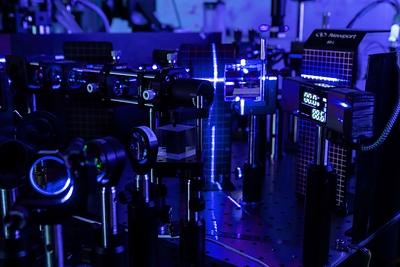
Published in the proceedings of the 23rd ACM International Conference on Computing Frontiers, the research demonstrates the potential of LightSolver's all-optical computing architecture to dramatically accelerate one of the most fundamental and computationally intensive workloads in high-performance computing (HPC): solving large-scale sparse systems of linear equations.
In the joint study, researchers from LightSolver and HLRS benchmarked projected LPU performance, using an emulator of LightSolver's LPU architecture, against established state-of-the-art iterative algorithms running on a GPU. Across the benchmark problems evaluated, the study projected that the LPU could achieve time-to-solution acceleration ranging from approximately 40× to more than 80,000×, depending on the algorithm and problem evaluated.
Large-scale linear systems sit at the mathematical core of some of the world's most demanding scientific and engineering simulations, including computational fluid dynamics, structural mechanics, electromagnetics, molecular dynamics and materials science. Solving these systems can dominate runtime and energy consumption in HPC applications, making them a critical computational bottleneck and an important target for next-generation computing architectures.
The findings highlight the potential for photonic processors to serve as specialized accelerators for large-scale linear systems, particularly for structured problems and computational workloads in which these mathematical operations must be solved repeatedly.
Executive Commentary
"This joint work demonstrates how an emerging photonic computing architecture can be evaluated against established numerical methods and modern GPU platforms," said Prof. Michael Resch, Director of the High-Performance Computing Center Stuttgart (HLRS). "The results provide valuable insight into where photonic computing may offer advantages for high-performance computing workloads and how it could be integrated into future hybrid computing systems."
"This research marks an essential milestone in validating the LPU as a transformative computing layer alongside traditional CPUs and GPUs," said Dr. Ruti Ben-Shlomi, CEO and Co-Founder of LightSolver. "Working with HLRS and its world-class researchers gave us an exceptional opportunity to benchmark and validate our technology against established computing platforms and test it on some of the most demanding computational problems. Collaborations like this are invaluable as we continue to expand the range of problems the LPU can address and demonstrate its potential across science, engineering and high-performance computing. We look forward to continuing to work with leading research institutions around the world to validate, challenge and advance this new computing architecture."
The Future of HPC: Heterogeneous Hybrid Architectures
The published research reinforces LightSolver's vision for the future of enterprise and scientific computing: a heterogeneous hybrid architecture in which CPUs, GPUs and LPUs work together, each executing the workloads best suited to its underlying architecture:
- CPUs provide general-purpose processing, orchestration and system control.
- GPUs accelerate massively parallel digital computing and tensor-based workloads.
- LPUs serve as specialized photonic accelerators, offloading computationally intensive mathematical workloads, including linear and differential equations and optimization-where LightSolver's optical architecture can provide significant acceleration.
This hybrid approach is designed to enable supercomputing centers, data centers and cloud providers to integrate photonic acceleration into existing computing environments, potentially delivering dramatic reductions in time-to-solution, energy consumption, computing costs and carbon footprint for targeted workloads.
Research Publication Details
The peer-reviewed paper, titled "Accelerating Sparse Linear Solvers with an Optical Laser Processing Unit," was presented and published in the proceedings of the 23rd ACM International Conference on Computing Frontiers (Workshops and Special Sessions).
The full paper is available via the ACM Digital Library: https://dl.acm.org/doi/10.1145/3801488.3808041.
About HLRS
The High-Performance Computing Center Stuttgart (HLRS) of the University of
About CollPlant
CollPlant Biotechnologies Ltd. (NASDAQ: CLGN) is an innovative technology company operating at the intersection of deep-tech computing and advanced biotechnology. Through its subsidiary LightSolver, CollPlant is advancing the development of proprietary all-optical laser based computing architectures designed to resolve the world's most demanding computational bottlenecks across artificial intelligence, aerospace, financial engineering, and high-performance computing. Concurrently, CollPlant remains a leader in regenerative medicine, pioneering plant-derived recombinant human collagen (rhCollagen) technologies for 3D bioprinting of tissues and organs and medical aesthetics.
Forward-Looking Statements
This press release contains forward-looking statements within the meaning of the Private Securities Litigation Reform Act of 1995. Forward-looking statements include, but are not limited to, statements regarding the future development, commercialization and market adoption of LightSolver's Laser Processing Unit (LPU) technology; the extent to which projected or emulated LPU performance may be replicated in physical hardware and real-world workloads; anticipated performance, capabilities and applications of the LPU; potential integration of the LPU into hybrid computing environments; potential reductions in time-to-solution and computing requirements; future research collaborations; and the future prospects, business plans and growth strategies of CollPlant and LightSolver. Forward-looking statements can be identified by words such as "anticipate," "believe," "expect," "intend," "plan," "may," "should," "could," "might," "seek," "target," "will," "project," "continue" and similar expressions or the negative of such terms. These forward-looking statements are based on assumptions and assessments made in light of management's experience and perception of historical trends, current conditions, expected future developments and other factors believed to be appropriate. Forward-looking statements are not guarantees of future performance and are subject to risks and uncertainties, many of which are outside of our control. Many factors could cause our actual activities or results to differ materially from the activities and results anticipated in forward-looking statements, including, but not limited to, the risk that the anticipated benefits of the transaction are not realized, or are not realized within the expected timeframe; risks associated with integrating LightSolver's business, operations and personnel; LightSolver's ability to achieve anticipated technological and commercial milestones; uncertainties regarding market acceptance and adoption of LightSolver's technology; the ability to develop and commercialize LightSolver's products and technology successfully; the ability to establish and expand strategic collaborations and commercial relationships; competition and technological developments; intellectual property risks; the availability of capital; CollPlant's ability to maintain compliance with Nasdaq listing requirements; general market, industry, economic and geopolitical conditions; and other risks and uncertainties described in CollPlant's filings with the U.S. Securities and Exchange Commission, including its most recent Annual Report on Form 20-F and subsequent Reports on Form 6-K. Forward-looking statements speak only as of the date of this press release. CollPlant undertakes no obligation to update or revise any forward-looking statements, whether as a result of new information, future events or otherwise, except as required by applicable law.
Contact Information:
CollPlant
Eran Rotem
Deputy CEO & CFO
+972.73.232.5600
LightSolver
Dr. Ruti Ben Shlomi
Co-Founder & CEO

 View original content to download multimedia:https://www.prnewswire.com/news-releases/lightsolver-a-collplant-company-and-hlrs-joint-research-demonstrated-photonic-computing-can-significantly-accelerate-fundamental-hpc-workloads-302889177.html
SOURCE CollPlant
FAQ
AI-generated questions and answers. How Rhea-AI works. Not financial advice.
What did CollPlant's LightSolver and HLRS study find about computing speed?
The study projected time-to-solution acceleration of approximately 40× to more than 80,000× across the problems evaluated, depending on the algorithm and problem. Researchers benchmarked an emulator of LightSolver's Laser Processing Unit against established iterative algorithms running on a GPU.
Where can I read the CollPlant LightSolver and HLRS research paper?
The paper, “Accelerating Sparse Linear Solvers with an Optical Laser Processing Unit,” is available through the ACM Digital Library at https://dl.acm.org/doi/10.1145/3801488.3808041.