Renewable natural gas (RNG) is a fuel made by capturing methane released from organic waste—like landfills, farms, or wastewater—and cleaning it so it can replace conventional natural gas. Think of it as recycled gas: it turns waste into a usable energy product that can be sold, piped, or used as vehicle fuel. Investors care because RNG projects create predictable revenue streams, often qualify for subsidies or carbon credits, and reduce regulatory and market risk tied to emissions, affecting long-term cash flow and asset value.
anaerobic digestersmedical
Anaerobic digesters are sealed systems where microbes break down organic material such as food waste, manure or crop residues without oxygen, producing biogas (mainly methane) and a nutrient-rich residue. They matter to investors because they convert waste into sellable energy and fertilizer, lower disposal costs and emissions, and can provide steady revenue from electricity or fuel sales, renewable credits, and byproduct markets — like turning trash into a small power plant and fertilizer source.
renewable identification numbers (RINs)regulatory
Renewable Identification Numbers (RINs) are unique tracking credits used under U.S. renewable fuel rules to prove that a gallon of transportation fuel contains an approved amount of biofuel. Think of them as tradable coupons that biofuel producers and fuel blenders earn, buy, or sell to show regulatory compliance; their price and availability directly affect the cost and profit of companies involved in fuel production, refining, and distribution, creating financial exposure and potential revenue streams for investors.
renewable fuel standard (RFS)regulatory
A renewable fuel standard (RFS) is a government rule that requires a certain portion of transportation fuel to come from renewable sources like biofuels, and it creates a system of tradable compliance credits to enforce those targets. It matters to investors because the RFS changes demand, pricing and profit margins across fuel producers, refiners, farmers and makers of renewable fuels, creating both regulatory risks and market opportunities similar to a store being required to stock a fixed share of eco-friendly products.
low carbon fuel standard (LCFS)regulatory
A low carbon fuel standard (LCFS) is a government rule that assigns value to fuels based on how much greenhouse gas they emit over their life cycle, rewarding cleaner alternatives with tradable credits and penalizing dirtier fuels. For investors, it creates a market signal that can raise demand and profits for low‑emission fuel producers, change operating costs for refineries and transport companies, and influence the economics of projects much like a price on pollution or a reward program for cleaner choices.
greenhouse gas (GHG) emissionstechnical
Greenhouse gas (GHG) emissions are gases released into the atmosphere—most commonly carbon dioxide, methane and nitrous oxide—that trap heat and raise global temperatures, like a blanket warming the planet. Investors watch GHG emissions because they influence regulatory costs, physical climate risks, insurance and supply-chain stability, and public reputation; companies with lower emissions may face fewer future expenses and attract more capital, while higher emissions can lead to fines, disruption or divestment.
carbon-intensitytechnical
Carbon-intensity measures how much greenhouse gas a company or activity emits for each unit of output — for example per dollar of revenue, per megawatt-hour of electricity produced, or per product made. It matters to investors because it shows how polluting and energy-inefficient a business is, which affects future costs, regulatory risk, and reputation; think of it like miles-per-gallon for emissions rather than fuel efficiency for a car.
pipeline-quality RNGtechnical
Pipeline-quality RNG (renewable natural gas) is biogas—usually from landfills, farms, or wastewater—cleaned and upgraded until it matches the chemical and safety standards required for injection into commercial natural gas pipelines. For investors, the distinction matters because meeting pipeline specs unlocks stable sales, higher prices, and access to transportation networks and regulatory credits, much like refining raw ore into a marketable metal that can be sold broadly rather than only used on-site.
See more from StockTitan in Google Search and AI answers.Adds StockTitan as a preferred source · opens Google
NEWPORT BEACH, Calif. & DIMMITT, Texas--(BUSINESS WIRE)--
Clean Energy Fuels Corp. (NASDAQ: CLNE) has announced it has successfully completed its renewable natural gas (RNG) facility located at South Fork Dairy in Dimmitt, Texas. The facility is now producing pipeline-quality RNG and has begun injecting into the interstate natural gas pipeline.
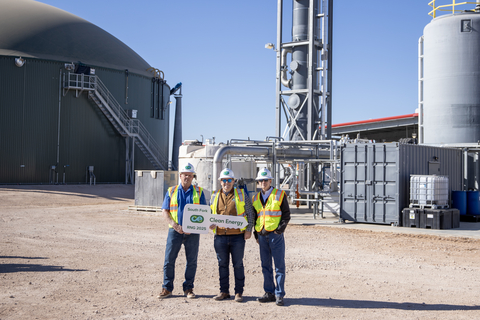
South Fork Dairy owner, Frank Brand, with Clean Energy VPs, Will Flanagan and Bart Frabotta, at South Fork RNG facility, Dimmitt, Texas.
Now one of the largest RNG production plants in the country, South Fork is home to a herd of 17,500 dairy cows and has the capability to produce approximately 2.6 million gallons of low-carbon RNG annually. The facility will process up to 300,000 gallons of dairy manure each day utilizing the four anaerobic digesters on-site, along with manure processing and advanced gas conversion equipment. The RNG produced is injected directly into an on-site gas line. Financed entirely by Clean Energy, the project broke ground in July 2024 and totaled $85 million. Clean Energy will receive 100 percent of the RNG fuel produced at South Fork Dairy.
“The requirements to reach production and injecting milestones were extremely stringent and we are incredibly proud of the team for getting our seventh RNG facility online, on time and on budget. It’s no small feat,” said Clay Corbus SVP at Clean Energy. “The completion of the project at South Fork is particularly special because not only is it a major step forward in building our low-carbon RNG supply to ensure we have the volumes needed to meet the growing fleet demand, but we were able to work side-by-side with such a remarkable dairyman in Frank Brand.”
“Partnering with Clean Energy to build an RNG facility on the dairy has been a success for us,” said Frank Brand, owner of South Fork Dairy. “We’re processing our manure into useful bedding and producing clean, useful fuel for vehicles – it’s pretty amazing stuff. Being a part of something so circular that allows the dairy to reduce its emissions while providing an additional income stream is an added bonus.”
During construction, the project temporarily paused due to a fire that impacted the dairy. South Fork’s owner, Frank Brand, and his team rebuilt the dairy working closely with Clean Energy to navigate this. Today, both the dairy and the RNG facility are fully restored and operating – an outcome that is testament to the determination of the South Fork and Clean Energy teams.
The RNG produced at South Fork Dairy has received full approval from the U.S. Environmental Protection Agency (EPA) to begin generating Renewable Identification Numbers (RINs) under the Renewable Fuel Standard (RFS) program. Clean Energy also expects to generate California Low Carbon Fuel Standard (LCFS) credits in Q1, 2026. Clean Energy continues to expand its fueling network nationwide with over 600 stations RNG is delivered to.
T Diamond Bar and Montrose Environmental worked closely with the Clean Energy team to complete South Fork facility.
Agriculture accounts for nearly 10 percent of U.S. GHG emissions and the transportation sector accounts for another 28%, according to the EPA. Capturing methane from farm waste lowers these emissions. RNG, produced by that captured methane and used as a transportation fuel, significantly lowers GHG emissions on a lifecycle basis when compared to diesel. This allows RNG to be one of the only fuels to receive a negative carbon-intensity score based on the reduction of emissions at the source and at the vehicle and costs significantly less than diesel at the pump.
About Clean Energy
Clean Energy Fuels Corp. is the country’s largest provider of the cleanest fuel for the transportation market. Our mission is to decarbonize transportation through the development and delivery of renewable natural gas (RNG), a sustainable fuel derived by capturing methane from organic waste. Clean Energy allows thousands of vehicles, from airport shuttles to city buses to waste and heavy-duty trucks, to reduce their amount of climate-harming greenhouse gas. We operate a vast network of fueling stations across the U.S. and Canada as well as RNG production facilities at dairy farms. Visit www.cleanenergyfuels.com and follow @ce_renewables on X and LinkedIn.
Forward-Looking Statements
This news release contains forward-looking statements within the meaning of Section 27A of the Securities Act of 1933 and Section 21E of the Securities Exchange Act of 1934 that involve risks, uncertainties and assumptions, including without limitation statements about: the timing and scope of design, construction, maintenance, and other projects; the amount of RNG to be produced and injected into the pipeline; the potential development of the market for RNG; the environmental and other benefits Clean Energy’s fuels; the availability of government programs and incentives; and the impacts of legislative and regulatory developments. Actual results and the timing of events could differ materially from those anticipated in these forward-looking statements. The forward-looking statements made herein speak only as of the date of this press release and, unless otherwise required by law, Clean Energy undertakes no obligation to publicly update such forward-looking statements to reflect subsequent events or circumstances. Additionally, the reports and other documents Clean Energy files with the SEC (available at www.sec.gov) contain risk factors, which may cause actual results to differ materially from the forward-looking statements contained in this news release.