
Collective Mining Expands Ramp Zone by Drilling its Highest Grade Intercept Ever at Apollo: 24.80 Metres @ 29.42 g/t Gold Within 63.90 Metres @ 13.46 g/t Gold from 388.25 Metres
Collective Mining (NYSE: CNL) reported drill results that expand the high‑grade Ramp Zone at the Apollo system.
Sentiment and the balance of points
Rhea-AI Sentiment reads the wording of the document, how positive or negative its language is on a 1 to 5 scale. The balance of points shown with the takes weighs what the document actually discloses, so the two can disagree, for example when a trial that missed its main goal is described in upbeat language.
Rhea-AI Summary
Collective Mining (NYSE: CNL) reported drill results that expand the high‑grade Ramp Zone at the Apollo system. Hole APC143‑D2 returned 63.90 m @ 13.46 g/t Au including 24.80 m @ 29.42 g/t Au from 388.25 m. The intercept is the highest‑grade and largest gram‑metre accumulation drilled to date at Ramp.
The Ramp Zone footprint increased to 315 m along strike by 300 m vertically and remains open in all directions. Collective has US$135M cash (as of Dec 1, 2025), three deep rigs operating, two more contracted, and plans up to 100,000 m of drilling in 2026.
Positive
- 24.80 m @ 29.42 g/t Au highest‑grade intercept at Ramp
- Ramp expanded to 315 m strike x 300 m vertical
- 63.90 m @ 13.46 g/t Au broad high‑grade zone
- US$135M cash on hand (Dec 1, 2025) to fund 2026
- Company targets up to 100,000 m additional drilling in 2026
- Three deep rigs active; two more contracted for mid‑Q1 2026
Negative
- APC140‑D3 returned lower grade 54.35 m @ 1.47 g/t Au
- Internal dilution allowance up to 15% below 0.30 g/t cutoff
- Directional hole APC143‑D3 assays pending, adding near‑term uncertainty
Details
News Market Reaction – CNL
On Dec 17, the first trading day after this news, CNL closed 5.38% above the previous close.
Data tracked by StockTitan Argus for the Dec 17 session.
Key Figures
- APC143-D2 high-grade interval
- 24.80 m @ 29.42 g/t gold, 28 g/t silver
- Ramp Zone, within broader 63.90 m interval from 388.25 m
- APC143-D2 broader zone
- 63.90 m @ 13.46 g/t gold, 13 g/t silver
- Ramp Zone from 388.25 m downhole
- APC140-D3 interval
- 14.65 m @ 3.03 g/t gold, 10 g/t silver
- Within 54.35 m @ 1.47 g/t gold, 4 g/t silver from 257.85 m
- Ramp Zone dimensions
- 315 m strike × 300 m vertical
- Expanded footprint, open in all directions
- Total drilling completed
- 154,500 metres
- Diamond drilling across Guayabales and San Antonio
- Apollo drilling
- 107,500 metres
- Completed at flagship Apollo system to date
- Cash balance
- US$135 million
- As of December 1, 2025, funding 2026 drill program
- Planned 2026 drilling
- Up to 100,000 metres
- Planned across projects in 2026
Historical Context
-
New Hanging Wall Vein Zone expanded Apollo strike and vertical dimensions.
-
High-grade Ramp Zone intercepts extended strike and vertical extent significantly.
-
Launched drilling targeting tungsten-rich near-surface portion of Apollo Ramp Zone.
-
Reported visual mineralization at Guayabales and San Antonio with 10 rigs active.
-
Extended Ramp Zone strike by 200 metres with strong gold and silver intercepts.
24h Move is the share-price change in the day after each event; other market factors may also have contributed.
Key Terms
diamond drill holes technical
veinlet stockworks technical
arsenopyrite technical
muscovite technical
sericite technical
National Instrument 43-101 regulatory
AI-generated analysis. How Rhea-AI works. Not financial advice.




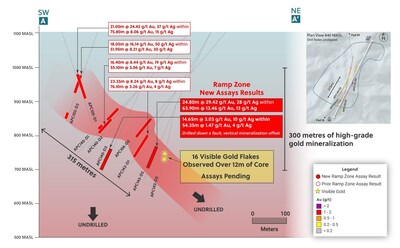
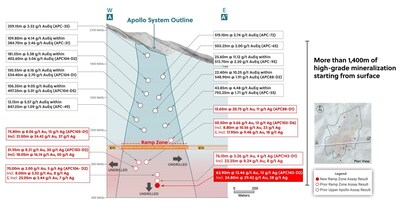
Hole APC143-D2, the deepest and northeasternmost hole drilled to date in the Ramp Zone, increases the mineralized envelope to 315 metres along strike by 300 metres vertically — and remains open in all directions.
Ari Sussman, Executive Chairman commented: "Today's step-out hole from the Ramp Zone is a classic example of how exceptional geological discoveries deliver consistent positive surprises. This intercept not only marks the highest-grade gold interval ever drilled at Ramp but also demonstrates remarkable continuity of mineralization across the interval. With the Ramp Zone now measuring 315 metres along strike by 300 metres vertically—and remaining open in all directions—we are increasingly confident that Ramp will be a major value driver as we ramp up expansion drilling aggressively into 2026."
To watch a video of David Reading, Special Advisor, explain today's results please click on the link here.
Key Highlights (see Table 1-2 and Figures 1-7)
- High-Grade Intercept at Ramp Zone: Drill hole APC143-D2 intersects 24.80 metres @ 29.42 g/t gold and 28 g/t silver within a broader mineralized zone of 63.90 metres @ 13.46 g/t gold and 13 g/t silver from 388.25 metres. This hole represents the highest-grade and largest grade accumulation (gram x metres) intercept drilled to date in the Ramp Zone.
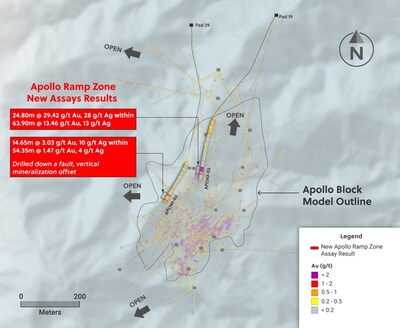
- Significant Expansion of Ramp Zone: APC143-D2 is the deepest and northeasternmost hole drilled to date, expanding the dimensions to 315 metres along strike by 300 metres vertically (previously 300 metres strike by 270 metres vertical). The zone remains open in all directions for further growth.
- Additional Step-Out Drilling Success to the West: Hole APC140-D3 locally extended the Ramp Zone by 100 metres below the previous westernmost intercept (APC140-D2), cutting 14.65 metres @ 3.03 g/t gold and 10 g/t silver within 54.35 metres @ 1.47 g/t gold and 4 g/t silver from 257.85 metres downhole.
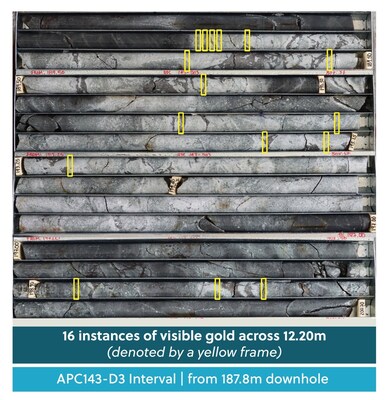
- Visuals Infer Another High-Potential Hole Pending Assays: Directional hole APC143-D3, designed to further extend the Ramp Zone's strike and depth, intersected 16 visible gold sightings over a 12-metre core interval—assays pending.
- Aggressive Drilling Ramp-Up: Three deep-capacity diamond rigs are currently operating at the Ramp Zone, with two additional deep-capacity rigs contracted for arrival on site in mid-Q1 2026.
To date, Collective has completed 154,500 metres of diamond drilling across the Guayabales and
With
Details (see Table 1-2 and Figures 1-7)
APC143-D2 was drilled as a wedge hole from mother hole APC-143D from Pad 19 in a southerly direction and successfully extended the Ramp Zone by 30 metres vertically and by 15 metres in strike with assays results as follows:
- 63.90 metres @ 13.46 g/t gold, 13 g/t silver from 388.25 metres downhole including 24.80 metres @ 29.42 g/t gold, 28 g/t silver from 395.20 metres downhole
APC140-D3 was drilled as a wedge hole from mother hole APC-140D from Pad 29 to the southwest and is interpreted to been vertically offset by faulting as it intersected the Ramp Zone 100 metres vertically below previous drill hole APC140‑D2 (see in press release dated December 3, 2025) with assays results as follows:
- 54.35 metres @ 1.47 g/t gold, 4 g/t silver from 257.85 meters downhole including 14.65 meters @ 3.03 g/t gold, 10 g/t silver from 257.85 metres downhole
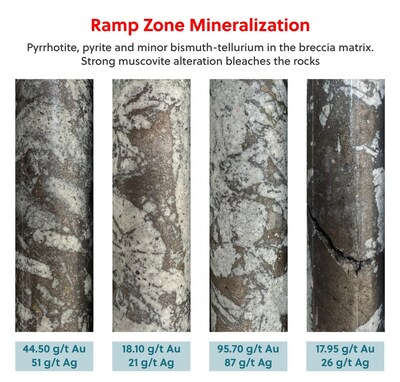
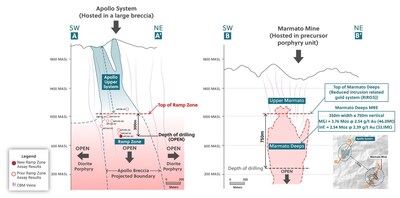
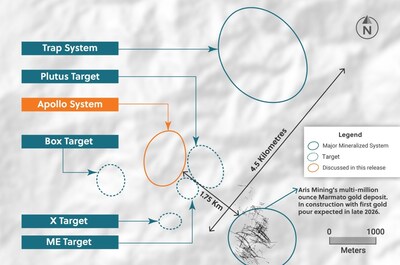
The Ramp Zone, which commences at approximately 1,000 metres above sea level, is classified as a reduced intrusion-related gold system with similarities, in terms of mineralogy, to the nearby Marmato Deeps deposit, owned by Aris Mining. Located just 1.75 kilometres apart, both systems begin at the same elevation and the gold-and-silver-bearing sulphide assemblages in the Ramp Zone closely resemble those at Marmato Deeps. Mineralization occurs with pyrite and pyrrhotite, accompanied by minor bismuth, tellurium, and locally arsenopyrite bearing sulphides, hosted in veinlet stockworks, cracks and miarolitic cavities. Alteration is dominated by muscovite, albite and sericite.
A key distinguishing feature at Ramp is the significantly higher gold grades encountered to date compared to Marmato Deeps. The Company attributes this superior grade profile primarily to the host rock: mineralization at the Ramp Zone is emplaced within a porous breccia matrix, which provides substantially greater permeability for metal-bearing fluids than the precursor porphyry host rock at Marmato Deeps.
Cautionary Note to Readers:
Although the Apollo project (including the Ramp Zone) and the Marmato Lower Mine (also referred to as the Bulk Mining Zone or formerly as Marmato Deeps) share certain geological characteristics, information regarding the Marmato Lower Mine is not necessarily indicative of mineralization in the Ramp Zone. Information regarding the Marmato Lower Mine has not been independently verified by the Company or its Qualified Person in accordance with National Instrument 43-101 – Standards of Disclosure for Mineral Projects ("NI 43-101"). All information presented herein regarding the Marmato Lower Mine is derived from the NI 43-101 compliant technical report titled "Technical Report for the Marmato Gold Mine, Caldas Department,
Table 1: Assays Results for Drill Holes APC140-D3 and APC143-D2
Hole # | From | To | Length | Au | Ag |
APC140-D3 | 257.85 | 312.20 | 54.35 | 1.47 | 4 |
Incl. | 257.85 | 272.50 | 14.65 | 3.03 | 10 |
APC143-D2 | 388.25 | 452.15 | 63.90 | 13.46 | 13 |
Incl. | 395.20 | 420.00 | 24.80 | 29.42 | 28 |
True widths have been estimated to be between
Table 2: Individual Assays Results from a Section of Hole APC143-D2
From | To | Length | Au | Ag |
395.20 | 396.20 | 1.00 | 16.70 | 14 |
396.20 | 397.20 | 1.00 | 44.50 | 51 |
397.20 | 398.35 | 1.15 | 18.10 | 21 |
398.35 | 399.25 | 0.90 | 78.00 | 58 |
399.25 | 400.30 | 1.05 | 9.90 | 12 |
400.30 | 401.55 | 1.25 | 95.70 | 87 |
401.55 | 402.60 | 1.05 | 15.80 | 16 |
402.60 | 403.50 | 0.90 | 3.90 | 4 |
403.50 | 404.45 | 0.95 | 52.20 | 61 |
404.45 | 405.50 | 1.05 | 0.18 | - |
405.50 | 406.50 | 1.00 | 0.10 | - |
406.50 | 407.40 | 0.90 | 77.80 | 88 |
407.40 | 408.45 | 1.05 | 6.00 | 3 |
408.45 | 409.60 | 1.15 | 25.70 | 13 |
409.60 | 410.65 | 1.05 | 27.30 | 20 |
410.65 | 411.85 | 1.20 | 57.00 | 57 |
411.85 | 412.95 | 1.10 | 78.30 | 68 |
412.95 | 414.00 | 1.05 | 3.47 | 5 |
414.00 | 415.15 | 1.15 | 41.70 | 42 |
415.15 | 416.05 | 0.90 | 4.47 | 6 |
416.05 | 417.60 | 1.55 | 0.04 | - |
417.60 | 418.85 | 1.25 | 10.40 | 17 |
418.85 | 420.00 | 1.15 | 17.05 | 16 |
Weighted Average | 24.80 | 29.42 | 28 | |
About Collective Mining Ltd.
To see our latest corporate presentation and related information, please visit www.collectivemining.com.
Founded by the team that developed and sold Continental Gold Inc. to Zijin Mining for approximately
The Company's flagship project, Guayabales, is anchored by the Apollo system, which hosts the large-scale, bulk-tonnage and high-grade gold-silver-copper-tungsten Apollo system. The Company's objectives at the Guayabales Project are to expand the newly discovered high-grade Ramp Zone along strike and to depth and drill a series of greenfield generated targets on the property.
Additionally, the Company has launched its largest drilling campaign in history at the San Antonio Project as it hunts for new discoveries and looks to expand upon the newly discovered porphyry system at the Pound target. The San Antonio Project is located between two to five kilometers east-northeast of the Guayabales Project and could potentially share infrastructure given their proximity to each other.
Management, insiders, a strategic investor and close family and friends own
Qualified Person (QP) and NI43-101 Disclosure
David J Reading is the designated Qualified Person for this news release within the meaning of National Instrument 43-101 ("NI 43-101") and has reviewed and verified that the technical information contained herein is accurate and approves of the written disclosure of same. Mr. Reading has an MSc in Economic Geology and is a Fellow of the Institute of Materials, Minerals and Mining and of the Society of Economic Geology (SEG).
Technical Information
Samples were cut by Company personnel at Collective Mining's core facility in Caldas,
Core samples have been prepared and analyzed at ALS laboratory facilities in
Information Contact:
Follow Executive Chairman Ari Sussman (@Ariski73) on X
Follow Collective Mining (@CollectiveMini1) on X, (Collective Mining) on LinkedIn, and (@collectivemining) on Instagram
FORWARD-LOOKING STATEMENTS
This news release contains "forward-looking statements" and "forward-looking information" within the meaning of applicable securities legislation (collectively, "forward-looking statements"). All statements, other than statements of historical fact, are forward-looking statements and are based on expectations, estimates and projections as at the date of this news release. Any statement that involves discussion with respect to predictions, expectations, beliefs, plans, projections, objectives, assumptions, future events or performance (often, but not always using phrases such as "plans", "expects", "is expected", "budget", "scheduled", "estimates", "forecasts", "intends", "anticipates", or "believes" or variations (including negative variations) of such words and phrases, or state that certain actions, events or results "may", "could", "would", "might" or "will" be taken, occur or be achieved) are not statements of historical fact and may be forward-looking statements. In this news release, forward-looking statements relate, among other things, to the anticipated advancement of mineral properties or programs; future operations; future recovery metal recovery rates; future growth potential of Collective; and future development plans.
These forward-looking statements, and any assumptions upon which they are based, are made in good faith and reflect our current judgment regarding future events including the direction of our business. Management believes that these assumptions are reasonable. Forward-looking statements involve known and unknown risks, uncertainties and other factors which may cause the actual results, performance or achievements of the Company to be materially different from any future results, performance or achievements expressed or implied by the forward-looking statements. Such factors include, among others: risks related to the speculative nature of the Company's business; the Company's formative stage of development; the Company's financial position; possible variations in mineralization, grade or recovery rates; actual results of current exploration activities; conclusions of future economic evaluations; fluctuations in general macroeconomic conditions; fluctuations in securities markets; fluctuations in spot and forward prices of gold, precious and base metals or certain other commodities; fluctuations in currency markets; change in national and local government, legislation, taxation, controls regulations and political or economic developments; risks and hazards associated with the business of mineral exploration, development and mining (including environmental hazards, industrial accidents, unusual or unexpected formation pressures, cave-ins and flooding); inability to obtain adequate insurance to cover risks and hazards; the presence of laws and regulations that may impose restrictions on mining; employee relations; relationships with and claims by local communities and indigenous populations; availability of increasing costs associated with mining inputs and labour; the speculative nature of mineral exploration and development (including the risks of obtaining necessary licenses, permits and approvals from government authorities); and title to properties, as well as those risk factors discussed or referred to in the annual information form of the Company dated March 24, 2025. Forward-looking statements contained herein are made as of the date of this news release and the Company disclaims any obligation to update any forward-looking statements, whether as a result of new information, future events or results, except as may be required by applicable securities laws. There can be no assurance that forward-looking statements will prove to be accurate, as actual results and future events could differ materially from those anticipated in such statements and there may be other factors that cause results not to be anticipated, estimated or intended. Accordingly, readers should not place undue reliance on forward-looking statements.

 View original content to download multimedia:https://www.prnewswire.com/news-releases/collective-mining-expands-ramp-zone-by-drilling-its-highest-grade-intercept-ever-at-apollo-24-80-metres--29-42-gt-gold-within-63-90-metres--13-46-gt-gold-from-388-25-metres-302643913.html
SOURCE Collective Mining Ltd.
FAQ
AI-generated questions and answers. How Rhea-AI works. Not financial advice.