
Cosa Reports Anomalous Uranium in Sandstone at Darby Joint Venture with Denison Mines
Cosa Resources reported May 6, 2026 drilling results from the Darby joint venture with Denison (TSX: DML; NYSE American: DNN).
Rhea-AI Summary
Cosa Resources reported May 6, 2026 drilling results from the Darby joint venture with Denison (TSX: DML; NYSE American: DNN). Cosa (operator, 70%) completed three winter holes at Charlie, Gamma and Delta, finding strongly anomalous sandstone uranium (DB26-39A: 5.6 ppm over 103.5 m; subinterval 9.5 ppm over 53.5 m) and a weak basement intersection (0.04% U3O8 over 0.5 m). Gamma returned a ~150 m graphitic fault corridor, hydrothermal alteration and 35 m of unconformity relief. Assays for Delta hole DB26-42 and Murphy Lake North remain pending; summer drilling planned to follow.
Positive
- DB26-39A: 5.6 ppm U over 103.5 m in sandstone
- Basal sandstone subinterval: 9.5 ppm U over 53.5 m
- Gamma: ~150 m graphitic fault corridor with hydrothermal alteration
- Observed 35 m of unconformity relief at Gamma (indicative of structural complexity)
Negative
- DB26-42 (Delta) returned no significant results; assays remain pending
- Key assays from Murphy Lake North are still pending, delaying conclusive interpretation
- Initial basement uranium mineralization is weak (0.04% U3O8 over 0.5 m) and not yet shown to be extensive
Details
News Market Reaction – COSAF
On May 6, the day this news came out, COSAF closed 5.03% above the previous close.
Data tracked by StockTitan Argus for the May 6 session.
Key Figures
- Basement mineralization
- 0.04% U3O8 over 0.5 metres
- Charlie Trend drill hole DB26-39A
- Sandstone uranium
- 5.6 ppm over 103.5 metres
- DB26-39A sandstone interval 600.0–703.5 m
- Basal sandstone interval
- 9.5 ppm over 53.5 metres
- DB26-39A basal sandstone 650.0–703.5 m
- Historical sandstone uranium
- 2.0 ppm over 116.8 metres
- Historical hole DB-09 543.2–660 m
- Graphitic corridor width
- more than 100 metres
- Gamma Trend graphitic structural corridor
- Unconformity relief
- 35 metres
- DB26-41 relative to DB-17 at Gamma Trend
- Fault corridor width
- approximately 150 metres
- Gamma Trend graphitic basement faulting corridor
- Continuous anomalous interval
- 48-metre interval
- Historical DB-27 sandstone uranium at Delta Trend
Previous Partnership Reports
-
Reported anomalous radioactivity in three of five Murphy Lake North JV drill holes.
-
5.0 m of anomalous radioactivity up to 13,900 CPS at Murphy Lake North JV.
-
Approved 2026 JV exploration programs and closed oversubscribed C$7.5M private placement.
24h Move is the share-price change in the day after each event; other market factors may also have contributed.
Key Terms
u3o8 medical
ppm technical
graphitic structural corridor technical
unconformity technical
hydrothermal alteration technical
uranium mineralization medical
graphitic basement faulting technical
AI-generated analysis. How Rhea-AI works. Not financial advice.




Vancouver, British Columbia--(Newsfile Corp. - May 6, 2026) - Cosa Resources Corp. (TSXV: COSA) (OTCQB: COSAF) (FSE: SSKU) ("Cosa" or the "Company") is pleased to report drilling results for the Company's Darby ("Darby") project. Darby is a joint venture (the "Joint Venture") between Cosa and Denison Mines Corp. ("Denison") (TSX: DML) (NYSE American: DNN) and is located 10 kilometres west of Cameco's Cigar Lake Mine in the eastern Athabasca Basin, Saskatchewan (Figure 1). Cosa is the operator of Darby and holds a
Highlights
- Highly anomalous uranium in sandstone and weak basement uranium mineralization (
0.04% U3O8 over 0.5 metres) intersected at Charlie Trend - Prospective sandstone and basement faulting, alteration, and unconformity relief identified at Gamma Trend
- Initial drill program significantly upgraded three trends at Darby
- Assays remain pending on exceptional winter 2026 Murphy Lake North drill program that intersected anomalous radioactivity
Keith Bodnarchuk, President and CEO, commented: "Prior to intersecting radioactivity at Murphy Lake North, we completed an exciting drill program at our Darby Lake Joint Venture with Denison. We are very encouraged by the results from Cosa's initial drill program at Darby, which have further upgraded multiple trends. We are in the process of finalizing summer plans, which will be released in the coming weeks and are expected to comprise a significant drill program at Murphy Lake North with drilling at Darby to follow. With assays pending at Murphy Lake North, we expect to have important news flow ahead of the resumption of drilling in June."
Andy Carmichael, Vice President of Exploration, commented: "Drilling at Gamma revealed the trend hosts a more than 100-metre-wide graphitic structural corridor with the strongest sandstone alteration known on the project and significant unconformity relief. With mineralization on trend to the north, Gamma is a high priority for further exploration. Drilling at Charlie intersected outstanding sandstone uranium content and weak basement hosted uranium mineralization, confirming the strong exploration potential of this trend. The exceptional winter 2026 drilling results from Murphy Lake North will remain our primary exploration focus, and these initial results from Darby are compelling additions to our inventory of excellent drill targets."
Darby Winter Drilling
Three holes were completed at Darby to test priority targets at the Charlie, Gamma, and Delta trends identified by Cosa's 2025 core relogging and reinterpretation program.
Charlie Trend
Winter drill hole DB26-39A followed up basement structure and anomalous1 sandstone uranium content in historical drill hole DB-09 and successfully intersected the targeted graphitic unit at the unconformity. DB26-39A intersected very strongly anomalous uranium content in the sandstone, averaging 5.6 ppm over 103.5 metres (600.0 - 703.5 metres) including a subinterval averaging 9.5 ppm over 53.5 metres (650.0 - 703.5 metres) in the basal sandstone (Figures 2 and 3). These values exceed the strongly anomalous results of DB-09 which intersected 2.0 ppm uranium over 116.8 metres (543.2 - 660 metres). DB26-39A also intersected
Gamma Trend
Winter drilling results significantly upgraded the Gamma trend and generated several follow-up targets.
The Gamma trend was prioritized for drilling based on elevated to anomalous sandstone uranium content proximal to graphitic basement faults in historical drill hole DB-17, and the presence of numerous intersections of uranium mineralization along trend north of Darby (Figures 2 and 4). DB26-41 targeted the DB-17 basement faults at the unconformity.
DB26-41 intersected two decametre-scale intervals of faulting and alteration in the lower sandstone, elevated to anomalous sandstone uranium content, and identified 35 metres of unconformity relief relative to DB-17. Basement rocks are graphitic and non-graphitic metasediments overlying granite. Graphitic fault zones intersected 30 to 124 metres below the unconformity are generally thicker than those in DB-17 and some are enveloped by metre-scale zones of hydrothermal alteration.
DB26-41 and DB-17 define a highly prospective geological environment which includes an approximately 150-metre-wide corridor of graphitic basement faulting, zones of hydrothermal alteration and faulting in the sandstone and basement, and uranium enrichment in the sandstone. The prominent unconformity relief is similar to unconformity offsets from reverse faulting present at several Athabasca uranium deposits, most notably at Cameco's McArthur River mine.
Delta Trend
DB26-42 followed up historical drill hole DB-27 (Figure 2), which intersected a 48-metre interval of continuously anomalous uranium content in the sandstone above graphitic basement faulting. DB26-42 targeted the DB-27 basement faulting at the unconformity and did not intersect any significant results; geochemical results remain pending. Several kilometres of prospective strike length remain at Delta.
Next Steps
Assays remain pending for DB26-42. Planning is underway for a summer drilling campaign at Darby which is expected to commence following completion of summer drilling at Murphy Lake North.
1 - When analyzed using SRC's partial digestion and Inductively Coupled Plasma Mass Spectrometry (ICP-MS) method, Cosa considers uranium concentrations in the Athabasca sandstone greater than 0.5 ppm to be elevated, greater than 1.0 ppm to be anomalous, and greater than 4 ppm to be strongly anomalous.
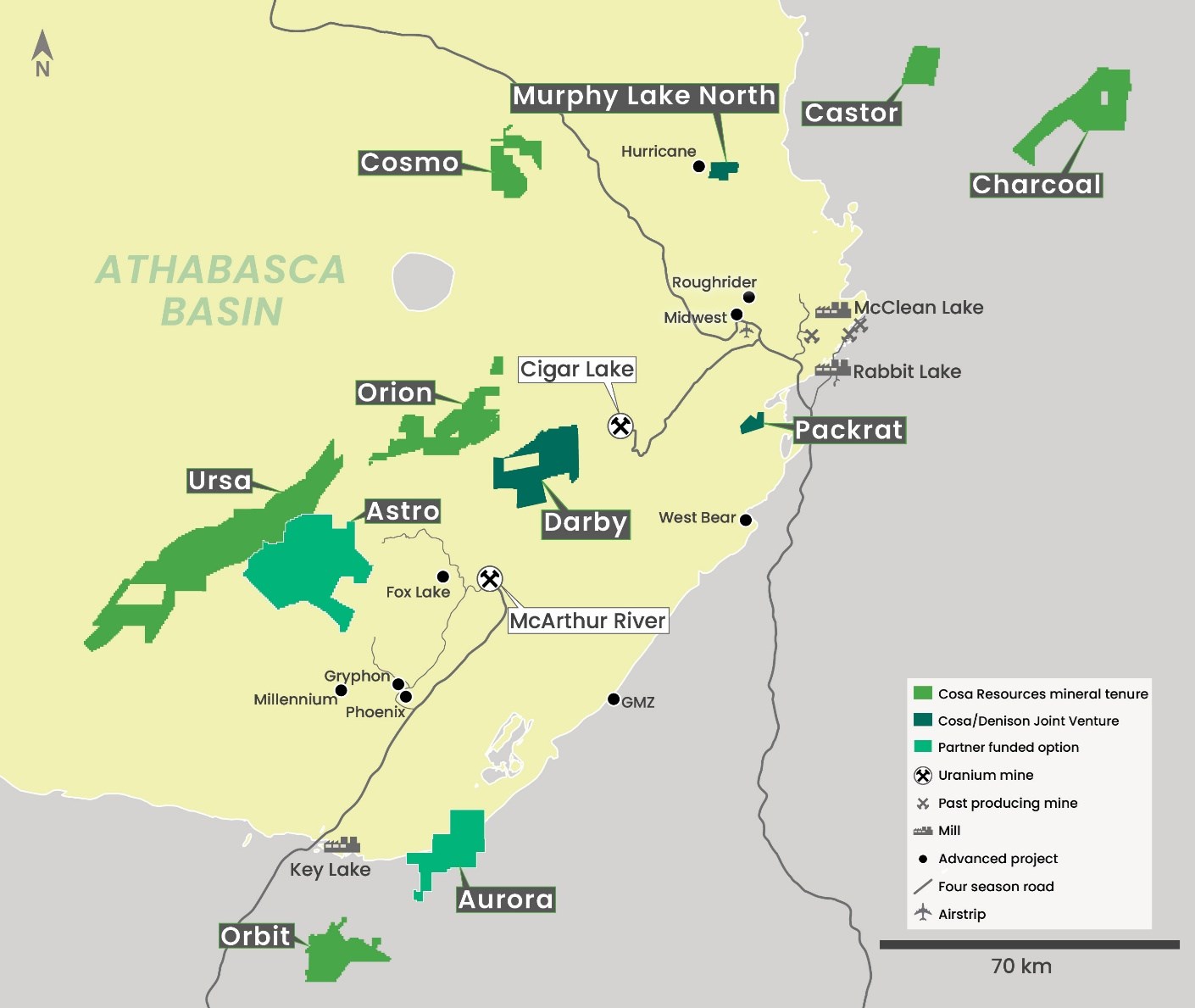
Figure 1 - Cosa's Eastern Athabasca Uranium Projects with Joint Venture Projects
To view an enhanced version of this graphic, please visit:
https://images.newsfilecorp.com/files/9865/296203_289f6d6b1437a904_003full.jpg
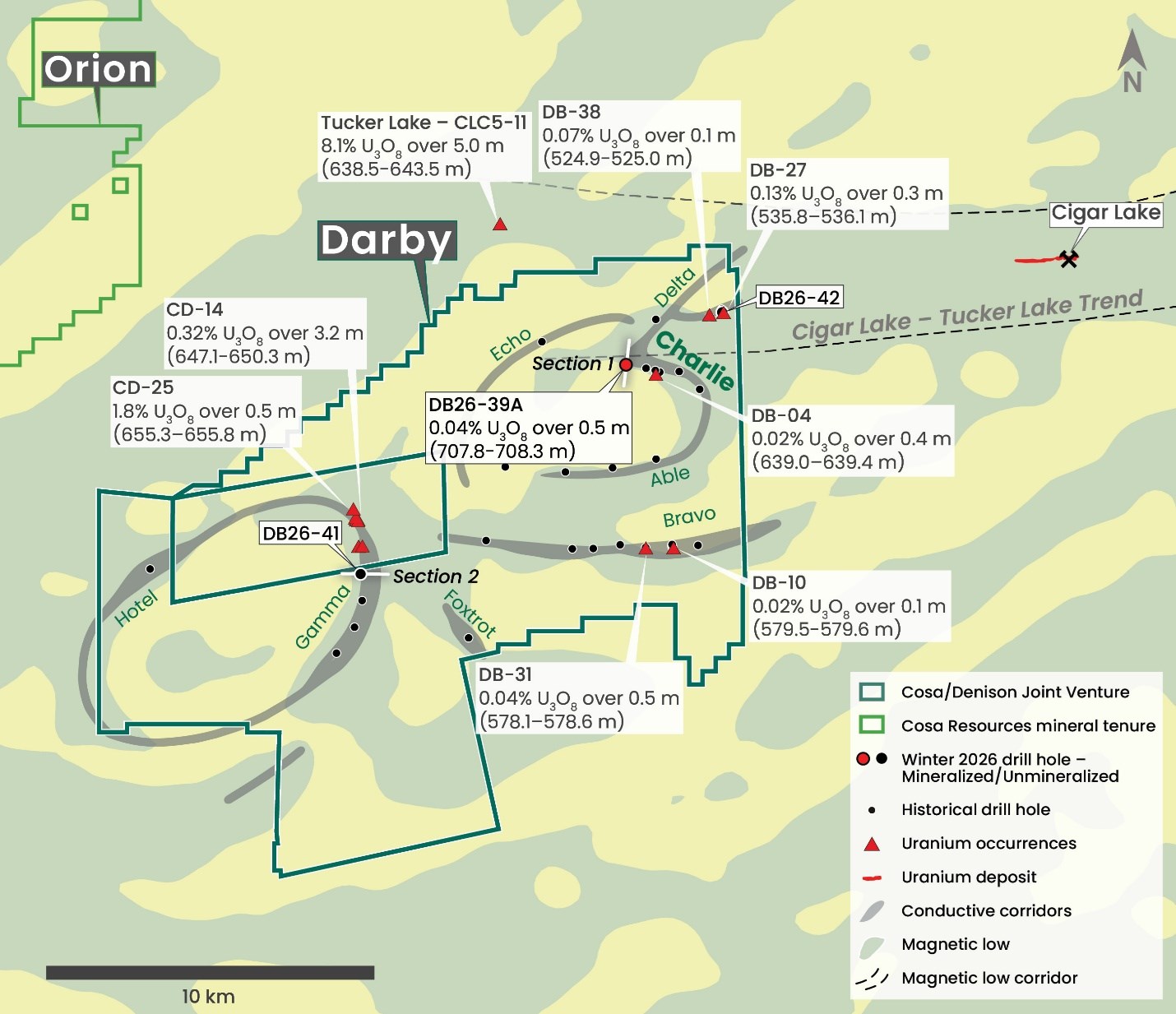
Figure 2 - Darby Project Overview
To view an enhanced version of this graphic, please visit:
https://images.newsfilecorp.com/files/9865/296203_289f6d6b1437a904_004full.jpg
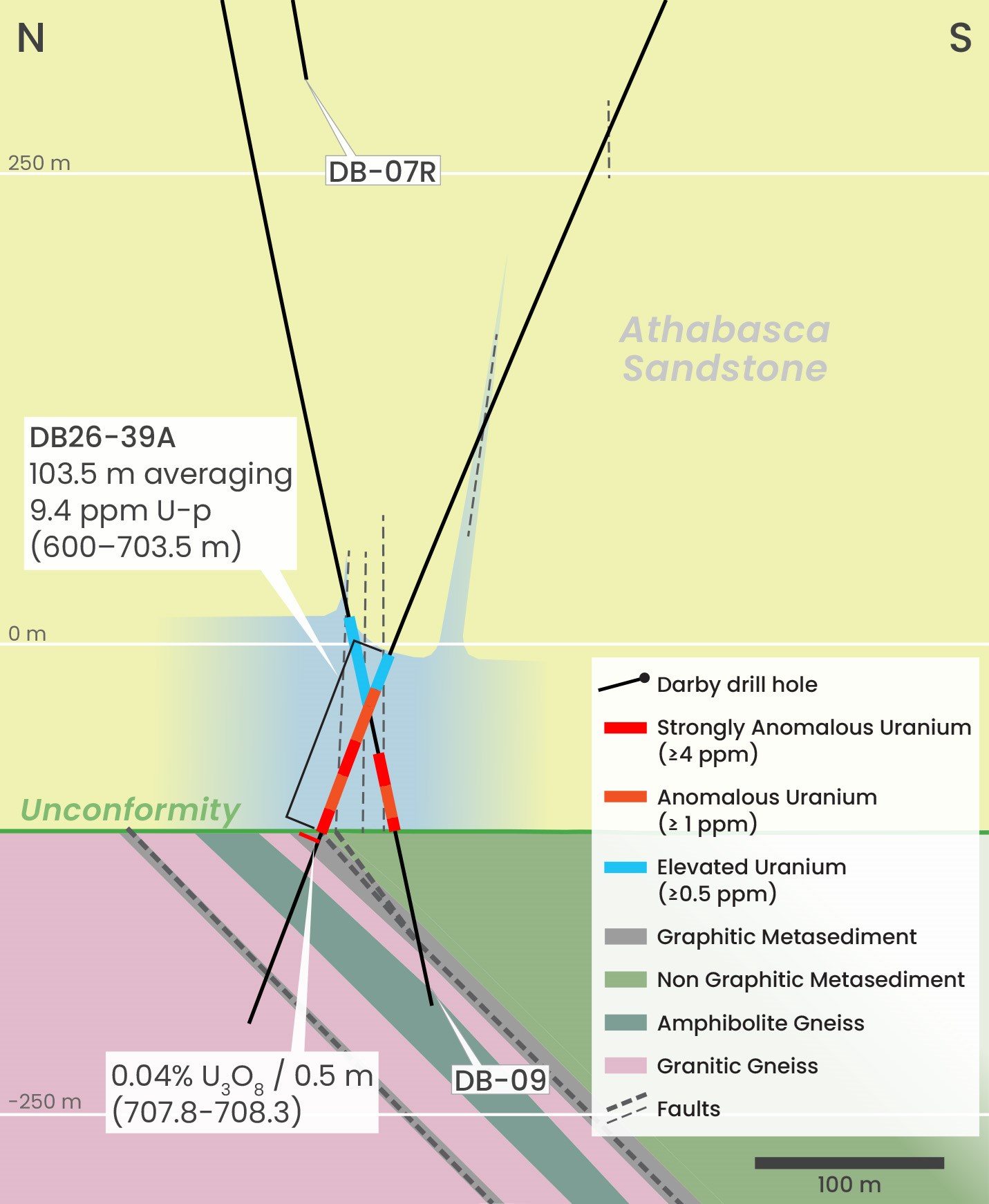
Figure 3 - Charlie Cross Section Showing DB26-39A and DB-09
To view an enhanced version of this graphic, please visit:
https://images.newsfilecorp.com/files/9865/296203_289f6d6b1437a904_005full.jpg
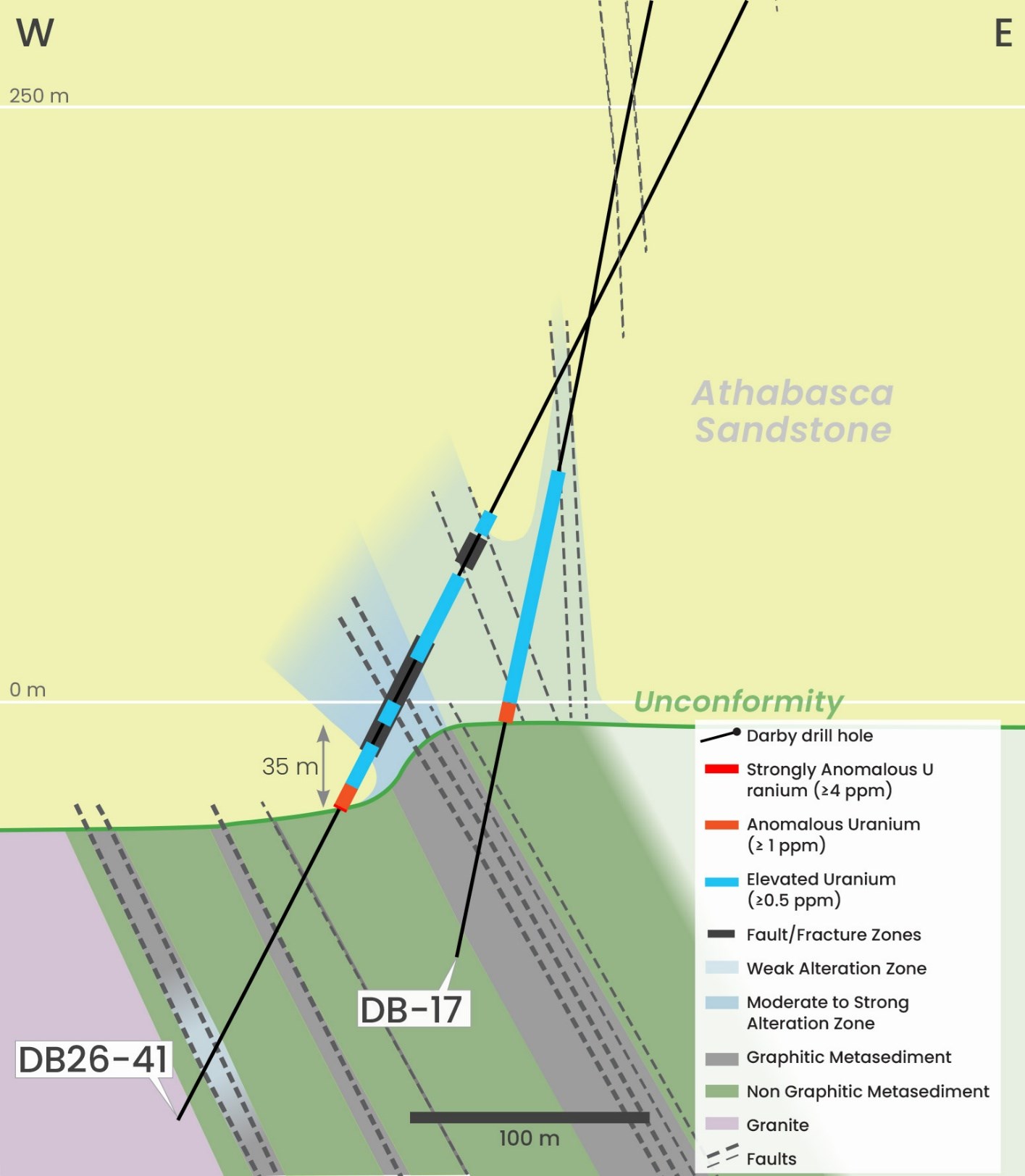
Figure 4 - Gamma Trend Cross Section Showing DB26-41 and DB-17
To view an enhanced version of this graphic, please visit:
https://images.newsfilecorp.com/files/9865/296203_289f6d6b1437a904_006full.jpg
About Darby
Located 10 kilometres west of the Cigar Lake Mine, Darby contains multiple prospective conductive trends and several intersections of weak uranium mineralization (Figures 1 and 2). Historical drilling indicates that many of these trends are highly prospective for uranium deposits characteristic of the eastern Athabasca Basin, yet most of the strike length has not been effectively evaluated. Work by Cosa in 2025 prioritized these trends and identified several historical drill holes with results that suggest proximity to uranium mineralization (See Cosa's news releases dated October 24, 2025 and January 21, 2026). Initial drilling results from winter 2026 significantly upgraded multiple trends. Future drilling will include follow up of anomalous results from both winter 2026 and historical drilling.
About Cosa Resources Corp.
Cosa Resources is a Canadian uranium exploration company operating in northern Saskatchewan. The portfolio comprises roughly 237,000 ha across multiple underexplored
In January of 2025, the Company entered a transformative strategic collaboration with Denison Mines (TSX: DML) (NYSE American: DNN) that has secured access to several additional highly prospective eastern Athabasca uranium exploration projects. As Cosa's largest shareholder, Denison gains exposure to Cosa's potential for exploration success and its pipeline of uranium projects.
The Company's primary focus through the remainder of 2026 will be drilling at the Murphy Lake North and Darby projects in the eastern Athabasca Basin. Drilling at Murphy Lake North will follow up the newly identified zones of anomalous radioactivity within an extensive zone of strong structure and hydrothermal alteration at the Cyclone trend. Drilling at Darby will follow up on intersections of anomalous geochemistry, structure, and zones of hydrothermal alteration from both winter 2026 drilling and historical drilling.
Cosa's award-winning management team has a track record of success in Saskatchewan. In 2022, members of the Cosa team were awarded the AME Colin Spence Award for the discovery of the Hurricane uranium deposit. Cosa personnel led teams or had integral roles in the discovery of Denison's Gryphon deposit and held key roles in the founding of both NexGen and IsoEnergy.
Technical Disclosure
Historical drilling and geophysical results for Darby and MLN were sourced from the Saskatchewan Mineral Assessment Database (SMAD). SMAD sources for Darby include file numbers 74H14-0021, 74H14-0023, 74H15-0041, 74H15-0053, 74H15-0055, 74H15-0056, 74H15-0066, 74H15-0067, 74I02-0031, 74I02-0042, 74I02-0053, 74I02-0080, 74I02-0095, and MAW00516. Some confidential data and reports not presently available via SMAD were supplied to Cosa by Denison. SMAD sources for MLN and adjacent projects include file numbers 64L05-0161, 64L05-0180, 74I-0060, 74I-0066, 74I-0067, 74I01-0114, 74I08-0056, 74I09-0053, 74I09-0057, 74I09-0061, 74I09-0064, 74I09-0066, 74I09-0071, 74I09-0077, 74I09-0079, 74I09-0087, 74I09-0088, 74I09-0090, 74I09-0091, 74I09-0092, 74I09-0098, MAW00510, MAW01939, MAW02327, MAW02599, and MAW02395. Data and reports related to the 2020 ground EM survey completed by Denison are not presently available via SMAD and were supplied to Cosa by Denison.
Verification of historical drilling results included confirming historical drill hole collar locations from air photos and ground checking selected collars with a handheld GPS unit. Basement and lower sandstone sections from most historical drill holes were relogged in 2024 and 2025 by Cosa. For Darby, verification of geochemical results for drill holes completed between 2008 and 2010 was facilitated by the reissuance of analytical certificates to Cosa by the Saskatchewan Research Council (SRC). Cosa thanks the SRC for its valued assistance in increasing confidence in the historical dataset.
Verification of historical geophysical results included confirming the locations of geophysical survey grids from air photos, compiling survey data and interpretations, and evaluating whether interpreted geophysical results could be reasonably explained by historical and current drilling results. For MLN, Cosa engaged a consultant to re-interpret historical geophysical surveys to validate selected previous interpretations.
Qualified Person
The Company's disclosure of technical or scientific information in this press release has been reviewed and approved by Andy Carmichael, P.Geo., Vice President, Exploration for Cosa. Mr. Carmichael is a Qualified Person as defined under the terms of National Instrument 43-101. This news release refers to neighbouring properties in which the Company has no interest. Mineralization on those neighbouring properties does not necessarily indicate mineralization on the Company's properties.
Contact
Keith Bodnarchuk, President and CEO
info@cosaresources.ca
+1 888-899-2672 (COSA)
Neither TSX Venture Exchange nor its Regulation Services Provider (as that term is defined in policies of the TSX Venture Exchange) accepts responsibility for the adequacy or accuracy of this release.
Cautionary Statements
This press release contains forward-looking information within the meaning of Canadian securities laws (collectively "forward-looking statements"). Forward-looking statements are typically identified by words such as: believe, expect, anticipate, intend, estimate, plans, postulate and similar expressions, or are those, which, by their nature, refer to future events. All statements that are not statements of historical fact are forward-looking statements. These forward-looking statements or information may relate to anticipated exploration, development and/or expansion activities, including exploration of the Company's current Projects; the collaboration with Denison, including the Joint Venture, and the anticipated benefits thereof; and the outlook regarding Cosa's business plans and objectives.
Such forward-looking information and statements are based on numerous assumptions, including among others, that the results of planned exploration activities are as anticipated, the cost of planned exploration activities are as anticipated, that general business and economic conditions will not change in a material adverse manner, that financing will be available if and when needed and on reasonable terms, that third party contractors, equipment and supplies and governmental and other approvals required to conduct Cosa's planned exploration activities will be available on reasonable terms and in a timely manner. Although the assumptions made by Cosa in providing forward-looking information or making forward-looking statements are considered reasonable by management at the time, there can be no assurance that such assumptions will prove to be accurate.
By their nature, forward-looking statements involve known and unknown risks, uncertainties and other factors which may cause our actual results, performance or achievements, or other future events, to be materially different from any future results, performance or achievements expressed or implied by such forward-looking statements. Such factors and risks include, among others: Cosa may require additional financing from time to time in order to continue its operations which may not be available when needed or on acceptable terms and conditions acceptable; Cosa may not be able to maintain compliance with its contractual obligations with third parties; Cosa may not be able to maintain compliance with extensive government regulation applicable to its operations; domestic and foreign laws and regulations could adversely affect Cosa's business and results of operations; the stock markets have experienced volatility that often has been unrelated to the performance of companies and these fluctuations may adversely affect the price of Cosa's securities, regardless of its operating performance; the ongoing military conflict in Ukraine, and other risk factors set out in Cosa's public disclosure documents.
The forward-looking information contained in this news release represents the expectations of Cosa as of the date of this news release and, accordingly, is subject to change after such date. Readers should not place undue importance on forward-looking information and should not rely upon this information as of any other date. Cosa does not undertake any obligation to update these forward-looking statements in the event that management's beliefs, estimates or opinions, or other factors, should change.

To view the source version of this press release, please visit https://www.newsfilecorp.com/release/296203
FAQ
AI-generated questions and answers. How Rhea-AI works. Not financial advice.