
Canagold Successfully Completes Taku River Landing Craft Trials for the New Polaris Project
Rhea-AI Summary
Canagold (OTCQB: CRCUF) announced the successful completion of shallow-draft landing craft trials on the Taku River, using the 98-foot by 23-foot, self-propelled Inlet Raider (approx. four-foot draft, 100-ton cargo capacity) to transport freight from Juneau, Alaska, to the Tulsequah River confluence near the proposed New Polaris Gold-Antimony Mine in northwestern British Columbia.
The June 11–19, 2026 program involved multiple trips guided by a sonar-equipped lead boat, plus a monitoring vessel carrying independent environmental consultants and Taku River Tlingit First Nation monitors. According to Canagold, preliminary observations indicate no significant negative effects on water quality, noise, or shoreline wake. Detailed environmental and navigational data, including bathymetry, tidal water depths, noise levels, wake heights, water quality, and drone video, will support future project planning, environmental assessment, and evaluation of the landing craft as a long-term logistics option for the New Polaris Project.
Positive
- Taku River freight corridor validated via multi-trip landing craft trials June 11–19, 2026
- Landing craft specifications: 98 ft length, 23 ft beam, ~4 ft draft, 100-ton cargo capacity
- Preliminary monitoring results show no significant negative effects on water quality, noise, or shoreline wake
- Extensive environmental and navigational data collected to support planning and assessment for New Polaris Project
Negative
- None.
Details
News Market Reaction – CRCUF
In the Jul 23 session, CRCUF declined 3.54%, reflecting a moderate negative market reaction.
Data tracked by StockTitan Argus on the day of publication.
AI-generated analysis. How Rhea-AI works. Not financial advice.




Vancouver, British Columbia--(Newsfile Corp. - July 23, 2026) - Canagold Resources Ltd. (TSX: CCM) (OTCQB: CRCUF) (FSE: CANA) ("Canagold" or the "Company") is pleased to announce the successful completion of landing craft trials on the Taku River, demonstrating the use of a shallow-draft, self-propelled landing craft to transport freight from Juneau, Alaska, to the Tulsequah River confluence near the Company's proposed New Polaris Gold-Antimony Mine in northwestern British Columbia.
The successful trial confirms that the Taku River is a viable alternative freight corridor for the New Polaris Project and represents an important milestone in finalizing the Company's long-term logistics strategy for the proposed construction and operations.
"The trials were an important step in de-risking the logistics plan for New Polaris," said Catalin Kilofliski, Chief Executive Officer of Canagold. "Demonstrating that a shallow-draft landing craft can safely and reliably navigate the Taku River provides additional flexibility as we finalize our freight transportation strategy while addressing environmental and community considerations. We greatly appreciate the support, collaboration, and commitment of everyone involved in bringing these trials to a successful conclusion."
To address concerns expressed by the Taku River Tlingit First Nation and other Taku River users regarding the use of conventional tug-and-barge operations, Canagold evaluated a shallow-draft, self-propelled landing craft as an alternative transportation method. The vessel selected for the trial was the Inlet Raider, a 98-foot-long by 23-foot-wide landing craft with a draft of approximately four feet and a cargo capacity of 100 tons (pictured below).
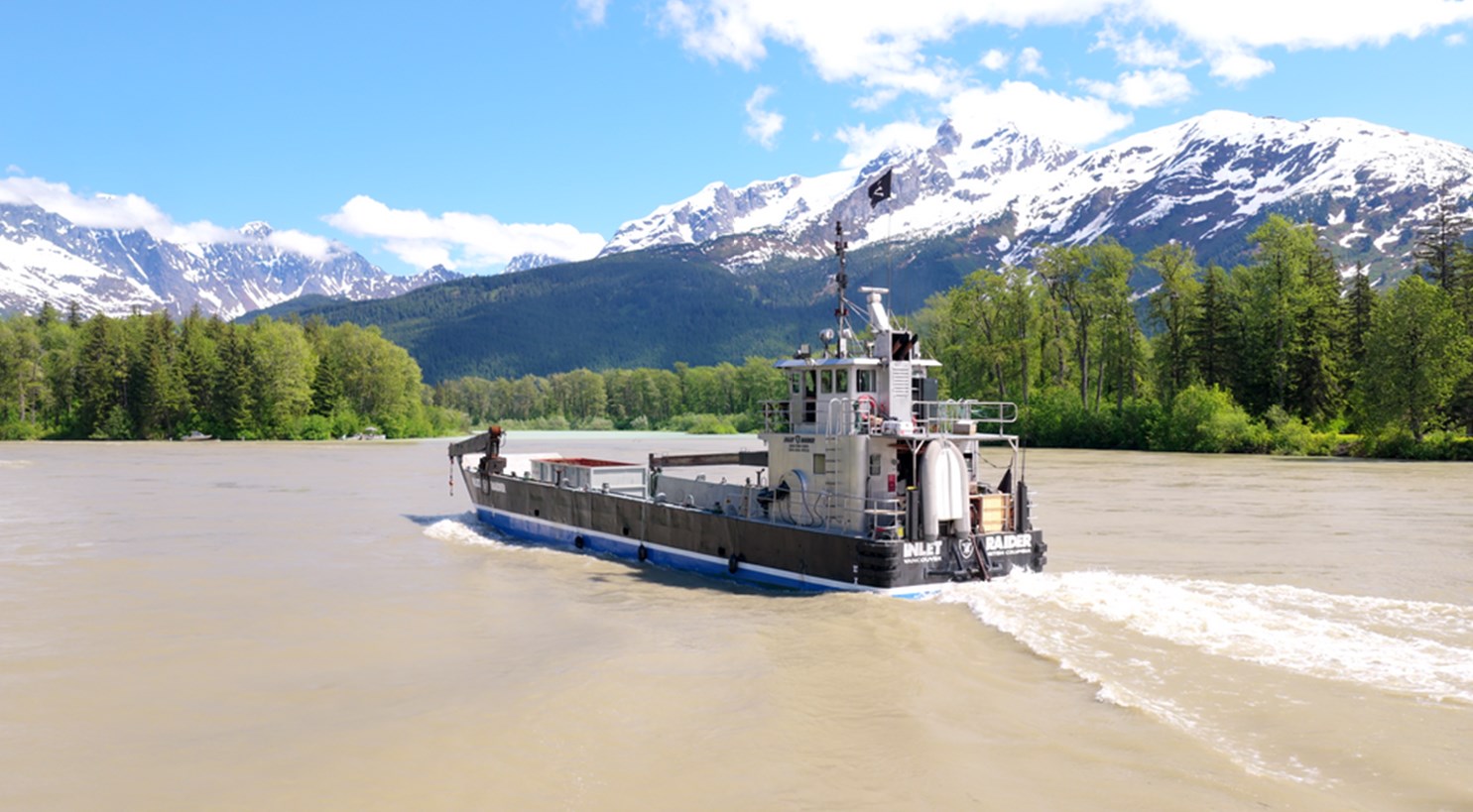
To view an enhanced version of this graphic, please visit:
https://images.newsfilecorp.com/files/11878/306217_9a2d7f3704774b79_001full.jpg
The trials were conducted between June 11 and June 19, 2026, and consisted of multiple trips along the Taku River to the Tulsequah River confluence during this period.
Each voyage was led by a guide boat equipped with sonar instrumentation to continuously measure water depths and identify the optimal navigation route. A separate monitoring vessel carried independent environmental consultants together with monitors from the Taku River Tlingit First Nation, who observed vessel operations throughout the trial.
In addition to confirming the vessel's ability to safely navigate the Taku River and the tidal flats above Taku Inlet, the trial was designed to collect information required for future project planning and environmental assessment. Data collected included:
- Navigation routes and river bathymetry;
- Water depths under varying tidal conditions;
- Above-water and underwater noise levels;
- Shoreline wake heights;
- Water quality measurements; and
- Drone video of the vessel along the river.
Environmental monitoring was conducted by independent specialist consultants, with Taku River Tlingit First Nation participating throughout the program as environmental monitors.
Preliminary observations are that the landing craft passage had no significant negative effects on water quality, noise, or shoreline wake. A more detailed report will be prepared when all the information collected during the trial is received from the consultants.
The data collected during the trial will be used to further evaluate the suitability of the landing craft transportation method and to support ongoing studies for the New Polaris Project.
Qualified Persons
In accordance with National Instrument 43-101 Standards of Disclosure for Mineral Projects, Garry Biles, P.Eng, President & COO is the Qualified Person for the Company and has prepared, validated, and approved the technical and scientific content of this news release. The Company strictly adheres to CIM Best Practices Guidelines in conducting, documenting, and reporting activities on its projects.
About Canagold
Canagold Resources Ltd. is an advanced development company dedicated to advancing the New Polaris Project through feasibility, permitting, and production stages. Additionally, Canagold aims to expand its asset base by acquiring advanced projects, positioning itself as a leading project developer. With a team of technical experts, the Company is poised to unlock substantial value for its shareholders.
"Catalin Kilofliski"
Catalin Kilofliski
Chief Executive Officer
For further information, please contact:
Catalin Kilofliski, Chief Executive Officer
CANAGOLD RESOURCES LTD
Catalin@canagoldresources.com
Tel: (604)-685-9700
Website: www.canagoldresources.com
Neither the TSX nor its Regulation Services Provider (as that term is defined in the policies of the TSX) accepts responsibility for the adequacy or accuracy of this release.
Cautionary Note Regarding Forward-Looking Statements

To view the source version of this press release, please visit https://www.newsfilecorp.com/release/306217
FAQ
AI-generated questions and answers. How Rhea-AI works. Not financial advice.