
Credo Introduces Robin 800G Optical DSP Family Tailored for Next Wave of AI Applications
Credo (NASDAQ: CRDO) launched the Robin family of 800G and 400G optical DSPs on March 17, 2026, targeting AI data center networks with improved signal integrity, lower power, and flexible deployment options.




Highly Integrated, High-Performance and Power-Efficient Devices Bring Flexible Deployment Options to Accelerate AI Infrastructure Build-Out
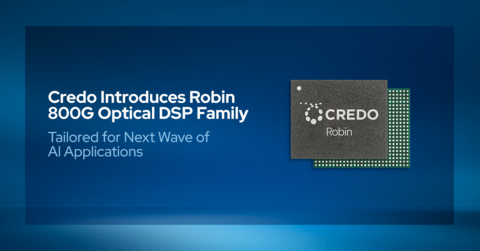
Credo’s Robin 800 series of DSPs are engineered for AI-optimized 800G transceivers, delivering enhanced signal integrity, reduced power consumption, and flexible deployment options. The Robin family's highly compact substrate saves up to
News Highlights:
- Credo’s Robin 800 series of DSPs are engineered for AI-optimized 800G transceivers.
- Highly integrated and flexible, the Robin family includes dedicated variants for both fully retimed transceivers and Linear Receive Optics (LRO) with integrated Silicon Photonics (SiPh) and EML drivers.
- Integrated, low-power, high-swing laser drivers capable of operating up to 3.3Vpp.
-
A highly compact substrate saves up to
50% PCB space versus competing devices, simplifying layouts and reducing manufacturing costs.
“The Robin family of optical DSPs introduces a truly differentiated solution to the massive 800G market,” said Chris Collins, AVP of Sales & Optical Product Marketing at Credo. “By substantially reducing the footprint, integrating low‑power laser drivers, and easing supply‑chain constraints, our customers simplify PCB design, improve yields, and enhance margins. Robin embodies our commitment to innovation and to delivering cutting‑edge technology that accelerates our customers’ success.”
“Our latest forecast highlights that 800G and 400G transceivers will be the majority of AI transceiver shipments in 2026-2027 at over 120M units combined,” said Bob Wheeler, Analyst-at-Large at LightCounting. “Credo’s Robin family is well positioned to capitalize on this tremendous market demand with DSPs that address supply and cost concerns while meeting the bandwidth and power requirements of next-generation AI infrastructure.”
Key Features of Credo’s Robin 800G Optical DSP Family
- Energy-efficiency with low-power, high-swing laser drivers capable of operating up to 3.3Vpp.
-
Exceptionally compact substrate saves up to
50% PCB space versus competing devices. - Designed for low-cost manufacturing using standard PCB materials and SMT processes.
- Superior receiver sensitivity and BER performance to overcome the toughest optical channel impairments.
- Includes a rich set of innovative Ethernet link health monitoring features, built for robust operation in demanding environments.
Robin Family Variants
- Robin 800: 800G DSP optimized for multimode applications
- Robin 802: 800G DSP with integrated SiPh and EML driver for single-mode applications
- Robin 850: 800G LRO DSP optimized for multimode applications
- Robin 852: 800G LRO DSP with integrated SiPh and EML driver for single-mode applications
- Robin 400: 400G DSP optimized for multimode applications
- Robin 402: 400G DSP with integrated SiPh and EML driver for single-mode applications
To learn more about the Credo products in this release, visit the product page linked here.
Product Availability
Credo’s Robin DSP family is available now. For more information contact sales@credosemi.com.
About Credo
Credo’s mission is to transform connectivity at scale through fast, reliable, and energy-efficient system solutions. Our high-speed copper and optical interconnect products deliver industry-leading power and performance at up to 1.6T to meet the ever-expanding data infrastructure demands of AI.
Our product portfolio includes ZeroFlap (ZF) Active Electrical Cables (AECs) and ZF optical transceivers, OmniConnect memory solutions, and a suite of retimers and DSPs for optical and copper Ethernet and PCIe, all leveraging the PILOT diagnostic and analytics software platform. Credo innovations enable our customers to connect the systems that connect the world.
For more information, please visit https://www.credosemi.com. Follow Credo on LinkedIn.
Credo and the Credo logo are registered trademarks of Credo Technology Group Limited in
View source version on businesswire.com: https://www.businesswire.com/news/home/20260317583466/en/
Media Contact:
Kristin Hehir
kristin.hehir@credosemi.com
Investor Contact:
Dan O’Neil
dan.oneil@credosemi.com
Source: Credo