
Contango Silver & Gold Intersects 2.45 Meters Grading 86.05 g/t Gold at Lucky Shot and Additional KM-Style Mineralization in West Drift Extension
With ~93% of the 2026 surface 6,000 m program done, Contango also found new KM2/KM3 veins, though most assays remain pending.
Sentiment and the balance of points
Rhea-AI Sentiment reads the wording of the document, how positive or negative its language is on a 1 to 5 scale. The balance of points shown with the takes weighs what the document actually discloses, so the two can disagree, for example when a trial that missed its main goal is described in upbeat language.
Rhea-AI Summary
Contango Silver and Gold (CTGO) reported initial 2026 surface diamond drill assay results from the Lucky Shot Project in Alaska and an update on underground development.
Key intercepts include hole LSS26016 with 2.45 meters grading 86.05 g/t Au, including 0.80 meters at 244.30 g/t Au and 0.30 meters at 49.96 g/t Au from the Coleman 3 vein extension, and hole LSS26003 with 0.50 meters at 81.57 g/t Au from Coleman 1. Approximately 5,700 meters in 27 surface drill holes, or about 93% of the planned 6,000-meter program, are complete. Underground, 332 meters of the planned 830 meters of lateral development (about 40%) are finished, including completion of the 2090W West Drift Extension. Development encountered two previously unmodeled KM-style mineralized vein structures, KM2 and KM3, with selective hand samples up to 395.10 g/t Au.
Positive
- LSS26016 intercept 2.45 m grading 86.05 g/t Au including 0.80 m at 244.30 g/t Au and 0.30 m at 49.96 g/t Au
- LSS26003 intercept 0.50 m grading 81.57 g/t Au in Coleman 1 vein
- Surface drilling progress about 5,700 m completed in 27 holes, ~93% of planned 6,000 m program
- Underground development 332 m of planned 830 m completed, ~40% of current phase
- New KM-style veins KM2 and KM3 discovered with selective hand samples up to 395.10 g/t Au
Negative
- True widths unknown all reported mineralized intervals are downhole lengths and may differ materially from true widths
- Assays outstanding only the first seven surface drill holes reported, remaining 2026 program assays still pending
- Selective KM sampling high-grade KM2/KM3 results are from limited, non-systematic samples and are not representative of vein or stockpile grades
- Development incomplete only about 40% of the planned 830 m underground exploration development has been completed
News Explained
The update is preliminary: selective underground samples do not establish representative grade, continuity, mineral resources or reserves.
The exploration update remains preliminary: assays from the balance of the surface program are pending and will be released as they are received, reviewed and validated, while KM2 and KM3 require follow-up mapping, systematic channel sampling and drilling to determine their geometry, continuity, grade distribution and relationship to the KM Vein.
Accordingly, the release does not establish resource, reserve, bulk-grade or continuity conclusions for those underground structures, and says the selective results are not representative of the entire vein, development round or stockpile.
The drill intervals are downhole core lengths, and true widths may be materially different; the underground samples comprise selective hand samples, fines and composite stockpile samples rather than systematic channel or bulk samples.
The next concrete milestone is completion of the underground exploration development phase, which the company currently expects in the middle of the fourth quarter of
Details
News Market Reaction – CTGO
On Sep 2, the day this news came out, CTGO closed 4.47% above the previous close. Our momentum scanner recorded 14 alerts for this stock that day.
Data tracked by StockTitan Argus for the Sep 2 session.
AI-generated analysis. How Rhea-AI works. Not financial advice.




Fairbanks, Alaska--(Newsfile Corp. - September 2, 2026) - Contango Silver and Gold Inc. (NYSE American: CTGO) (TSX: CTGO) ("Contango" or the "Company") is pleased to announce initial gold assay results from the 2026 surface diamond drilling program at the Lucky Shot Project in Alaska, provide an update on underground exploration development, and report two previously unmodeled KM-style mineralized vein structures encountered during development of the West Drift Extension.
Highlights
- LSS26016 returned 2.45 meters grading 86.05 grams per tonne ("g/t") gold ("Au"), including 0.80 meters grading 244.30 g/t Au and 0.30 meters grading 49.96 g/t Au, from the Coleman 3 vein extension.
- LSS26003 returned 0.50 meters grading 81.57 g/t Au from the Coleman 1 Vein.
- Five of the seven holes reported visible gold.
- Pad C drilling returned multiple mineralized intervals and provided additional data supporting the interpreted down-dip continuation of Coleman veins toward the Lucky Shot Fault.
- Approximately 5,700 meters in 27 drill holes have been completed from five surface drill pads, representing approximately
93% of the planned 6,000-meter program. - Underground exploration development has advanced 332 meters of a planned 830 meters, or approximately
40% , and the West Drift Extension has been completed to design. - Development of the West Drift Extension encountered two previously unmodeled KM-style mineralized vein structures, tentatively designated KM2 and KM3. Sample from stockpile ran up to 395.10 g/t Au (reported in Table 2).
Rick Van Nieuwenhuyse, the Company's Chief Executive Officer said, "These initial surface drill results validate our systematic approach to defining the Coleman vein geometry, even as our underground crews push forward on developing the access needed for our next underground drilling phase. Hitting 2.5 meters of nearly 3 ounce per tonne high-grade gold in LSS26016-along with multiple mineralized intercepts from Pad C-adds critical data that sharpens our geologic model. Furthermore, extending the West Drift and intercepting additional high-grade KM-style vein structures gives us immediate, high-priority targets that we can now drill efficiently from underground."
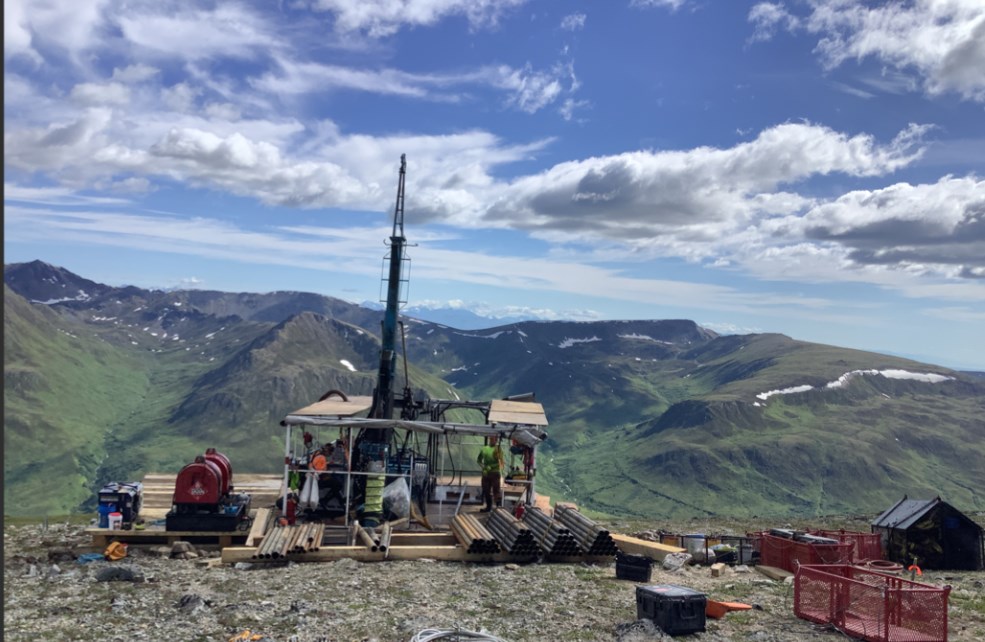
Figure 1. Helicopter-supported diamond core drill operating from Coleman Pad D on Lucky Shot Ridge.
To view an enhanced version of this graphic, please visit:
https://images.newsfilecorp.com/files/12610/312553_c780be66043e9a03_002full.jpg
2026 Lucky Shot Surface Drill Program
The 2026 Lucky Shot surface diamond drilling program commenced on June 22, 2026 and is planned to total approximately 6,000 meters. As of August 27, 2026, the Company had completed approximately 5,700 meters in 27 drill holes from five drill pads (Figures 1, 2). The program is designed to infill portions of the Coleman area within the current geological and mineral resource model and to complete step-out drilling that tests the interpreted structural relationship between the Coleman and Lucky Shot vein systems.
This release reports the first assay batch from seven holes drilled from Coleman Pads C and D. Six holes returned the selected significant intervals reported in Table 1; LSS26015 is identified as having no significant interval selected for reporting. Assays from the balance of the program remain pending and will be released as they are received, reviewed and validated.
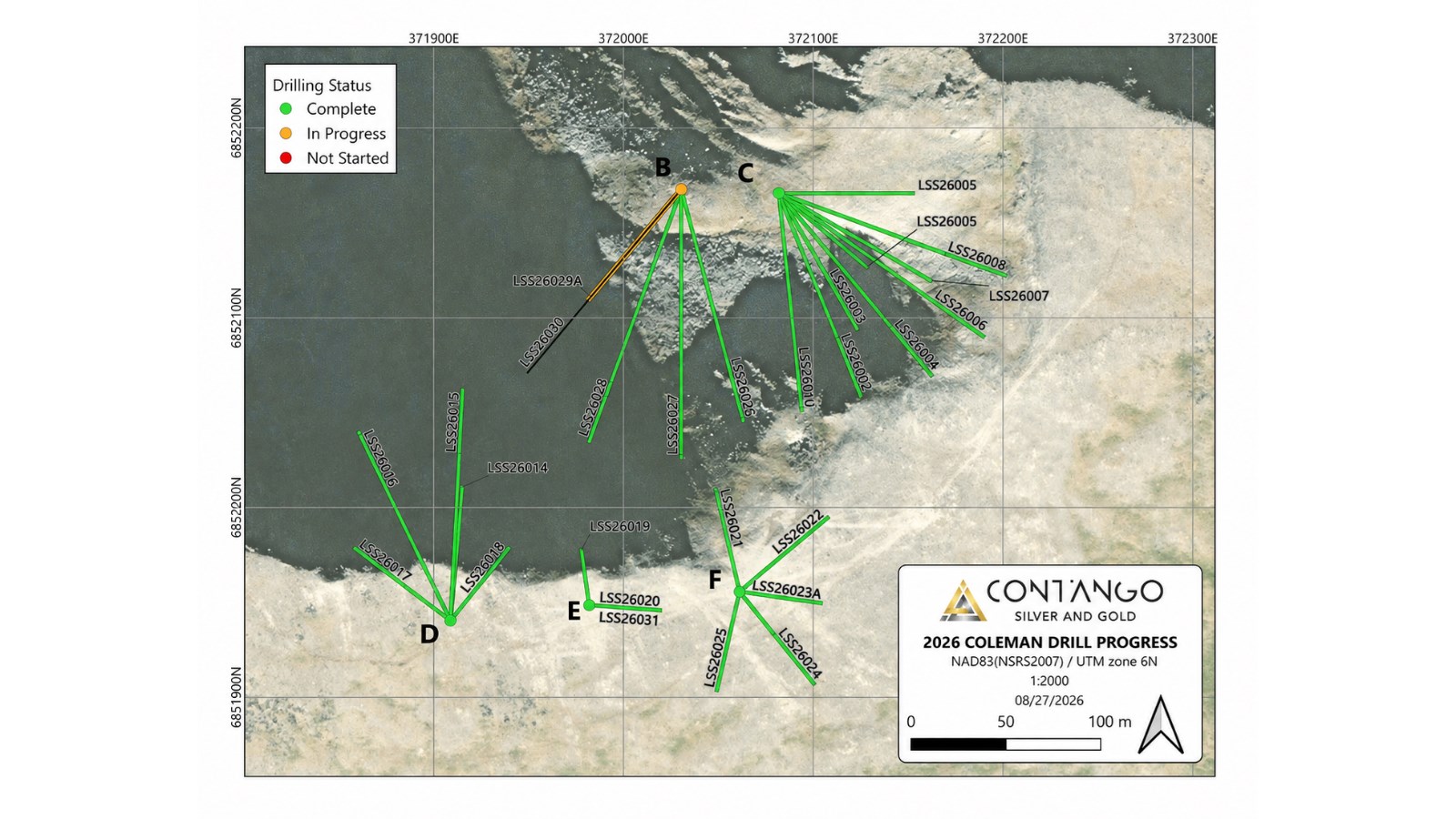
Figure 2. Plan view of the 2026 Coleman surface drill program showing drill-pad and drill-hole locations and drilling status as of August 27, 2026. Completed holes are shown in green, the hole in progress in orange, and holes not started in red.
To view an enhanced version of this graphic, please visit:
https://images.newsfilecorp.com/files/12610/312553_c780be66043e9a03_003full.jpg
Initial Surface Drill Results
Table 1 summarizes selected significant mineralized intervals from the first batch of assays. All interval lengths are downhole core lengths. True widths are not yet known and may be materially different from the reported interval lengths.
Coleman Pad C
Drilling from Pad C tested the lower, down-dip portions of the northeastern Coleman vein system closest to the Lucky Shot Fault. The drilling provided additional control on the near-surface location of the fault and improved the projection of the Lucky Shot Fault intercepts identified during the initial phase of underground drilling. Results support the interpreted down-dip continuation of Coleman veins 1, 3 and 4 toward the fault and identified additional mineralized splays adjacent to the fault (Figure 3).
Selected Pad C results include 0.50 meters grading 81.57 g/t Au in LSS26003; 0.37 meters grading 8.30 g/t Au, 0.39 meters grading 6.15 g/t Au and 0.51 meters grading 5.82 g/t Au in LSS26002; and multiple intervals in LSS26004, including 1.26 meters grading 3.73 g/t Au, 2.08 meters grading 2.39 g/t Au, including 0.30 meters grading 14.72 g/t Au, and 1.32 meters grading 2.54 g/t Au, including 0.31 meters grading 7.64 g/t Au.
Table 1. Selected significant surface drill assay results - Coleman Pads C and D
| Drill Station | Hole ID | From (m) | To (m) | Length (m) | Au (g/t) | Vein | Visible Gold Observed* |
| CLMN - C | LSS26002 | 160.40 | 160.77 | 0.37 | 8.30 | Splay of LS Fault | YES |
| 186.91 | 187.30 | 0.39 | 6.15 | CLMN 3 | YES | ||
| 197.46 | 197.97 | 0.51 | 5.82 | CLMN 3 or 4 | YES | ||
| LSS26003 | 202.00 | 202.50 | 0.50 | 81.57 | CLMN 1 | YES | |
| 231.40 | 231.70 | 0.30 | 13.14 | Undesignated | |||
| LSS26004 | 180.00 | 181.26 | 1.26 | 3.73 | Splay of LS Fault | ||
| (includes) | 180.00 | 180.30 | 0.30 | 6.41 | Splay of LS Fault | ||
| 194.78 | 196.86 | 2.08 | 2.39 | CLMN 3 | YES | ||
| (includes) | 196.56 | 196.86 | 0.30 | 14.72 | CLMN 3 | YES | |
| 208.50 | 209.82 | 1.32 | 2.54 | CLMN 3 or 4 | |||
| (includes) | 208.50 | 208.81 | 0.31 | 7.64 | CLMN 3 or 4 | ||
| LSS26005 | 214.60 | 215.43 | 0.83 | 2.09 | CLMN 3 or 4 | ||
| CLMN - D | LSS26014 | 177.10 | 177.70 | 0.60 | 2.05 | CLMN 1 | YES |
| 187.35 | 187.90 | 0.55 | 2.98 | CLMN 4 | NO | ||
| LSS26015 | N/S | ||||||
| LSS26016 | 195.40 | 197.85 | 2.45 | 86.05 | CLMN 2 | YES | |
| (includes) | 195.40 | 196.20 | 0.80 | 244.30 | CLMN2 | YES | |
| (includes) | 197.55 | 197.85 | 0.30 | 49.96 | CLMN2 | YES | |
| 206.53 | 207.02 | 0.49 | 2.62 | CLMN 1 | |||
Notes: All reported intervals are downhole core lengths; true widths are not yet known and may be materially different. Composite intervals are reported as length-weighted averages. N/S means no significant interval selected for reporting. Selected intervals are those interpreted to represent targeted or newly recognized mineralized vein structures and are included because they are relevant to the current geological interpretation. *Visible-gold observations are qualitative observations made during core logging. They do not necessarily indicate higher gold grades, mineral continuity, metallurgical performance or economic significance. Gold assays are the only quantitative measure of gold content. Blank entries indicate no visible gold was observed.
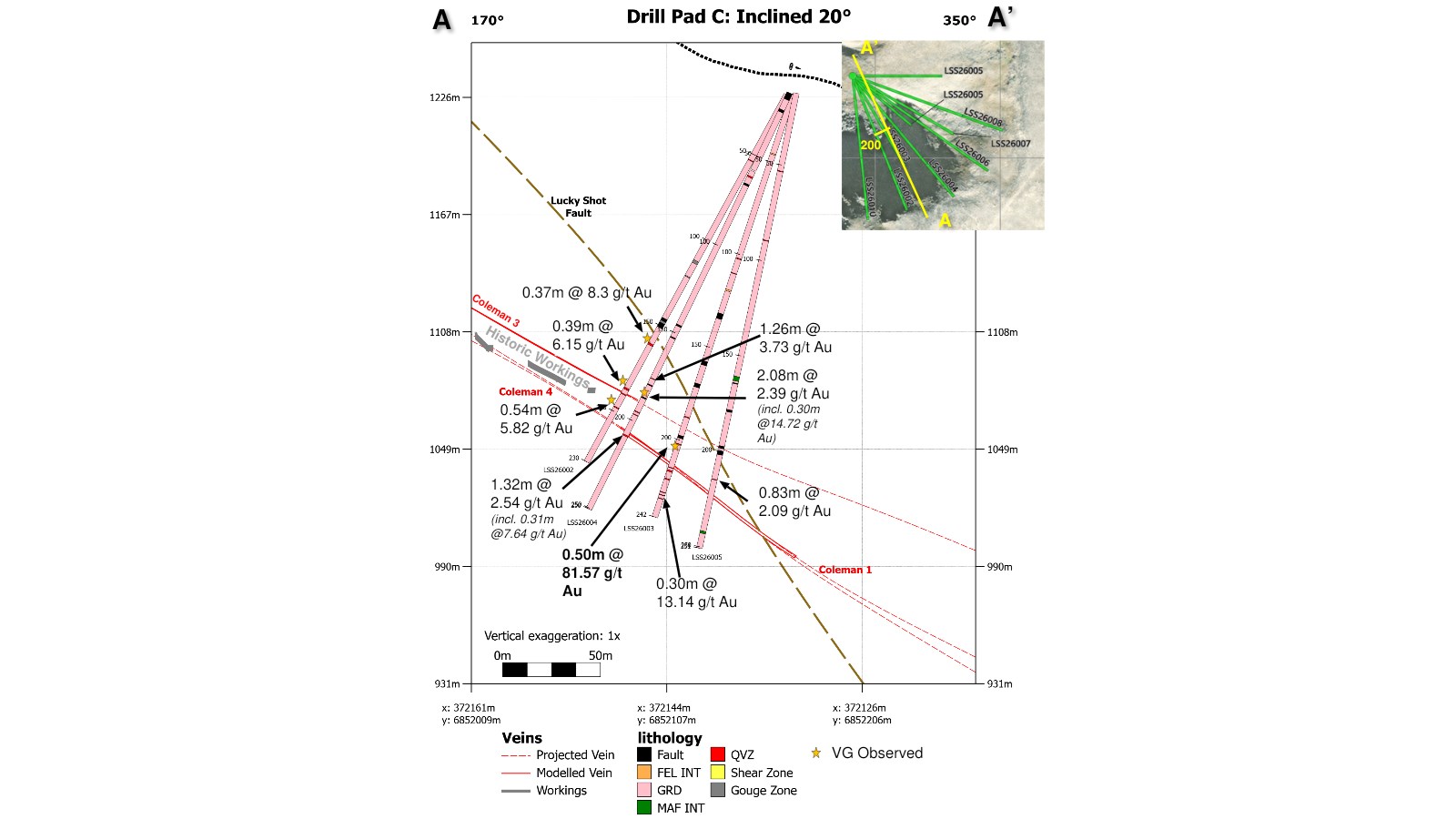
Figure 3. Inclined section through Coleman Pad C looking east, showing reported Au assay results, the current and projected vein interpretation, and the updated interpretation of the Lucky Shot Fault.
To view an enhanced version of this graphic, please visit:
https://images.newsfilecorp.com/files/12610/312553_c780be66043e9a03_004full.jpg
Coleman Pad D
Drilling from Pad D targets the central Coleman vein system to improve resolution of the multiple subparallel veins and associated fault controls. LSS26016 returned 2.45 meters grading 86.05 g/t Au from the interpreted Coleman 3 extension, including 0.80 meters grading 244.30 g/t Au and 0.30 meters grading 49.96 g/t Au. The Pad D interpretation also incorporates the newly modeled West Coleman Fault (Figure 4).
Dave Larimer, CPG, and the Company's Vice President Exploration stated, "The initial Coleman results materially improve our structural understanding of the system. Pad C drilling provides additional control on the Coleman veins as they approach the Lucky Shot Fault, while Pad D has confirmed high-grade mineralization within the interpreted Coleman 3 extension. Underground, the two newly encountered KM-style structures show that the local vein architecture is more complex than the current model. Our next step is disciplined follow-up through detailed mapping, systematic sampling and drilling to determine geometry, continuity and significance."
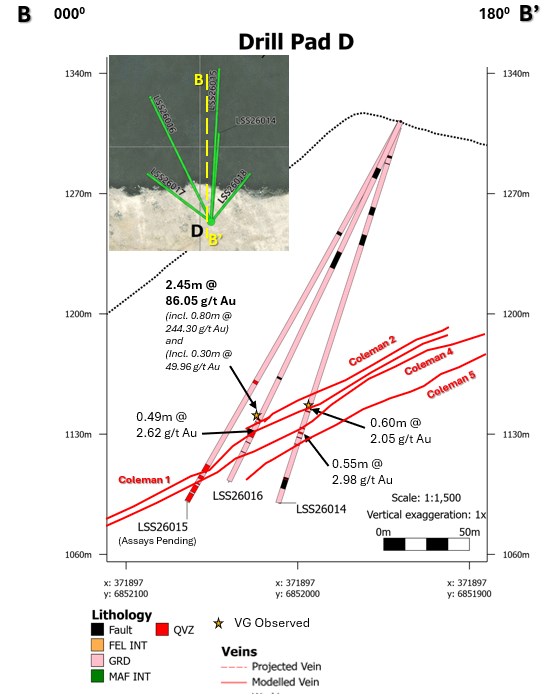
Figure 4. North-South section through Coleman Pad D looking east, showing reported Au assay results, the current and vein interpretation
To view an enhanced version of this graphic, please visit:
https://images.newsfilecorp.com/files/12610/312553_c780be66043e9a03_005full.jpg
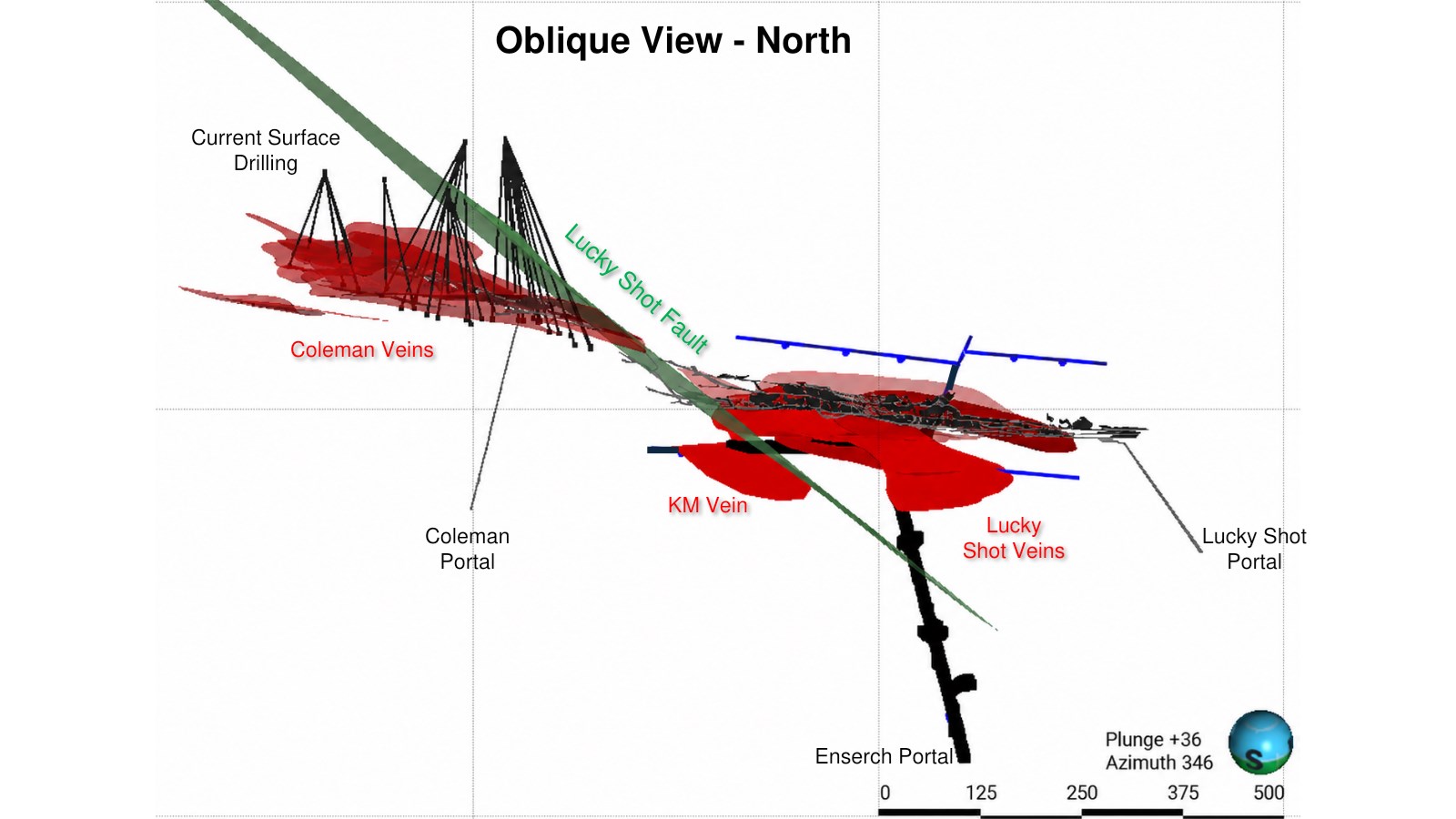
Figure 5. Oblique view looking north across the Lucky Shot deposit area, showing 2026 surface drilling, historic, current and planned underground development, and the interpreted principal vein and fault systems.
To view an enhanced version of this graphic, please visit:
https://images.newsfilecorp.com/files/12610/312553_c780be66043e9a03_006full.jpg
Underground Exploration Development
Underground exploration development continued during the quarter on a two-shift, 24-hour schedule. To date, 332 meters of the planned 830 meters of lateral development have been completed, representing approximately
The 2090W West Drift Extension has been completed to design and is being prepared for the next phase of underground drilling. Planned development will continue in the 2070E heading, the Enserch Tunnel extension and the 2300E heading. Subject to operating conditions and continued progress, the Company currently expects to complete this phase of underground exploration development during the middle of the fourth quarter of 2026.
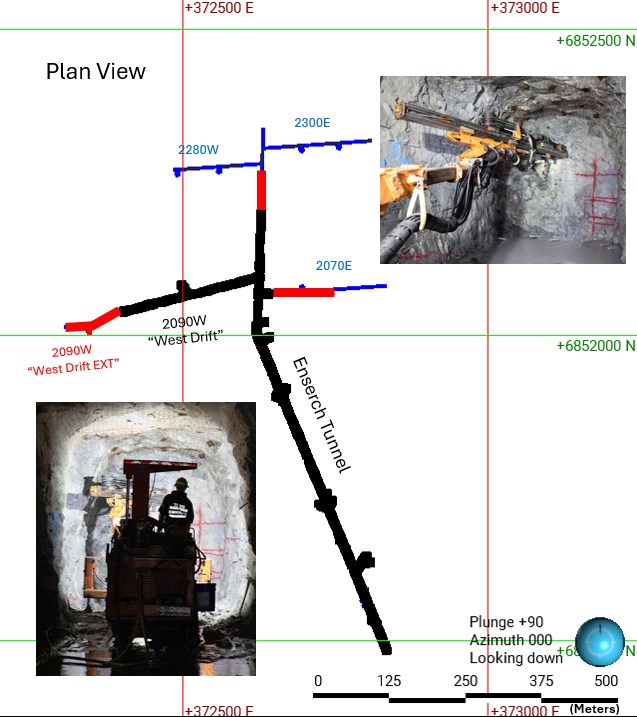
Figure 6. Plan view showing underground exploration development completed to date in red and planned or in-progress development in blue. The inset photograph shows the 2090W West Drift Extension during the exploration drift cycle.
To view an enhanced version of this graphic, please visit:
https://images.newsfilecorp.com/files/12610/312553_c780be66043e9a03_007full.jpg
Additional KM-Style Mineralization Encountered in the West Drift Extension
The West Drift Extension was designed to advance approximately 100 meters westward beneath the previously identified KM Vein with previously reported assays including 5.92 meters @ 60.22 and 0.31 meters @ 99.75 g/t Au in downhole lengths (see Contango's press release dated March 2, 2026). This exploration advancement will establish short-distance underground drill access to this target zone. Initial development rounds indicated that the modeled KM Vein projected above the planned development heading. As the drift continued westward, two previously unmodeled mineralized vein structures were encountered. The structures have orientations, shearing and mineralization characteristics similar to the KM Vein with true widths approximately 0.5 meters. These have been tentatively designated KM2 and KM3 (Figure 7).
It is not yet known whether KM2 and KM3 are separate vein structures or local splays of the KM Vein. Development muck from the mineralized rounds was segregated into a dedicated stockpile, and detailed underground mapping identified frequent visible gold within the encountered vein material. Follow-up mapping, systematic channel sampling and drilling will be required to determine geometry, continuity, grade distribution and the relationship of these structures to the KM Vein.
Three sampling approaches were used for preliminary characterization: (i) three selectively collected hand samples of vein-material approximately four kilograms each; (ii) two approximately five-kilogram samples of the less-than-one-centimeter fines fraction from the segregated stockpile; and (iii) two approximately five-kilogram composite stockpile samples containing a mixture of vein material, fines and waste rock. The results are shown in Table 2. Because the samples are selective, limited in number, and not collected on a systematic channel or bulk-sampling basis, they must not be interpreted as representative of the grade of the vein structures, development rounds or stockpile.
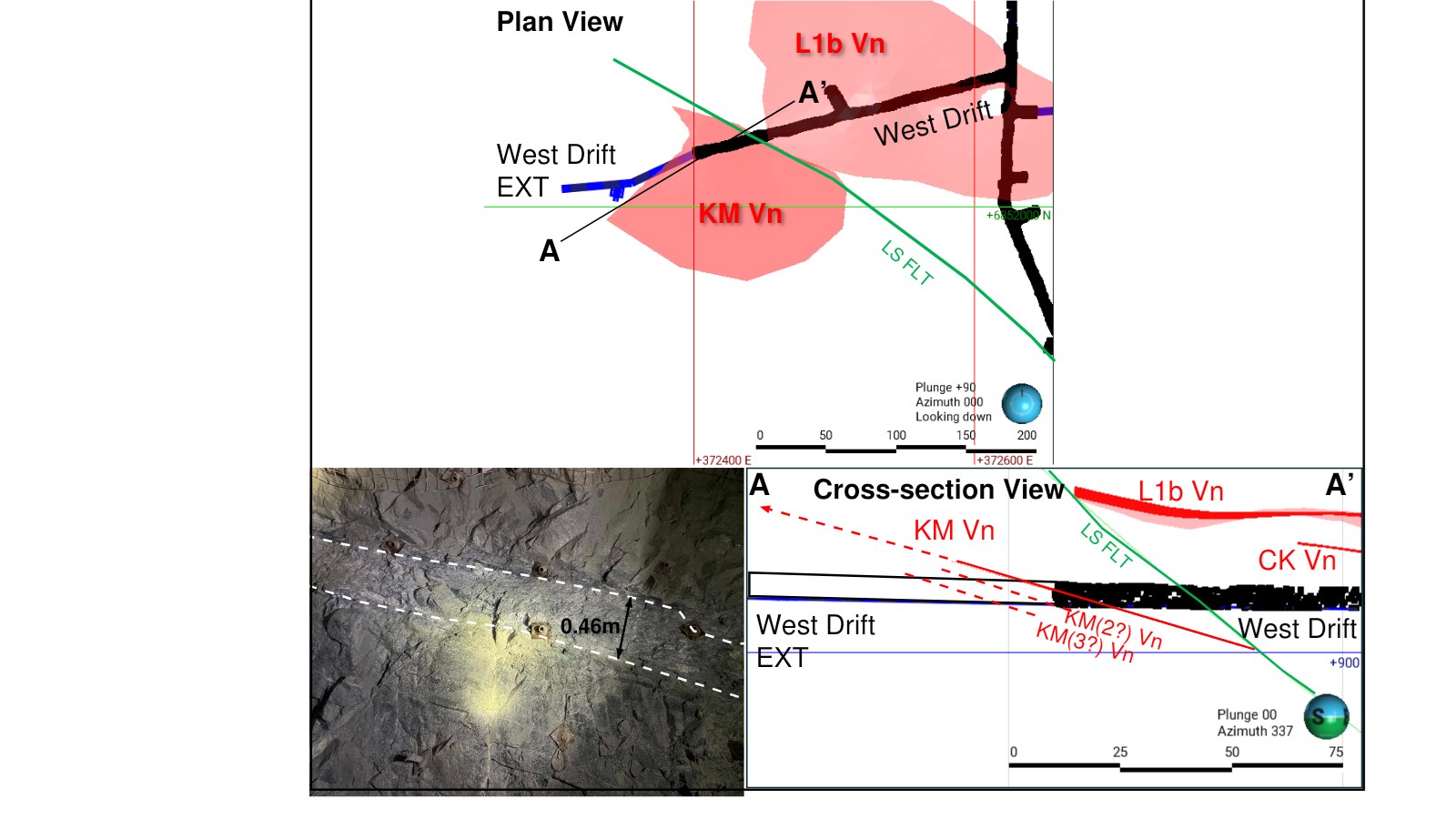
Figure 7. Plan and cross-sectional views looking north across the West Drift Extension, showing the interpreted KM-oriented mineralized vein structures encountered during development. The inset photograph shows approximately 0.46-meter true width of mineralized material.
To view an enhanced version of this graphic, please visit:
https://images.newsfilecorp.com/files/12610/312553_c780be66043e9a03_008full.jpg
Table 2. Selective underground hand and stockpile sample results - West Drift Extension
| Sample ID | Au (g/t) | Sample description |
| 5007904 | 101.75 | Vein-material hand sample |
| 5007905 | 395.10 | Vein-material hand sample |
| 5007906 | 74.34 | Vein-material hand sample |
| 5007907 | 5.26 | Fines from mineralized stockpile |
| 5007908 | 1.80 | Fines from mineralized stockpile |
| 5007909 | 0.72 | Composite stockpile sample |
| 5007910 | 13.27 | Composite stockpile sample |
Notes: The hand samples were selectively collected from visually mineralized vein material. The fines and composite stockpile samples were collected for preliminary characterization of segregated development muck. These samples are not systematic channel samples and are not representative of the entire vein, development round or stockpile. The results do not establish width, continuity, bulk grade, mineral resources or mineral reserves.
Cautionary Note Regarding Exploration Results
The Company cautions that drill intercept lengths reported in this release are downhole core lengths. True widths are not yet known and may be materially different from reported interval lengths. Visible-gold observations are qualitative geological observations and do not necessarily correlate with higher gold grades, mineral continuity, metallurgical performance or economic significance. Gold assay results derived from laboratory analysis are the only quantitative measure of gold content.
The underground hand, fines and composite stockpile samples reported in Table 2 are selective and non-representative. They do not establish a bulk grade, mining width, continuity, mineral resource or mineral reserve and should not be extrapolated beyond the specific material sampled.
Lucky Shot is an exploration-stage property. No mineral reserves have been declared for the Lucky Shot Project, and the work described in this release is exploratory in nature. The exploration results reported in this release do not demonstrate economic viability.
Quality Assurance and Quality Control
Contango's drilling and sampling programs are conducted in accordance with industry best practices and applicable SEC Regulation S-K 1300 requirements. Drill core is systematically logged, photographed and sampled under the supervision of the Company's Qualified Person.
Quality assurance and quality control procedures include the regular insertion of certified reference materials, blanks and duplicate samples into the analytical stream. Mineralized drill-core intervals are sampled as whole core, with shoulder samples extending beyond mineralized zones where appropriate. Samples are sealed and transported to the laboratory under documented chain-of-custody procedures.
Analytical testing was performed by Bureau Veritas North America, with sample preparation conducted in Fairbanks, Alaska. Gold analyses for the samples reported in this release were completed using a two-cycle PhotonAssay™ method by Paragon Geochemical in Vancouver, British Columbia. The published lower detection limit for the two-cycle PhotonAssay method is 0.015 g/t Au and the upper detection limit is 355 g/t Au. Samples returning gold values above the upper detection limit are re-assayed using a 50-gram charge fire assay with gravimetric finish through Bureau Veritas. Samples also undergo multi-element ICP-MS analysis to quantify minor- and trace-element associations.
Qualified Person
The scientific and technical information contained in this news release has been reviewed and approved by Dave Larimer, CPG, VP Exploration for Contango, who is a Qualified Person as defined by SEC Regulation S-K 1300. Mr. Larimer is not independent of the Company.
ABOUT CONTANGO
Contango is a NYSE American and TSX listed company that engages in the exploration for and development and production of gold and associated minerals in Alaska and in the Golden Triangle in British Columbia. Contango holds a
Additional information can be found on our web page at www.contangoore.com.
FORWARD-LOOKING STATEMENTS
This press release contains forward-looking information and forward-looking statements within the meaning of applicable securities ("Forward-looking Statements"). These include statements regarding Contango's plans and expectations for its properties and operations, the content within future annual filings, operations in respect of Contango mineral properties and any benefits of investment in Contango. The Forward-looking Statements regarding Contango are intended to be covered by the safe harbor for "forward-looking statements" provided by the Private Securities Litigation Reform Act of 1995, based on Contango's current expectations and includes statements regarding future results of operations, quality and nature of the asset base, the assumptions upon which estimates are based and other expectations, beliefs, plans, objectives, assumptions, strategies or statements about future events or performance (often, but not always, using words such as "expects", "projects", "anticipates", "plans", "estimates", "intends", "believes", "ensures", "forecasts", "predicts", "proposes", "contemplates", "aims", "seeks", "continues", "potential", "positioned", "strategy", "outlook", "future", "going forward", "designed to", and similar expressions or other words of similar meaning, and the negatives thereof, or stating that certain actions, events or results "may", "might", "will", "should", "would", or "could" be taken, or that they are "possible", "probable", or "likely" to occur or be achieved). However, the absence of these words does not mean that the statements are not forward-looking. Forward-looking Statements are based on current expectations, estimates and projections that involve a number of risks and uncertainties, which could cause actual results to differ materially from those reflected in the statements. These risks include, but are not limited to: the risks of the exploration and the mining industry (for example, operational risks in exploring for and developing mineral reserves); risks and uncertainties involving geology; the speculative nature of the mining industry; the uncertainty of estimates and projections relating to future production, costs and expenses; the volatility of natural resources prices, including prices of gold and associated minerals; the existence and extent of commercially exploitable minerals in properties acquired by Contango or the Peak Gold JV; ability to realize the anticipated benefits of the Peak Gold JV; potential delays or changes in plans with respect to exploration or development projects or capital expenditures; the interpretation of exploration results and the estimation of mineral resources; the loss of key employees or consultants; health, safety and environmental risks; risks related to weather and other natural disasters; uncertainties as to the availability and cost of financing; Contango's inability to retain or maintain its relative ownership interest in the Peak Gold JV; inability to realize expected value from acquisitions; inability of our management team to execute its plans to meet its goals; the extent of disruptions caused by an outbreak of disease, such as the COVID-19 pandemic; and the possibility that government policies may change, political developments may occur or governmental approvals may be delayed or withheld, including as a result of presidential and congressional elections in the U.S. or the inability to obtain mining permits. Additional information on these and other factors which could affect Contango's operations or financial results are included in Contango's other reports on file with the U.S. Securities and Exchange Commission. Investors are cautioned that any Forward-looking Statements are not guarantees of future performance and actual results or developments may differ materially from the projections in the Forward-looking Statements. Forward-looking Statements are based on the estimates and opinions of management at the time the statements are made. Contango does not assume any obligation to update Forward-looking Statements should circumstances or management's estimates or opinions change.
CONTACTS:
Contango Silver & Gold Inc.
Rick Van Nieuwenhuyse
(907) 388-7770
www.contangoore.com

To view the source version of this press release, please visit https://www.newsfilecorp.com/release/312553
FAQ
AI-generated questions and answers. How Rhea-AI works. Not financial advice.