
Contango Silver & Gold Intersects 62.97 g/t Gold over 3.92 Meters and Advances Underground Exploration at Lucky Shot
Sentiment and the balance of points
Rhea-AI Sentiment reads the wording of the document, how positive or negative its language is on a 1 to 5 scale. The balance of points shown with the takes weighs what the document actually discloses, so the two can disagree, for example when a trial that missed its main goal is described in upbeat language.
Rhea-AI Summary
Contango Silver and Gold (CTGO) released the final Coleman surface drilling results and reported underground exploration progress at Lucky Shot, Alaska. Hole LSS26031 returned 62.97 grams of gold per tonne over 3.92 meters, including 325.20 grams per tonne over 0.73 meters. Contango interprets the intercept below Coleman 4 as a possible new vein.
Phase 3 surface drilling is complete. Underground exploration access is about 73% complete, and 29 underground holes totaling approximately 2,050 meters are complete, with assays pending. Contango plans an updated mineral resource estimate in late Q2 2027 and a feasibility study in the second half of 2027.
How this balance works
Rhea-AI gives every point it takes from this document a weight. Minor counts 1, Moderate 3 and Major 9, so one Major point outweighs several Minor ones. The bar adds up the weights on each side, and when neither side holds more than 65% of the total the balance reads Mixed.
It reads the document as published, with the same rules for every company, and it does not look at what the market expected or at how the stock traded, so a point can be objectively good on a day the stock falls.
Rhea-AI Sentiment measures something else, the tone of the wording.
Hollow bars mark forward-looking points. How the balance works
Positive
- Moderate pointHole LSS26031 returned 62.97 g/t gold over 3.92 meters, including 325.20 g/t over 0.73 meters.
- Moderate point. Forward-looking: it has not happened yet and may not happen.Mineral resource estimate update is planned for late Q2 2027 after planned drilling and incorporation of validated assays.
- Moderate point. Forward-looking: it has not happened yet and may not happen.Feasibility study is scheduled for the second half of 2027.
- Minor pointPhase 3 Coleman surface drilling finished with 27 holes totaling approximately 5,800 meters.
- Minor pointUnderground drilling completed 29 holes totaling approximately 2,050 meters since September 16, 2026.
7 minor points
- Minor pointUnderground exploration access reached approximately 606 of 830 planned meters, or approximately 73%.
- Minor point. Forward-looking: it has not happened yet and may not happen.Second underground rig is planned for the 2300E drift, with underground drilling planned through February/March 2027.
- Minor pointL2 and L1D vein exposures closely match the updated model and contain visible gold.
- Minor pointHole LSS26028 returned 48.75 g/t gold over 0.30 meters.
- Minor pointHole LSS26027 returned 24.46 g/t gold over 0.30 meters.
- Minor pointHole LSS26010 returned 17.16 g/t gold over 0.36 meters.
- Minor pointHole LSS26026 returned 11.01 g/t gold over 1.04 meters.
Negative
- Minor pointUnderground gold assays are all pending and will be reported after receipt, review and validation.
- Minor pointPossible new vein below Coleman 4 has unconfirmed continuity pending further drilling and interpretation.
- Minor point. Forward-looking: it has not happened yet and may not happen.Planned drilling from the 2280W drift depends on access and operating conditions.
News Explained
The reported 3.92-meter Coleman intercept is a downhole core length, not an established vein width; true width is unknown and may differ materially, so actual thickness remains undetermined.
Key Figures
- Gold intercept
- 62.97 g/t over 3.92 meters, including 325.20 g/t over 0.73 meters
- LSS26031; downhole core lengths; true widths are not yet known
- Underground development
- 606 of 830 planned meters; approximately 73%
- Current underground exploration development program
- Underground drilling completed
- 29 holes totaling approximately 2,050 meters
- Since September 16, 2026
- Mineral resource estimate
- Late Q2 2027
- Planned after completion of drilling and incorporation of validated assays
- Feasibility Study
- Second half of 2027
- Scheduled milestone
Historical Context
-
Reported Lucky Shot assays and underground progress; the current interval had remained assay-pending.
-
Reported East Drift drilling underway; this update advances drilling from underground access.
24h Move is the share-price change in the day after each event; other market factors may also have contributed.
Key Terms
fire assay technical
icp-ms technical
AI-generated analysis. How Rhea-AI works. Not financial advice.


Fairbanks, Alaska--(Newsfile Corp. - November 18, 2026) - Contango Silver and Gold Inc. (NYSE American: CTGO) (TSX: CTGO) ("Contango" or the "Company") announces the final batch of Coleman surface drill assays and continued underground exploration progress at Lucky Shot, Alaska. LSS26031 returned 62.97 grams per tonne ("g/t") gold ("Au") over 3.92 meters, including 325.20 g/t Au over 0.73 meters.
Contango's five-phase strategy advances Lucky Shot from initial underground drilling and new exploration access (Phases 1 and 2), through Coleman surface drilling (Phase 3), to underground resource-definition drilling (Phase 4) and a Feasibility Study (Phase 5). This series of surface assay releases marks the completion of Phase 3. Ongoing work will support an updated mineral resource estimate followed by a Feasibility Study scheduled for the second half of 2027.
Highlights*
LSS26031: 62.97 g/t Au over 3.92 meters, including 325.20 g/t Au over 0.73 meters, located below the modeled Coleman 4 and is currently interpreted as a new vein.
Underground development: 606 of 830 planned meters are complete, or approximately
73% . L2 and L1D exposures closely match the updated model and contain visible gold.Underground drilling: 29 holes totaling approximately 2,050 meters completed since September 16, 2026. Drilling is currently at the second station in the 2070E drift.
A second rig will shortly mobilize for drilling in the 2300E drift. Drilling is planned through February/March 2027, followed by an updated mineral resource estimate scheduled for late Q2 2027.
*All reported drill assay interval lengths are downhole core lengths. True widths are not yet known and may be materially different. Visible gold is a qualitative observation, not a measure of gold grade.
Rick Van Nieuwenhuyse, the Company's Chief Executive Officer, said, "The final assay results from the surface drilling on the Coleman segment of the Lucky Shot vein system complete an important phase of our work at Lucky Shot. As the drilling demonstrates, we continue to find new high-grade veins that will potentially contribute to future resource growth. We are now using the new underground access to test down dip of the historically mined Lucky Shot vein system. The drill results and underground mapping will support the next resource update and the technical work needed to advance towards a feasibility study planned for release in H2 2027."
Phase 3 Coleman Surface Drilling
The 2026 surface program completed approximately 5,800 meters in 27 holes from five pads between June 22 and August 31, 2026. It targeted infill areas within the Coleman vein segment and step-out areas toward the Lucky Shot vein system. Figure 1 shows the completed drilling and highlights the holes with new results reported in this release.
The current batch includes 20 selected new intervals at or above 2.00 g/t Au from eight holes, plus one included subinterval. Results from the Company's September 2 and October 6, 2026 releases are excluded from Table 1. Previously reported Pad E results are shown separately in Figure 2 to provide geological context.
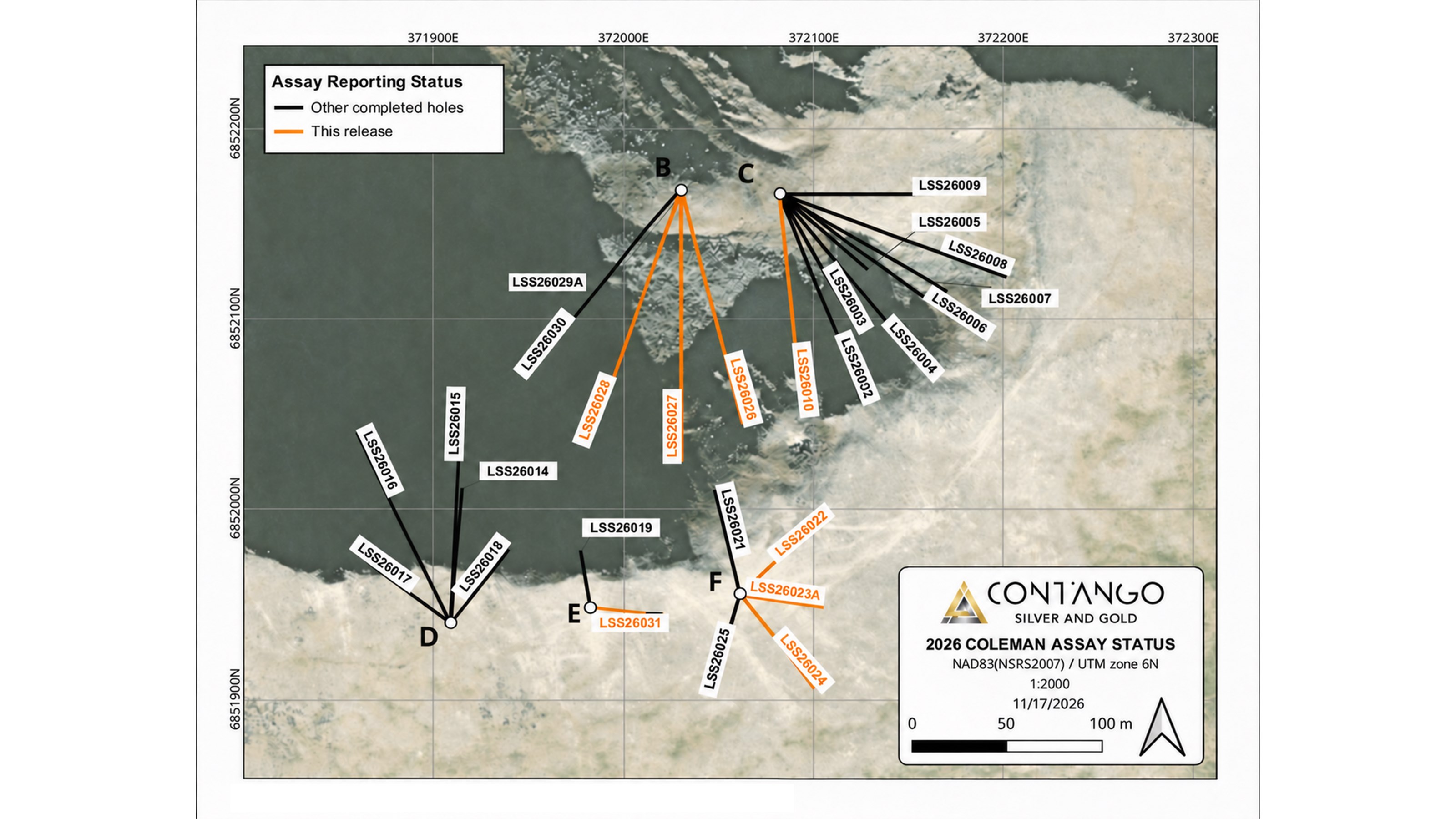
Figure 1. Plan view of completed Phase 3 Coleman surface exploration drilling. Orange highlights the holes with new assays in this release; black identifies the other completed holes. LSS26031 includes the newly reported deeper interval as well as shallower results previously released. Grid coordinates and scale-bar distances are in meters.
To view an enhanced version of this graphic, please visit:
https://images.newsfilecorp.com/files/12610/324603_f27fc6cc243fb966_002full.jpg
Coleman Pad E New Results Below Modeled Coleman 4
LSS26031 intersected 62.97 g/t Au over 3.92 meters from 164.64 to 168.56 meters, including 325.20 g/t Au over 0.73 meters from 166.33 to 167.06 meters (Figure 2). The October 6, 2026 release identified this interval as "Assay Pending"; its final gold grade is reported here for the first time.
The new intercept lies below the modeled Coleman 4 vein and is currently interpreted as a new vein. Its position is interpreted to correlate with a separate 0.36-meter interval grading 27.28 g/t Au in LSS26019, also below the modeled Coleman 4 and previously reported on October 6, 2026. This spatial relationship suggests possible continuity of a new mineralized structure beneath Coleman 4, subject to further drilling and interpretation.
The other LSS26019 assays shown in Figure 2 were also reported on October 6, 2026 and are included for context.
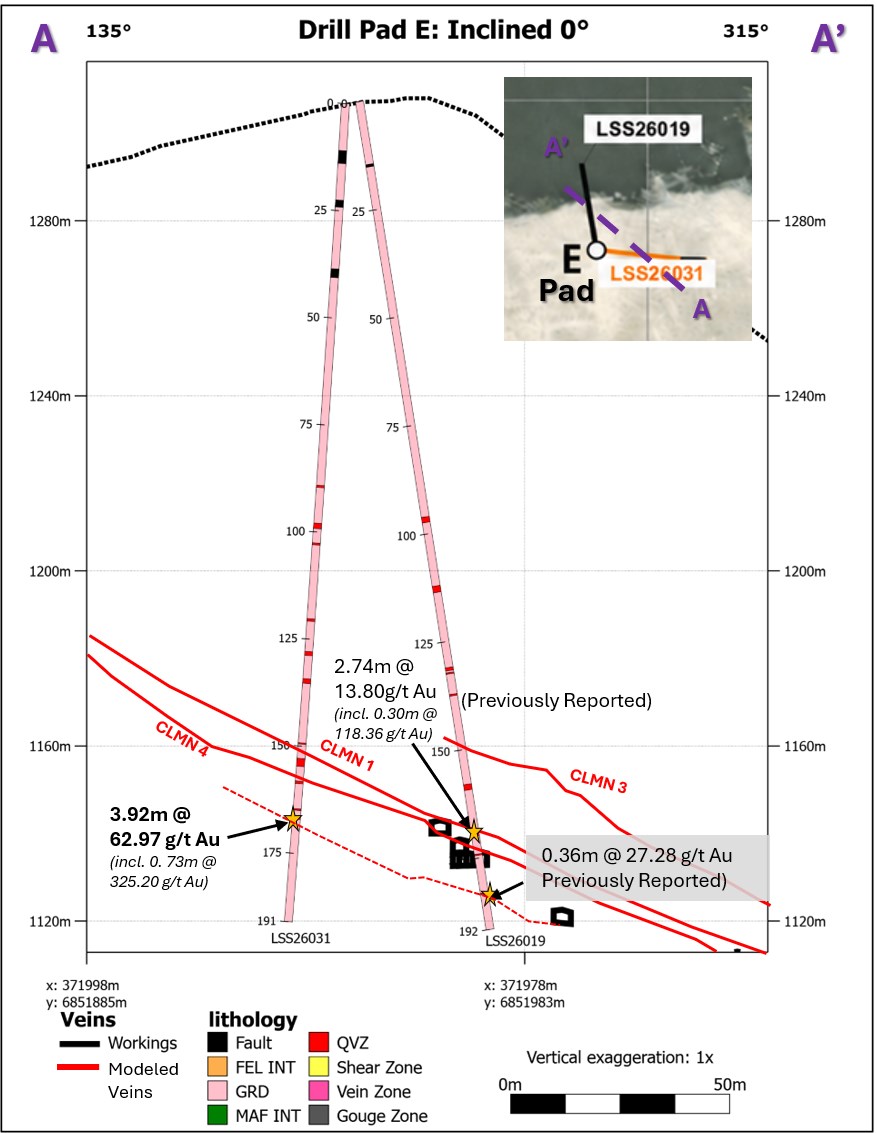
Figure 2. Cross-section through Coleman Pad E looking southwest, showing the updated LSS26031 assay and current vein interpretation. The 3.92-meter interval grading 62.97 g/t Au, including 0.73 meters grading 325.20 g/t Au, was previously identified as pending. LSS26019 assays were reported on October 6, 2026. The deeper intercepts lie below modeled Coleman 4 and remain unassigned; their correlation is interpretive. All assay lengths are downhole lengths; true widths are not yet known.
To view an enhanced version of this graphic, please visit:
https://images.newsfilecorp.com/files/12610/324603_f27fc6cc243fb966_003full.jpg
Dave Larimer, the Company's Vice President of Exploration, commented, "The new Pad E result gives us a mineralized intersection below modeled Coleman 4 that warrants further investigation and modeling. Underground, the close agreement between the newly exposed L2 and L1D structures and our updated model provides valuable geological control. We are using these observations, together with the ongoing drilling, to test our interpretations and strengthen the technical basis for the next resource update planned for the second quarter of 2027."
Selected Newly Reported Surface Drill Results
Table 1 contains only newly reported intervals at or above 2.00 g/t Au. Composite grades are length-weighted averages. Vein assignments are provisional and reflect the current interpretation. These selected intervals are not a complete listing of sampled material or an indication of the average grade of a hole or vein.
Table 1. Newly reported significant surface drill assay results - Coleman Pads E, C, F and B
| Drill station | Hole ID | From (m) | To (m) | Length (m) | Au (g/t) | Vein | Visible gold observed* |
| Pad E | LSS26031 | 164.64 | 168.56 | 3.92 | 62.97 | Unassigned | YES |
| (includes) | 166.33 | 167.06 | 0.73 | 325.20 | YES | ||
| Pad C | LSS26010 | 180.28 | 180.64 | 0.36 | 17.16 | CLMN 3 | YES |
| Pad F | LSS26022 | 185.60 | 186.50 | 0.90 | 8.42 | CLMN 1 | |
| 190.58 | 190.88 | 0.30 | 12.04 | CLMN 4 | YES | ||
| LSS26023A | 124.68 | 125.06 | 0.38 | 2.49 | Shallow veins | ||
| 146.88 | 147.34 | 0.46 | 4.28 | CLMN 3 | |||
| 152.87 | 154.33 | 1.46 | 4.64 | CLMN 1 | |||
| 155.87 | 159.19 | 3.32 | 4.32 | CLMN 1 | |||
| 166.85 | 168.33 | 1.48 | 3.22 | CLMN 4 | YES | ||
| LSS26024 | 137.20 | 140.75 | 3.55 | 2.05 | CLMN 1 | ||
| Pad B | LSS26026 | 159.59 | 159.91 | 0.32 | 4.95 | CLMN 3 | |
| 177.53 | 178.57 | 1.04 | 11.01 | CLMN 1 and 4 | YES | ||
| 204.87 | 205.58 | 0.71 | 2.81 | CLMN 8 | |||
| LSS26027 | 158.22 | 158.52 | 0.30 | 3.38 | CLMN 3 | ||
| 175.42 | 175.72 | 0.30 | 24.46 | CLMN 1 | YES | ||
| 198.55 | 199.12 | 0.57 | 2.09 | CLMN 7 | |||
| LSS26028 | 157.35 | 157.65 | 0.30 | 48.75 | CLMN 3 | YES | |
| 166.30 | 166.60 | 0.30 | 2.26 | CLMN 1 | YES | ||
| 171.30 | 171.95 | 0.65 | 3.30 | CLMN 4 | |||
| 196.40 | 197.10 | 0.70 | 3.19 | CLMN 7 |
Notes: All intervals are downhole core lengths; true widths are not yet known and may be materially different. Composite grades are length-weighted averages. "Includes" identifies a subinterval contained within the preceding composite and is not an additional interval. CLMN = Coleman. Vein assignments are provisional. Only newly reported intervals at or above 2.00 g/t Au are included. Blank entries indicate no visible gold was logged.
*Visible gold is a qualitative observation made during core logging. It does not necessarily indicate higher grades, continuity, metallurgical performance or economic significance. Reported gold grades are based on laboratory assays. Blank entries indicate that the source summary records no visible gold.
Coleman Pads C and F
From Pad C, LSS26010 returned 17.16 g/t Au over 0.36 meters in the interpreted Coleman 3 vein. From Pad F, LSS26022 returned 8.42 g/t Au over 0.90 meters in Coleman 1 and 12.04 g/t Au over 0.30 meters in Coleman 4. LSS26023A intersected 4.64 g/t Au over 1.46 meters and a separate 4.32 g/t Au interval over 3.32 meters in interpreted Coleman 1, and 3.22 g/t Au over 1.48 meters in Coleman 4. LSS26024 returned 2.05 g/t Au over 3.55 meters in interpreted Coleman 1.
Coleman Pad B
Pad B drilling provides additional control on the Coleman vein geometry (Figure 3). LSS26026 intersected 4.95 g/t Au over 0.32 meters in interpreted Coleman 3, 11.01 g/t Au over 1.04 meters across interpreted Coleman 1 and Coleman 4, and 2.81 g/t Au over 0.71 meters in Coleman 8.
LSS26027 returned 24.46 g/t Au over 0.30 meters in interpreted Coleman 1, 3.38 g/t Au over 0.30 meters in Coleman 3, and 2.09 g/t Au over 0.57 meters in Coleman 7. LSS26028 returned 48.75 g/t Au over 0.30 meters in Coleman 3, 2.26 g/t Au over 0.30 meters in Coleman 1, 3.30 g/t Au over 0.65 meters in Coleman 4, and 3.19 g/t Au over 0.70 meters in Coleman 7.
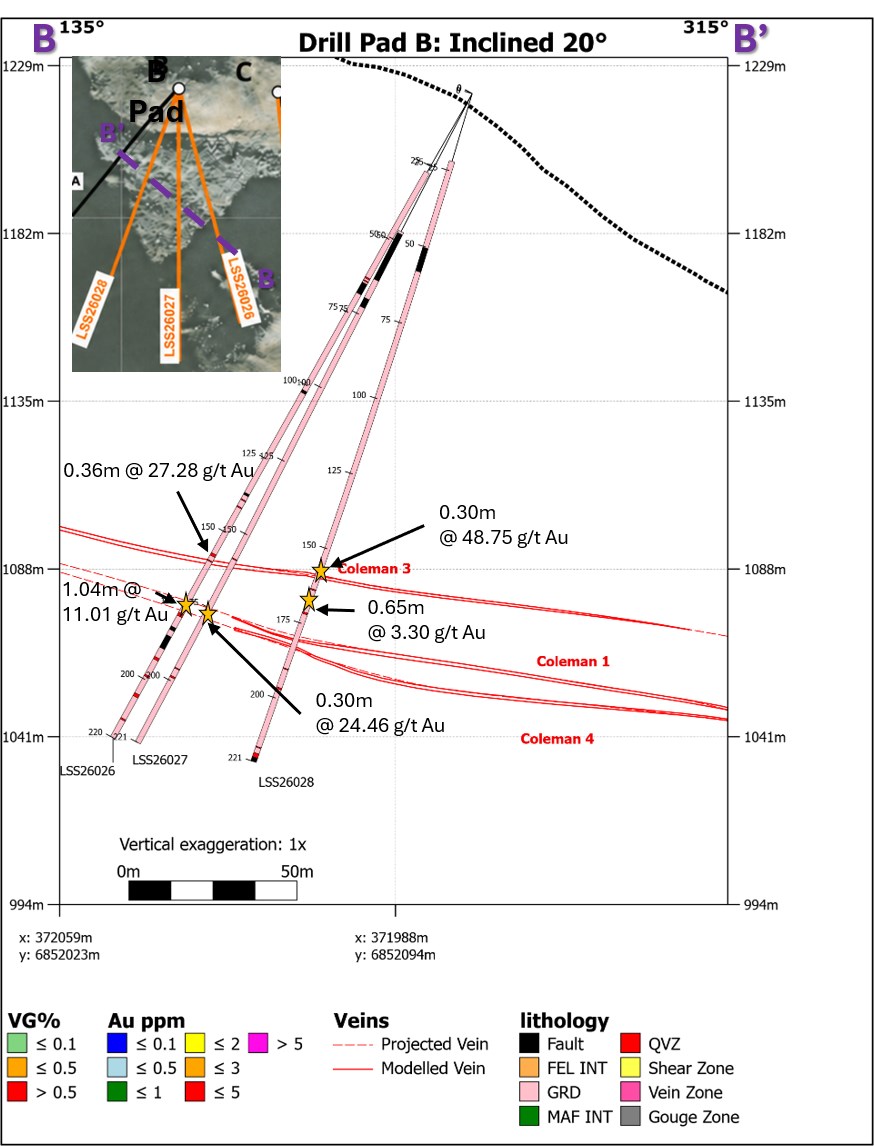
Figure 3. Cross-section through Coleman Pad B looking southwest, showing selected newly reported assays in LSS26026, LSS26027 and LSS26028 and the interpreted Coleman vein geometry. The inset locates the section. Table 1 provides all newly reported selected intervals and current vein assignments. All assay lengths are downhole lengths; true widths are not yet known.
To view an enhanced version of this graphic, please visit:
https://images.newsfilecorp.com/files/12610/324603_f27fc6cc243fb966_004full.jpg
Underground Exploration Development and Geological Observations
Underground exploration development has advanced to approximately 606 meters of the current 830-meter program, representing approximately
In the main Enserch tunnel near the 2300E junction, crews encountered a northwest-trending fault zone. Its orientation and projected position are interpreted to correlate with the Capps Fault observed in the historically mined Lucky Shot (500 level and above). The exposure provides additional information on the local fault geometry, although the correlation remains subject to mapping and interpretation.
The main Enserch tunnel also exposed mineralization interpreted as the L2 and L1D veins. These structures were newly modeled following the initial underground drilling phase, and their observed positions closely match the updated model. Visible gold was observed in both L2 and L1D. In the 2070E drift, the CK vein has also been exposed, with its observed trend generally parallel to the drift. These exposures provide direct geological control for subsequent drilling; visual observations alone do not establish grade, continuity or economic significance.
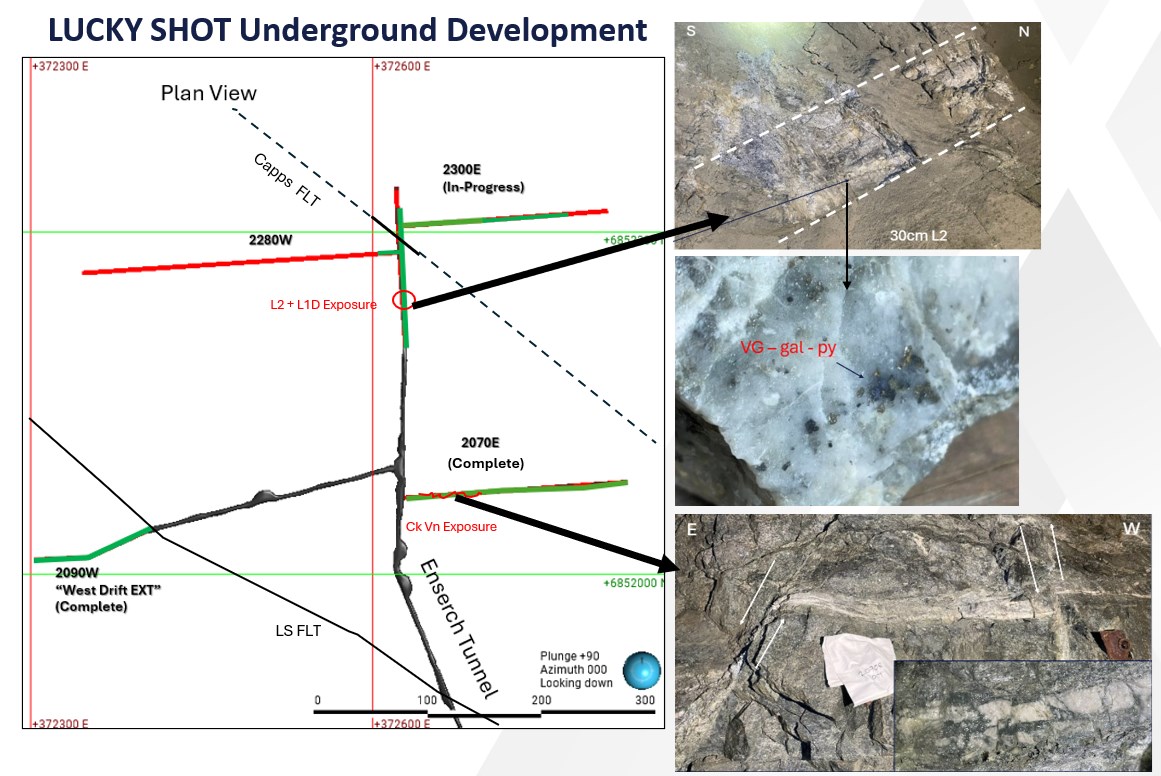
Figure 4. Plan view of underground exploration development. Green identifies completed development; red identifies planned or in-progress development. The upper photograph shows the L2/L1D exposure, with a close-up of visible mineralization at right. The lower photograph shows the CK vein exposed along 2070E. Vein and fault correlations are geological interpretations. Visible gold is qualitative and does not establish assay grade.
To view an enhanced version of this graphic, please visit:
https://images.newsfilecorp.com/files/12610/324603_f27fc6cc243fb966_005full.jpg
Phase 4 Underground Resource Definition Drilling
Since underground drilling resumed on September 16, 2026, the Company has completed 29 holes totaling approximately 2,050 meters. This update covers the underground campaign since that start date, including completed drilling from the West Drift Extension at the KM vein and subsequent drilling from the new exploration access. This release does not report any new underground assay results as all are pending and will be released as they are received, reviewed and validated.
The October 6, 2026 release described the start of KM drilling on September 16. The October 28 update subsequently reported completion of 943 meters in 16 KM holes and the start of drilling from 2070E on October 22. The current rig is now operating from the second drill station in the 2070E drift, drilling from the footwall upward into the Lucky Shot vein system (Figure 5).
The Company will mobilize a second drill rig shortly to begin drilling from the 2300E drift. The broader plan also includes drilling from 2280W as access and operating conditions allow. Drilling is planned to continue through February/March 2027. Assay results will be reported following receipt, review and validation.
After completion of the planned drilling and incorporation of validated assays, the Company intends to prepare an updated mineral resource estimate in late Q2 2027. That estimate, together with geological, engineering and other technical work, is intended to support a Feasibility Study scheduled for the second half of 2027.
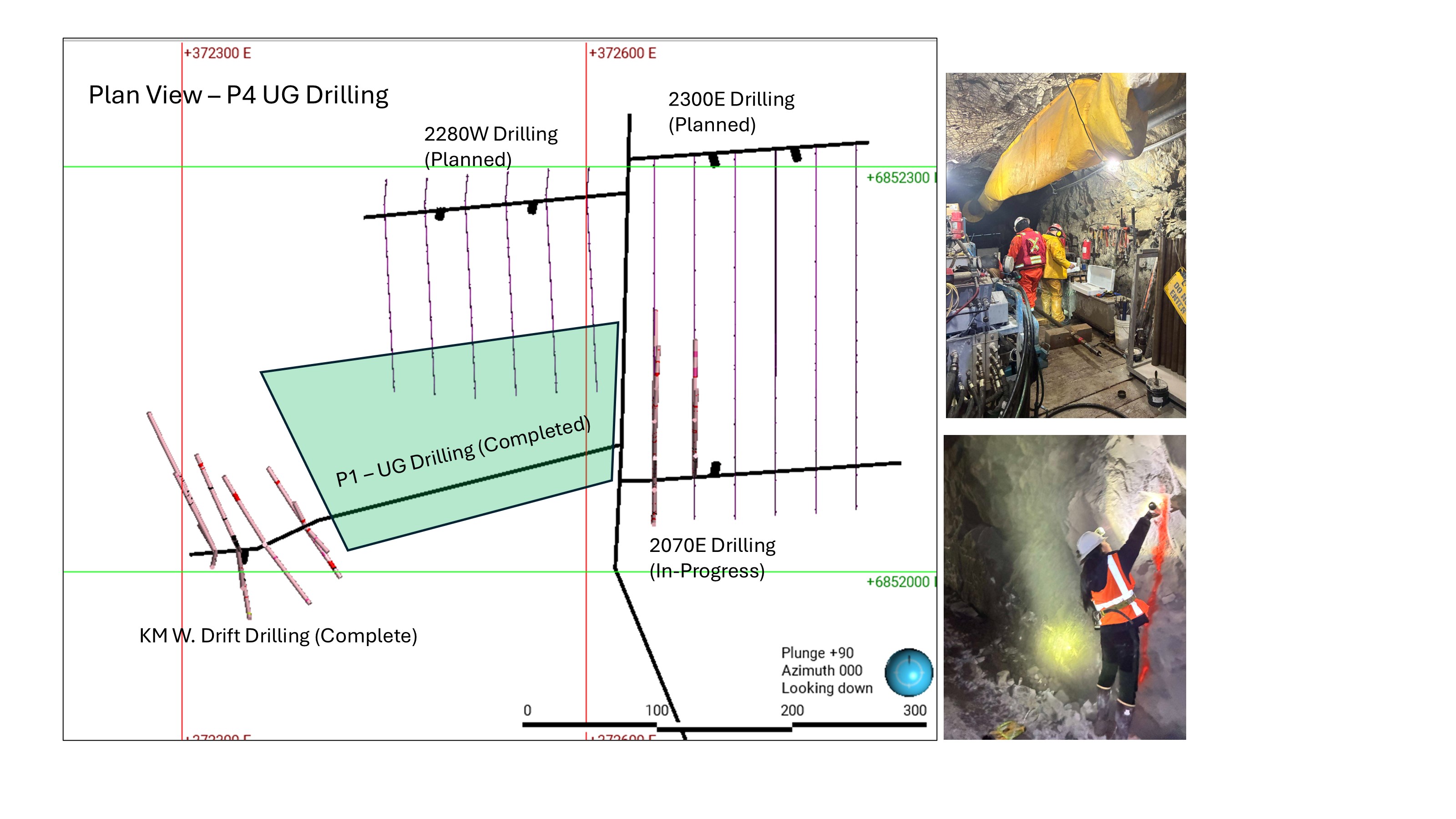
Figure 5. Plan view of Phase 4 underground drilling from the new exploration drifts. Initial Phase 1 underground drilling and the KM/West Drift Extension program are complete. Current drilling is from the second station in 2070E; drilling from 2300E and 2280W is planned. Photographs show underground drilling and geological work. Planned traces illustrate exploration targets and are not mineral resource or mineral reserve boundaries.
To view an enhanced version of this graphic, please visit:
https://images.newsfilecorp.com/files/12610/324603_f27fc6cc243fb966_006full.jpg
Conference Call and Webcast
Contango will host a conference call and webcast to discuss the Lucky Shot assay results on Thursday, November 19, 2026, at 11:00am EST / 9:00am PCT / 7:00am Alaska time. Please note the updated time zone for BC residents. Participants may join the webcast using the following call-in details: Update on Lucky Shot Assays
Cautionary Note Regarding Exploration Results
The Company cautions that drill intercept lengths reported in this release are downhole core lengths. True widths are not yet known and may be materially different from reported interval lengths. Visible-gold observations are qualitative geological observations and do not necessarily correlate with higher gold grades, mineral continuity, metallurgical performance or economic significance. Reported gold grades are based on laboratory assays.
The suggested relationship between the unassigned deeper Pad E intercepts and the correlations of underground vein and fault exposures are geological interpretations. Further mapping, drilling and sampling are required to establish geometry and continuity. Visible gold in core or underground exposures is qualitative and is not a substitute for laboratory assays. No underground assay results or representative grades for the newly exposed L2, L1D or CK material are reported in this release.
Lucky Shot is an exploration-stage property. No mineral reserves have been declared for the Lucky Shot Project, and the work described in this release is exploratory in nature. The exploration results reported in this release do not demonstrate economic viability. This release does not report a new or updated mineral resource or mineral reserve estimate. Modeled vein traces and surfaces illustrate geological interpretations and do not, by themselves, establish continuity of gold grade between drill intersections.
Quality Assurance and Quality Control
Contango's drilling and sampling programs are conducted under the supervision of the Company's Qualified Person. Drill core is systematically logged, photographed and sampled. The sampling, sample preparation, analytical and quality-control procedures for the surface assay results reported here are unchanged from those described in the Company's September 2 and October 6, 2026 news releases.
Quality assurance and quality control procedures include the regular insertion of certified reference materials, blanks and duplicate samples into the analytical stream. Mineralized drill-core intervals are sampled as whole core, with shoulder samples extending beyond mineralized zones where appropriate. Samples are sealed and transported to the laboratory under documented chain-of-custody procedures.
Sample preparation was performed by Bureau Veritas North America in Fairbanks, Alaska. Gold analyses for the samples reported in this release were completed using a two-cycle PhotonAssay™ method by Paragon Geochemical in Vancouver, British Columbia. The published lower detection limit for the two-cycle PhotonAssay method is 0.015 g/t Au and the upper detection limit is 355 g/t Au. Samples returning gold values above the upper detection limit are re-assayed using a 50-gram charge fire assay with gravimetric finish through Bureau Veritas. Samples also undergo multi-element ICP-MS analysis to quantify minor- and trace-element associations.
Qualified Person
The scientific and technical information contained in this news release has been reviewed and approved by Dave Larimer, CPG, VP Exploration for Contango, who is a Qualified Person as defined by SEC Regulation S-K 1300. Mr. Larimer is not independent of the Company.
About Contango
Contango is a NYSE American and TSX-listed mining company engaged in the exploration for and development of silver, gold and associated minerals in Alaska and British Columbia's Golden Triangle. Its Canadian assets comprise approximately 247,000 acres of mineral tenures in and around Kitsault Valley. In Alaska, Contango holds a
Additional information can be found on our web page at www.contangoore.com.
Forward-Looking Statements
This press release contains forward-looking information and forward-looking statements within the meaning of applicable securities laws ("Forward-looking Statements"). These include statements regarding Contango's plans and expectations for its properties and operations, the scope, timing and completion of underground exploration development and drilling, mobilization of a second rig, future geological interpretation, potential vein and fault correlations, the timing of an updated mineral resource estimate and Phase 5 feasibility study, and future operations at Contango mineral properties. The Forward-looking Statements regarding Contango are based on Contango's current expectations and are intended to be covered by the safe harbor for "forward-looking statements" provided by the Private Securities Litigation Reform Act of 1995. They include statements regarding future results of operations, quality and nature of the asset base, the assumptions upon which estimates are based and other expectations, beliefs, plans, objectives, assumptions, strategies or statements about future events or performance (often, but not always, using words such as "expects", "projects", "anticipates", "plans", "estimates", "intends", "believes", "ensures", "forecasts", "predicts", "proposes", "contemplates", "aims", "seeks", "continues", "potential", "positioned", "strategy", "outlook", "future", "going forward", "designed to", and similar expressions or other words of similar meaning, and the negatives thereof, or stating that certain actions, events or results "may", "might", "will", "should", "would", or "could" be taken, or that they are "possible", "probable", or "likely" to occur or be achieved). However, the absence of these words does not mean that the statements are not forward-looking.
Forward-looking Statements are based on current expectations, estimates and projections that involve a number of risks and uncertainties, which could cause actual results to differ materially from those reflected in the statements. These risks include, but are not limited to: the risks of the exploration and the mining industry (for example, operational risks in exploring for and developing mineral reserves); risks and uncertainties involving geology, ground conditions and the continuity of mineralization; laboratory turnaround times and delays in receiving final assay results; the speculative nature of the mining industry; the uncertainty of estimates and projections relating to future production, costs and expenses; the volatility of natural resources prices, including prices of gold and associated minerals; the existence and extent of commercially exploitable minerals in properties acquired by Contango or the Peak Gold JV; ability to realize the anticipated benefits of the Peak Gold JV; potential delays or changes in plans with respect to exploration or development projects or capital expenditures; the interpretation of exploration results and the estimation of mineral resources; the loss of key employees or consultants; health, safety and environmental risks; risks related to weather and other natural disasters; uncertainties as to the availability and cost of financing; Contango's inability to retain or maintain its relative ownership interest in the Peak Gold JV; inability to realize expected value from acquisitions; inability of our management team to execute its plans to meet its goals; the extent of disruptions caused by an outbreak of disease, such as the COVID-19 pandemic; and the possibility that government policies may change, political developments may occur or governmental approvals may be delayed or withheld, including as a result of presidential and congressional elections in the U.S. or the inability to obtain mining permits. Additional information on these and other factors which could affect Contango's operations or financial results are included in Contango's other reports on file with the U.S. Securities and Exchange Commission. Investors are cautioned that any Forward-looking Statements are not guarantees of future performance and actual results or developments may differ materially from the projections in the Forward-looking Statements. Forward-looking Statements are based on the estimates and opinions of management at the time the statements are made. Except as required by applicable law, Contango does not undertake any obligation to update Forward-looking Statements should circumstances or management's estimates or opinions change.
Contacts
Contango Silver & Gold Inc.
Rick Van Nieuwenhuyse
(907) 388-7770
www.contangoore.com
To view the source version of this press release, please visit https://www.newsfilecorp.com/release/324603
FAQ
AI-generated questions and answers. How Rhea-AI works. Not financial advice.