
Cyngn Accelerates Commercial Deployment of Physical AI with NVIDIA Isaac Sim
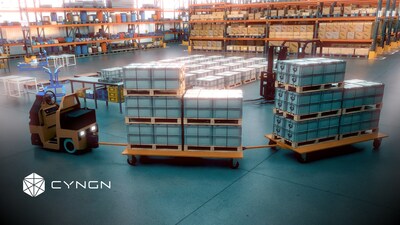
Cyngn (CYN) and NVIDIA expanded a collaboration to build a high-fidelity simulation environment using NVIDIA Isaac Sim to accelerate commercial deployment of Cyngn's autonomy and fleet-management software.
Rhea-AI Summary
Cyngn (CYN) and NVIDIA expanded a collaboration to build a high-fidelity simulation environment using NVIDIA Isaac Sim to accelerate commercial deployment of Cyngn's autonomy and fleet-management software.
The environment runs Cyngn's autonomy stack, mission tools, and telematics at scale, enables larger simulated fleets and complex scenarios, and includes a contributed industrial-vehicle dynamics model to improve real-world accuracy for development, QA, demonstrations, and early-stage training workflows.
Positive
- Built a persistent, high-fidelity simulation environment on NVIDIA Isaac Sim
- Enables larger simulated fleets and more complex operational scenarios
- Contributed a detailed industrial-vehicle dynamics model to improve simulation accuracy
Negative
- None.
Details
News Market Reaction – CYN
In the Feb 3 session, CYN gained 17.37%, reflecting a significant positive market reaction.
Data tracked by StockTitan Argus on the day of publication.
Key Figures
- Revenue
- $150,851
- Nine months ended Sep 30, 2025
- Net loss
- $17,798,600
- Nine months ended Sep 30, 2025
- Total assets
- $49,267,435
- Balance sheet as of Sep 30, 2025
- Short-term U.S. Treasuries
- $30,054,492
- Balance sheet as of Sep 30, 2025
- Cash
- $4,820,464
- Balance sheet as of Sep 30, 2025
- Total liabilities
- $10,588,062
- Balance sheet as of Sep 30, 2025
- Shelf capacity
- $300,000,000
- S-3 shelf base prospectus filed Sep 5, 2025
- U.S. patent portfolio
- 24 patents
- AI-powered autonomous vehicle technologies
Previous AI Reports
-
Notice of allowance for AI-powered autonomous driving patent, expanding portfolio.
-
Highlight of NVIDIA Isaac-based robotics collaboration and commercial AV deployments.
-
Notice of allowance for modular sensor system patent for industrial machines.
-
Grant of cloud-based autonomous vehicle operation patent and fleet management tools.
-
Addition of Kennedy Robotics AI as dealer for autonomous DriveMod Tugger vehicles.
24h Move is the share-price change in the day after each event; other market factors may also have contributed.
Key Terms
simulation environment technical
autonomous vehicle solutions technical
telematics systems technical
regression testing technical
industrial-vehicle dynamics model technical
AI-generated analysis. How Rhea-AI works. Not financial advice.




The Isaac Sim-based environment executes Cyngn's autonomy stack, mission creation tools, and telematics systems as if the vehicles were operating in a real facility. This capability supports larger simulated fleets, more complex environments, and a broader range of operational scenarios. It also enables Cyngn to accelerate QA cycles, expand regression testing, and evaluate new features earlier in development.
"Simulation is becoming a critical lever for how we bring new autonomous products to market," said Felix Singh, VP of Engineering Services at Cyngn. "By using NVIDIA Isaac Sim to run our autonomy and fleet software in realistic, full-scale environments, we can validate new forklift use cases faster, reduce development risk, and shorten the timeline from concept to commercial deployment. This capability directly supports our ability to scale into more complex applications and accelerate revenue-generating programs."
As part of the collaboration, Cyngn is contributing a detailed industrial-vehicle dynamics model into the Isaac Sim framework. This model captures the physical characteristics of heavy material-handling vehicles and is designed to improve the accuracy of simulation for real-world performance. The integration is expected to support Cyngn's long-term strategy to scale its autonomy across a wider range of vehicle platforms.
Cyngn expects to use the new environment for development, customer demonstrations, and early-stage training workflows. The company is also exploring opportunities with existing partners whose facilities are being represented inside the simulation environment.
Additional video materials demonstrating the Isaac Sim-based simulation capabilities will accompany this announcement.
About Cyngn
Cyngn develops and deploys autonomous vehicle technology for industrial organizations like manufacturers and logistics companies. The Company addresses significant challenges facing industrial organizations today, such as labor shortages and costly safety incidents.
Cyngn's DriveMod technology empowers customers to seamlessly bring self-driving technology to their operations without high upfront costs or infrastructure installations. DriveMod is currently available on Motrec MT-160 Tuggers and BYD Forklifts.
The DriveMod Tugger hauls up to 12,000 lbs, travels inside and out, and targets a typical payback period of less than 2 years. The DriveMod Forklift lifts heavy loads that use non-standard pallets and is currently available to select customers. For all terms referenced within, please refer to the Company's annual report on Form 10-K/A with the SEC filed on November 14, 2025.
Investor Contact:
Natalie Russell
Chief Financial Officer
investors@cyngn.com
Media Contact:
Luke Renner
Head of Marketing
media@cyngn.com
Where to Find Cyngn:
- Website: https://cyngn.com
- X: https://x.com/cyngn
- LinkedIn: https://www.linkedin.com/company/cyngn
- YouTube: https://www.youtube.com/@cyngnhq
Forward-Looking Statements
This press release contains forward-looking statements within the meaning of the Private Securities Litigation Reform Act of 1995, Section 27A of the Securities Act of 1933, as amended, and Section 21E of the Securities Exchange Act of 1934, as amended. Any statement that is not historical in nature is a forward-looking statement and may be identified by the use of words and phrases such as "expects," "anticipates," "believes," "will," "will likely result," "will continue," "plans to," "potential," "promising," and similar expressions. These statements are based on management's current expectations and beliefs and are subject to a number of risks, uncertainties and assumptions that could cause actual results to differ materially from those described in the forward-looking statements, including the risk factors described from time to time in the Company's reports to the Securities and Exchange Commission (SEC), including, without limitation the risk factors discussed in the Company's annual report on Form 10-K/A filed with the SEC on November 14, 2025. Readers are cautioned that it is not possible to predict or identify all the risks, uncertainties and other factors that may affect future results. No forward-looking statement can be guaranteed, and actual results may differ materially from those projected. Cyngn undertakes no obligation to publicly update any forward-looking statement, whether as a result of new information, future events, or otherwise.
 View original content to download multimedia:https://www.prnewswire.com/news-releases/cyngn-accelerates-commercial-deployment-of-physical-ai-with-nvidia-isaac-sim-302676806.html
SOURCE Cyngn
FAQ
AI-generated questions and answers. How Rhea-AI works. Not financial advice.