
Pre-Feasibility Study for Richmond Hill Delivers Strong Economics with US$2 Billion After-Tax NPV(5%) and 71% IRR
Sentiment and the balance of points
Rhea-AI Sentiment reads the wording of the document, how positive or negative its language is on a 1 to 5 scale. The balance of points shown with the takes weighs what the document actually discloses, so the two can disagree, for example when a trial that missed its main goal is described in upbeat language.
Rhea-AI Summary
Dakota Gold (DC) released a pre-feasibility study for its proposed Richmond Hill open-pit gold mine in South Dakota, along with its first reserve estimate. At US$3,500 per ounce of gold, the study estimates a US$2.0 billion after-tax net present value at a 5% discount rate, a 71% after-tax internal rate of return and a 1.4-year after-tax payback.
The study projects 1,562,000 payable gold ounces over nine years. It estimates US$538 million in initial capital costs and US$1,289 in all-in sustaining costs per payable gold ounce, including state severance tax. The first proven and probable reserves contain 2,158,000 ounces of gold and 25,421,000 ounces of silver.
Feasibility and environmental baseline work are underway. Dakota Gold plans the feasibility study for mid-2027 and targets production in 2029. Permitting is through the county and state.
How this balance works
Rhea-AI gives every point it takes from this document a weight. Minor counts 1, Moderate 3 and Major 9, so one Major point outweighs several Minor ones. The bar adds up the weights on each side, and when neither side holds more than 65% of the total the balance reads Mixed.
It reads the document as published, with the same rules for every company, and it does not look at what the market expected or at how the stock traded, so a point can be objectively good on a day the stock falls.
Rhea-AI Sentiment measures something else, the tone of the wording.
Hollow bars mark forward-looking points. How the balance works
Positive
- Major point. Forward-looking: it has not happened yet and may not happen.Base-case economics project US$2.0 billion in after-tax net present value at a 5% discount rate, a 71% after-tax internal rate of return and a 1.4-year after-tax payback, assuming US$3,500 gold and US$50.00 silver per ounce
- Moderate point. Forward-looking: it has not happened yet and may not happen.Nine-year mine plan projects 1,562,000 payable gold ounces and an annual average of 171,000 payable ounces
- Moderate pointFirst proven and probable reserves contain 2,158,000 gold ounces and 25,421,000 silver ounces at 0.561 and 6.61 grams per tonne, respectively
- Moderate point. Forward-looking: it has not happened yet and may not happen.Feasibility work has started, with the study planned for mid-2027 and production targeted for 2029
- Minor point. Forward-looking: it has not happened yet and may not happen.Base-case after-tax free cash flow averages approximately US$366 million annually in years 1–8 and totals US$2,558 million over the mine life
5 minor points
- Minor point. Forward-looking: it has not happened yet and may not happen.US$4,250-per-ounce gold scenario projects US$2,744 million in after-tax net present value at a 5% discount rate, a 94% after-tax internal rate of return and a 1.1-year after-tax payback
- Minor point. Forward-looking: it has not happened yet and may not happen.Definition drilling is underway, targeting a minimum 10% reserve increase for the feasibility study
- Minor pointMillable resources contain 3,197,000 gold ounces and 35,655,000 silver ounces in measured and indicated material, plus 2,719,000 gold ounces and 28,071,000 silver ounces in inferred material
- Minor pointHeap-leachable resources outside reserves contain 381,000 gold ounces and 5,158,000 silver ounces in measured and indicated material, plus 1,088,000 gold ounces and 8,012,000 silver ounces in inferred material
- Minor pointEnvironmental baseline studies are underway to inform future permitting requirements
Negative
- Moderate point. Forward-looking: it has not happened yet and may not happen.Initial capital costs are estimated at US$538 million, including US$84 million in contingency 98% of market cap
- Moderate point. Forward-looking: it has not happened yet and may not happen.All-in sustaining costs are estimated at US$1,289 per payable gold ounce including state severance tax, versus US$1,066 before the tax
- Moderate point. Forward-looking: it has not happened yet and may not happen.Base-case cumulative after-tax free cash flow is projected at negative US$471 million before production and negative US$170 million at the end of year 1
- Minor pointCounty and South Dakota state permitting remains ahead, with baseline studies underway
- Minor pointRichmond Hill property remains subject to an option agreement with Homestake Mining Company of California
7 minor points
- Minor point. Forward-looking: it has not happened yet and may not happen.Sustaining capital costs are estimated at US$133 million
- Minor point. Forward-looking: it has not happened yet and may not happen.Closure capital costs are estimated at US$62 million
- Minor point. Forward-looking: it has not happened yet and may not happen.US$2,750-per-ounce gold scenario lowers projected after-tax net present value to US$1,249 million at a 5% discount rate and after-tax internal rate of return to 47%, extending after-tax payback to 2.1 years
- Minor point. Forward-looking: it has not happened yet and may not happen.Lower gold recovery of 66% versus the 72.4% base case reduces projected after-tax net present value to US$1,692 million at a 5% discount rate
- Minor point. Forward-looking: it has not happened yet and may not happen.Operating cost sensitivity puts projected after-tax net present value at US$1,799 million at a 5% discount rate if operating costs rise 21% from the base case
- Minor point. Forward-looking: it has not happened yet and may not happen.Capital cost sensitivity puts projected after-tax net present value at US$1,911 million at a 5% discount rate if modeled capital costs rise 21% from the base case
- Minor pointMineral estimates include a preliminary estimated royalty rate of 3.8% averaged across the project
News Explained
Millable ounces and targeted reserve growth sit outside the heap-leach reserve case quantified by the PFS.
The separate millable-resource estimate includes measured-and-indicated and inferred gold resources; Dakota Gold describes these resources as long-term project optionality.
Definition drilling is underway to inform feasibility work, targeting inferred material in the high-recovery breccia zone that is excluded from PFS economics; Dakota Gold is targeting a minimum
Key Figures
- After-tax NPV(5%)
- $2.0 billion
- PFS base case at $3,500/oz gold
- IRR
- 71%
- PFS base case at $3,500/oz gold
- After-tax NPV(5%)
- $2.7 billion
- At a gold price of $4,250/oz
- IRR
- 94%
- At a gold price of $4,250/oz
- Proven and Probable heap-leachable gold reserves
- Approximately 2.16 million ounces
- Richmond Hill updated mineral estimate
- Life-of-mine gold production
- 1.6 million ounces over nine years
- PFS production profile
- Initial capital
- $538 million
- Includes $84 million contingency
- Life-of-mine AISC
- $1,289 per ounce
- Including State Severance Tax
Historical Context
-
Reported positive oxide metallurgical test results, including recovery data informing Richmond Hill's PFS.
-
Selected crush size and heap-leach facility, with modeled recoveries to inform the Richmond Hill PFS.
24h Move is the share-price change in the day after each event; other market factors may also have contributed.
Key Terms
S-K 1300 regulatory
net present value financial
internal rate of return financial
all-in sustaining costs financial
AI-generated analysis. How Rhea-AI works. Not financial advice.




Lead, South Dakota--(Newsfile Corp. - November 23, 2026) - Dakota Gold Corp. (NYSE American: DC) ("Dakota Gold" or the "Company") is pleased to report the results of its S-K 1300 Pre-Feasibility Study ("Report" or "PFS") for the Richmond Hill Oxide Heap Leach Gold Project ("Richmond Hill" or "Project") in South Dakota. The PFS was prepared in conjunction with a maiden mineral reserve and an updated mineral resource estimate ("mineral estimate"). The PFS highlights the potential for a profitable, open pit, gold heap leach operation at Richmond Hill.
PFS Highlights
- Strong Economics: At a base case gold price of
$3,500 per ounce, the Project has an after-tax net present value ("NPV5% ") of$2.0 billion and an internal rate of return ("IRR") of71% . At a gold price of$4,250 per ounce, the NPV5% increases to$2.7 billion , and the IRR increases to94% .
- Heap leachable Mineral Reserves and Resources (Table 4): An updated mineral estimate for Richmond Hill following a successful definition and expansion drill program includes Proven and Probable heap leachable mineral reserves grading 0.56 grams per tonne ("g/t") gold ("Au") and 6.61 g/t silver ("Ag"), containing approximately 2.16 million ounces ("Moz") of Au and 25.4 Moz of Ag. The Measured and Indicated category of the mineral resource exclusive of reserves includes 0.4 Moz Au and 5.2 Moz of Ag grading 0.32 g/t Au and 4.28 g/t Ag. The Inferred category contains 1.1 Moz of Au and 8.0 Moz of Ag grading 0.38 g/t Au and 2.74 g/t Ag.
- Millable Resources Provide Long-Term Optionality for the Project (Table 5): The Measured and Indicated category of the millable mineral resource includes 3.2 Moz Au grading 0.48 g/t Au, and the Inferred category contains 2.7 Moz of Au grading 0.43 g/t Au.
- Gold Production at Low-Cost: Life of mine production totals 1.6 million ounces of gold over nine years, with an average annual production of 171,000 ounces of gold, at a nominal design stacking rate of 41,000 tonnes per day. Initial Capital is
$538 million , including$84 million contingency, with life of mine All-in Sustaining Costs ("AISC") of$1,066 per ounce of gold before State Severance Tax and$1,289 per ounce of gold including the State Severance Tax. AISC is a non-GAAP measure; see "Non-GAAP Measures" below.
- Feasibility and Permitting Underway: Work has commenced on the Feasibility Study ("FS") planned for mid-2027 with production targeted for 2029. Permitting is through the county and state of South Dakota where the Project could generate over
$348 million in State Severance taxes over the life of the project along with hundreds of high paying jobs and other economic benefits.
- Targeting a Minimum
10% Increase in Reserves for the FS: Approximately 3,800 m of metallurgical drilling throughout the Project and 11,000 m of definition drilling in the central area to inform the FS is underway with two drills in operation. The definition drilling is targeting Inferred material conversion in the high-recovery breccia zone not included in the PFS economics, mine sequence and mineral estimate - representing further upside. (see details and disclosure for the 2026-2027 Definition Drill Program)
Jack Henris, CEO, President and Director of Dakota Gold, said, "We are pleased to share results that demonstrate Richmond Hill's potential to be a significant economic driver for South Dakota. As a South Dakotan, I am proud to see that we have an opportunity to advance a project at home that could generate more than
Shawn Campbell, Chief Financial and Development Officer of Dakota Gold, commented, "Richmond Hill combines strong project economics, competitive operating costs and relatively low initial capital intensity in a well-established U.S. mining jurisdiction. These attributes provide a strong foundation as we advance feasibility work, evaluate future construction financing opportunities, continue investing in local communities, and advance our broader portfolio of projects across the Homestake District."
Table 1: PFS key parameters
| Pre-Feasibility Key Parameters (All Currencies in US$) | |
| Key Assumptions | |
| Base Case Gold Price | |
| Base Case Silver Price | |
| Production Profile | |
| Total Tonnes Processed (Mt) | 120 |
| Strip Ratio | 1.18 |
| Heap Leach Gold Feed Grade (oz/ton) | 0.016 |
| Heap Leach Gold Feed Grade (g/t) | 0.561 |
| Mine Life (years) | 9 |
| Nominal Stacking Rate (KTPD) | 41 |
| LOM Gold Recovery (%) | |
| LOM Gold Payable (koz) | 1,562 |
| LOM Average Annual Gold Payable (koz) | 171 |
| Unit Operating Costs ($/payable oz Au) | |
| Operating Costs | |
| AISC | |
| Capital Costs | |
| Initial Capital Cost | |
| Sustaining Capital Cost | |
| Closure Capital Cost | |
Abbreviations in the table include ounces ("oz"); million tonnes ("Mt"); ounces per ton ("oz/ton"); grams per tonne ("g/t"); thousand tonnes per day ("KTPD"); thousand ounces ("koz"); life of mine ("LOM"); all-in sustaining costs ("AISC").
Table 2: PFS sensitivity to gold price, costs and recovery
Sensitivity to Gold Price (US$ where applicable)
| Gold Price (US$/oz) | (Base Case) | ||||||||
| After-Tax NPV( | |||||||||
| After-Tax IRR | |||||||||
| After-Tax Payback | 2.1 years | 1.8 years | 1.6 years | 1.4 years | 1.3 years | 1.2 years | 1.1 years | 1.0 years | 0.9 years |
Abbreviations in the table include net present value ("NPV"); internal rate of return ("IRR").
Sensitivity to Operating Costs and Capital Costs (After-Tax NPV
| Sensitivity Parameters | Base Case | - | - | - | (Base Case) | + | + | + |
| Operating Costs | ||||||||
| Capital Costs |
Sensitivity to Recovery* (After-Tax NPV
| Sensitivity Parameters | Base Case | (Base Case) | |||
| Gold Recovery |
* Recoveries above base case (
Table 3: PFS after-tax free cash flow profile - For years 1 through 8 the average after-tax free cash flow per year is ~
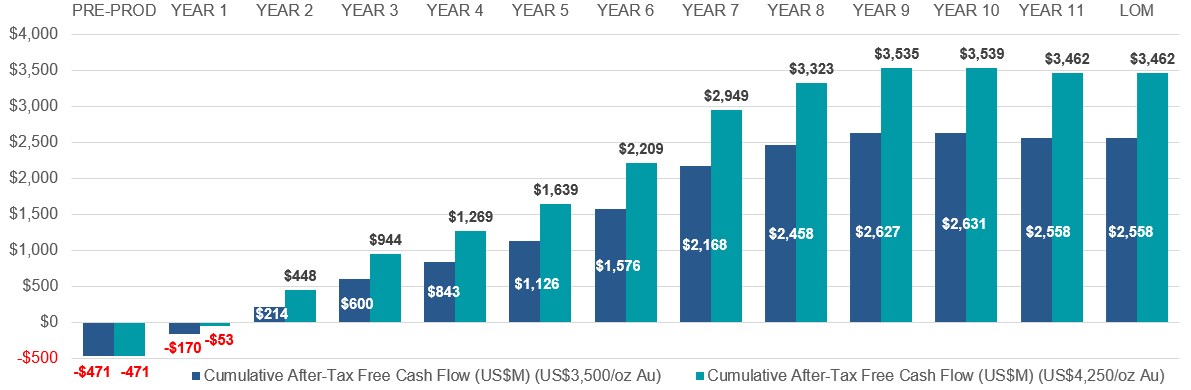
To view an enhanced version of this graphic, please visit:
https://images.newsfilecorp.com/files/8218/325309_15f5eb9d341d9a61_002full.jpg
Cumulative After-Tax Free Cash Flow Profile (US$M)
| PRE-PROD | YR 1 | YR 2 | YR 3 | YR 4 | YR 5 | YR 6 | YR 7 | YR 8 | YR 9 | YR 10 | YR 11 | LOM | |
| (US | - | - | |||||||||||
| (US | - | - |
Abbreviations in the table include pre-production ("Pre-Prod"); year ("YR").
Overview
The PFS outlines a strong foundation for future growth and mine-sequence optimization at Richmond Hill. The study is informed by a large, near-surface heap-leachable resource which has been updated concurrently with the PFS.
Table 4: Richmond Hill heap leachable reserves and resources as of November 2026
| Richmond Hill heap leachable reserves | ||||||
| Category | NSR ($/tonne) | Ktonnes | Gold (g/t) | Silver(g/t) | Gold (koz) | Silver (koz) |
| Proven | 36.57 | 57,115 | 0.613 | 7.33 | 1,126 | 13,457 |
| Probable | 30.99 | 62,482 | 0.514 | 5.96 | 1,033 | 11,964 |
| Reserves Total | 33.65 | 119,597 | 0.561 | 6.61 | 2,158 | 25,421 |
| Richmond Hill heap leachable resources | ||||||
| Category | NSR ($/tonne) | Ktonnes | Gold (g/t) | Silver(g/t) | Gold (koz) | Silver (koz) |
| Measured | 21.24 | 8,718 | 0.307 | 4.03 | 86 | 1,129 |
| Indicated | 21.03 | 28,764 | 0.319 | 4.36 | 295 | 4,029 |
| M&I Resources Total | 21.08 | 37,482 | 0.316 | 4.28 | 381 | 5,158 |
| Inferred | 25.09 | 89,731 | 0.377 | 2.74 | 1,088 | 8,012 |
Notes:
- Mineral resources reported are exclusive of reserves.
- Based on a constrained block model using drill results up to June 17, 2026, with estimation using inverse distance squared methodology.
- A gold price of
$2,900 per ounce and a silver price of$35 per ounce was used for the mineral resources. - The mineral resources are based on a net smelter return (NSR) cut-off of
$6.39 /tonne for heap leachable material. - A gold price of
$2,600 per ounce and a silver price of$30 per ounce was used for the mineral reserves. - Mineral reserves are based on net smelter return (NSR) cut-offs that vary by time period to balance mine and plant production capacities. They range from a high of
$11.00 /tonne to a low of$6.39 /tonne (internal cut-off grade). - Heap-leachable resources NSR ($/tonne) =
$81.00 x gold (g/tonne) x recovery +$0.97 x silver (g/tonne) x recovery. Heap-leachable reserves NSR ($/tonne) =$72.60 x gold (g/tonne) x recovery +$0.83 x silver (g/tonne) x recovery. Gold and silver recoveries vary by rock type, cyanide soluble amount, and sulfur content. - The NSR values account for metal recoveries, treatment charges, refining costs, and refinery payable percentages.
- The heap-leachable mineral resource consists of the oxide and transition mineralization in the mineral deposit.
- Includes a preliminary estimated royalty rate of
3.8% averaged across the project. - The mineral resources are reported in relation to a conceptual constraining pit shell to demonstrate reasonable prospects for economic extraction, as required by the definition of a mineral resource in SK-1300; mineralization lying outside of the pit shell is excluded from the mineral resources.
- The mineral reserve estimate and mineral resource estimate is also constrained by the Richmond Hill Project Boundary.
The additional milled material provides long-term optionality for the Project (see Table 5). The reserves and resources are informed by a historical database containing 56,280 gold assays from 901 drill holes totaling 92,464 meters of drilling, and an additional 62,366 gold assays from 485 drill holes totaling 92,617 meters of drilling by Dakota Gold since 2022 to expand the resource.
The Richmond Hill property remains subject to an option agreement between Dakota Gold and Homestake Mining Company of California a Barrick company.
The PFS was led by M3 Engineering and Technology Corporation (M3), SLR (formerly Forte Dynamics), NewFields, and IMC, independent engineering firms capable of delivering through Feasibility and into production as soon as 2029. Concurrently, the Company is undertaking baseline environmental studies that will inform future permitting requirements.
The S-K 1300 technical report summary for the PFS (the "Report") has been published on the Company's website and filed by the Company with the Securities and Exchange Commission on EDGAR as an exhibit to its Current Report on Form 8-K dated Monday, November 23, 2026. The Report was prepared by an independent group of Qualified Persons with M3 as the Study Manager.
Details of the PFS will be presented in a webcast conference call on Monday, November 23, 2026 at 4:45 PM Eastern Time Zone.
Webcast Conference Call Information
Date: Monday, November 23, 2026
Time: 4:45 PM Eastern Time Zone
Webcast and replay: Click Here
USA/Canada Toll Free: +1-833-752-4751
International Toll: +1-647-849-3335
About Dakota Gold Corp.
Dakota Gold is a responsible exploration and development company advancing the Richmond Hill Gold Project toward production as soon as 2029, while continuing to define and expand the high-grade underground gold resource potential at the Maitland Gold Project. Both projects are located on private land within the historic Homestake District of South Dakota, one of the most prolific gold mining regions in the United States.
Subscribe to Dakota Gold's e-mail list at www.dakotagoldcorp.com to receive the latest news and other Company updates.
Shareholder and Investor Inquiries
For more information, please contact:
Jack Henris
CEO, President and Director
Tel: +1 605-717-2540
Shawn Campbell
Chief Financial and Development Officer
Tel: +1 778-655-9638
Carling Gaze
Director of Investor Relations
Tel: +1 605-679-7429
Email: info@dakotagoldcorp.com
Qualified Persons
The Report was prepared by an independent group of Qualified Persons with M3 Engineering and Technology Corporation as the Study Manager. M3 has reviewed and approved the contents of this news release.
Forward-Looking Statements
This communication contains forward-looking statements within the meaning of Section 27A of the Securities Act of 1933, as amended, and Section 21E of the Securities Exchange Act of 1934, as amended. When used in this communication, the words "plan," "target," "anticipate," "believe," "estimate," "intend," "potential," "will" and "expect" and similar expressions are intended to identify such forward-looking statements. Any express or implied statements contained in this communication that are not statements of historical fact may be deemed to be forward-looking statements, including, without limitation: the results of the PFS, including estimated mineral reserves and resources, mine plan and life, production, recoveries, capital and operating costs, AISC, severance taxes and economic results; our expectations regarding additional drilling, metallurgy and modeling; our expectations for the improvement and growth of the mineral resources and potential for conversion of mineral resources into reserves; our expectations regarding the economics of the project; completion of a feasibility study, and/or permitting; and our overall expectation for the possibility of near-term production at the Richmond Hill project. These forward-looking statements are based on assumptions and expectations that may not be realized and are inherently subject to numerous risks and uncertainties, which could cause actual results to differ materially from these statements. These risks and uncertainties include, among others: gold and silver prices; the preliminary nature of the PFS and the risk that a feasibility study does not confirm its results or support a production decision; uncertainty in mineral reserve, mineral resource and recovery estimates, including limited cyanide-soluble and sulfur assay data; increases in capital and operating costs; delays in or failure to obtain permits; environmental, reclamation and closure liabilities; the risk that the Richmond Hill option is not exercised; the availability of financing; construction and operating risks; changes in laws, royalties and taxes; the execution and timing of our planned exploration activities; our use and evaluation of historic data; our ability to achieve our strategic goals; the state of the economy and financial markets generally and the effect on our industry; and the market for our common stock. The foregoing list is not exhaustive. For additional information regarding factors that may cause actual results to differ materially from those indicated in our forward-looking statements, we refer you to the risk factors included in Item 1A of the Company's Annual Report on Form 10-K for the fiscal year ended December 31, 2025, as updated by annual, quarterly and current reports that we file with the SEC, which are available at www.sec.gov. We caution investors not to place undue reliance on the forward-looking statements contained in this communication. These statements speak only as of the date of this communication, and we undertake no obligation to update or revise these statements, whether as a result of new information, future events or otherwise, except as may be required by law. We do not give any assurance that we will achieve our expectations.
All references to "$" in this communication are to U.S. dollars unless otherwise stated.
Cautionary Note Regarding Mineral Reserves and Mineral Resources
Mineral resources that are not mineral reserves do not have demonstrated economic viability. Inferred mineral resources have a great amount of uncertainty as to their existence and as to their economic and legal feasibility, are not included in the PFS mine plan or economic analysis, and investors should not assume that any part or all of an Inferred mineral resource exists or is economically or legally mineable.
Non-GAAP Measures
Total cash costs, AISC, NPV, IRR and payback are project-level, forward-looking estimates that are not prepared in accordance with U.S. GAAP and may not be comparable to similarly titled measures of other companies. AISC is calculated as AISC is calculated as Total Cash Costs, plus sustaining capital expenditures, sustaining lease payments, applicable corporate and site-level general and administrative expenses, and estimated sustaining reclamation, rehabilitation and closure costs, less applicable by-product credits. Royalties and State Severance Taxes are included in the calculation to the extent attributable to the Project's production and not otherwise reflected in Total Cash Costs. Initial development capital expenditures, expansion capital expenditures and other non-sustaining capital expenditures are excluded from AISC. The calculation of AISC reflects management's methodology and assumptions and may differ from the methodology used by other companies.
2026-2027 Definition Drill Program Details and Disclosure
The 2026-2027 Definition Drill Program includes approximately 11,000 meters in 123 holes and is designed to test the potential to convert Inferred Mineral Resources within and adjacent to the PFS pit to Measured and Indicated (M&I"). The Definition Drill Program is targeting a minimum
Appendix
Table 5: Richmond Hill millable resources as of November 2026
| Resource Category | NSR ($/tonne) | Ktonnes | Gold (g/t) | Silver (g/t) | Gold (koz) | Silver (koz) |
| Measured Total | 43.75 | 84,181 | 0.538 | 5.42 | 1,457 | 14,661 |
| Indicated Total | 35.78 | 125,298 | 0.432 | 5.21 | 1,740 | 20,994 |
| M&I Total | 38.99 | 209,479 | 0.475 | 5.29 | 3,197 | 35,655 |
| Inferred Total | 34.69 | 198,948 | 0.425 | 4.39 | 2,719 | 28,071 |
Mineral resources are based on a constrained block model using drill results up to June 17, 2026 using an inverse distance squared methodology and the following assumptions:
- A gold price of
$2900 per ounce and a silver price of$35 per ounce was used for the mineral resource. - Mineral resources are based on a net smelter return (NSR) cut-off of
$12.22 /tonne for mill material. - Millable resources NSR ($/tonne) =
$77.55 x gold (g/tonne) x recovery +$0.92 x silver (g/tonne) x recovery. Gold and silver recoveries are estimated at85% for both metals. - The NSR values account for metal recoveries, treatment charges, refining costs, and refinery payable percentages.
- The millable mineral resource consist of the sulfide portion of the mineral deposit.
- Includes a preliminary estimated royalty rate of
3.8% averaged across the project. - The mineral resources are reported in relation to a conceptual constraining pit shell to demonstrate reasonable prospects for economic extraction, as required by the definition of a mineral resource in SK-1300; mineralization lying outside of the pit shell is excluded from the mineral resources.
- The mineral resource estimate is also constrained by the Richmond Hill Project Boundary.
Table 6: Richmond Hill combined heap leachable and millable resources inclusive of reserves as of November 2026
| Resource Category | NSR ($/tonne) | Ktonnes | Gold (g/t) | Silver (g/t) | Gold (koz) | Silver (koz) |
| Measured Total | 41.34 | 150,014 | 0.549 | 6.17 | 2,669 | 29,248 |
| Indicated Total | 33.48 | 216,544 | 0.446 | 5.14 | 3,068 | 36,986 |
| M&I Total | 36.70 | 366,558 | 0.480 | 5.49 | 5,737 | 66,234 |
| Inferred Total | 31.70 | 288,680 | 0.411 | 3.77 | 3,807 | 36,083 |
Mineral resources are based on a constrained block model using drill results up to June 17, 2026 using an inverse distance squared methodology and the following assumptions:
- A gold price of
$2900 per ounce and a silver price of$35 per ounce was used for the mineral resource. - The mineral resources are based on a net smelter return (NSR) cut-off of
$6.39 /tonne for heap leachable material and a NSR cut-off of$12.22 /tonne for mill material. - Heap-leachable resources NSR ($/tonne) =
$81.00 x gold (g/tonne) x recovery +$0.97 x silver (g/tonne) x recovery. Gold and silver recoveries vary by rock type, cyanide soluble amount, and sulfur content for heap-leachable mineral resources. - Millable resources NSR ($/tonne) =
$77.55 x gold (g/tonne) x recovery +$0.92 x silver (g/tonne) x recovery. Gold and silver recoveries are estimated at85% for both metals for millable mineral resources. - The NSR values account for metal recoveries, treatment charges, refining costs, and refinery payable percentages.
- Includes a preliminary estimated royalty rate of
3.8% averaged across the project. - The mineral resources are reported in relation to a conceptual constraining pit shell to demonstrate reasonable prospects for economic extraction, as required by the definition of a mineral resource in SK-1300; mineralization lying outside of the pit shell is excluded from the mineral resource.
- The mineral resource estimate is also constrained by the Richmond Hill Project Boundary.

To view the source version of this press release, please visit https://www.newsfilecorp.com/release/325309
FAQ
AI-generated questions and answers. How Rhea-AI works. Not financial advice.