
Ginkgo Bioworks' Autonomous Laboratory Driven by OpenAI's GPT-5 Achieves 40% Improvement Over State-of-the-Art Scientific Benchmark
Ginkgo Bioworks (NYSE: DNA) and OpenAI report an autonomous laboratory using GPT-5 that cut cell-free protein synthesis reaction costs by 40% versus prior state of the art, producing sfGFP at $422 per gram versus $698 per gram.
Rhea-AI Summary
Ginkgo Bioworks (NYSE: DNA) and OpenAI report an autonomous laboratory using GPT-5 that cut cell-free protein synthesis reaction costs by 40% versus prior state of the art, producing sfGFP at $422 per gram versus $698 per gram. The system ran 36,000 reaction compositions across six iterative cycles and generated ~150,000 data points.
The collaborative workflow combined GPT-5 reasoning, Ginkgo's cloud laboratory infrastructure, validation via a Pydantic model, and limited human oversight; the AI-improved reagent mix is now commercially available.
Positive
- Reaction cost reduced by 40% to $422 per gram
- Executed 36,000 reaction compositions across six cycles
- Generated ~150,000 experimental data points
- Pydantic validation model to prevent invalid experiments
- AI-improved reagent mix now commercially available
Negative
- Human role still required for reagent preparation and oversight
- Results limited to stated experimental conditions and benchmark protein
- Commercialization scope and revenue impact not quantified
Details
News Market Reaction – DNA
In the Feb 5 session, DNA gained 0.60%, reflecting a mild positive market reaction.
Data tracked by StockTitan Argus on the day of publication.
Key Figures
- Cost reduction
- 40%
- Reduction in cell-free protein synthesis reaction costs vs state of the art
- Experiments run
- 36,000
- Experimental conditions across six iterative cycles in autonomous lab
- Experiment cycles
- 6
- Six rounds of experiments over six months
- Production cost
- $422 per gram
- Total reaction component cost for sfGFP benchmark protein
- Prior benchmark cost
- $698 per gram
- Previously reported state-of-the-art reaction cost for sfGFP
- Plates run
- 580
- More than 580 384-well plates executed by autonomous lab
- Data points
- 150,000
- Nearly 150,000 experimental data points generated
- Benchmark improvement
- 40%
- Improvement over state-of-the-art scientific benchmark cited in headline
Previous AI Reports
-
Strategic AI-driven lab-in-the-loop workflow partnership for drug discovery.
-
Launch of Ginkgo Datapoints to supply large biological datasets for AI training.
-
Grant to develop AI-enabled forecasting tools for measles outbreaks.
24h Move is the share-price change in the day after each event; other market factors may also have contributed.
Key Terms
cell-free protein synthesis medical
reconfigurable automation carts technical
catalyst automation software technical
superfolder green fluorescent protein medical
sfGFP medical
384-well plates technical
pydantic model technical
large language model technical
AI-generated analysis. How Rhea-AI works. Not financial advice.




- Research conducted in collaboration with OpenAI using Ginkgo's cloud laboratory
- Preprint describes how GPT-5-driven autonomous lab significantly reduced reaction costs in cell-free protein synthesis
- GPT-5-driven autonomous lab executed over 36,000 experiments
- Ginkgo now selling the AI-improved reaction mix in its reagents store, showing commercial potential of AI-driven science
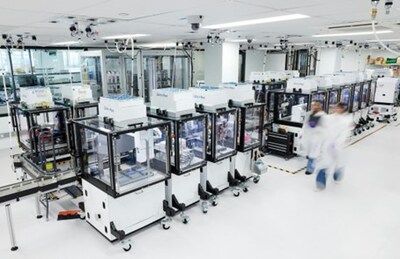
The study represents a real-world scientific application of Ginkgo's autonomous lab. The collaborators combined OpenAI's GPT-5 reasoning model with Ginkgo's cloud laboratory infrastructure, built from its reconfigurable automation carts (RAC) technology and Catalyst automation software, to design, execute, and analyze experiments in an iterative, closed-loop workflow. GPT-5 was given internet access, a computer with data analysis packages, experimental (meta)data from prior iterations, and a preprint describing state of the art, and was able to operate like an experimental scientist – designing experiments, analyzing results, and refining its approach in response. In six rounds of experiments over the course of six months, it was able to design lower cost cell-free protein synthesis reaction compositions than had been shown in the scientific literature previously.
"By pairing a frontier large language model with an autonomous lab, we found reaction compositions that are notably cheaper than prior state of the art," said Reshma Shetty, co-founder of Ginkgo Bioworks and co-author of the study. "We expect more and more experiments to be run on autonomous labs where reagent and consumables costs dominate the cost of an experiment. Lower cost reagents for protein production enable more data generation and thus more scientific progress per dollar spent."
The autonomous lab achieved production of a standard benchmark protein, superfolder green fluorescent protein (sfGFP), at
"At OpenAI, this was the first time we were able to interface a frontier model with an autonomous lab to carry out experimentation at a very large scale," said Joy Jiao, life sciences research lead at OpenAI and co-corresponding author of the study. "This success points to how AI systems can augment the experimental workflow, contributing to hypothesis generation, testing, and refinement based on real-world data."
The autonomous lab executed more than 580 384-well plates, tested 36,000 reaction compositions, and generated nearly 150,000 experimental data points. Human involvement was primarily limited to reagent preparation, loading and unloading and system oversight, while experimental design, execution data interpretation, and hypothesis generation were handled by the GPT-5-driven autonomous lab. Notably, the model also proposed and prioritized new reagents to test, some of which independently anticipated findings from published research it had not been given access to.
To preclude the AI from proposing impractical, invalid, or hallucinatory experiments, every design was validated against a Pydantic model before execution, including checking plate layout, standards, controls, replication, reagent availability, and volume constraints. Only experiments that passed validation were eligible to run. Additional scoring prioritized scientific rigor and consideration of prior results. GPT-5 generated human-readable lab notebook entries documenting its analysis, observations, and rationale, providing transparency into its reasoning.
"This is AI doing real experimental science: designing experiments, running them, and learning from the results," said Jason Kelly, co-founder and CEO of Ginkgo Bioworks. "AI combined with autonomous labs is needed to keep
The Pydantic model is being released open source and the AI-improved cell-free reaction mix can be ordered by the scientific community at https://reagents.ginkgo.bio/
About the Preprint
The findings are described in a scientific preprint that has not yet undergone peer review. The full manuscript, "Using a GPT-5-driven autonomous lab to optimize the cost and titer of cell-free protein synthesis," is available on OpenAI's website and will soon be available on bioRxiv.
About Ginkgo Bioworks
Ginkgo Bioworks builds the tools that make biology easier to engineer for everyone. The company offers autonomous laboratories that replace manual laboratory work with robotics in the lab, greatly improving the productivity of scientists. Ginkgo's in-house autonomous lab is also available as a "cloud lab" through our Datapoints and Solutions contract research services. For more information, visit ginkgobioworks.com and ginkgobiosecurity.com, read our blog, or follow us on social media channels such as X (@Ginkgo and @Ginkgo_Biosec), Instagram (@GinkgoBioworks), Threads (@GinkgoBioworks), or LinkedIn.
Forward-Looking Statements of Ginkgo Bioworks
This press release contains certain forward-looking statements within the meaning of the federal securities laws, including statements regarding the capabilities and potential success of Ginkgo's autonomous laboratories. These forward-looking statements generally are identified by the words "believe," "can," "project," "potential," "expect," "anticipate," "estimate," "intend," "strategy," "future," "opportunity," "plan," "may," "should," "will," "would," "will be," "will continue," "will likely result," and similar expressions. Forward-looking statements are predictions, projections and other statements about future events that are based on current expectations and assumptions and, as a result, are subject to risks and uncertainties. Many factors could cause actual future events to differ materially from the forward-looking statements in this press release, including but not limited to: (i) our ability to realize near-term and long-term cost savings associated with our site consolidation plans, including the ability to terminate leases or find sub-lease tenants for unused facilities, (ii) volatility in the price of Ginkgo's securities due to a variety of factors, including changes in the competitive and highly regulated industries in which Ginkgo operates and plans to operate, variations in performance across competitors, and changes in laws and regulations affecting Ginkgo's business, (iii) the ability to implement business plans, forecasts, and other expectations, and to identify and realize additional business opportunities, including with respect to our solutions and tools offerings, (iv) the risk of downturns in demand for products using synthetic biology, (v) the uncertainty regarding the demand for passive monitoring programs and biosecurity services, (vi) changes to the biosecurity industry, including due to advancements in technology, emerging competition and evolution in industry demands, standards and regulations, (vii) the outcome of any pending or potential legal proceedings against Ginkgo, (viii) our ability to realize the expected benefits from and the success of our Foundry platform programs and Codebase assets, (ix) our ability to successfully develop engineered cells, bioprocesses, data packages or other deliverables, (x) the product development, production or manufacturing success of our customers, (xi) our exposure to the volatility and liquidity risks inherent in holding equity interests in other operating companies and other non-cash consideration we may receive for our services, (xii) the potential negative impact on our business of our restructuring or the failure to realize the anticipated savings associated therewith and (xiii) the uncertainty regarding government budgetary priorities and funding allocated to government agencies. The foregoing list of factors is not exhaustive. You should carefully consider the foregoing factors and the other risks and uncertainties described in the "Risk Factors" section of Ginkgo's annual report on Form 10-K filed with the
Contacts
Ginkgo Bioworks investor contact:
investors@ginkgobioworks.com
Ginkgo Bioworks media contact:
press@ginkgobioworks.com
 View original content to download multimedia:https://www.prnewswire.com/news-releases/ginkgo-bioworks-autonomous-laboratory-driven-by-openais-gpt-5-achieves-40-improvement-over-state-of-the-art-scientific-benchmark-302680619.html
SOURCE Ginkgo Bioworks
FAQ
AI-generated questions and answers. How Rhea-AI works. Not financial advice.