
Eminent Hits 57.9 m @ 0.3 g/t Au of Oxide Gold on the Otis Fault, Ending in 3.0 m @ 2.1 g/t Au
Drilling at Otis and Little Humboldt defines a northeast‑deepening oxide gold trend, guiding Eminent Gold’s next phase of core testing.
Rhea-AI Summary
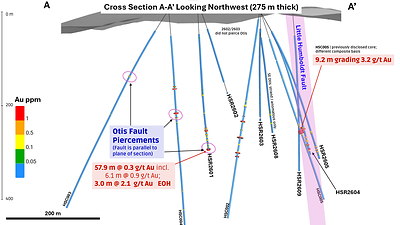
Eminent Gold (EMGDF) reported first reverse circulation assay results from the Otis target at its 100%-owned Hot Springs Range Project in Nevada. Key hole HSR2601 intersected 57.9 m @ 0.3 g/t Au oxide mineralization, including 6.1 m @ 0.9 g/t Au, and ended in 3.0 m @ 2.1 g/t Au at the technical limit of the RC rig, with plans to re-enter the hole using core drilling.
Additional RC holes at the Little Humboldt target returned up to 35.0 m @ 0.3 g/t Au, including 3.0 m @ 1.1 g/t Au in HSR2604, plus shorter intercepts in HSR2605 and HSR2606. Mineralization, clay alteration and pathfinder elements strengthen to the northeast and at depth along the Otis corridor, outlining a larger untested target for planned deeper core drilling. Several other holes were anomalous only or did not fully test their intended structures. QA/QC results for 1,675 samples were reviewed by the Qualified Person and deemed acceptable.
Positive
- HSR2601: 57.9 m @ 0.3 g/t Au, incl. 3.0 m @ 2.1 g/t Au, ending in mineralization
- HSR2604 (Little Humboldt): 35.0 m @ 0.3 g/t Au, incl. 3.0 m @ 1.1 g/t Au
- Mineralization and pathfinders strengthen northeast and at depth, defining a larger untested target
- Qualified Person reviewed 1,675 samples with QA/QC results considered acceptable for disclosure
Negative
- Several holes (HSR2602, HSR2603, HSR2607–HSR2609) were anomalous only or did not fully test their targets
- Reported intercept lengths are downhole only; true widths remain unknown
AI-generated analysis. How Rhea-AI works. Not financial advice.




Eminent's RC program was designed to expand on the successful initial program at Otis and to build on what was discovered in the previous core drilling program. The RC program was successful in expanding the widths of mineralization: Hole HSR2601 returned 57.9 m @ 0.3 g/t Au, including 6.1 m @ 0.9 g/t Au, which is the thickest width yet encountered. The hole was terminated in mineralization — 3.0 m @ 2.1 g/t Au was encountered at the bottom limit of the RC rig's capabilities. The Company will re‑enter the hole with core in its next program.
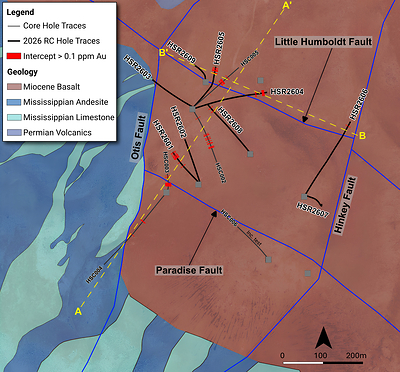
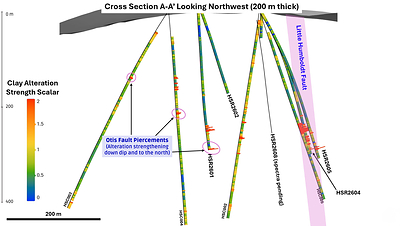
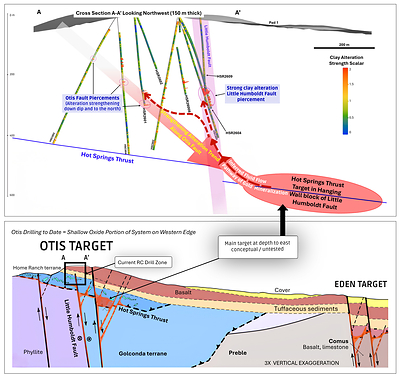
The program was also designed to determine the primary direction in which the mineralization is trending and the vector along which it is strengthening. The Company discovered that the mineralization trends NE along the Otis corridor and strengthens in that direction, and at depth. Together, these results frame a larger, still‑untested target for planned core drilling beneath and northeast of the current extent of drilling.
Highlights
- HSR2601 (Otis): 57.9 m @ 0.3 g/t Au, including 6.1 m @ 0.9 g/t Au, ending in 3.0 m @ 2.1 g/t Au (see Figure 2)
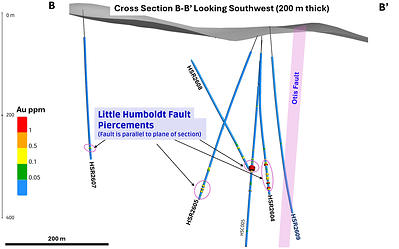
- HSR2604 (Little Humboldt, partial pierce): 35.0 m @ 0.3 g/t Au, including 3.0 m @ 1.1 g/t Au (see Figure 4)
- HSR2605 (Little Humboldt): 15.2 m @ 0.3 g/t Au, including 3.0 m @ 0.4 g/t Au and 3.0 m @ 0.5 g/t Au (see Figure 4)
- HSR2606 (Little Humboldt): 4.6 m @ 0.2 g/t Au (see Figure 1)
- Clay alteration and pathfinder elements (especially arsenic) strengthen northeast and deeper, framing a larger untested target for planned core (see Figures 3, and 5)
Dan McCoy, President & CEO, commented:
"We are very pleased to see the increased widths of the mineralized envelopes at Otis and to see a vector developing to the NE and at depth, showing us the direction we need to go with our ensuing core program, which we will use RC pre‑collars for. We are actively drilling at Otis and ready to drill our Eden target in the eastern portion of Hot Springs Range, as well as our Celts property, anticipated this fall."
Vice President of Exploration, Justin Milliard states:
"We are encouraged by our results to date,
Table 1. Significant intercepts
(0.1 g/t Au cut-off; limited internal dilution)
|
Fault - Hole ID |
From (m) |
To (m) |
Width (m) |
Grade (g/t) |
|
Otis - Hole HSR2601 |
300.2 |
358.1 |
57.9 |
0.3 |
|
including |
300.2 |
320.0 |
19.8 |
0.5 |
|
including |
301.8 |
312.4 |
10.7 |
0.7 |
|
including |
306.3 |
312.4 |
6.1 |
0.9 |
|
and |
355.1 |
358.1 |
3.0 |
2.1 |
|
Little |
315.5 |
350.5 |
35 |
0.3 |
|
incl. |
333.8 |
336.8 |
3 |
0.8 |
|
and |
344.4 |
350.5 |
6.1 |
0.7 |
|
incl. |
344.4 |
347.4 |
3 |
1.1 |
|
|
|
|
|
|
|
Little |
365.8 |
381.0 |
15.2 |
0.3 |
|
incl. |
365.8 |
368.8 |
3.0 |
0.4 |
|
and |
378.0 |
381.0 |
3.0 |
0.5 |
|
|
|
|
|
|
|
Little |
355.1 |
359.7 |
4.6 |
0.2 |
Holes not in Table 1
- HSR2602 — void; did not fully test Otis. Anomalous only (max 0.034 g/t Au).
- HSR2603 — footwall; did not pierce Otis. Anomalous only (max 0.097 g/t Au).
- HSR2607 — Hinkey Fault. Anomalous only (peak 0.066 g/t Au).
- HSR2608 — SE Otis strand. Anomalous only (peak 0.32 g/t Au); two 0.1 g/t Au composites of 3.0 m @ 0.16 g/t Au (291.1–294.1 m) and 3.0 m @ 0.24 g/t Au (313.9–317.0 m).
- HSR2609 — stopped short of target. Anomalous only (peak 0.077 g/t Au).
HSC005 is previously disclosed Phase 1 core (Jan. 6, 2026), not this batch, and was not re‑assayed.
About the Hot Springs Range Project
HSRP is a 4,311-hectare land package about 15 km northwest of
Qualified Person
The scientific and technical information in this news release has been reviewed and approved by Justin B. Milliard, P.Geo., Vice President of Exploration of the Company and a non-independent Qualified Person under NI 43-101.
RC chips were collected as continuous 5 ft (1.52 m) intervals at the rig under Company supervision. Each interval was split at the rig with a rotary splitter; the sample split was bagged and shipped directly to MSALABS,
Composites use a 0.1 g/t Au cut-off and allow up to two consecutive below-cut-off samples (each ≤ one sample interval of 5 ft / 1.52 m), with trailing dilution trimmed. Reported intercept lengths are downhole; true widths are unknown.
ON BEHALF OF THE BOARD OF DIRECTORS
Website: www.eminentgoldcorp.com
X: @eminent_gold
LinkedIn
Instagram
About Eminent Gold
Eminent Gold is a gold exploration company focused on creating shareholder value through the exploration and discovery of world-class gold deposits in Nevada. Its multidisciplinary team has had multiple successes in gold discoveries and brings expertise and new ideas to the Great Basin. The Company's exploration assets in the Great Basin include: Hot Springs Range, Celts and Gilbert South.
Neither TSX Venture Exchange nor its Regulation Services Provider (as that term is defined in the policies of the TSX Venture Exchange) accepts responsibility for the adequacy or accuracy of this release.
This news release contains certain "forward-looking statements" and "forward-looking information" within the meaning of applicable Canadian securities laws. Forward-looking statements are frequently characterized by words such as "plan", "expect", "project", "intend", "believe", "anticipate", "estimate", "may", "will", "could" and other similar words, or statements that certain events or conditions "may", "will" or "could" occur.
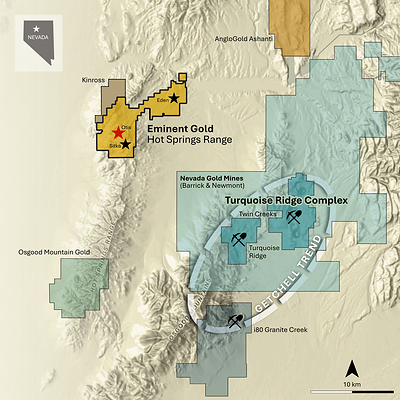
Forward-looking statements in this release include, but are not limited to, statements regarding the timing and commencement of drilling, mobilization of the drill rig, the planned scope and objectives of the drill program, the interpretation of geological features and mineralized systems, the interpreted relationship among pathfinder elements, clay alteration and gold, northeast / east-northeast vectoring based on clay alteration and pathfinder elements, plans to core-test a large conceptual Turquoise Ridge–analogue target beneath and northeast of the current oxide window, the interpreted strike length, continuity, grade at depth and up-dip extent of mineralization, and the Company's exploration plans for its Nevada portfolio including Eden. Any comparison to Turquoise Ridge, Twin Creeks or the Getchell Trend is conceptual; mineralization on adjacent properties is not necessarily indicative of mineralization at HSRP.
These forward-looking statements are based on the opinions and estimates of management as of the date of this news release and are subject to a variety of known and unknown risks, uncertainties and other factors that could cause actual events or results to differ materially from those projected in the forward-looking statements. Such risks include, but are not limited to, exploration and drilling risks, contractor availability and performance, changes in project parameters, geological interpretations, commodity price fluctuations, and general economic, market and business conditions. Although the Company believes that the expectations reflected in the forward-looking statements are reasonable, it cannot guarantee future results, levels of activity, performance or achievements.
Readers are cautioned not to place undue reliance on forward-looking statements. The Company does not undertake any obligation to update or revise any forward-looking statements, whether as a result of new information, future events or otherwise, except as required by applicable securities laws.

 View original content to download multimedia:https://www.prnewswire.com/news-releases/eminent-hits-57-9-m--0-3-gt-au-of-oxide-gold-on-the-otis-fault-ending-in-3-0-m--2-1-gt-au-302881398.html
SOURCE Eminent Gold Corp.
FAQ
AI-generated questions and answers. How Rhea-AI works. Not financial advice.
What follow-up drilling is planned after these Otis and Little Humboldt results?
The company plans to re-enter Hole HSR2601 with core drilling, as it ended in plus-gram oxide mineralization at 3.0 m @ 2.1 g/t Au. The next phase will follow the northeast-trending vector on the Otis structural corridor with deeper core tests. The company also stated it is actively drilling at Otis and is preparing to drill the Eden target in the eastern portion of Hot Springs Range and the Celts property, anticipated in the fall.
How were samples collected and analyzed for the HSR2601–HSR2609 drill holes?
Reverse circulation chips were collected as continuous 5 ft (1.52 m) intervals under company supervision, split at the rig with a rotary splitter, bagged and shipped to MSALABS in Elko, Nevada for preparation and analysis. Gold was assayed by the CPA-Au1 method with a detection limit of 0.015 g/t Au. Certified reference materials, blanks and field duplicates were inserted, with approximate insertion rates of 7.8% standards, 2.0% blanks and 2.3% field duplicates relative to 1,675 primary samples.
How was oxide gold and alteration identified in these drill results?
Oxide gold was defined based on visual identification of iron oxide (including goethite) in the RC chips, and where gold occurs, sulfides were not observed. Arsenic and other pathfinder elements were measured using portable X-ray fluorescence (pXRF). Clay alteration was characterized using Terracore SWIR hyperspectral scanning of the chips. These observations, together with geochemistry, helped define the northeast-deepening mineralized target.
What compositing rules were applied to report the gold intercepts?
Composites use a 0.1 g/t Au cut-off and allow up to two consecutive below-cut-off samples, each no longer than one 5 ft (1.52 m) interval. Trailing dilution is trimmed. All reported intercept lengths are downhole and true widths are not known at this stage.