
Celts Age Date Points to Arthur-Style Gold System; Company Expands Claims Ahead of Drilling
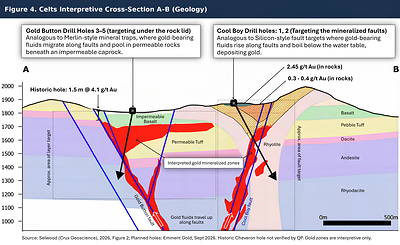
The planned program assigns two holes to the Cool Boy fault and three to layer-hosted targets near the Gold Button Mine.
Sentiment and the balance of points
Rhea-AI Sentiment reads the wording of the document, how positive or negative its language is on a 1 to 5 scale. The balance of points shown with the takes weighs what the document actually discloses, so the two can disagree, for example when a trial that missed its main goal is described in upbeat language.
Rhea-AI Summary
Eminent Gold (EMGDF) more than doubled its Celts claim package to 1,020 hectares ahead of its first planned drill program.
An alunite sample returned an age of 11.73 ± 0.12 million years, matching the reported age of gold mineralization at Silicon within AngloGold Ashanti’s Arthur Project. The date is preliminary and unpublished, with the analytical method pending a formal laboratory report. Eminent considers the age and mapped fault structures a basis for testing similar target styles; mineralization at Arthur is not necessarily indicative of Celts.
New surface samples outside historic dumps returned up to 1.5 g/t gold. Eminent plans five holes totaling approximately 2,500 metres to test fault-hosted and layer-hosted targets. The first two holes are permitted; the remaining three require permit approval and financing.
How this balance works
Rhea-AI gives every point it takes from this document a weight. Minor counts 1, Moderate 3 and Major 9, so one Major point outweighs several Minor ones. The bar adds up the weights on each side, and when neither side holds more than 65% of the total the balance reads Mixed.
It reads the document as published, with the same rules for every company, and it does not look at what the market expected or at how the stock traded, so a point can be objectively good on a day the stock falls.
Rhea-AI Sentiment measures something else, the tone of the wording.
Hollow bars mark forward-looking points. How the balance works
Positive
- Moderate pointCelts claims more than doubled to 1,020 hectares ahead of the first drill program.
- Minor pointPreliminary alunite age of 11.73 ± 0.12 million years supports Eminent’s comparison with Silicon mineralization.
- Minor pointStructural mapping identified a down-dropped fault block considered favorable for gold mineralization.
- Minor pointNew surface samples outside historic dumps returned up to 1.5 g/t gold.
- Minor point. Forward-looking: it has not happened yet and may not happen.Five holes totaling approximately 2,500 metres are planned to test fault-hosted and layer-hosted targets.
- Minor pointFirst two drill holes are already permitted.
Negative
- Minor pointThree additional drill holes remain subject to permit approval and financing.
- Minor pointAlunite age is preliminary, unpublished and verbally reported; the analytical method awaits the formal laboratory report.
- Minor pointArthur mineralization is not necessarily indicative of mineralization at Celts.
- Minor pointSelective rock-chip samples may not represent average grades or continuity of mineralization.
AI-generated analysis. How Rhea-AI works. Not financial advice.




Highlights
- Age date of 11.73 million years matches the age of gold mineralization at AngloGold Ashanti's Silicon deposit (part of the Arthur Project).
- Structural setting at Celts is consistent with the style that hosts large, bulk-mineable gold systems at the Arthur Project.
- Mapping has identified priority fault targets; claims more than doubled to 1,020 hectares ahead of drilling.
- Five-hole drill program planned to test both fault-hosted (Silicon-style) and layer-hosted (Merlin-style) targets.
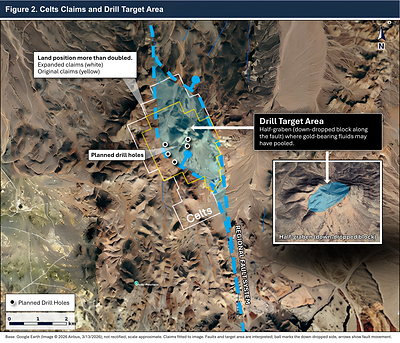
The Company has received surface rock samples up to 1.5 g/t gold from a new area away from the historic mines and completed mapping and structural work that highlights strong potential for mineralization (Figure 2). As a result, the Company has more than doubled its claim package to 1,020 hectares ahead of its first drill program. Five holes are planned to test two target styles similar to those at the Arthur Project: fault-hosted targets like Silicon and layer-hosted targets like Merlin.
Dan McCoy, PhD, President and CEO, stated:
"As we enter an exciting and potentially transformational phase of advanced discovery drilling at HSRP, we are thrilled to have advanced Celts to drill-ready status, positioning us for the opportunity to make a second major gold discovery in
Justin Milliard, PhD, Vice President of Exploration, commented:
"The age dating is a key technical result. It shows Celts was active during the same event that formed the major gold system at the Arthur Project. Combined with the structural opening we have mapped along a major regional fault, this gives us a stronger geological basis to test both the fault-hosted and layer-hosted targets with our upcoming drill program."
Age Dating Results
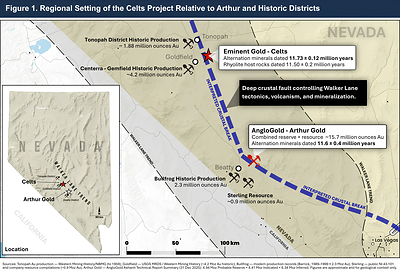
A sample of alunite (a mineral that forms during gold-related hydrothermal activity) returned an age of 11.73 ± 0.12 million years. This matches the age of the host volcanic rocks on the property and the age of gold mineralization at Silicon (part of the Arthur Project). It is significantly younger than the gold systems at
Mapping and Structural Results
Mapping shows that the historic Gold Button Mine sits on a bend in a major northwest-trending fault. Stress from that bend appears to have been transferred to the north-south Cool Boy fault, which the Company identified in earlier geophysical work. This bend created an opening in the rocks (a half-graben — a down-dropped block where fluids can collect) that is considered a favorable setting for gold mineralization (Figure 2). This structural style developed during the same period of tectonic activity that formed the Arthur Project.
Rock Sample Results
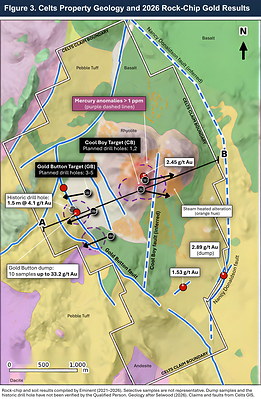
The Company previously reported high-grade samples (up to 33 g/t gold) from the historic Gold Button mine dump. Those samples were collected by a previous operator from dump material and have not been verified by the Company. New sampling by Eminent has returned gold values up to 1.5 g/t from areas outside the historic dumps, including along the Cool Boy fault and in a zone of silica veining and breccias west of Nancy Donaldson. These results support the decision to drill beneath the rhyolite dome and in the half-graben.
Planned Drill Program
The Company plans five holes totaling approximately 2,500 metres. Two holes will test the Cool Boy fault beneath the rhyolite dome, and three additional holes will test for layer-hosted gold mineralization (similar to Merlin) in the half-graben (down-dropped fault block) near the Gold Button Mine (Figures 3 and 4). The first two holes are already permitted. The additional three holes are subject to permit approval and financing.
Qualified Person
The scientific and technical information in this news release has been reviewed and approved by Justin B. Milliard, CPG (American Institute of Professional Geologists, Certificate No. 12053), Vice President of Exploration of the Company and a non-independent Qualified Person ("QP") under NI 43-101.
Sampling and QA/QC
March 2026 rock-chip samples (24 samples collected, 23 with gold results; 0.2–1.6 kg each) were collected by J. Slayton and R. Selwood between March 21 and 23, 2026 and were received by MSALABS,
Data verification
The QP visited the Property on May 19, 2026. Mr. Milliard has verified the 2026 data disclosed in this news release, subject to the limitations below. The QP has reviewed the QA/QC procedures and results and considers the data adequate for the purposes of this news release. Limitations: the CS061 alunite age is preliminary, unpublished and verbally reported, and the analytical method has not been reported, pending the formal laboratory report; the host rhyolite age is a conventional K-Ar sanidine age published in 1976 (recalculated as compiled by USGS/NBMG) and has not been re-dated by modern methods; the Chevron drill result is historical and has not been verified; rock-chip samples collected by previous operators before the Company acquired the Property in February 2025, including mine-dump samples, are selective and have not been verified by the Qualified Person; and information on Silicon, Merlin,
References
|
1AngloGold Ashanti plc. (2026). NI 43-101 Technical Report for the Arthur Gold Project, |
|
2 Vikre, P.G. (USGS), personal communication (email), 15 September 2026: sample CS061 alunite 11.73 ± 0.12 Ma, date provided by C.D. Henry (NBMG) on 4 September 2026; preliminary and unpublished; cited with permission |
|
3 Ashley, R.P. and Silberman, M.L., 1976, Direct dating of mineralization at |
|
4 McKee, E.H. and Bergquist, J.R., 1993, New radiometric ages related to alteration and mineralization in the vicinity of Yucca Mountain, |
|
5 John, D.A., and Henry, C.D., 2020, Magmatic-tectonic settings of Cenozoic epithermal gold-silver deposits of the Great Basin, western |
|
6 Coolbaugh, M., Pace, D., Craig, L. D., |
ON BEHALF OF THE BOARD OF DIRECTORS
Dan McCoy, President & CEO
Website: www.eminentgoldcorp.com
X: @eminent_gold
LinkedIn
Instagram
About Eminent Gold
Eminent Gold is a gold exploration company focused on creating shareholder value through the exploration and discovery of significant gold deposits in Nevada. Its multidisciplinary team has had multiple successes in gold discoveries and brings expertise and new ideas to the Great Basin. The Company's exploration assets in the Great Basin include: Hot Springs Range, Celts and Gilbert South.
Neither TSX Venture Exchange nor its Regulation Services Provider (as that term is defined in the policies of the TSX Venture Exchange) accepts responsibility for the adequacy or accuracy of this release.
This news release contains certain "forward-looking statements" and "forward-looking information" within the meaning of applicable Canadian securities laws. Forward-looking statements are frequently characterized by words such as "plan", "expect", "project", "intend", "believe", "anticipate", "estimate", "may", "will", "could" and other similar words, or statements that certain events or conditions "may", "will" or "could" occur.
Forward-looking statements in this release include statements regarding structural interpretations (half-graben and relay ramp, crustal discontinuity and linkage to Silicon), the significance of 2026 mapping, sampling and age-dating results, the scope, January 2027 timing, metreage and targeting of Program A (~1,000 m) and Program B (~1,500 m), permitting, financing, geochemical and geophysical surveys and the Company's Nevada exploration plans. References to Silicon and Merlin are for geological context only.
These statements reflect management's opinions and estimates as of the date of this release and are subject to known and unknown risks, including exploration and drilling, permitting, financing, contractor availability and performance, geological interpretation, commodity prices and general economic and market conditions, that could cause actual results to differ materially. Although the Company believes these expectations are reasonable, it cannot guarantee future results, performance or achievements.
Readers are cautioned not to place undue reliance on forward-looking statements. The Company does not undertake any obligation to update or revise any forward-looking statements, whether as a result of new information, future events or otherwise, except as required by applicable securities laws.

 View original content to download multimedia:https://www.prnewswire.com/news-releases/celts-age-date-points-to-arthur-style-gold-system-company-expands-claims-ahead-of-drilling-302909510.html
SOURCE Eminent Gold Corp.
FAQ
AI-generated questions and answers. How Rhea-AI works. Not financial advice.
What did Eminent Gold’s Celts age dating show?
An alunite sample returned an age of 11.73 ± 0.12 million years, matching the reported age of gold mineralization at Silicon, part of the Arthur Project. The result is preliminary and unpublished, and the analytical method has not been reported pending the formal laboratory report.
What drilling does Eminent Gold plan at Celts?
Eminent plans five holes totaling approximately 2,500 metres. Two will test the Cool Boy fault beneath the rhyolite dome, while three will test layer-hosted targets near the Gold Button Mine. The first two are permitted; the additional three require permit approval and financing.