
Electric Metals Ore Sorting Assessment Indicates Potential to More Than Double Emily Manganese Feed Grade While Recovering 92% of Contained Manganese
Electric Metals (OTCQB:EMUS) reported ore sorting assessment results for the Emily Manganese Deposit at its North Star Manganese Project in Minnesota.
Sentiment and the balance of points
Rhea-AI Sentiment reads the wording of the document, how positive or negative its language is on a 1 to 5 scale. The balance of points shown with the takes weighs what the document actually discloses, so the two can disagree, for example when a trial that missed its main goal is described in upbeat language.
Rhea-AI Summary
Electric Metals (OTCQB:EMUS) reported ore sorting assessment results for the Emily Manganese Deposit at its North Star Manganese Project in Minnesota.
Simulated XRF-based sorting upgraded drill core from an average 8.2% Mn to 17.5% Mn while recovering about 92% of contained manganese and rejecting roughly 57% of material before processing. Bulk sorting scenarios, higher-grade concentrate options and strong XRF–assay correlation support further engineering and economic evaluation.
Positive
- Simulated particle sorting upgraded 8.2% Mn feed to 17.5% Mn at ~92% Mn recovery
- Approximately 57% of material potentially rejected before processing while retaining ~92% of contained manganese
- Simulated bulk sorting increased grade from 8.2% Mn to 13.1% Mn at ~92% recovery
- Higher-selectivity scenario at 18% threshold produced concentrate grades approaching 33% Mn
- Calibration accuracy of XRF measurements ~R²=0.97 for manganese and ~R²=0.98 for iron
- More than 132,000 particle-scale measurements from ~4,200 feet of drill core across 18 holes support the dataset
Negative
- Reported ore sorting results are based on numerical simulations, not yet on physical sorting trials
- Economic benefits remain subject to future physical test work, engineering studies and economic evaluations
Details
News Market Reaction – EMUS
On Jun 30, the day this news came out, EMUS closed 27.13% above the previous close.
Data tracked by StockTitan Argus for the Jun 30 session.
AI-generated analysis. How Rhea-AI works. Not financial advice.




Drill Core Dataset Averaging
Higher-selectivity simulated sorting scenarios produced concentrate grades approaching
WILMINGTON, DE / ACCESS Newswire / June 30, 2026 / Electric Metals (USA) Limited (TSXV:EML)(OTCQB:EMUS) ("Electric Metals" or the "Company") is pleased to report positive results from an ore sorting assessment completed by Rados International Technologies ("Rados") on drill core from the Emily Manganese Deposit, part of the Company's North Star Manganese Project in Minnesota. The results show that particle-scale ore sorting upgraded a drill core dataset, averaging approximately
"These results demonstrate that ore sorting has the potential to be a significant value-enhancing technology for the Emily Manganese Deposit," said Brian Savage, Chief Executive Officer of Electric Metals. "The work demonstrates that material previously below our
The work supports Electric Metals' strategy of evaluating advanced sensor-based pre-concentration technologies capable of upgrading ore feed grade, reducing downstream processing costs, improving project economics and enhancing the utilization of mineralized material within the deposit.
The evaluation utilized the Rados XRF+ Drill Core Analyzer ("DCA"), which scanned approximately 4,200 feet of drill core from 18 drill holes at high resolution. The resulting dataset was calibrated against laboratory assays and used to simulate the performance of XRF-based ore sorting under a range of operating scenarios. The results demonstrate that the Emily manganese mineralization exhibits the grade variability and geological characteristics required for successful sensor-based ore sorting.
For a project like what is being explored in Emily, the results could translate into lower transportation, crushing, grinding, leaching, reagent consumption, material handling and tailings management costs while improving overall project economics. The technology may also help mitigate mining dilution and provide additional flexibility in mine planning and resource utilization.
The study also confirms that the Emily Deposit exhibits the degree of natural geological variability required for commercial-scale ore sorting applications. Rados concluded that the Emily Deposit is technically well suited to both XRF-based particle sorting and bulk ore sorting and recommended further engineering and economic evaluation.
The Company intends to incorporate the results into ongoing engineering studies evaluating the optimal development pathway for the Emily Manganese Deposit and the broader North Star Manganese Project, which aims to establish a fully domestic U.S. supply chain for high-purity manganese products used in electric vehicle batteries, energy storage systems, defense applications, technology applications and industrial markets.
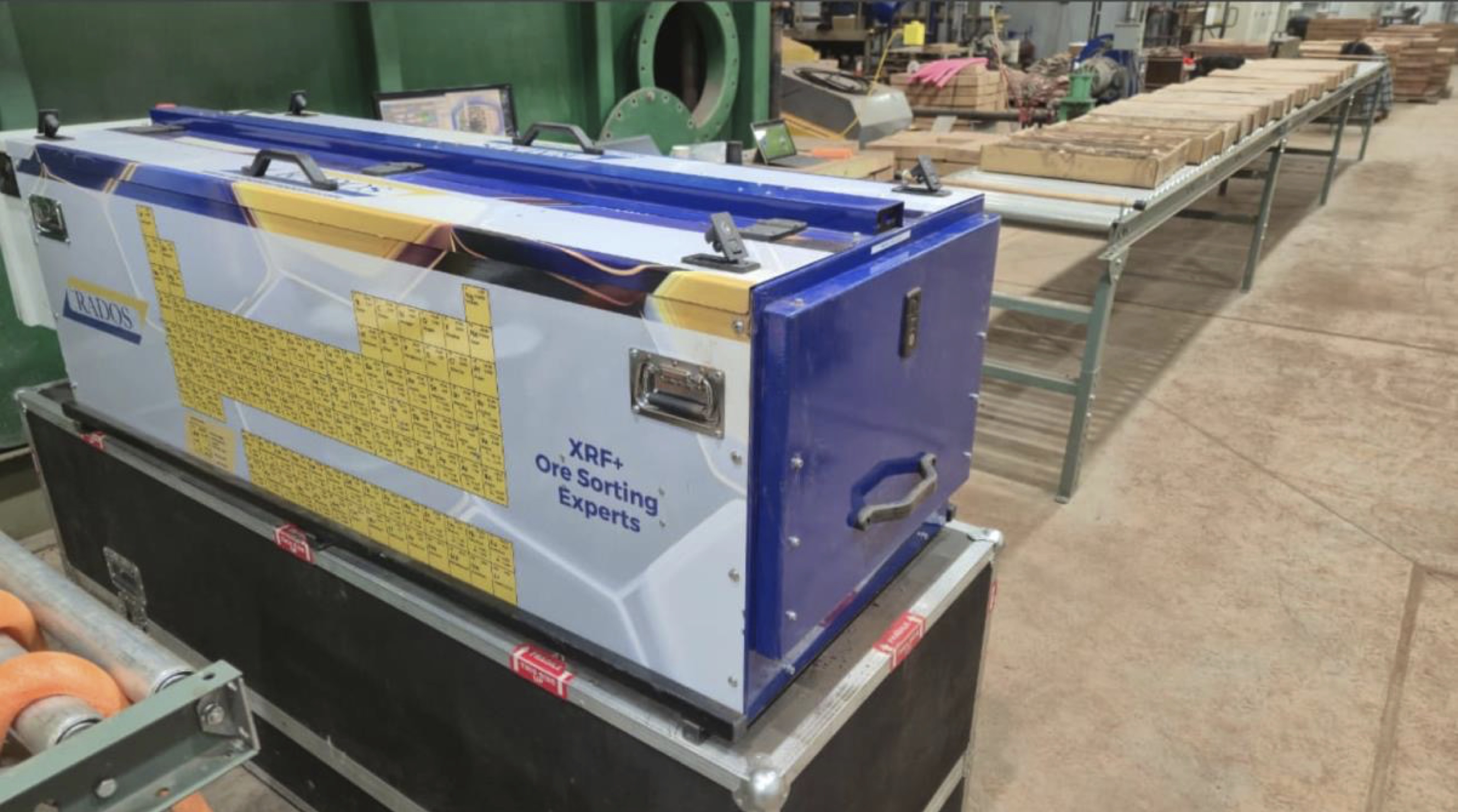
Rados DCA Setup at the North Star Manganese Project Core Storage Facility in Emily, Minnesota
Highlights
Simulated particle-scale ore sorting upgraded a drill core dataset, averaging approximately
8.2% Mn to approximately17.5% Mn while recovering approximately92% of the contained manganese.Approximately
57% of the material could potentially be rejected prior to downstream processing while retaining approximately92% of the contained manganese.The study demonstrates the potential for sensor-based pre-concentration to enhance the economic utilization of lower-grade mineralized material.
Simulated bulk ore sorting upgraded a drill core dataset averaging approximately
8.2% Mn to approximately13.1% Mn while recovering approximately92% of contained manganese.Higher-selectivity simulated sorting scenario at an
18% threshold produced concentrate grades approaching33% Mn.Progressive rejection of iron-bearing material was observed in simulated sorting scenarios at higher manganese thresholds, indicating potential downstream metallurgical benefits.
Strong short-range manganese variability is confirmed throughout the deposit, a key prerequisite for successful sensor-based ore sorting.
Excellent correlation between XRF measurements and laboratory assays, with calibration accuracy of approximately R² = 0.97 for manganese and R² = 0.98 for iron.
More than 132,000 particle-scale measurements collected from approximately 4,200 feet of drill core across 18 drill holes.
What Makes This Result Important?
Metric | Mn Grade |
Current Emily Resource Cutoff Grade | |
Current Emily Resource Grade - Indicated Current Emily Resource Grade - Inferred Average Grade of Dataset Evaluated by Rados | |
Simulated Ore Sorting Product Grade | |
Simulated Manganese Recovery |
While the reported sorting results are based on numerical simulations calibrated against laboratory assays rather than physical sorting trials, the study demonstrates that material averaging below the Company's current resource cutoff grade may potentially be upgraded to a grade substantially above the cutoff while retaining approximately
In simulated ore sorting scenarios based on more than 132,000 high-resolution XRF measurements, manganese feed grade more than doubled while recovering approximately
The study also confirmed the short-range grade variability required for successful ore sorting and demonstrated that the technology can accurately distinguish between higher-grade and lower-grade manganese-bearing material.
Perhaps most importantly, these results suggest that ore sorting may provide a pathway to economically utilize portions of the deposit that would otherwise be difficult to process efficiently. If confirmed through future physical test work, engineering studies and economic evaluations, this could materially enhance project economics and improve resource utilization."
A particularly significant outcome of the study is that the dataset evaluated by Rados averaged approximately
In a simulated particle-scale sorting scenario at a 10 mm size fraction and a
Under a simulated bulk ore sorting scenario at the same
At a more selective simulated sorting threshold of
The study also demonstrated that iron increasingly reports to the discard stream at higher manganese sorting thresholds, suggesting that ore sorting may provide additional metallurgical benefits through the early rejection of iron-bearing material before hydrometallurgical processing.
These preliminary results suggest that the Emily Manganese Deposit is amenable to XRF-based pre-concentration. The successful deployment of pre-concentration methods such as ore sorting could provide the opportunity for:
Low-impact manganese upgrading utilizing physical separation processes without chemicals or water consumption;
Reduction of ore shipment volumes through removal of gangue and low-grade material prior to processing;
Potential reductions in crushing, grinding, reagent consumption, material handling requirements and tailings generation; and
Potential enhancement of overall project economics through improved feed grade and waste rejection.
About the Test Program
The ore sorting assessment was completed by Rados International Technologies using its proprietary XRF+ Drill Core Analyzer. A total of 684 drill core trays representing approximately 4,200 feet of core from 18 drill holes were scanned at 10 mm intervals. The resulting dataset was calibrated against laboratory assays and used to estimate sorter performance through numerical simulation of multiple operating scenarios. No physical ore sorting trials were conducted as part of this program. The study concluded that the Emily Deposit is technically well suited to XRF-based ore sorting and identified clear opportunities for manganese grade upgrading and waste rejection prior to processing.
The results reported herein are based on simulated ore sorting performance derived from high-resolution XRF analysis of drill core and calibration against laboratory assays. Actual commercial ore sorting performance may differ and will require confirmation through future physical test work, engineering studies and economic evaluations.
Qualified Person
The scientific and technical information in this news release was reviewed and approved by Ronald A. Steiner, Ph.D., C.P.G. #12248, an independent consultant with Big Rock Exploration and a Qualified Person as defined under NI 43-101.
Legal Proceeding
The Company advises that its wholly‑owned subsidiary, North Star Manganese Inc ("North Star"), has been named as a defendant in a lawsuit filed on April 21, 2026 in the District Court for the Ninth Judicial District, Crow Wing County, Minnesota. The plaintiff alleges that certain historical royalty and mining arrangements relating to the Emily manganese deposit were breached by other defendants and asserts non‑contract claims against North Star in connection with the agreements through which North Star holds its interest in the Emily manganese project, the Company's principal asset. The plaintiff seeks monetary damages, declaratory relief regarding those agreements, and other relief.
North Star believes the claims against it are without merit and intends to assert all available defenses and rights in the action. Under the agreements governing North Star's interest in the project, Cooperative Mineral Resources, LLC ("CMR") is responsible for complying with any obligations of CMR to the plaintiff, and is required to defend, indemnify and hold North Star harmless with respect to such claims, including related costs. Litigation is inherently uncertain, and the Company cannot predict the outcome or timing of the matter. An adverse determination could have a material adverse effect on the Company's interest in the Emily manganese project and on the Company.
About Electric Metals USA Limited
Electric Metals (USA) Limited (TSXV:EML)(OTCQB:EMUS) is a U.S.-domiciled critical minerals and advanced materials company developing the North Star Manganese Project to establish a fully domestic U.S. supply of high-purity manganese products for battery, defense, infrastructure, technology, and industrial markets.
The Company's principal asset is the Emily manganese deposit in Minnesota, the highest-grade manganese deposit in North America. The North Star Manganese Project is a
Electric Metals' mission is to strengthen America's critical mineral independence by developing a secure domestic supply of high-purity manganese chemical and metal products for North American electric vehicle and energy storage batteries, defense applications, critical infrastructure, specialty alloys, advanced technologies, and industrial uses.
With manganese playing an increasingly important role in lithium-ion battery formulations and with no current domestic U.S. production of manganese ore, HPMSM, or EMM, the development of the North Star Manganese Project represents a strategic opportunity to reduce dependence on foreign supply chains and support U.S. industrial, energy, and national security priorities.
For further information, please contact:
Electric Metals (USA) Limited
Brian Savage
Chief Executive Officer & Director
(303) 656‑9197
Forward‑Looking Information
This news release contains "forward-looking information" and "forward-looking statements" (collectively, "forward-looking information") within the meaning of applicable securities laws. Forward-looking information is generally identifiable by the use of words such as "believes," "expects," "plans," "intends," "anticipates," "estimates," "projects," "may," "will," "could," "would," and similar expressions.
Forward-looking information in this news release includes, without limitation: statements regarding the potential application of sensor-based ore sorting technologies at the Emily Manganese Deposit; the potential for ore sorting to upgrade ore feed grade, reject waste material, reduce processing costs, lower reagent consumption, decrease tailings volumes, improve metallurgical performance, and enhance overall project economics; the incorporation of ore sorting results into future engineering, economic, and development studies; the potential development of the Emily Manganese Deposit and the broader North Star Manganese Project; the establishment of a fully domestic U.S. manganese supply chain; the future production of high-purity manganese products; the strategic importance of manganese to U.S. industry; the Company's future plans, objectives, and development strategy; and statements regarding the legal proceeding described under "Legal Proceeding" above (the "Proceeding"), including the Company's belief that the claims against North Star under the Proceeding are without merit, North Star's intention to defend the matter, the anticipated conduct and outcome of the Proceeding and any related arbitration, the timing and nature of any conclusion, verdict or result which may be reached in the Proceeding, and the availability, scope, enforceability, and sufficiency of the contractual indemnity in favor of North Star, as well as the effects of the Proceeding on the Company both during the course of such Proceeding and as a result of any conclusion, verdict or result reached in the legal proceeding.
Forward-looking information is based on management's current expectations, estimates, assumptions, and beliefs as of the date of this news release, including assumptions regarding the technical applicability and economic benefits of ore sorting technologies, the continuity and characteristics of mineralization at the Emily Manganese Deposit, the results of future engineering and economic studies, the validity and enforceability of the Company's agreements relating to the North Star Manganese Project, expectations with respect to the expected result from the Proceeding and timing for the Proceeding to be concluded, expectations with respect to the cost of the Proceeding to the Company, expectations with respect to how third parties may view the Proceeding and the effects of such Proceeding on the ability of the Company to conduct its business as currently or proposed to be conducted, and the availability and sufficiency of the contractual indemnity in favor of North Star, and prevailing market, regulatory, and economic conditions.
Such forward-looking information involves known and unknown risks, uncertainties, and other factors that may cause actual results, performance, or achievements to differ materially from those expressed or implied by such forward-looking information. These risks and uncertainties include, without limitation: the risk that future test work, engineering studies, or economic analyses may not confirm the anticipated benefits of ore sorting; changes in project design or development plans; variations in mineralization characteristics; metallurgical and processing risks; the results of future technical and economic studies; the ability to obtain necessary permits, approvals, financing, and regulatory authorizations; fluctuations in manganese and other commodity prices; changes in market conditions and demand for manganese products; the inherent uncertainty of litigation and arbitration and the risk of an unfavorable judgment, award, or settlement in the legal proceeding described above; the risk that an adverse outcome could impair the Company's interest in the North Star Manganese Project; the risk that the contractual indemnity in favor of North Star may be unavailable, insufficient, or uncollectible or may not cover all liabilities or costs associated with the Proceeding; the risk that the Proceeding may not be concluded as expected by the Company or on the timeline expected by the Company; the costs and diversion of management resources associated with defending the proceeding; general economic, market, business, environmental, and regulatory conditions; and the other risk factors disclosed in the Company's continuous disclosure record on its profile on SEDAR+ at www.sedarplus.ca.
Although the Company believes the assumptions and expectations reflected in the forward-looking information are reasonable, there can be no assurance that such information will prove to be accurate. Readers should not place undue reliance on forward-looking information, as actual results and future events may differ materially from those anticipated. Except as required by applicable law, the Company undertakes no obligation to update or revise any forward-looking information to reflect new events or circumstances.
Neither the TSX Venture Exchange nor its Regulation Services Provider (as that term is defined in the policies of the TSX Venture Exchange) accepts responsibility for the adequacy or accuracy of this release.
SOURCE: Electric Metals (USA) Limited
View the original press release on ACCESS Newswire
FAQ
AI-generated questions and answers. How Rhea-AI works. Not financial advice.