STOCK TITAN

Equinix Puts Enterprises in Control of Data Sovereignty Across Hybrid Multicloud Environments

(Neutral)
Tags

Equinix (Nasdaq: EQIX) announced a global expansion of Equinix Fabric Geo Zones, a network-level data sovereignty control layer for hybrid multicloud environments across five continents. Built into the Equinix Fabric software-defined network spanning 77 metros, it lets customers keep traffic within defined geographic boundaries.

According to Equinix, Geo Zones helps reduce regulatory risk by enforcing jurisdiction-specific routing rules and blocking non-compliant paths. It is in preview across Australia, Brazil, Canada, Japan, Switzerland, the U.K. and the U.S., with European Union availability expected in June, and is offered as a premium-tier feature.

Loading...
Loading translation...

Positive

  • None.

Negative

  • None.

News Market Reaction – EQIX

+0.22%
+0.22% Session close to close

In the May 14 session, EQIX gained 0.22%, reflecting a mild positive market reaction.

Data tracked by StockTitan Argus on the day of publication.

Market Context

This announcement extends Equinix’s AI-oriented networking stack by adding Fabric Geo Zones, a netwo...
Analysis

This announcement extends Equinix’s AI-oriented networking stack by adding Fabric Geo Zones, a network-layer sovereignty control spanning 5 continents and running over a footprint of 77 metros. It targets regulated workloads under regimes like GDPR, LGPD and APRA, and is positioned as a premium feature for Unlimited Ports packages. In context with recent AI launches and new debt financing, investors may watch adoption in regulated industries and how it supports Equinix’s broader multicloud and AI strategy.

Key Figures

Continents covered: 5 continents Global metros: 77 metros Share price: $1077.28 +2 more
5 metrics
Continents covered 5 continents Global expansion of Fabric Geo Zones
Global metros 77 metros Equinix Fabric software-defined network footprint
Share price $1077.28 Price before sovereignty solution expansion news
52-week high $1128.68 Upper end of EQIX’s 52-week trading range
Regions in preview Australia, Brazil, Canada, Japan, Switzerland, U.K., U.S. Geo Zones preview availability ahead of EU launch

Historical Context

5 past events · Latest: Apr 29 (Positive)
Pattern 5 events
Date Event Sentiment 24h Move Catalyst
Apr 29 Quarterly dividend Positive -0.6% Declared quarterly cash dividend of $5.16 per share with June payment date.
Apr 29 Earnings and outlook Positive -0.6% Reported Q1 2026 results with $2.444B revenue and raised full-year outlook.
Apr 23 Customer win partnership Positive +1.2% SpinLaunch chose Equinix to host global ground infrastructure for LEO constellation.
Apr 15 AI networking launch Positive -0.4% Launched Fabric Intelligence to automate multi-cloud and edge networking for AI.
Mar 24 Workforce investment Positive -0.3% Announced global workforce development programs and technician training initiatives.

24h Move is the share-price change in the day after each event; other market factors may also have contributed.

Pattern Detected

Recent strategically positive news (AI, partnerships, earnings beat, dividend) often saw flat-to-negative next-day moves, indicating limited immediate upside reaction to good news.

Recent Company History

Over the past two months, EQIX has highlighted multiple strategic and financial milestones. On Mar 24, it expanded global workforce initiatives. On Apr 15, it launched Fabric Intelligence for AI workloads, leveraging its global footprint. On Apr 23, SpinLaunch chose Equinix for satellite ground infrastructure. On Apr 29, EQIX reported Q1 2026 revenue of $2.444B with raised full-year guidance and also declared a $5.16 quarterly dividend. Despite generally positive narratives, next-day price reactions were small and often negative, similar to today’s muted move.

Key Terms

data sovereignty, hybrid multicloud, software-defined network, gdpr, +4 more
8 terms
data sovereignty regulatory
"Puts Enterprises in Control of Data Sovereignty Across Hybrid Multicloud Environments"
Data sovereignty is the principle that digital information is subject to the laws and control of the country or entity where it is stored or processed. For investors, it matters because where data lives affects a company's legal obligations, costs, ability to sell services across borders, and exposure to government access or restrictions — like owning a house that must follow the rules of the town it sits in.
hybrid multicloud technical
"data sovereignty across hybrid multicloud environments"
A hybrid multicloud is an IT approach that combines an organization’s private on‑site computing resources with services from two or more public cloud providers, letting data and applications move between them as needed. For investors, it matters because this setup can improve flexibility, resilience and cost control—like storing goods in a mix of your own warehouse and several rented facilities—while also creating vendor, security and execution risks that can affect a company’s profitability and growth prospects.
software-defined network technical
"built on the Equinix Fabric industry-leading software-defined network spanning 77 metros"
A software-defined network is a way of running computer networks where the decision-making 'brain' is moved into software instead of being built into each piece of hardware. Like replacing many individual radio dials with a single smartphone app that controls them all, it makes networks easier to change, scale and secure on demand. Investors care because it can lower hardware costs, speed deployment of new services and improve operational efficiency and security, which affects a company’s margins and growth potential.
gdpr regulatory
"operating under GDPR in Europe, LGPD in Brazil, and APRA in Australia"
General Data Protection Regulation is a law that sets rules for how organizations must collect, store and use personal data about people, and gives individuals rights over that data. It matters to investors because noncompliance can lead to large fines, higher operating costs and damaged reputation, while strong compliance can be a competitive advantage—think of it as a strict safety code for handling customer information.
lgpd regulatory
"operating under GDPR in Europe, LGPD in Brazil, and APRA in Australia"
Brazil’s General Data Protection Law (LGPD) is a national privacy law that sets rules for how organizations collect, store and use personal data, similar to a rulebook for handling customer information. It matters to investors because noncompliance can lead to fines, legal action and reputational damage, while strong compliance reduces operational risk and can preserve customer trust and market value—think of it as a safety inspection for a company’s data practices.
apra regulatory
"operating under GDPR in Europe, LGPD in Brazil, and APRA in Australia"
APRA is Australia’s financial safety regulator that oversees banks, insurance companies and retirement (superannuation) funds, setting rules and running checks to make sure they have enough cash and controls to meet obligations. For investors it matters because APRA’s rules and decisions — like requiring firms to hold more reserves or approve major changes — can act like a safety inspector’s stamp, affecting a firm’s costs, dividend capacity and market confidence, and therefore share prices.
sovereign ai technical
"A government agency can deploy sovereign AI with data confined to national or regional boundaries."
An AI system described as "sovereign" is built, hosted, or operated under a country’s legal and technical control so that data, code, and decision-making stay within that jurisdiction. For investors, sovereign AI matters because it affects which vendors can sell to governments or regulated industries, imposes compliance and infrastructure costs, and can create protected local markets—similar to a factory that must follow a nation’s building codes and can only sell to certain buyers.
multicloud technical
"Across Hybrid Multicloud Environments"
Multicloud is the practice of a company using cloud computing services from two or more different providers instead of relying on just one, like keeping money in several banks so you can use each bank’s strengths. For investors, it matters because it can lower operational risk, improve reliability and flexibility, and affect costs and growth prospects — all of which influence a company’s profitability and competitive position.

AI-generated analysis. How Rhea-AI works. Not financial advice.

See more from StockTitan in Google Search and AI answers. Adds StockTitan as a preferred source · opens Google
Add on Google

Announces global expansion of Fabric Geo Zones across five continents, the first network-level, multicloud sovereignty solution

REDWOOD CITY, Calif., May 14, 2026 /PRNewswire/ -- Equinix, Inc. (Nasdaq: EQIX), the world's digital infrastructure company®, today announced the global expansion of Equinix Fabric Geo Zones, the first network-level, sovereignty enforcement layer that operates across interconnected clouds and providers. Enterprises face growing compliance risks from network rerouting events that can inadvertently move sovereign data across borders they are legally required to respect. Built natively into Equinix Fabric®, Geo Zones eliminates that risk by keeping data within defined geographic boundaries.

"Businesses are facing one of the most complex global regulatory environments in history while at the same time facing huge pressure to deploy new technologies," said Courtney Munroe, Founder, Apex Research. "A global enterprise operating under GDPR in Europe, LGPD in Brazil, and APRA in Australia simultaneously needs different data routing rules for each jurisdiction, with every outage, failover, or congestion event a potential compliance violation. With Fabric Geo Zones, Equinix is delivering a foundational solution that is truly built from the ground up with native sovereignty controls at its core, giving enterprises confidence to operate in a globally fragmented regulated environment."

Most networks prioritize availability and performance over geographic or regulatory boundaries, often leaving customers with limited visibility or control over where their data travels. Fabric Geo Zones ensures that rerouted data remains within defined jurisdictions. This capability is especially critical for organizations operating in regulated industries.

Unlike solutions built within a single cloud or delivered as software overlays, Fabric Geo Zones enforces sovereignty at the network layer. Because it is enforced directly within the interconnection fabric itself, it delivers a level of control difficult for a single cloud or software overlay provider to match.

"Sovereignty can't be a setting you configure inside a single cloud. Global enterprises must enforce sovereignty at the network layer, across every cloud, provider and path simultaneously," said Arun Dev, Vice President of Digital Interconnection at Equinix. "Equinix Fabric Geo Zones is the only solution that enforces geographic boundaries as a property of the network itself. Traffic either flows along compliant paths or it's blocked. That's why enterprises across industries trust Equinix to move data across clouds without compromising sovereignty."

The expansion of Fabric Geo Zones is part of Equinix's ongoing investment in reimagining networking for the AI era, following the launch of Fabric Intelligence and the Distributed AI Hub. Together, these capabilities provide customers with an adaptive, secure foundation for distributed AI and multicloud environments. Fabric Geo Zones is built on the Equinix Fabric industry-leading software-defined network spanning 77 metros worldwide, enabling customer-controlled data sovereignty at global scale. Reflecting the advanced compliance and control it delivers, Geo Zones is available at a premium tier—included in Unlimited Ports and Unlimited Ports Plus packages and priced at a premium to standard virtual circuits.

Fabric Geo Zones is built for workloads where compliance can't be an afterthought. A European financial institution can run real‑time transactions across multiple clouds while ensuring customer data never leaves the EU, even when an outage triggers automatic rerouting across clouds. A healthcare organization can keep patient and AI inference data within defined jurisdictions across hybrid environments. A government agency can deploy sovereign AI with data confined to national or regional boundaries. A global company can automatically apply jurisdiction‑specific routing rules to meet GDPR, LGPD, APRA and other regional requirements across its operations.

Fabric Geo Zones enables customers to: 

  • Keep sensitive data within approved jurisdictions
  • Reduce regulatory and jurisdictional risk from unintended cross-border routing
  • Accelerate deployments using Fabric Super Agent
  • Eliminate uncertainty during failover where outages reroute sensitive traffic

Fabric Geo Zones is available today in preview across Equinix's global footprint, including Australia, Brazil, Canada, Japan, Switzerland, the U.K. and the U.S., with European Union availability to come in June. Equinix will be speaking about this at the International Telecoms Week conference panels on May 19: "The quest for sovereign AI meets the edge-cloud infrastructure battle" and "Unleashing the 3 pillars of AI."

Additional Resources 

About Equinix  
Equinix, Inc. (Nasdaq: EQIX) shortens the path to boundless connectivity anywhere in the world. Its digital infrastructure, data center footprint and interconnected ecosystems empower innovations that enhance our work, life and planet. Equinix connects economies, countries, organizations and communities, delivering seamless digital experiences and cutting-edge AI—quickly, efficiently and everywhere.  

Forward-Looking Statements  
This press release contains forward-looking statements that involve risks and uncertainties. Actual results may differ materially from expectations discussed in such forward-looking statements. Factors that might cause such differences include, but are not limited to, risks to our business and operating results related to the current inflationary environment; foreign currency exchange rate fluctuations; stock price fluctuations; increased costs to procure power and the general volatility in the global energy market; the challenges of building and operating IBX® and xScale® data centers, including those related to sourcing suitable power and land, and any supply chain constraints or increased costs of supplies; the challenges of developing, deploying and delivering Equinix products and solutions; unanticipated costs or difficulties relating to the integration of companies we have acquired or will acquire into Equinix; a failure to receive significant revenues from customers in recently built out or acquired data centers; failure to complete any financing arrangements contemplated from time to time; competition from existing and new competitors; the ability to generate sufficient cash flow or otherwise obtain funds to repay new or outstanding indebtedness; the loss or decline in business from our key customers; risks related to our taxation as a REIT; risks related to regulatory inquiries or litigation; and other risks described from time to time in Equinix filings with the Securities and Exchange Commission. In particular, see recent and upcoming Equinix quarterly and annual reports filed with the Securities and Exchange Commission, copies of which are available upon request from Equinix. Equinix does not assume any obligation to update the forward-looking information contained in this press release.  
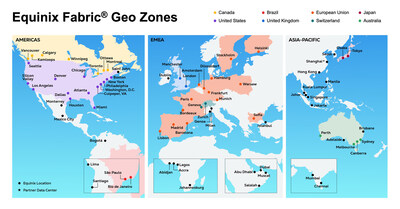
A map of Equinix Fabric Geo Zones

Equinix.  (PRNewsFoto/Equinix) (PRNewsfoto/Equinix, Inc.)


Cision View original content to download multimedia:https://www.prnewswire.com/news-releases/equinix-puts-enterprises-in-control-of-data-sovereignty-across-hybrid-multicloud-environments-302771894.html

SOURCE Equinix, Inc.

FAQ

What did Equinix (EQIX) announce about Fabric Geo Zones on May 14, 2026?

Equinix announced the global expansion of Fabric Geo Zones, a network-level data sovereignty control for hybrid multicloud. According to Equinix, it enforces geographic boundaries across interconnected clouds to keep sensitive traffic within defined jurisdictions and support complex regulatory requirements worldwide.

How does Equinix Fabric Geo Zones improve data sovereignty for EQIX customers?

Fabric Geo Zones provides customer-controlled geographic boundaries at the network layer across multiple clouds. According to Equinix, it keeps rerouted traffic within approved jurisdictions, aims to reduce cross-border compliance risk, and blocks non-compliant paths during outages, failovers or congestion in hybrid multicloud environments.

Where is Equinix Fabric Geo Zones preview available and when will the EU be added?

Fabric Geo Zones is in preview in Australia, Brazil, Canada, Japan, Switzerland, the U.K. and the U.S. According to Equinix, European Union availability is expected in June, extending its data sovereignty controls to additional regulated workloads across the region.

Which industries can benefit most from Equinix (EQIX) Fabric Geo Zones?

Equinix highlights financial services, healthcare, government and global enterprises as key beneficiaries. According to Equinix, these users can keep transactions, patient information and AI inference data within required jurisdictions while applying routing rules aligned with GDPR, LGPD, APRA and other regional regulations.

How is Equinix Fabric Geo Zones packaged and priced for EQIX customers?

Fabric Geo Zones is positioned as a premium-tier feature within the Equinix Fabric ecosystem. According to Equinix, it is included in Unlimited Ports and Unlimited Ports Plus packages and is priced at a premium compared with standard virtual circuits due to its advanced compliance controls.

How does Fabric Geo Zones fit into Equinix’s AI and multicloud strategy for EQIX?

Fabric Geo Zones extends Equinix’s investments in networking for the AI era, alongside Fabric Intelligence and the Distributed AI Hub. According to Equinix, these offerings together provide an adaptive, secure foundation for distributed AI and multicloud deployments while supporting strict data sovereignty requirements.