
Eskay Mining Corp. Provides Update on 2026 Diamond Drilling, Surface Work and Structural Studies
Eskay Mining outlines 2026 drilling and structural work while signalling key assay results expected from October through December.
Sentiment and the balance of points
Rhea-AI Sentiment reads the wording of the document, how positive or negative its language is on a 1 to 5 scale. The balance of points shown with the takes weighs what the document actually discloses, so the two can disagree, for example when a trial that missed its main goal is described in upbeat language.
Rhea-AI Summary
Eskay Mining Corp (ESKYF) reports progress on its 2026 exploration program, having completed 3,638 meters of NQ diamond drilling in nine holes on multiple targets as of September 6, 2026.
All cut half-core is composited into intervals up to three meters and sent for analysis, with every second sample going to ALS in Vancouver and alternate core-saw sludge analysed in Eskay’s Stewart laboratory by portable XRF and PortablePPB’s detectORE gold method to guide ongoing hole placement. ALS assays for hole EM26-02 and subsequent holes, as well as surface sample results, are expected between October and December.
The company highlights structural work by Dr. Brett Davis, completion of a first comprehensive structural framework for the Eskay-Corey property, and visually promising core from the Vermillion and Sultan targets that will remain subject to pending assay results.
Details
News Market Reaction – ESKYF
On Sep 8, the day this news came out, ESKYF closed 0.39% above the previous close.
Data tracked by StockTitan Argus for the Sep 8 session.
AI-generated analysis. How Rhea-AI works. Not financial advice.




TORONTO, ON / ACCESS Newswire / September 8, 2026 / Eskay Mining Corp. ("Eskay" or the "Company") (TSXV:ESK)(OTC PINK:ESKYF)(Frankfurt:KN7)(WKN:A0YDPM) is pleased to provide an update on its 2026 exploration program, including drilling progress, laboratory affairs, structural studies and surface mapping and sampling.
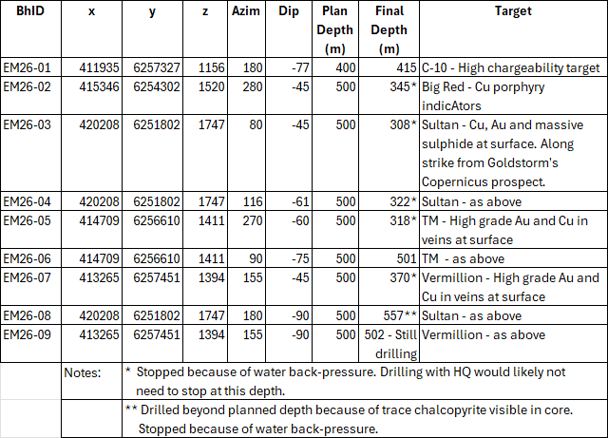
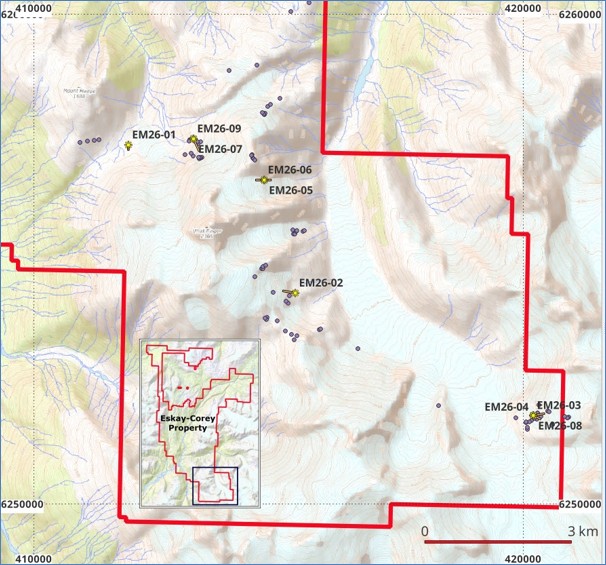
To date, 3,638 meters of NQ drilling has been completed in nine NQ diamond drill holes as listed in Table 1 at the locations shown in Figure 1. Figure 1 also shows the locations of all surface rock samples collected this year to date.
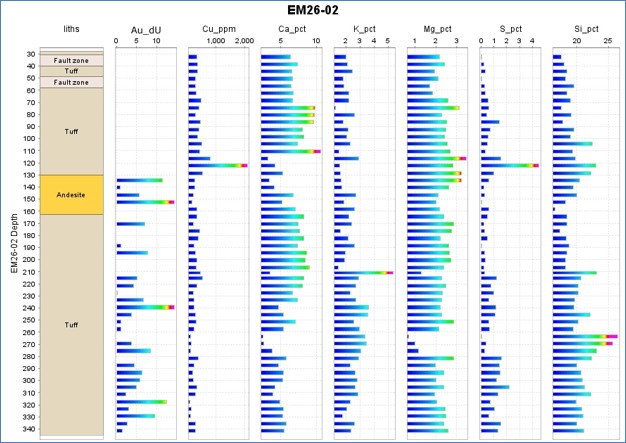
All diamond core is cut and all half-core composited into three meter samples (or less) and submitted for laboratory analysis. Every second sample is submitted to the ALS laboratory in Vancouver for analysis, while the sludge collected from the core saw from alternate samples is analysed in Eskay's Stewart laboratory by portable XRF for a suite of 37 elements and by PortablePPB's detectORE method for gold. Data from the Stewart laboratory provides the Company with quickly-available compositional data used to optimally site new boreholes as the season progresses. Figure 2 shows downhole profiles for selected elements reported by the Stewart laboratory from hole EM26-02 on the Sultan prospect. The "Au_dU" units are parts per billion reported from Portable PPB's detectORE method, and are proportional to the amount of gold that has been chemically extracted from our drill core sludge and concentrated onto a specialized collector device. While not providing a "total contained gold" assay, these results are very helpful in flagging intervals of invisible gold mineralisation and deciding what samples should be selected for fire assay. ALS assays for hole EM26-02 and subsequent holes are not expected until October. They will be reported, along with our Stewart laboratory results, once the ALS results have been received and evaluated.
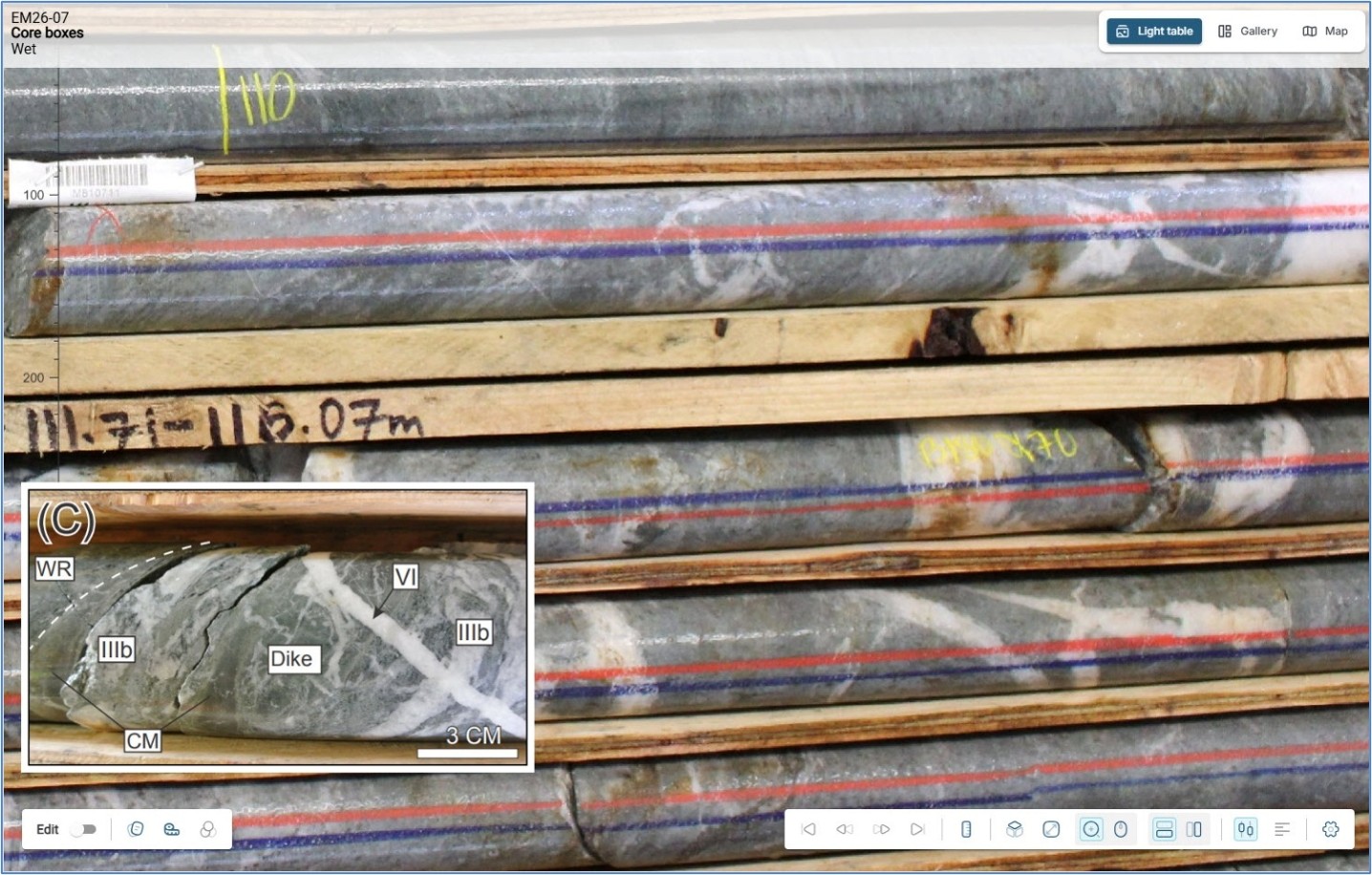
Before cutting, all core is photographed, and all core photographs are loaded into Seequent's Imago system.
Our team has been struck by the similarity in appearance of multi-generational veins in core from drill hole EM26-07 and drill core recently described from the neighbouring Brucejack Gold Deposit. Figure 3 shows an Imago image of EM26-07 core at 111.71m with an inset showing similar Brucejack core described as "Contact between wall rock (WR) and a trachybasaltic dike in drill core showing a chilled margin (CM) and stage IIIb and VI veins cutting the dike" (from Figure 4 in McLeish e al. (2026)). 'Cryptic Telescoping in Porphyry-Epithermal Systems: An Integrated Microtextural-Chemical Study of Pyrite from the Brucejack Bonanza-Type Epithermal Au-Ag Deposit'. Economic Geology, doi:10.5382/econgeo.5249). Visual similarities do not indicate similar chemical compositions or mineralogy. The Company's drill core remains subject to assay results.
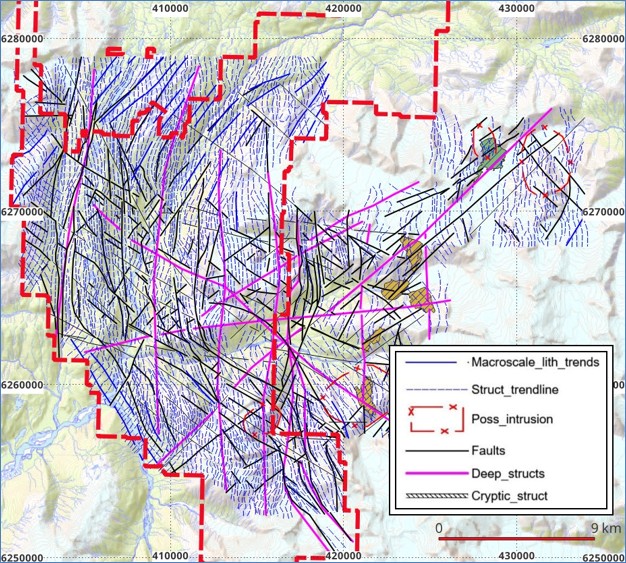
Dr. Brett Davis spent ten days in August examining and reporting on the core from drill holes EM26-01 and EM26-02, at the same time as upgrading the Eskay exploration team's use of structural geology in exploration, with particular emphasis on logging multi-generational vein systems. During September he completed the first comprehensive structural framework study of the property, one of the deliverables of which is presented in Figure 4. Features in structural framework studies, whether observed or inferred, assist in the prioritisation of exploration targets, particularly when there are many, as in the case of the Eskay-Corey property.
Surface mapping and sampling has been ongoing around the Company's drilling targets since July. Locations of samples collected in 2026 are shown in Figure 1. All surface samples are submitted to the ALS laboratory in Vancouver for analysis. Analytical results will be reported once the results are received and evaluated by the Company, which is expected to be in October or November.
Mac Balkam, President and CEO comments: "While Eskay's focus for years has been to find a second Eskay Creek VMS deposit, the fact is that our very large property is equally prospective for copper/gold porphyry deposits and the epithermal gold deposits that often form around them. So I am delighted that in our first three months of looking for these targets we are making very good progress. Our Vermillion target is now yielding core which looks similar in appearance to core from the rich Brucejack Gold Deposit which lies only 13 kilometers to the east of Vermillion. In addition, core and surface mapping at our Sultan target indicates that we are in the same Hazleton stratigraphy that hosts Goldstorm's Copernicus copper gold porphyry prospect four kilometers to its south, and not in Stuhini stratigraphy as shown on historical maps. So I am very excited to see the assay results from these, the two most promising areas we have drilled this year, as well, of course, as the results from the other three target areas we have drilled, all of which are expected between October and December.".
Qualified Person
Clinton Smyth, P. Geo., Chief Geologist for the Company, a qualified person as defined by National Instrument 43-101, has reviewed and approved the technical contents of this news release.
About Eskay Mining Corp:
Eskay Mining Corp (TSX-V:ESK) is a TSX Venture Exchange listed company, headquartered in Toronto, Ontario. Eskay is an exploration company focused on the exploration and development of precious and base metals along the Eskay rift in a highly prolific region of northwest British Columbia known as the "Golden Triangle," 70km northwest of Stewart, BC. The Company currently holds mineral tenures in this area comprised of 177 claims (52,600 hectares).
All material information on the Company may be found on its website at www.eskaymining.com and on SEDAR+ at www.sedarplus.com.
For further information, please contact:
Mac Balkam
President & Chief Executive Officer
T: 416 907 4605
E: Mac@eskaymining.com
Neither the TSX Venture Exchange nor its Regulation Services Provider (as that term is defined in the policies of the TSX Venture Exchange) accepts responsibility for the adequacy or accuracy of this release.
Forward-Looking Statements: This Press Release contains forward-looking statements that involve risks and uncertainties, which may cause actual results to differ materially from the statements made. When used in this document, the words "may", "would", "could", "will", "intend", "plan", "anticipate", "believe", "estimate", "expect" and similar expressions are intended to identify forward-looking statements. Such statements reflect our current views with respect to future events and are subject to risks and uncertainties. Many factors could cause our actual results to differ materially from the statements made, including those factors discussed in filings made by us with the Canadian securities regulatory authorities. Should one or more of these risks and uncertainties, such as actual results of current exploration programs, the general risks associated with the mining industry, the price of gold and other metals, currency and interest rate fluctuations, increased competition and general economic and market factors, occur or should assumptions underlying the forward looking statements prove incorrect, actual results may vary materially from those described herein as intended, planned, anticipated, or expected. We do not intend and do not assume any obligation to update these forward-looking statements, except as required by law. Shareholders are cautioned not to put undue reliance on such forward-looking statements.
SOURCE: Eskay Mining Corp.
View the original press release on ACCESS Newswire
FAQ
AI-generated questions and answers. How Rhea-AI works. Not financial advice.
How is Eskay Mining processing and analysing drill core during the 2026 program?
All diamond core is photographed before cutting, then cut with half-core composited into samples up to three meters. Every second core sample is sent to the ALS laboratory in Vancouver for analysis. Sludge from the core saw for the alternate samples is analysed in Eskay’s Stewart laboratory using portable XRF for 37 elements and PortablePPB’s detectORE method for gold. The Stewart laboratory data provides quickly available compositional information used to help optimally locate new boreholes as the drilling season progresses.
Which targets are emphasised in the 2026 work and what comparisons are made?
The company emphasises the Vermillion and Sultan targets. The team notes that multi-generational veins in core from drill hole EM26-07 at Vermillion look visually similar to core from the nearby Brucejack Gold Deposit, while core and surface mapping at Sultan indicate Hazleton stratigraphy similar to that hosting Goldstorm’s Copernicus copper-gold porphyry prospect. The company states that these visual observations are subject to confirmation by pending assay results.
When does Eskay Mining expect to receive and report assay results from the 2026 program?
ALS assays for hole EM26-02 and subsequent drill holes, along with results for surface rock samples collected since July, are expected in October or November. The company indicates that results from the Vermillion, Sultan and three other drilled target areas are expected to be received and reported between October and December, after evaluation.