
Firefly Aerospace Accelerates Spacecraft Production with Expanded Campus and Innovation Lab in Central Texas
Rhea-AI Summary
Firefly Aerospace (Nasdaq: FLY) expanded its Cedar Park, Texas campus, doubling local facility size to support higher-rate spacecraft production.
The site now includes 144,000 square feet for assembly, testing, mission control, avionics, and operations, a Texas-funded cleanroom four times larger than before, and the new Gloworks innovation lab. Firefly is also adding 30,000 square feet at its Briggs Rocket Ranch and upgrading engine test stands and production workflows.
Positive
- Cedar Park campus expanded to 144,000 square feet across a unified spacecraft facility
- New cleanroom is 4x larger, supporting assembly lines for Blue Ghost and Elytra vehicles
- Texas Space Commission grant funding supports advanced cleanroom infrastructure
- Gloworks innovation lab adds high-tech machinery for propulsion, composites, robotics, and 3D printing
- Rocket Ranch gains 30,000 square feet of added engineering and manufacturing workspace
- Engine test stand upgrades aim to support multiple engines and higher testing cadence
Negative
- None.
News Market Reaction – FLY
In the May 19 session, FLY declined 3.14%, reflecting a moderate negative market reaction. Argus tracked a peak move of +7.8% during that session. Argus tracked a trough of -6.2% from its starting point during tracking. Our momentum scanner triggered 46 alerts that day, indicating elevated trading interest and price volatility.
Data tracked by StockTitan Argus on the day of publication.
Key Figures
Historical Context
| Date | Event | Sentiment | 24h Move | Catalyst |
|---|---|---|---|---|
| May 11 | AFRL contract award | Positive | +2.8% | SciTec won AFRL contract for advanced algorithm R&D and verification architecture. |
| May 04 | Q1 2026 earnings | Positive | -5.5% | Reported strong Q1 revenue growth and raised 2026 guidance but shares fell. |
| May 04 | Missile defense OTA | Positive | -1.3% | SciTec received OTA to advance Space Force space‑based interceptor program. |
| Apr 21 | Earnings date notice | Neutral | -5.0% | Announced timing of Q1 2026 results release and conference call logistics. |
| Apr 08 | NVIDIA moon imaging | Positive | +7.2% | Unveiled NVIDIA Jetson on Elytra for AI‑driven lunar imaging and data fusion. |
24h Move is the share-price change in the day after each event; other market factors may also have contributed.
Operational and contract wins have often been positive, but earnings-related headlines saw negative reactions, suggesting some tendency to sell into fundamentally strong updates.
Over the last six weeks, Firefly has combined strong operational progress with financial growing pains. On Apr 8, a collaboration with NVIDIA for on‑orbit lunar imaging AI coincided with a +7.17% move. Subsequent Golden Dome missile-defense and AFRL algorithm awards in early May brought important defense validation but modest or negative price reactions. First‑quarter 2026 results on May 4 showed rapid revenue growth yet ongoing losses and the stock fell 5.54%. Today’s campus expansion update extends this theme of scaling capacity and technology.
Key Terms
cleanroom technical
lunar landers technical
orbital vehicles technical
propulsion technical
carbon composites technical
robotics technical
3d printing technical
deorbiting technical
AI-generated analysis. How Rhea-AI works. Not financial advice.




New campus doubles the size of Firefly’s facilities in Cedar Park, Texas to enable assembly line of lunar landers and orbital vehicles
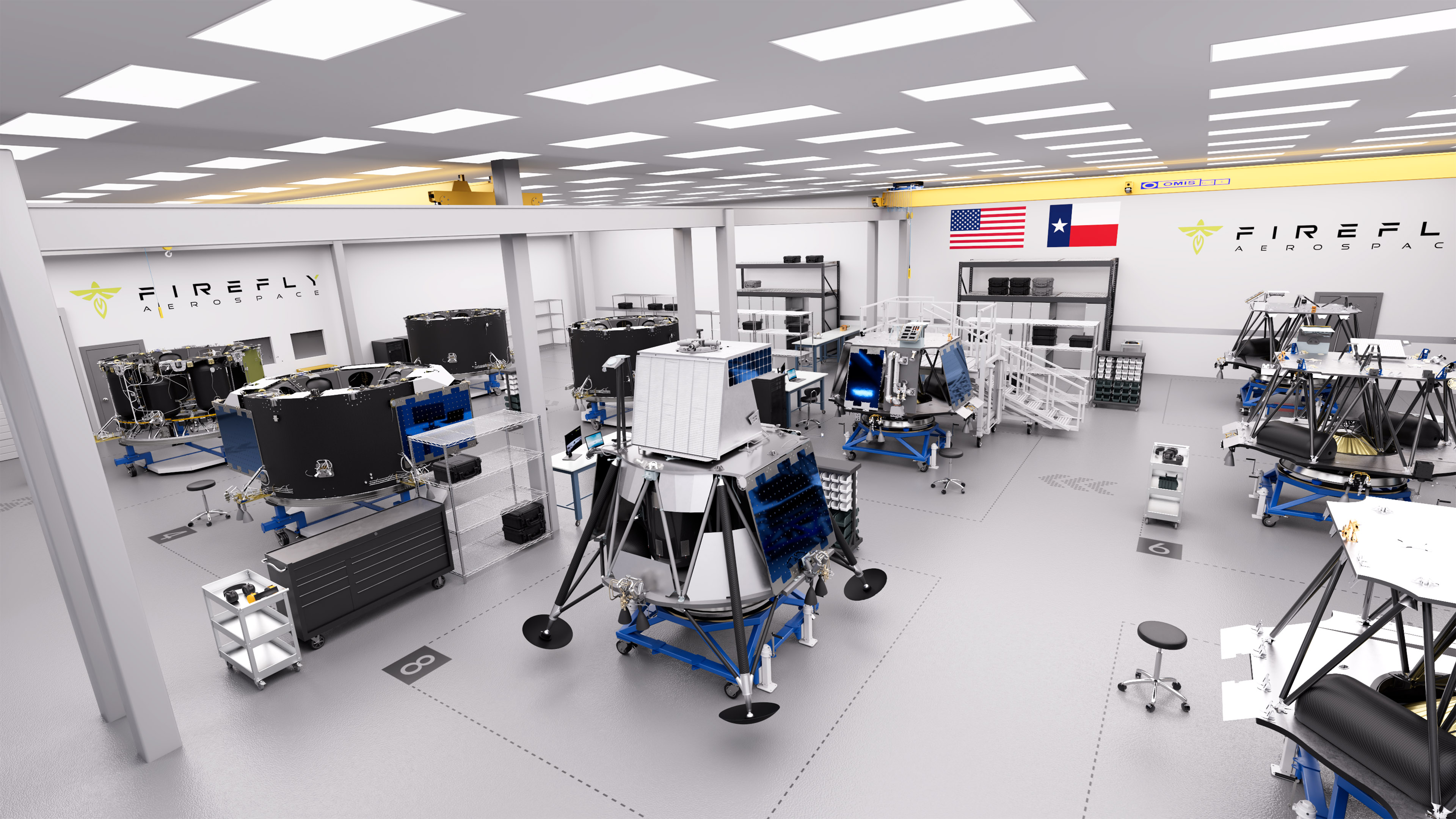
*Rendering of Firefly’s new cleanroom at its spacecraft facility in Cedar Park, Texas; Credit: Firefly Aerospace
CEDAR PARK, Texas, May 19, 2026 (GLOBE NEWSWIRE) -- Firefly Aerospace (Nasdaq: FLY), a market leading space and defense technology company, today announced the company moved into a new headquarters, expanded its cleanroom space, and added an innovation lab to support Firefly’s growing workforce, accelerate spacecraft production, and enable breakthrough space technologies.
The expansion includes two new buildings adjacent to Firefly’s existing spacecraft facility in Cedar Park, Texas, enabling one robust campus with 144,000 total square feet for spacecraft assembly and testing, mission control, avionics and component production, engineering, and business operations. The new campus is twice the size of Firefly’s former Cedar Park facilities and is less than 30 miles from Firefly’s 200-acre Rocket Ranch in Briggs, Texas, where the company operates six test stands and 217,000 square feet of facilities for launch vehicle engineering, manufacturing, and integration.
“With operations centralized in Texas, Firefly is producing rockets and spacecraft at scale to meet the demand of the rapidly growing defense, exploration, and commercial space markets,” said Ramon Sanchez, COO of Firefly Aerospace. “The strategic investments we’ve made in our Cedar Park campus allow us to template our successful Blue Ghost lunar lander into a production line for multiple lunar missions a year that support NASA's Moon Base initiative and the larger commercial lunar economy.”
A Media Snippet accompanying this announcement is available by clicking on this link.
As part of the expanded campus, Firefly has made significant progress on a new cleanroom that is four times the size of its existing cleanroom. Funded by a Texas Space Commission grant, the new cleanroom enables a dedicated assembly line of Firefly’s Blue Ghost lunar landers and Elytra orbital vehicles.
Firefly’s new innovation lab, called Gloworks, further enables rapid technology innovation in key areas, such as propulsion, carbon composites, robotics, and 3D printing. This emergent-work lab is utilized to enhance the capabilities of Firefly’s launch, lunar, and orbital vehicles and break into new categories that align with the growing needs of Firefly’s diverse customers. The lab houses high-tech machinery, including 3D and titanium printers, plasma cutters, composite fabrication, welding, and automated milling machines.
“Gloworks allows us to amplify our rapid, innovative mindset to tackle the problems of the future, including everything from surviving the lunar night to efficiently deorbiting spacecraft that reach end of life,” said Shea Ferring, Chief Technology Officer at Firefly Aerospace. “This lab is the incubator driving key space technologies and differentiators that disrupt the future without disrupting our existing production line.”
Firefly is also making vast improvements to its Rocket Ranch and recently added two new mezzanines for an additional 30,000 square feet of engineering and manufacturing workspace. The company is further making continuous upgrades to its automated carbon composite and propulsion machinery as well as improvements in its production and integration workflow for enhanced quality and scalability.
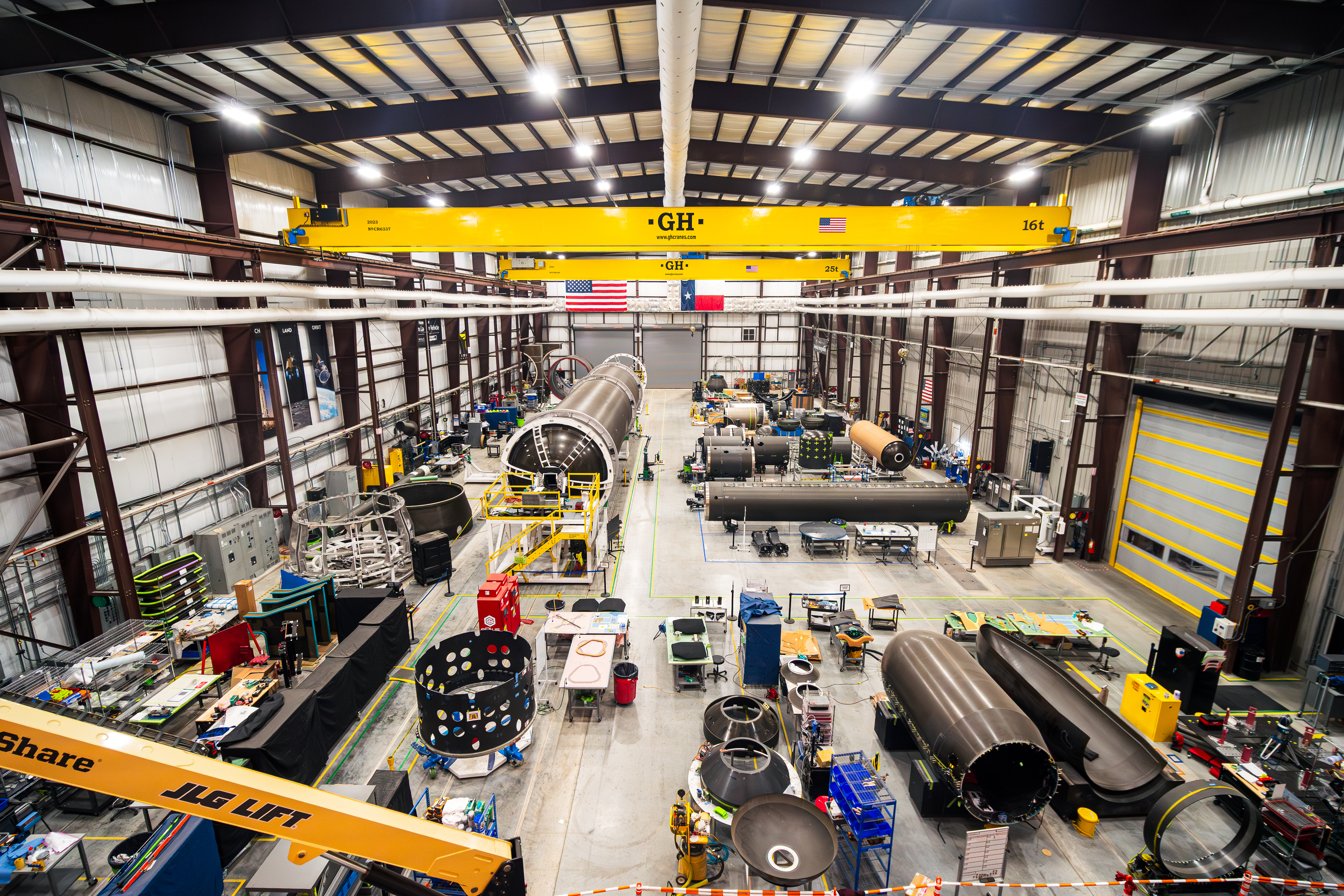
*Image of Firefly’s launch vehicle integration building at its Rocket Ranch in Briggs, Texas; Credit: Firefly Aerospace
Additional upgrades are being made to Firefly's Eclipse engine test stand to support multiple engines on the stand at once and increase testing cadence. Alpha's stage test stand is also getting enhancements to streamline test operations and improve ground system reliability.
About Firefly Aerospace
Firefly Aerospace is a space and defense technology company on a mission to reliably and repeatedly launch, land, and operate space systems from Earth to the Moon and beyond. As the partner of choice for responsive space missions, Firefly is the first commercial company to launch a satellite to orbit with approximately 24-hour notice and the first to achieve a successful landing on the Moon. Established in 2017, Firefly’s engineering, manufacturing, and test facilities are co-located in central Texas to enable rapid innovation and vertical integration for the company’s small- to medium-lift launch vehicles, lunar landers, and orbital vehicles. For more information, visit www.fireflyspace.com.
Forward-Looking Statements
This press release contains “forward-looking statements” including, but not limited to, statements regarding expectations regarding the Company’s clean room capacity, the Gloworks innovation lab, test stand enhancements, statements of Firefly’s chief operating officer and chief technology officer and other statements regarding Firefly’s future expectations, beliefs, plans, objectives, financial condition, assumptions, future events, or performance that are not historical facts. In some cases, you can identify forward-looking statements because they contain words such as “enable,” “demonstrate,” “may,” “will,” “expects,” “plans,” “anticipates,” “could,” “would,” “target”, “intends,” “support,” and “believes.” There may also be negative words or other similar terms or expressions that concern our expectations, strategy, plans, or intentions. Not all forward-looking statements contain such identifying words. The inclusion of forward-looking statements should not be regarded as a representation that such plans, estimates, or expectations will be achieved. Readers are cautioned not to place undue reliance on the forward-looking statements contained herein, which speak only as of the date hereof. These statements are based on management’s current expectations, assumptions, and beliefs concerning future developments, which are inherently subject to uncertainties, risks, and changes in circumstances that are difficult to predict. We cannot assure you that the events reflected in the forward-looking statements will occur; actual events could differ materially from those described in the forward-looking statements. In addition to the risks and uncertainties of our ordinary business operations and conditions in the general economy and markets in which we compete, the forward-looking statements in this press release are subject to the risks, uncertainties, and other factors disclosed in our filings with the U.S. Securities and Exchange Commission, including our Form 10-Q for the three months ended March 31, 2026, which risks, uncertainties, and other factors could cause actual events to differ materially from those described in the forward-looking statements. Any forward-looking statement speaks only as of the date as of which such statement is made, and except as required by law, we undertake no obligation to update or revise publicly any forward-looking statements whether because of new information, future events; etc.
Media Contact
press@fireflyspace.com
Photos accompanying this announcement are available at:
https://www.globenewswire.com/NewsRoom/AttachmentNg/e4067a1f-4c83-4cb4-ad0f-61a7c52cf3ef
https://www.globenewswire.com/NewsRoom/AttachmentNg/04e47455-b1ce-4a39-a6c0-4ca31536fba0
