
Firefly Aerospace Awarded $144 Million NASA CLPS Contract for Accelerated Blue Ghost Lunar Mission
Firefly Aerospace (Nasdaq: FLY) received a $144 million NASA CLPS contract to deliver an accelerated Blue Ghost lunar lander mission targeted for 2028.
Rhea-AI Summary
Firefly Aerospace (Nasdaq: FLY) received a $144 million NASA CLPS contract to deliver an accelerated Blue Ghost lunar lander mission targeted for 2028. The company plans to design, build, test, and deliver the mission in about two years, roughly half Mission 1’s timeline.
This will be Firefly’s sixth contracted lunar mission, using its flight-proven Blue Ghost design to provide repeatable lunar access. The lander will deliver three NASA science instruments to the Moon’s near side and is supported by expanded spacecraft production capacity near Austin, Texas.
Positive
- $144 million NASA CLPS contract for rapid Blue Ghost lunar mission
- Sixth contracted lunar mission, reinforcing recurring lunar business pipeline
- Mission design-to-delivery timeline cut to approximately two years
- Leveraging data from first successful Moon landing to enhance landers
- Strategy expanded from one to multiple Moon landings per year
- New spacecraft facility near Austin enables higher lander and orbiter production
Negative
- None.
Details
News Market Reaction – FLY
In the Jul 1 session, FLY declined 3.50%, reflecting a moderate negative market reaction.
Data tracked by StockTitan Argus on the day of publication.
Key Figures
- NASA CLPS contract
- $144 million
- Blue Ghost lunar lander mission award under NASA Commercial Lunar Payload Services
- Contracted lunar missions
- 6 missions
- Total number of contracted lunar missions including the new Blue Ghost award
- Target launch date
- 2028
- Planned launch year for the accelerated Blue Ghost lunar near-side mission
- Mission timeline
- 2 years
- Approximate design‑to‑delivery schedule, about half the time of Blue Ghost Mission 1
- NASA instruments
- 3 instruments
- LRA, LETS, and SCALPSS payloads to be delivered on the Blue Ghost lander
Historical Context
-
Acquisition of Space-ng to enhance autonomous guidance and navigation across missions.
-
SciTec awarded $5.5M U.S. Air Force contract option under larger ABMS award.
-
Public offering of common stock priced at $48 per share including secondary shares.
-
Launch of proposed common stock offering by company and selling stockholders.
-
Award of $75M NASA JPL MoonFall subcontract using Elytra to deliver lunar drones.
24h Move is the share-price change in the day after each event; other market factors may also have contributed.
Key Terms
commercial lunar payload services (clps) technical
lunar lander technical
laser retroreflector array (lra) technical
linear energy transfer spectrometer (lets) technical
stereo cameras for lunar plume surface studies (scalpss) technical
AI-generated analysis. How Rhea-AI works. Not financial advice.




Mission accelerates Moon delivery timeline and enables repeatable lunar access with flight proven lunar lander
CEDAR PARK, Texas, June 30, 2026 (GLOBE NEWSWIRE) -- Firefly Aerospace (Nasdaq: FLY), a market leading space and defense technology company, today announced a
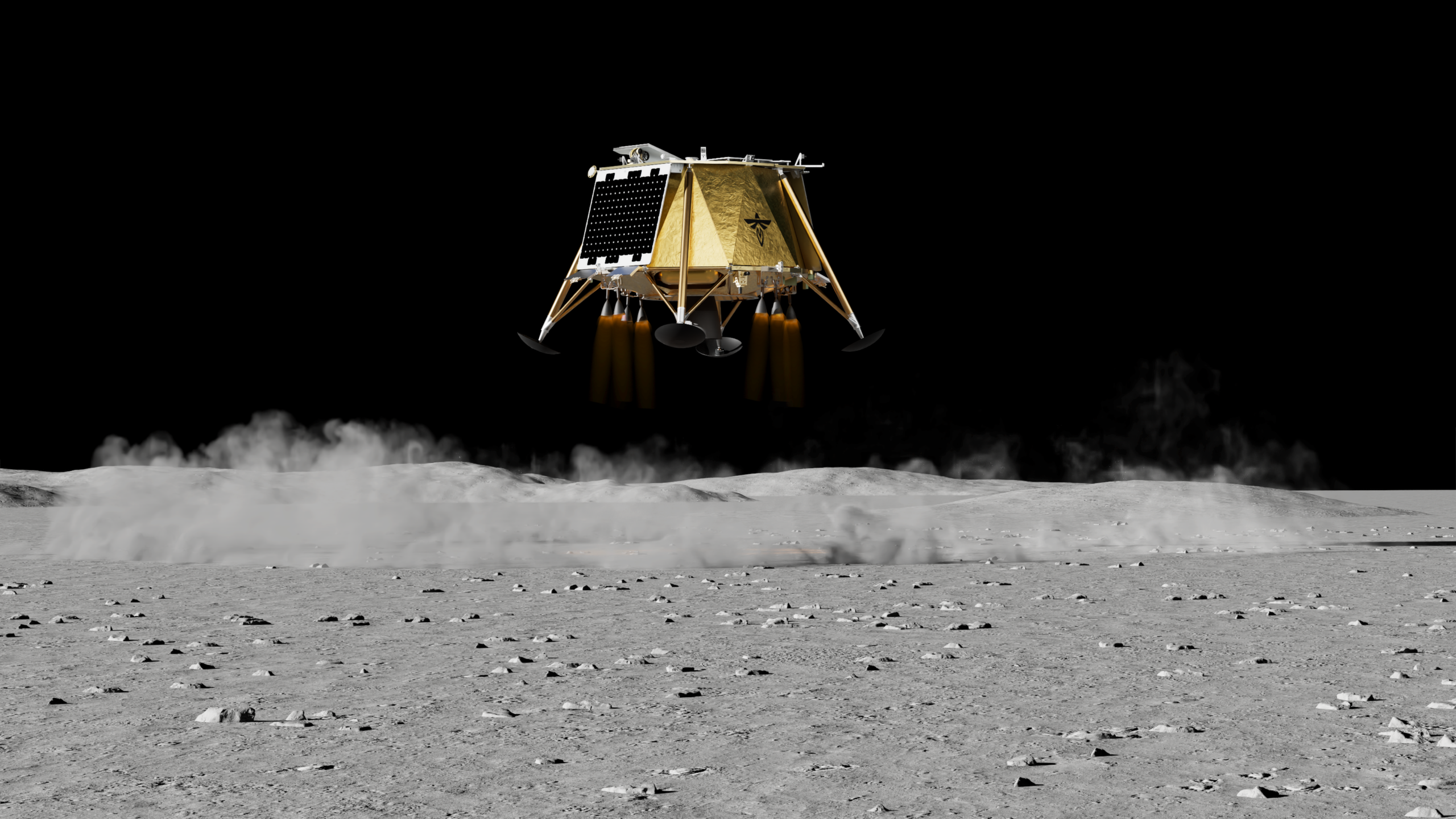
Targeted to launch in 2028, Firefly will design, build, test, and deliver the mission in approximately two years, half the time of the historic Blue Ghost Mission 1, by utilizing its proven Blue Ghost lander design and operations. For this mission, Blue Ghost will return to the Moon’s near side, similar to where Mission 1 landed, and deliver three NASA science instruments, including the Laser Retroreflector Array (LRA) to enable precision laser ranging, the Linear Energy Transfer Spectrometer (LETS) to measure the radiation environment, and the Stereo Cameras for Lunar Plume Surface Studies (SCALPSS) to further study plume-surface interactions during touchdown.
“This latest mission award will help prove that commercial lunar delivery can be rapid, repeatable, and reliable – exactly what's needed to enable a permanent lunar presence and support NASA’s Moon Base initiative and Artemis program,” said Jason Kim, CEO of Firefly Aerospace. “With amplified demand signal from NASA and commercial customers, Firefly extended our growth strategy from one annual Moon landing to multiple a year. We’re now utilizing our proven lander, operational maturity, and expanded production capacity to meet this demand.”
Firefly is leveraging valuable flight data from its first successful lunar mission to enhance its Blue Ghost landers with optimized thermal systems and advanced operational procedures based on real mission experience. These incremental improvements are being integrated into a build-to-print lander, enabling faster production cycles without the need for extensive redesign between missions.
“We're not reinventing the wheel with each mission,” said Ray Allensworth, Vice President of Spacecraft at Firefly Aerospace. “We’ve templated our Blue Ghost design to cut our lunar delivery time in half, and we're not stopping there. We'll continue to improve that timeline as we scale up spacecraft production, execute on multiple missions, and apply lessons learned from each mission.”
Following the company’s first successful Moon landing, Firefly’s other upcoming lunar missions include deliveries to the Moon’s far side, Gruithuisen Domes, and south pole with Firefly’s Blue Ghost lander and Elytra orbiter as well as a recent subcontract to deliver NASA’s MoonFall drones above the lunar south pole with Elytra. Each vehicle will be built and assembled at Firefly new expansive spacecraft facility and cleanroom near Austin, Texas, enabling a more robust production line of lunar landers and orbital vehicles.
For more information on the latest mission, visit: https://fireflyspace.com/missions/blue-ghost-lunar-near-side/
About Firefly Aerospace
Firefly Aerospace is a space and defense technology company on a mission to reliably and repeatedly launch, land, and operate space systems from Earth to the Moon and beyond. As the partner of choice for responsive space missions, Firefly is the first commercial company to launch a satellite to orbit with approximately 24-hour notice and the first to achieve a successful landing on the Moon. Established in 2017, Firefly’s engineering, manufacturing, and test facilities are co-located in central Texas to enable rapid innovation and vertical integration for the company’s small- to medium-lift launch vehicles, lunar landers, and orbital vehicles. For more information, visit www.fireflyspace.com.
Forward-Looking Statement
This press release contains “forward-looking statements” including, but not limited to, statements regarding expectations regarding CLPS mission targets, timing to execute missions, mission details and mission payloads, statements regarding Firefly’s upcoming lunar missions, statements of Firefly’s chief executive officer and VP of spacecraft, and other statements regarding Firefly’s future expectations, beliefs, plans, objectives, financial condition, assumptions, future events, or performance that are not historical facts. In some cases, you can identify forward-looking statements because they contain words such as “expand,” “may,” “will,” “expects,” “plans,” “anticipates,” “could,” “would,” “target,” “intends,” “support,” and “believes.” There may also be negative words or other similar terms or expressions that concern our expectations, strategy, plans, or intentions. Not all forward-looking statements contain such identifying words. The inclusion of forward-looking statements should not be regarded as a representation that such plans, estimates, or expectations will be achieved.
Various risks that could cause actual results to differ from those expressed by the forward-looking statements included in this press release include, but are not limited to: our failure to manage our growth effectively, including the increasing technological complexity of our business, and our ability to achieve and maintain profitability; the potential for delayed or failed launches, and any failure of our launch vehicles and spacecraft to operate as intended; our inability to deliver software on time or of a quality that our customers demand; the hazards and operational risks that our products and service offerings are exposed to, including the wide and unique range of risks due to the unpredictability of space; the inability to realize our backlog; the fluctuation of our operating results; adverse publicity stemming from any incident involving us, our competitors, or our customers; the failure to adequately protect our proprietary intellectual property rights; our inability to comply with our contractual obligations; and other risk factors set forth in our filings with the Securities and Exchange Commission.
Readers are cautioned not to place undue reliance on the forward-looking statements contained herein, which speak only as of the date hereof. These statements are based on management’s current expectations, assumptions, and beliefs concerning future developments, which are inherently subject to uncertainties, risks, and changes in circumstances that are difficult to predict. We cannot assure you that the events reflected in the forward-looking statements will occur; actual events could differ materially from those described in the forward-looking statements. We undertake no intent or obligation to publicly update or revise any of the estimates and other forward-looking statements made in this announcement, whether as a result of new information, future events or otherwise, except as required by law.
Media Contact
press@fireflyspace.com
A photo accompanying this announcement is available at https://www.globenewswire.com/NewsRoom/AttachmentNg/2d3c8e1a-eee1-4d1e-822c-9fefef14d4a6

FAQ
AI-generated questions and answers. How Rhea-AI works. Not financial advice.