
Firefly Aerospace Wins $75 Million NASA JPL MoonFall Subcontract to Deliver Drones to the Moon’s South Pole
Firefly Aerospace (Nasdaq: FLY) won a $75 million NASA JPL MoonFall subcontract to use its Elytra spacecraft to deliver four drones to the Moon’s south pole.
Rhea-AI Summary
Firefly Aerospace (Nasdaq: FLY) won a $75 million NASA JPL MoonFall subcontract to use its Elytra spacecraft to deliver four drones to the Moon’s south pole. Launch is targeted for no earlier than 2028 and supports NASA’s Moon Base and Artemis initiatives.
The Elytra Dark configuration will transport up to 1,000 kg of drones, deploying them about 50 km above the lunar south pole. The drones will survey terrain and resources over a lunar day, with survive-the-night payloads operating for several months.
Positive
- $75 million NASA JPL subcontract for MoonFall mission
- Elytra Dark configuration designed to deliver 1,000 kg of drones
- Mission supports NASA Moon Base and Artemis south pole exploration
- Builds on Blue Ghost systems and first commercial Moon landing heritage
- Adds to three existing NASA CLPS lunar missions in Firefly’s portfolio
- Expansion of cleanroom to enable assembly line lunar spacecraft production
Negative
- None.
Details
News Market Reaction – FLY
In the May 27 session, FLY declined 2.60%, reflecting a moderate negative market reaction.
Data tracked by StockTitan Argus on the day of publication.
Key Figures
- NASA JPL subcontract value
- $75 million
- MoonFall drones delivery mission award
- Number of drones
- 4 drones
- Elytra spacecraft payload for MoonFall mission
- Earliest launch year
- 2028
- MoonFall mission targeted launch no earlier than 2028
- Transit duration
- 45 days
- Elytra transit time from launch to lunar orbit
- Deployment altitude
- 50 km
- Approximate altitude above lunar south pole for drone deployment
- Operational period
- 14 Earth days
- Maximum single lunar day surface operations per drone
- Drone payload capacity
- 1,000 kg
- Elytra Dark configuration delivery capacity for MoonFall drones
- Price move on news
- 15.49%
- Pre-news 24h price change for FLY
Historical Context
-
Expanded Cedar Park campus and cleanroom to boost spacecraft production.
-
SciTec awarded AFRL contract for advanced sensor algorithms and architecture.
-
Strong revenue growth but substantial operating and net losses in Q1 2026.
-
SciTec received OTA agreement supporting Space-Based Interceptor program.
-
Announced timing of Q1 2026 results release and related conference call.
24h Move is the share-price change in the day after each event; other market factors may also have contributed.
Key Terms
cislunar technical
AI-generated analysis. How Rhea-AI works. Not financial advice.




Firefly’s Elytra spacecraft will deliver four drones above the lunar south pole to support NASA’s MoonFall mission and the agency’s Moon Base initiatives
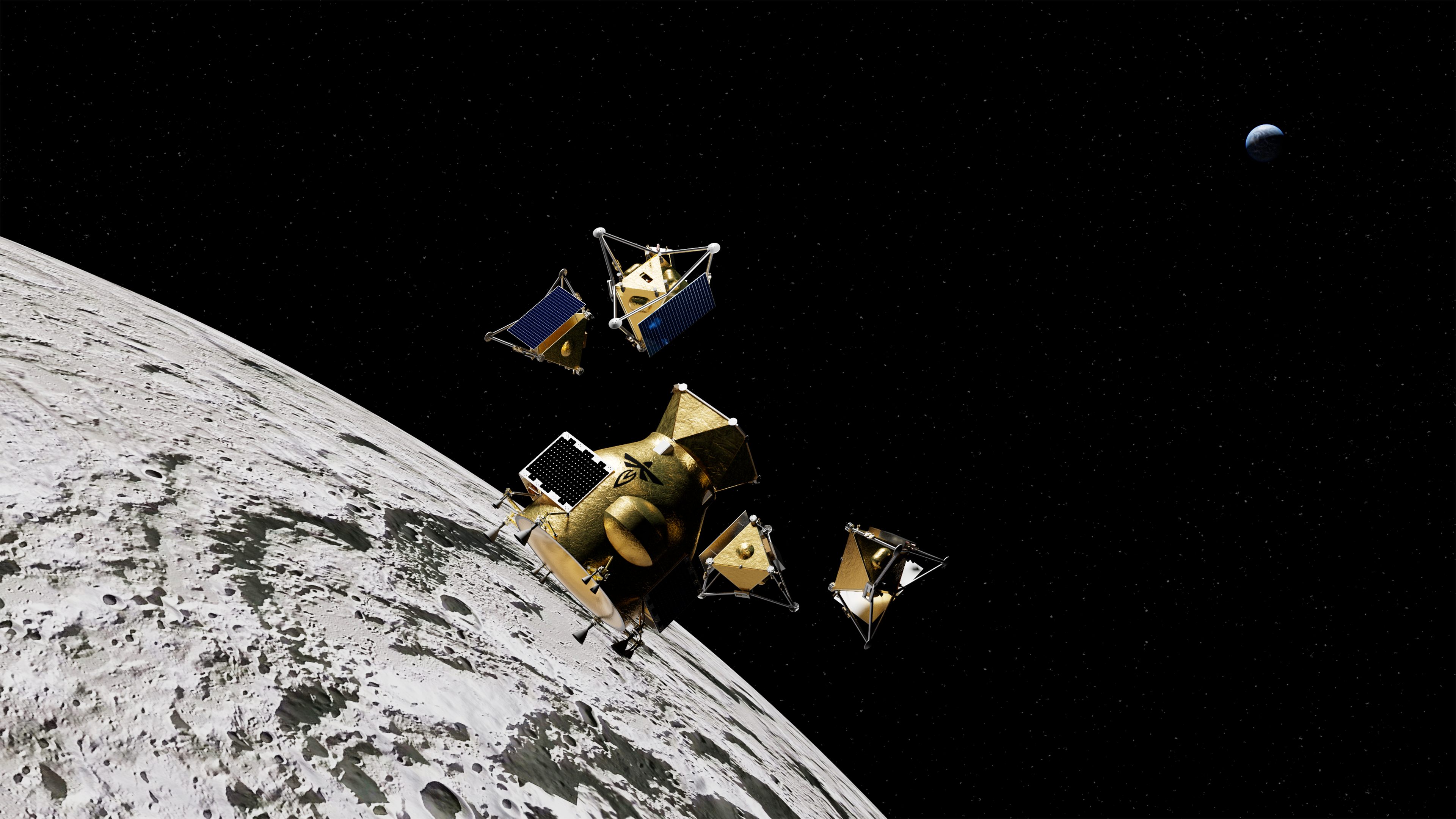
CEDAR PARK, Texas, May 26, 2026 (GLOBE NEWSWIRE) -- Firefly Aerospace (Nasdaq: FLY), a market leading space and defense technology company, today announced it was awarded a
"NASA’s MoonFall is an incredible breakthrough mission well aligned with the bold innovation and successful execution that Firefly is known for,” said Jason Kim, CEO of Firefly Aerospace. "This subcontract underscores our commitment to executing challenging missions that push the boundaries of lunar exploration. Built upon the same proven systems that landed Blue Ghost on the Moon, our Elytra spacecraft are equipped to deploy critical high-mass payloads across cislunar space.”
JPL is building the drones and managing the mission for NASA, which will source the launch vehicle for MoonFall. Upon launching, Firefly’s Elytra spacecraft will carry the drones over a 45-day transit to the Moon and enter lunar orbit before deorbiting and performing a braking maneuver to deploy the drones approximately 50 km above the Moon’s south pole.
The MoonFall drones will then land and operate over the course of a single lunar day (up to 14 Earth days) to survey the lunar south pole terrain, including permanently shadowed regions, with high-definition optical cameras and instruments. Based on the legacy of NASA’s Ingenuity Mars Helicopter, the drones will be capable of multiple propulsive hops to explore hard-to-reach areas and map safe landing spots and resources, such as water ice, in support of future human missions under NASA’s Artemis program. After each drone’s final flight, its survive-the-night payload will continue to operate for several months, marking a sustained U.S. presence at the lunar south pole.
The MoonFall subcontract builds on Firefly’s growing portfolio of spacecraft missions, including three additional missions to the Moon through NASA’s Commercial Lunar Payload Services (CLPS) initiative. Firefly recently completed critical test milestones for Blue Ghost Mission 2 and is making significant progress on Blue Ghost Missions 3 and 4 as the company simultaneously expands its cleanroom to enable an assembly line of lunar landers and spacecraft.
“As NASA accelerates its Moon Base initiatives, Firefly is rapidly scaling spacecraft production to support these missions and subsequent Blue Ghost lunar landings,” said Ray Allensworth, Vice President of Spacecraft at Firefly aerospace. “This is a transformational era for our industry, and we're excited to add this innovative mission to our growing manifest.”
Firefly’s Elytra spacecraft are built with proven systems from Blue Ghost Mission 1, including the core avionics, carbon composite structures, and Spectre engines that enabled the first successful commercial Moon landing. With high delta-V and added payload capacity, the Elytra Dark configuration for the MoonFall mission is equipped to deliver 1,000 kg of drones.
For more information on NASA’s MoonFall mission, visit https://fireflyspace.com/missions/elytra-nasa-moonfall/ or https://www.jpl.nasa.gov/missions/moonfall.
About Firefly Aerospace
Firefly Aerospace is a space and defense technology company on a mission to reliably and repeatedly launch, land, and operate space systems from Earth to the Moon and beyond. As the partner of choice for responsive space missions, Firefly is the first commercial company to launch a satellite to orbit with approximately 24-hour notice and the first to achieve a successful landing on the Moon. Established in 2017, Firefly’s engineering, manufacturing, and test facilities are co-located in central Texas to enable rapid innovation and vertical integration for the company’s small- to medium-lift launch vehicles, lunar landers, and orbital vehicles. For more information, visit www.fireflyspace.com.
Forward-Looking Statement
This press release contains “forward-looking statements” including, but not limited to, statements regarding expectations regarding timing of the MoonFall mission, Elytra and drone performance specifics and capabilities, targets for drone surveys, status of Firefly’s Blue Ghost missions, statements of Firefly’s chief executive officer and other statements regarding Firefly’s future expectations, beliefs, plans, objectives, financial condition, assumptions, future events, or performance that are not historical facts. In some cases, you can identify forward-looking statements because they contain words such as “enable,” “demonstrate,” “may,” “will,” “expects,” “plans,” “anticipates,” “could,” “would,” “target”, “intends,” “support,” and “believes.” There may also be negative words or other similar terms or expressions that concern our expectations, strategy, plans, or intentions. Not all forward-looking statements contain such identifying words. The inclusion of forward-looking statements should not be regarded as a representation that such plans, estimates, or expectations will be achieved. Readers are cautioned not to place undue reliance on the forward-looking statements contained herein, which speak only as of the date hereof. These statements are based on management’s current expectations, assumptions, and beliefs concerning future developments, which are inherently subject to uncertainties, risks, and changes in circumstances that are difficult to predict. We cannot assure you that the events reflected in the forward-looking statements will occur; actual events could differ materially from those described in the forward-looking statements. In addition to the risks and uncertainties of our ordinary business operations and conditions in the general economy and markets in which we compete, the forward-looking statements in this press release are subject to the risks, uncertainties, and other factors disclosed in our filings with the U.S. Securities and Exchange Commission, including our Form 10-Q for the three months ended March 31, 2026, which risks, uncertainties, and other factors could cause actual events to differ materially from those described in the forward-looking statements. Any forward-looking statement speaks only as of the date as of which such statement is made, and except as required by law, we undertake no obligation to update or revise publicly any forward-looking statements whether because of new information, future events; etc.
Media Contact
press@fireflyspace.com
A photo accompanying this announcement is available at https://www.globenewswire.com/NewsRoom/AttachmentNg/4660de3e-abd3-4b7d-846c-00bcf4793424

FAQ
AI-generated questions and answers. How Rhea-AI works. Not financial advice.