GE HealthCare Announces First Patient Dosed in Phase 2/3 LUMINA Trial for Manganese-Based MRI Contrast Agent Under FDA Fast Track Designation, Further Advancing Its Innovation Pipeline of Novel Imaging Agents
GE HealthCare Announces First Patient Dosed in Phase 2/3 LUMINA Trial for Manganese-Based MRI Contrast Agent Under FDA Fast Track Designation, Further Advancing Its Innovation Pipeline of Novel Imaging Agents
Magnetic resonance imaging (MRI) is a medical scan that uses magnetic fields and radio waves to create detailed pictures of the inside of the body, like a high-resolution camera for tissues and organs. Investors care because MRI drives demand for imaging machines, hospital services, diagnostics and can be central to clinical trial results and regulatory decisions—changes in MRI use or technology can affect revenue, capital spending and reimbursement in healthcare and medical device markets.
fast track designationregulatory
Fast track designation is a status the U.S. Food and Drug Administration grants to drugs intended to treat serious conditions and address an unmet medical need. It gives the developer more frequent communication with the FDA and can allow parts of the application to be reviewed on a rolling basis, and it may pave the way to priority review or accelerated approval. It can shorten development timelines, though it does not guarantee approval.
contrast agentmedical
A contrast agent is a substance given to a patient before an imaging scan (like an X-ray, CT, or MRI) that makes blood vessels, organs or abnormal tissue show up more clearly — think of it as a dye that highlights features on a photo. Investors care because the safety, regulatory approval, supply, and pricing of these agents directly affect demand for imaging procedures, reimbursement, and the revenues and risks of companies that make or use them.
gadolinium-based mri agentsmedical
Gadolinium-based MRI agents are injectable substances used during magnetic resonance imaging to make blood vessels, tissues, and abnormalities show up more clearly on scans—think of them as a harmless dye that highlights details in a photograph. Investors care because safety findings, regulatory rulings, and competition influence how often these agents are used, their price and market access, and potential legal or recall costs, all of which can affect healthcare company revenues and stock values.
relaxivitytechnical
Relaxivity measures how effectively a magnetic resonance imaging (MRI) contrast agent changes the MRI signal per unit concentration, similar to how a small amount of dye can make a photo noticeably brighter. Higher relaxivity means less of the agent is needed to produce a clear image, which can affect clinical performance, dosing, safety profiles and regulatory approval — all factors that influence a product’s competitiveness and commercial value to investors.
rare-earth metaltechnical
A rare-earth metal is one of a group of 17 metallic elements used in small amounts to make everyday high-tech products work — for example, powerful magnets in electric motors, components in smartphones, and catalysts in refining. Investors care because these metals are critical supply-chain ingredients whose scarcity, concentrated production, and export controls can sharply influence costs and profit margins for companies that rely on them, much like a hard-to-find spice can change the price of a recipe.
endogenous elementmedical
An endogenous element is a factor or component that originates from inside a system rather than coming from outside — for example something produced by the body in medical settings or a condition arising within a company or market. Investors care because internally driven changes often signal the underlying health, sustainability, or risk of an asset; knowing whether a shift comes from within is like checking whether a car problem is due to the engine (internal) or the weather (external), which affects prognosis and response.
central nervous systemmedical
The central nervous system (CNS) is the body's main control center, made up of the brain and spinal cord, that processes information and directs movement, sensation and basic functions like breathing. For investors, CNS-related products and research matter because they face long development times, strict safety testing and regulatory hurdles; success or failure can dramatically affect a company’s costs, timelines and potential market value.
See more from StockTitan in Google Search and AI answers.Adds StockTitan as a preferred source · opens Google
Mangaciclanol, if approved, could transform contrast-enhanced MR imaging by offering an alternative to - or even replacing - gadolinium-based MRI agents
A manganese-based MRI contrast agent could address concerns with gadolinium-based contrast agents around retention in the body, security of supply, and the environment, with mangaciclanol’s clinical development under FDA Fast Track designation
The program demonstrates GE HealthCare’s commitment to advancing novel imaging agents to address unmet patient needs
CHALFONT ST GILES, England--(BUSINESS WIRE)--
GE HealthCare (Nasdaq: GEHC) today announced the first patient has been dosed in the international, multi-center Phase 2/3 LUMINA clinical trial of its manganese-based magnetic resonance imaging (MRI) contrast agent, mangaciclanol, at Mayo Clinic in Rochester, Minnesota. Mangaciclanol, if approved, could offer an alternative to – or even replace – gadolinium-based MRI contrast agents, the current standard of care. The investigational agent has been granted Fast Track designation by the U.S. Food and Drug Administration (FDA) for use in adults and pediatric patients aged 2 years and older with MRI to detect and visualize lesions with abnormal vascularity in the central nervous system and the body. FDA Fast Track designation expedites the review of new therapeutics and medical imaging agents that have the potential to address significant unmet patient needs.
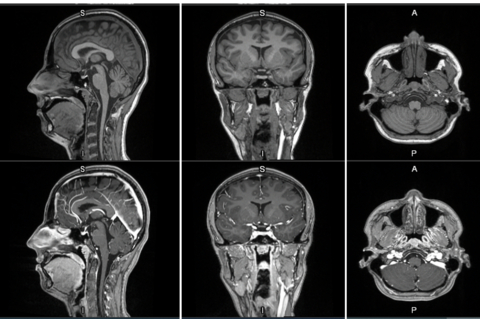
First-in-human contrast enhanced MRI images with GE HealthCare's mangaciclanol
MRI contrast agents enhance the visualization of abnormal structures or lesions during imaging procedures and help clinicians better distinguish between healthy and diseased tissue. Mangaciclanol is intended for general-purpose MR imaging and demonstrates comparable relaxivity (the ability to enhance signal intensity) to market-leading gadolinium-based agent, gadobutrol, with early clinical images suggesting similar diagnostic capability. Unlike gadolinium, which is a rare-earth metal, manganese is present in our food, and is an endogenous element, naturally occurring and autoregulated in the body. The macrocyclic ‘cage-like’ structure of mangaciclanol lessens the possibility of retention.
Approximately one-third of global MRI procedures require a contrast agent for effective diagnosis,1 with around 65 million gadolinium contrast enhanced procedures globally each year.2 As a rare-earth element, gadolinium supply is largely dependent on mining and processing infrastructure in China. Manganese, however, is abundantly available from multiple countries, including South Africa, Australia and Gabon, reducing the risk of supply challenges impacting patient care. Furthermore, as manganese is naturally found in water sources, mangaciclanol could also reduce environmental concerns associated with post-patient excreted contrast media in groundwater.
Dr Jit Saini, Chief Medical Officer, Pharmacutical Diagnostics, GE HealthCare, said, “Existing gadolinium-based contrast agents carry safety language associated with gadolinium retention. In comparison, mangaciclanol could offer an alternative for broad patient groups, including vulnerable patients and those requiring multiple scans, while still offering similar diagnostic performance. The FDA Fast Track designation recognizes the potential significance of mangaciclanol and aligns with our focus on advancing its development for patients.”
“As demand for diagnostic imaging continues to rise, we continue to advance our imaging agent pipeline to better meet the needs of patients,” said Peter Arduini, President and CEO, GE HealthCare. “This clinical milestone builds on GE HealthCare’s leadership in contrast media, as mangaciclanol has the potential to transform the MR imaging market and strengthen the resiliency of its supply chain.”
Phase 1 results for mangaciclanol showed the investigational agent was well tolerated in a first in human trial with no serious adverse events, no dose limiting toxicities, nor clinically relevant findings reported.
GE HealthCare’s Pharmaceutical Diagnostics unit is a global leader in imaging agents used to support 140 million patient procedures per year globally, equivalent to four procedures every second. For more than 40 years, GE HealthCare contrast media has been routinely used across MRI, X-ray/CT and ultrasound to enhance clinical images and support diagnosis.
Mangaciclanol is in clinical development and currently not approved for use.
About GE HealthCare Technologies Inc.
GE HealthCare is a leading global healthcare solutions provider of advanced medical technology, pharmaceutical diagnostics, and AI, cloud and software solutions that help clinicians tackle the world’s most complex diseases. Serving patients and providers for 130 years, GE HealthCare is delivering bold innovations designed for the next era of medicine across its Imaging, Advanced Visualization Solutions, Patient Care Solutions, and Pharmaceutical Diagnostics segments to help clinicians deliver more personalized, precise patient care. We are a $20.6 billion business with approximately 54,000 colleagues working to create a world where healthcare has no limits.