
Gen Q4 Threat Report Shows Scams Thriving Inside Ads, Feeds, and Video
Gen (NASDAQ: GEN) released its Q4 2025 Threat Report (Oct–Dec), showing scams and malvertising dominated consumer cyberthreats.
Rhea-AI Summary
Gen (NASDAQ: GEN) released its Q4 2025 Threat Report (Oct–Dec), showing scams and malvertising dominated consumer cyberthreats. Key data: over 45 million fake shop attacks blocked in Q4 (a 62% increase vs Q4 2024), malvertising made up 41% of attacks, and breaches rose 176% QoQ. The report highlights deepfake scam videos, cross‑device GhostPairing attacks, and social‑platform concentration on Facebook, YouTube, and X.
Positive
- Blocked >45 million fake shop attacks in Q4 2025
- Fake shops were >50% of 2025 fake shop blocks
- Malvertising accounted for 41% of all attacks
- Breaches detection rose 176% quarter‑over‑quarter
Negative
- Fake shop attacks rose >62% vs Q4 2024
- 65% of social media threats tied to fake shops
- AI deepfake scam videos prevalent on YouTube and Facebook
Details
News Market Reaction – GEN
On Jan 20, the day this news came out, GEN closed 3.68% below the previous close.
Data tracked by StockTitan Argus for the Jan 20 session.
Key Figures
- Fake shop attacks blocked
- over 45 million
- Q4 2025 fake online shop attacks blocked by Gen
- Fake shop attack growth
- more than 62%
- Increase vs Q4 2024 in fake shop attacks
- Social threats share
- 65%
- Share of social media threats from fake shops
- Facebook phishing share
- 77%
- Share of phishing activity led by Facebook
- YouTube phishing share
- 13%
- Share of phishing activity on YouTube
- Reddit phishing share
- 4%
- Share of phishing activity on Reddit
- Malvertising share
- 41%
- Portion of 2025 individual attacks tied to fake ads
- Breach increase
- 176%
- Quarter-over-quarter increase in breaches in Gen telemetry
Historical Context
-
Form S-4 filing for proposed RTB Digital merger structure and timeline.
-
Announcement of fiscal 2026 Q3 earnings release and conference call timing.
-
Cybersecurity predictions highlighting AI, deepfakes, and browser-based malvertising.
-
MoneyLion holiday giveaway campaign offering daily cash prizes.
-
CEO and CFO fireside chat at Barclays Global Technology Conference.
24h Move is the share-price change in the day after each event; other market factors may also have contributed.
Key Terms
malvertising technical
deepfake technical
phishing technical
telemetry technical
sideloading technical
AI-generated analysis. How Rhea-AI works. Not financial advice.




Fake ads led all consumer cyberthreats in 2025, with over 45 million fake shop attacks blocked in Q4 and deepfake scams surging on social media
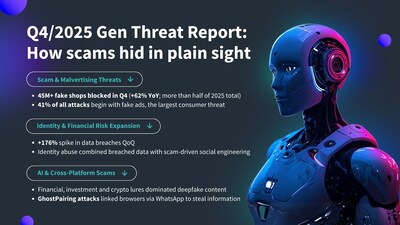
The report reveals how cybercrime in late 2025 increasingly relied on ordinary digital actions rather than sophisticated exploits. Across browsers, social feeds, messaging apps, and money tools, the most damaging attacks succeeded when people completed the final step themselves: clicking a link, scanning a QR code, approving a device pairing, or entering a verification code.
"Increasingly throughout 2025, scams did not announce themselves as threats. They blended into everyday digital routines," said Siggi Stefnisson, Cyber Safety CTO at Gen. "Attackers leaned on familiar platforms, trusted interfaces, and automated persuasion, then scaled those tactics across devices and channels."
Scams and Malvertising Dominate Shopping and Social Media
Scams showed up where people already spend their time online: in social feeds and videos. Fake online shops dominated during the holiday season with over 45 million blocked fake shop attacks in Q4, more than half of all fake shop attacks blocked in 2025 and a more than
Gen telemetry also showed that malvertising – fake advertisements – was the top cyberthreat to individuals in 2025, accounting for
Dangerous Deepfakes
Gen introduced on-device detection on Windows focused on the intersection of manipulated media and scam intent. Early telemetry from this launch showed that YouTube accounted for the largest share of blocked AI scam videos, followed by Facebook and X. Most blocked content was tied to financial, investment, and cryptocurrency lures, and was intercepted during playback, not downloads.
Identity and Financial Risk Broadened
Identity abuse continued to compound beyond traditional credit misuse. Gen telemetry shows the number of breaches increased
- New property-related records
- Unusual activity in everyday banking accounts
- New applications for installment loans, leases, and retail credit
- Transaction-level anomalies on credit cards and loans
The rising risk ratios in these categories reinforce what external reports suggest: identity fraud is getting more layered, touching property records, deposits, credit instruments and scam-driven social engineering in parallel.
Threats Continue to Move Across Platforms
In Q4, Gen saw scams increasingly move back and forth between devices, using people to carry the attack across platforms. Some campaigns started on desktop with fake tutorial pages, then pushed victims to scan the screen with their phone, shifting the next steps onto mobile where permissions, sideloading, or verification were more likely. Others moved in the opposite direction. In GhostPairing attacks, first uncovered and named by Gen Threat Labs, victims entered a numeric code in WhatsApp on their phone, unknowingly linking an attacker-controlled browser as a trusted device and enabling rapid spread through contacts. Together, these patterns showed how modern scams crossed device boundaries to scale quickly and stay invisible.
As 2025 closed, Gen's Q4 data showed that the attack surface had become continuous across browsers, chats, social platforms, and money apps. The most damaging incidents began with small, familiar actions performed under time pressure or false reassurance.
To read the full Q4/2025 Gen Threat Report, visit https://www.gendigital.com/blog/insights/reports/threat-report-q4-2025
About Gen
Gen (NASDAQ: GEN) is a global company dedicated to powering Digital Freedom through its trusted consumer brands including Norton, Avast, LifeLock, MoneyLion and more. The Gen family of consumer brands is rooted in providing financial empowerment and cyber safety for the first digital generations. Today, Gen empowers people to live their digital lives safely, privately and confidently for generations to come. Gen brings award-winning products and services in cybersecurity, online privacy, identity protection and financial wellness to nearly 500 million users in more than 150 countries. Learn more at GenDigital.com.
About the Gen Threat Labs
Gen Threat Labs is the Cyber Safety research team within Gen, focused on uncovering and analyzing the latest digital threats and scams worldwide. Rooted in data, research, and technical expertise, the team identifies patterns and risks that shape the evolving cyber landscape. Their insights power the security technologies that protect people across Gen's portfolio of trusted brands, including Norton, Avast, LifeLock, and others.
Brittany Posey
Gen
Press@GenDigital.com
Courtney Rowles
Edelman for Gen
Courtney.Rowles@Edelman.com
____________________ | |
1 | Data from PCs |

 View original content to download multimedia:https://www.prnewswire.com/news-releases/gen-q4-threat-report-shows-scams-thriving-inside-ads-feeds-and-video-302664955.html
SOURCE Gen Digital Inc.
FAQ
AI-generated questions and answers. How Rhea-AI works. Not financial advice.