
GoldMining Announces Positive PEA Highlighting $532 Million After-Tax NPV and 42% IRR at its São Jorge Project, Brazil
GoldMining (NYSE American: GLDG) announced a positive PEA for its São Jorge gold project in Brazil, outlining an after-tax NPV5% of $532 million, 42.4% IRR, and 2.8-year payback at $3,500/oz gold with $202 million initial capital.
Rhea-AI Summary
GoldMining (NYSE American: GLDG) announced a positive PEA for its São Jorge gold project in Brazil, outlining an after-tax NPV5% of $532 million, 42.4% IRR, and 2.8-year payback at $3,500/oz gold with $202 million initial capital.
The study forecasts average annual production of about 51 koz over a 10.6-year mine life, total production of 543 koz, and estimated AISC of $1,464/oz. GoldMining reports a balance sheet with roughly $183 million in cash and securities and plans to advance pre-feasibility and permitting. The PEA is preliminary and includes Inferred resources, so results are uncertain.
Positive
- Base case after-tax NPV5% of $532.5 million at $3,500/oz gold
- After-tax IRR of 42.4% and payback in 2.83 years
- Initial capital of $202.2 million including 25% contingency
- Estimated average LOM AISC of $1,464/oz payable
- Forecast total gold production of 543 koz over 10.6 years
- Company holds about $183 million in cash and marketable securities
Negative
- PEA is preliminary and includes Inferred Mineral Resources with uncertain economics
- No Mineral Reserves have been defined for the São Jorge project yet
- Total capital requirements estimated at $267.2 million including closure costs
Details
News Market Reaction – GLDG
In the Jun 11 session, GLDG gained 10.01%, reflecting a significant positive market reaction.
Data tracked by StockTitan Argus on the day of publication.
Key Figures
- After-tax NPV5% (base case)
- $532.5M
- São Jorge PEA at $3,500/oz Au
- After-tax IRR (base case)
- 42.4%
- São Jorge PEA at $3,500/oz Au
- After-tax NPV5% (spot)
- $836.8M
- São Jorge PEA at $4,400/oz Au
- After-tax IRR (spot)
- 58.6%
- São Jorge PEA at $4,400/oz Au
- Initial capital
- $202.2M
- São Jorge initial capex including 25% contingency
- AISC
- $1,464/oz
- São Jorge life-of-mine all-in sustaining cost
- Average annual production
- 51.2 koz
- São Jorge LOM average gold production
- Mine life
- 10.6 years
- São Jorge PEA life of mine
Historical Context
-
Filed NI 43-101 PEA for La Mina with $1.0B after-tax NPV5% and 32.2% IRR.
-
Commenced fully funded 1,200 m core drilling at Yarumalito gold-copper project.
-
Reported 2026 AGM results with over 91% support for all director nominees.
-
Released updated La Mina PEA showing $1.0B after-tax NPV5% and 32.2% IRR.
-
Started 8,000 m drill program and 49 line-km IP survey at São Jorge.
24h Move is the share-price change in the day after each event; other market factors may also have contributed.
Key Terms
preliminary economic assessment technical
npv5% financial
internal rate of return financial
all-in sustaining cost financial
life of mine technical
indicated technical
inferred mineral resources technical
ni 43-101 regulatory
AI-generated analysis. How Rhea-AI works. Not financial advice.




All currency amounts herein are in US dollars unless otherwise indicated.
PEA Highlights
- Strong Base Case Economics: The PEA sets out a base case scenario with an after-tax net present value at a
5% discount rate ("NPV5% ") of$532 million 42.4% utilizing base case gold price of$3,500 - Leverage to Gold Price: At spot gold prices (
$4,400 5% increases to$836.8 million 58.6% and an initial payback of just 2.4 years. - High Capital Efficiency & Infrastructure Advantage: Initial capital is estimated at a highly manageable
$202 million 25% contingency), representing an attractive 2.6x base case NPV5% to initial capital ratio. This relatively low capital hurdle is directly supported by the Project's ideal location, situated adjacent to existing power lines, paved highways, and an available skilled workforce. - Balance Sheet Backing: The Company's strong balance sheet comprising approximately
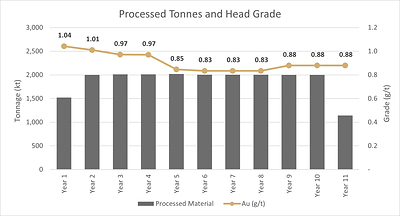
$183 million - Cash Generator for the Company: The PEA envisages a robust internal free cash flow, supported by a stable gold production profile averaging an estimated 51,250 oz annually over a 10.6-year life of mine ("LOM"), with peak gold production of 57,200 oz per year in years 2 through 4.
- Resilient Cost Profile: The PEA highlights relatively strong estimated margins, supported by an estimated life of mine All-In Sustaining Cost ("AISC") of
$1,464 - Conventional Operation: The PEA contemplates a conventional open-pit truck-and-shovel operation and a processing rate of 5,500 tonnes per day. A proven processing flowsheet utilizing standard gravity and leach circuits achieves high metallurgical recoveries of
90% Au. - Advancing Pre-Feasibility Studies: The Company plans to expeditiously commence pre-feasibility studies as the Project is further de-risked and moves forward with permitting towards a construction decision.
Alastair Still, CEO of GoldMining commented, "The São Jorge PEA marks a significant milestone in the advancement of our corporate strategy. By combining a manageable
The PEA is preliminary in nature, and there is no certainty that the reported results will be realized. The PEA includes Inferred Mineral Resources, which are considered too speculative geologically to have the economic considerations applied to them that would enable them to be categorized as Mineral Reserves. There is no certainty that this PEA, including the conceptual economics set out therein, will be realized.
Table 1: Summary of São Jorge PEA Selected Production Metrics
São Jorge PEA Key Metrics | ||
Production | Result | Units |
Mine life | 10.6 | Years |
LOM Strip ratio (waste:processed material) | 4.27 | Ratio |
Total mined material | 109.1 | Mt |
Total processed material | 20.7 | Mt |
Nominal process plant rate | 5,500 | tpd |
Gold Production | ||
Average gold feed grade | 0.91 | g/t |
Average gold metallurgical recovery | 90.0 | % |
Total gold produced | 543.2 | koz |
Average annual gold production (Years 1-5) | 53.4 | koz |
LOM | 51.2 | koz |
Numbers may not add due to rounding. |
Table 2: Summary of São Jorge PEA Selected Financial Metrics
São Jorge PEA Key Financial Metrics | ||
Operating Costs (OPEX) | Units | Result |
Mining unit cost | $/t mined $/t milled | 1.98 10.40 |
Process unit cost | $/t milled | 10.44 |
General and Administrative (G&A) unit cost | $/t milled | 1.29 |
Royalty (including government royalites) | $/t milled | 4.21 |
Other (including maintenance and contingency) | $/t milled | 8.55 |
Total OPEX | $/t milled | 34.88 |
Transport & Refining Cost | $/t milled | 0.16 |
Total Cash Cost2 | $/t milled $/oz payable | 35.04 1,344 |
All-In Sustaining Costs (AISC)3 | $/oz payable | 1,464 |
Capital Expenditures (CAPEX) | Units | Result |
Initial capital expenditure (includes pre-strip) | $M | 202.2 |
Sustaining capital expenditure | $M | 53.0 |
Closure costs | $M | 12.0 |
Total Capital | $M | 267.2 |
Base Case Economics ( | Units | Result |
Net present value (NPV | $M | 645.7 |
Internal rate of return (IRR) – pre-tax | % | 48.9 |
Net present value (NPV | $M | 532.5 |
Internal rate of return (IRR) – after-tax | % | 42.4 |
Payback – after-tax | Years | 2.83 |
Spot Price Economics ( | Units | Result |
Net present value (NPV | $M | 1,004.8 |
Internal rate of return (IRR) – pre-tax | % | 67.3 |
NPV | $M | 836.8 |
IRR – after-tax | % | 58.6 |
Payback – after-tax | Years | 2.38 |
Numbers may not add due to rounding. |
(1) Total Cash Cost consists of total operating costs plus transportation and refining costs. |
(2) AISC includes Total Cash Cost plus sustaining capital and closure costs. |
(3) Spot price determined on June 9, 2026 based on the 10-day trailing average rounded down to the nearest hundred. |
São Jorge PEA Summary
The São Jorge Project is located in the southeastern portion of Pará State,
The current mineral resource estimate for São Jorge was reported in the Company's technical report titled "NI 43-101 Technical Report São Jorge Project, Para State,
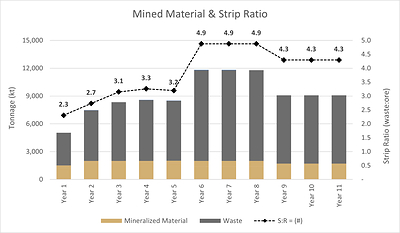
The PEA considers a conventional drill, blast, load, and haul open pit operation mining an average of 27,000 tpd (9.9 million tonnes per annum (Mtpa) over the 10.6 year life of mine. It contemplates that resources will be processed at a nominal rate of 5,500 tpd (1.9 Mtpa) at an average strip ratio of 4.27:1. Conventional gravity and leach circuit is planned to generate gold doré on site.
The PEA includes on-site development including mining, haul roads, access roads, process facilities, tailings and waste storage facilities, and related ancillary facilities. Construction is anticipated to take approximately two years with an initial capital expenditure of
Under the PEA, highest metal production occurs in the initial five years of production averaging 53.4 koz Au annual production. LOM average production is 51.2 koz Au.
Table 3: Estimated Capital Breakdown
Capital Area | Initial ($M) | Sustaining ($M) | Total ($M) |
Site General & Pre-Construction | 33.0 | 33.0 | |
Power Distribution | 16.8 | 16.8 | |
Mining & Equipment | 11.6 | 30.7 | 42.3 |
Process Plant | 47.0 | 9.4 | 56.4 |
Tailing Storage & Water Management | 4.5 | 4.5 | |
Indirect Costs | 13.9 | 13.9 | |
Owner's Cost and General Services | 40.5 | 40.5 | |
Contingency ( | 34.9 | 13.0 | 47.9 |
Sub-total Capital | 202.2 | 53.0 | 255.2 |
Mine Closure | 12.0 | 12.0 | |
Total Capital | 202.2 | 65.0 | 267.2 |
Numbers may not add due to rounding |
The São Jorge Deposit
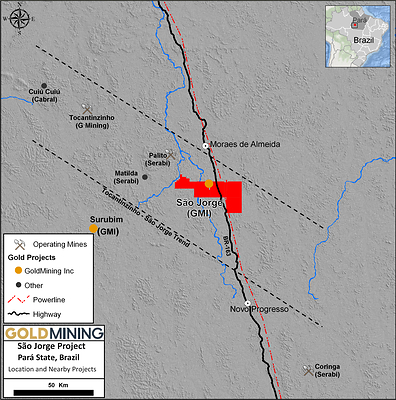
The São Jorge Gold Project is located in the Tapajós gold district (see Figure 3) in the south-central portion of the Amazon Craton. The São Jorge gold deposit is a granite-hosted, intrusion-related gold mineral system which is a similar style to the Tocantinzinho gold mine owned and operated by G Mining located approximately 80 km northwest of São Jorge, that commenced commercial production in 2024 and produced 171,871 ounces of gold in 2025.
Exploration activities at the Project carried out by the Company over the past two years have successfully delineated several new exploration targets comprising gold ± copper ± molybdenum ± silver soil geochemical anomalies, which cumulatively outline a large mineral system (see news releases dated March 18, 2025 and April 14, 2025). The São Jorge mineral system is defined by a comprehensive exploration data set which the Company has developed over previous systematic exploration campaigns. Surrounding the currently delineated São Jorge deposit, which has a defined 1.4 km strike length, the broader mineral system comprises a zone of contiguous surface geochemical anomalies over an area of 12 km x 7 km, which the Company interprets to be the surface expression of a broad intrusion related gold system.
Mineral Resource Estimate
The PEA is based on the Company's existing previously disclosed mineral resource estimate, which is summarized in the table below.
Table 4: Pit Constrained Mineral Resource Estimate
Category | Tonnage (000 t) | Grade (g/t Au) | Contained Metal (000 oz Au) |
Indicated | 19,418 | 1.00 | 624 |
Inferred | 5,557 | 0.72 | 129 |
Notes: | |
1. | See technical report titled "NI 43-101 Technical Report São Jorge Project, Para State, |
2. | CIM (2014) definitions were followed for Mineral Resources. |
3. | Mineral Resource are estimated at a break-even cut-off grade of 0.27 g/t Au for classified blocks above a constraining pit shell. |
4. | Mineral Resources are estimated using a long-term gold price of |
5. | A minimum mining width of five meters was used. |
6. | There are no Mineral Reserves estimated at São Jorge Project. Mineral Resources that are not Mineral Reserves have not demonstrated economic viability. |
7. | Numbers may not add due to rounding. |
8. | The Qualified Person (QP) of the mineral resource estimate is not aware of any environmental, permitting, legal, title, taxation, socio-economic, marketing, political, or other relevant factors that could materially affect the mineral resource estimates. |
For a description of the data verification, assay procedures and the quality assurance program and quality control measures applied by the Company, please see the Company's Annual Information Form for the year ended November 30, 2025, filed under the Company's profile on SEDAR+ at www.sedarplus.ca. Further information about the PEA referenced in this news release, including information in respect of data verification, key assumptions, parameters, risks and other factors, will be contained in a technical report, which will be filed by the Company in respect of the PEA within 45 days under its profile at SEDAR+ at www.sedarplus.ca.
Opportunities
This new PEA highlights strong potential for the advancement of the Project and sets out several opportunities for future study which may further enhance project value, including:
Opportunity | Potential Benefits | ||
Metallurgical test work & Process design | Variability test work to optimize process flowsheet and improve gold | ||
Infill Drilling | Increase confidence in the geological models and controls on and | ||
Exploration Drilling | Expansion opportunities at the existing deposits to delineate | ||
Geotechnical test work | Optimize pit wall slopes and potentially reduce strip ratio and to | ||
Infrastructure design & Scheduling | Optimize site layout, material handling and pit backfill to reduce | ||
Environmental & Sustainability Governance (ESG) | Environmental baseline & heritage studies, and community | ||
Qualified Persons
The PEA was prepared for the Company by Beck Nader,DSc, MSc.,FAIG, CBRR , who is independent of the Company and a Qualified Person, as such term is defined in NI 43-101.
The Mineral Resources were estimated by Reno Pressacco, M.Sc. (A), P.Geo., FGC, who is independent of the Company and a Qualified Person, as such term is defined in NI 43-101.
The specific sections of the technical report for which each such Qualified Person is responsible will be set out in the technical report relating to the PEA. Each such Qualified Person has reviewed and approved the scientific and technical information regarding the PEA as disclosed in this news release.
Imola Götz, M.Sc. P.Eng., F.E.C., Vice President, Project Development of the Company and a Qualified Person, as such term is defined in NI 43-101, has supervised the preparation of this news release and has reviewed and approved the scientific and technical information contained herein.
About GoldMining Inc.
GoldMining Inc. is a public mineral exploration company focused on acquiring and developing gold assets in the Americas. Through its disciplined acquisition strategy, GoldMining now controls a diversified portfolio of resource-stage gold and gold-copper projects in Canada, the U.S.A., Brazil, Colombia, and Peru.
Notice to Readers
Disclosure regarding the Project, including the PEA and Mineral Resource Estimates included herein, has been prepared by the Company in accordance with NI 43-101. NI 43-101 is a rule developed by the Canadian Securities Administrators that establishes standards for public disclosure by issuer of scientific and technical information concerning mineral projects. NI 43-101 differs significantly from the disclosure requirements of the United States Securities and Exchange Commission ("SEC") generally applicable to U.S. companies subject to the SEC's disclosure requirements. For example, the terms "Indicated Mineral Resource" and "Inferred Mineral Resource" are defined in NI 43-101 by reference to the guidelines set out in the CIM Definition Standards on Mineral Resources and Mineral Reserves. Accordingly, information contained herein or in the Company's descriptions of its projects may not be comparable to similar information made public by U.S. companies reporting pursuant to SEC disclosure requirements.
Investors are cautioned not to assume that all or any part of "Measured" or "Indicated" Mineral Resource will ever be converted into "reserves". Investors should also understand that "Inferred Mineral Resources" have a great amount of uncertainty as to their existence and great uncertainty as to their economic and legal feasibility. Under Canadian rules, estimated "Inferred Mineral Resources" may not form the basis of feasibility or pre-feasibility studies except in rare cases.
For further information regarding the Company's projects and the resource estimates disclosed herein, please refer to the Company's most recent Annual Information Form and the technical reports filed under the Company's profile at www.sedarplus.ca and www.sec.gov.
Forward-Looking Statements
Certain of the information contained in this news release constitutes "forward-looking information" and "forward-looking statements" within the meaning of applicable Canadian and U.S. securities laws ("forward-looking statements"), which involve known and unknown risks, uncertainties and other factors that may cause the Company's actual results, performance and achievements to be materially different from the results, performance or achievements expressed or implied therein. Forward-looking statements, which are all statements other than statements of historical fact, include, but are not limited to the results of the PEA, the Company's plans and expectations regarding future opportunities and proposed work at the Project and the Company's other plans and expectations regarding the Project. Forward-looking statements are based on the then-current expectations, beliefs, assumptions, estimates and forecasts about the business and the markets in which GoldMining operates. Investors are cautioned that all forward-looking statements involve risks and uncertainties, including: the inherent risks involved in the exploration and development of mineral properties, fluctuating metal prices, unanticipated costs and expenses, risks related to government and environmental regulation, social, permitting and licensing matters, and uncertainties relating to the availability and costs of financing needed in the future. These risks, as well as others, including those set forth in GoldMiningꞌs Annual Information Form for the year ended November 30, 2025, and other filings with Canadian securities regulators and the SEC, could cause actual results and events to vary significantly. Accordingly, readers should not place undue reliance on forward-looking statements. There can be no assurance that forward-looking statements, or the material factors or assumptions used to develop such forward-looking statements, will prove to be accurate. The Company does not undertake to update any forward-looking statements, except in accordance with applicable securities law.

 View original content to download multimedia:https://www.prnewswire.com/news-releases/goldmining-announces-positive-pea-highlighting-532-million-after-tax-npv-and-42-irr-at-its-sao-jorge-project-brazil-302797434.html
SOURCE GoldMining Inc.
FAQ
AI-generated questions and answers. How Rhea-AI works. Not financial advice.