
GMG Unveils Graphene Aluminium-Ion Battery That Fully Charges in 6 Minutes
Graphene Manufacturing Group (OTCQX: GMGMF) announced progress on its graphene aluminium-ion (G+AI) battery, reporting third‑party BIC test data and development milestones.
Sentiment and the balance of points
Rhea-AI Sentiment reads the wording of the document, how positive or negative its language is on a 1 to 5 scale. The balance of points shown with the takes weighs what the document actually discloses, so the two can disagree, for example when a trial that missed its main goal is described in upbeat language.
Rhea-AI Summary
Graphene Manufacturing Group (OTCQX: GMGMF) announced progress on its graphene aluminium-ion (G+AI) battery, reporting third‑party BIC test data and development milestones. Key disclosed results: 58 Wh/kg for 60‑minute charge and 26 Wh/kg for 6‑minute charge; cells reached 62% capacity in 3.2 minutes and nominal voltage ~3.0 V. Targets include charging under 6 minutes, 10,000 cycle life, and eventual goals of >150 Wh/kg (1 hr) and >75 Wh/kg (6 min). Technology readiness is BTRL 4; company roadmap calls for customer cell testing in 2026 and small commercial production in 2027.
Positive
- 58 Wh/kg at 60‑minute charge (third‑party BIC test)
- 26 Wh/kg at 6‑minute charge with 62% capacity in 3.2 minutes
- Company target: 10,000 cycles long cycle life
- Roadmap: customer testing in 2026, small commercial production in 2027
Negative
- Technology at BTRL 4 (lab validation; not yet pilot‑scale)
- Current 6‑minute energy density (26 Wh/kg) well below stated goal of >75 Wh/kg
- Durability data limited to hundreds of cycles at fast charge (long‑term life unproven)
Details
News Market Reaction – GMGMF
On Dec 15, the day this news came out, GMGMF closed 22.17% above the previous close.
Data tracked by StockTitan Argus for the Dec 15 session.
AI-generated analysis. How Rhea-AI works. Not financial advice.




Brisbane, Australia--(Newsfile Corp. - December 15, 2025) - Graphene Manufacturing Group Ltd. (TSXV: GMG) (OTCQX: GMGMF) ("GMG" or the "Company") is pleased to provide the latest progress update on the Graphene Aluminium-Ion Battery technology ("G+AI") being developed by GMG and the University of Queensland ("UQ") under a Joint Development Agreement with Rio Tinto, one of the world's largest metals and mining groups, and with the support of the Battery Innovation Center of Indiana ("BIC") in the United States of America.
Based on its current state of development as reflected below, the GMG G+AI Battery has similar performance characteristics to those provided by High Power Lithium Titanate Oxide ("LTO") batteries, which are sold at a premium price of up to US
Battery Performance Update:
GMG is pleased to announce that it has progressed its G+AI Battery technology and believes that, once development is completed, it can meet the key target specification requirements for the main targeted battery use case as per Figure 1, including:
- Charging in under 6 minutes;
- Energy density > 100 Wh/kg after 1 hour of charging;
- Long Cycle Life (10,000 cycles);
- Safe (no Lithium);
- Lower Thermal Runaway Risk; and
- Likely no thermal management system will be needed.
Bob Galyen, GMG Non-Executive Director, commented: "In my nearly five decades in the battery industry, I have rarely seen a technology with the disruptive potential of GMG's next-generation graphene aluminium-ion battery. With the possibility of charging from empty to full in around six minutes, this chemistry fundamentally changes how designers can think about electric vehicles, consumer electronics, and stationary storage. Instead of planning around long charge stops with large packs, engineers can optimise for rapid energy turnaround, with higher power, and safer, with GMG's battery made from abundant raw materials. Lithium-ion will remain a key part of the energy landscape for years to come, but its limitations in fast charging, temperature tolerance, and critical-mineral supply are increasingly evident. By leveraging aluminium and graphene, the GMG team is demonstrating a pathway to reduce reliance on traditional lithium-based systems while delivering step-change improvements in charge time and power density. This is not an incremental tweak to existing cells - it is a new platform that can open markets and use cases that were previously uneconomic or impractical. As GMG moves from the lab toward scaled manufacturing, its primary focus is on proving reliability, safety, and cost at industrial level. Automotive, grid, and specialty-device partners are already engaging with GMG to explore pilot programs and early integrations. The companies that adapt quickest to this shift will lead the next wave of electrification, and GMG intends to be at the centre of that transition with graphene aluminium-ion technology."

Figure 1: G+AI Battery Use Case - heavy mobile equipment
To view an enhanced version of this graphic, please visit:
https://images.newsfilecorp.com/files/8082/278044_gmg_figure1.jpg
GMG is pleased to share the energy densities of the current GMG G+AI pouch cell at 60 minutes and 6-minute charging compared to other chemistry batteries on the market (Figure 2), and a voltage vs capacity graph (Figure 3) of its latest G+AI Battery technology based on data provided by the third-party BIC battery testing laboratory.
Based on that testing, the current stage of development, batteries produced by GMG and BIC had an energy density of 58 Wh/kg when charged in 1 hour and 26 Wh/kg when charged in 6 minutes. In 6-minute fast charging, the battery cells achieved
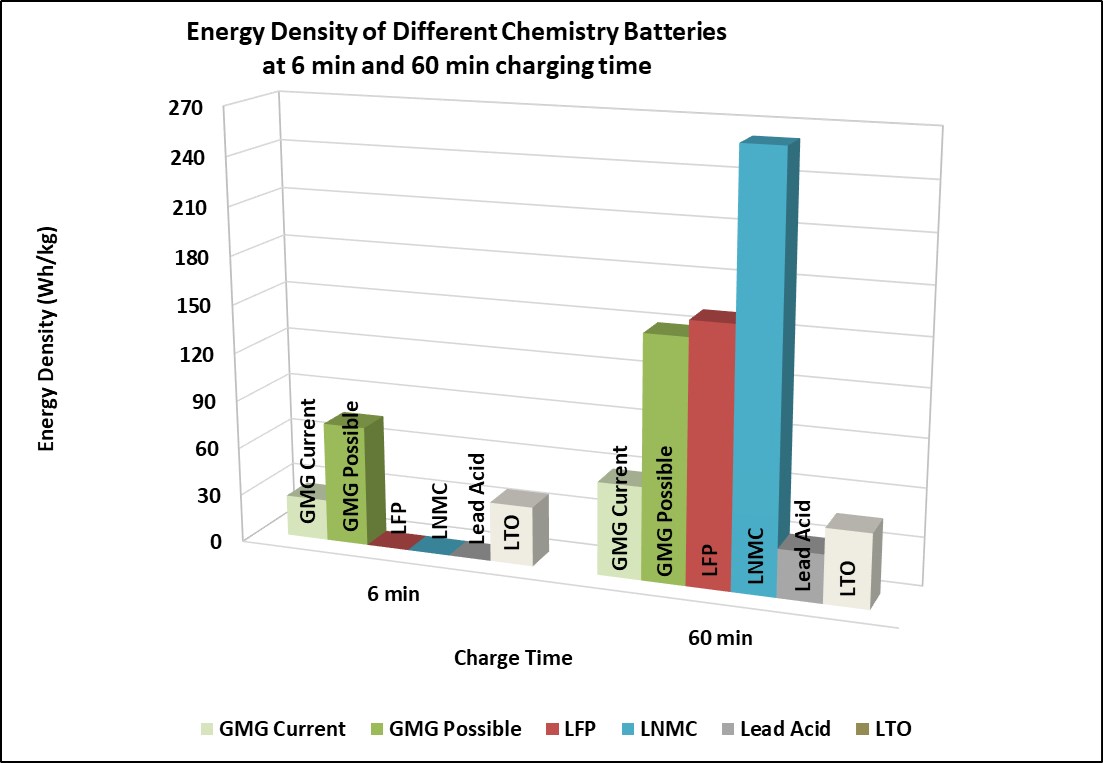
Figure 2: Different Battery Chemistry Performance at 6 min and 60 min Charge[2]
To view an enhanced version of this graphic, please visit:
https://images.newsfilecorp.com/files/8082/278044_3e8dbe4f44c75b4b_002full.jpg
Standard commercial Lithium Nickel Manganese Cobalt ("LNMC") and Lithium Iron Phosphate ("LFP") battery cells for electric vehicles and stationary storage are not designed for continuous 6-minute charging (10C); typical recommended charge rates are ≤1 hour (1C), often 2 hours (0.5C), with only limited fast charge operation. Only specialized high-power cell designs like LTO battery cells can tolerate charge rates of 6 minutes (10C).[3]
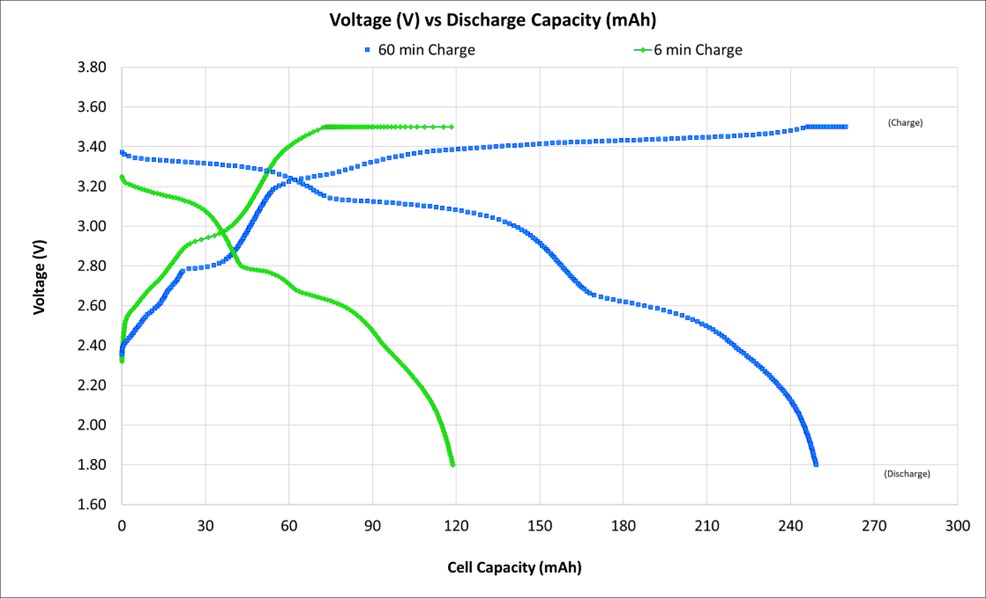
Figure 3: Battery performance curves of GMG's G+AI Battery at 60 min and 6min charge
To view an enhanced version of this graphic, please visit:
https://images.newsfilecorp.com/files/8082/278044_3e8dbe4f44c75b4b_003full.jpg
GMG has now developed a completely new hybrid electrolyte that is chloride free and noncorrosive, unlike common aluminium battery electrolytes, along with a complex cathode and anode technology that enables very stable fast charging over several cycles. The substrate for both the cathode and anode in the GMG G+AI Battery is aluminium foil - which provides significant cost and weight savings compared with copper, the substrate material used in most lithium and sodium-ion batteries. GMG's technology does not include the use of lithium or copper. The Company has submitted an additional patent application covering these new developments.
Craig Nicol, GMG Managing Director and CEO, commented: "I couldn't be happier with the GMG team to get to this point with our battery. We have rebuilt this battery in our weekly sprints from the ground up and developed completely new complex cathode, anode and electrolyte. This will provide a next generation fast charging battery technology currently not available in the world, and we look forward to sending out sample cells to test with partners in early 2026. This technology has many years of development in front of it and will improve as we keep pushing through known issues to improve capacity, voltage and reduce weight."
GMG management believes that the Company's battery technology can eventually achieve over 150 Wh/kg when charged in 1 hour, and over 75 Wh/kg when charged in 6 minutes. The Company believes further development of the cathode, anode, electrolyte and component weights will eventually achieve this end goal.
Figure 4 shows the latest Graphene Aluminium-Ion Battery multi-layer pouch cell.
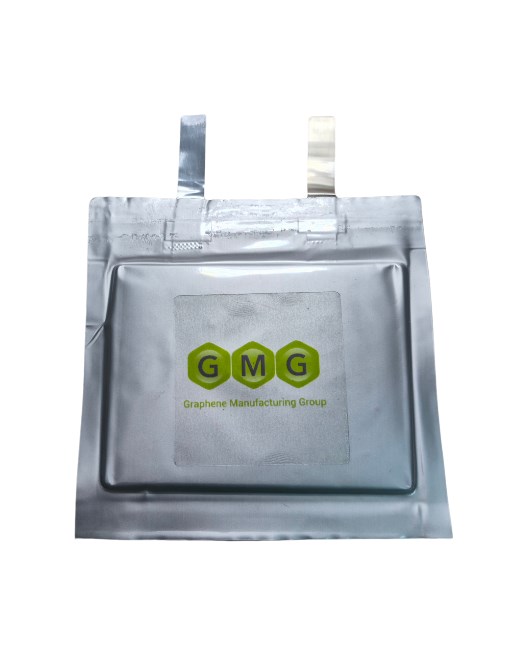
Figure 4: Current Multi-Layer Battery Pouch Cell
To view an enhanced version of this graphic, please visit:
https://images.newsfilecorp.com/files/8082/278044_3e8dbe4f44c75b4b_004full.jpg
Battery Technology Readiness Level
The battery technology readiness level ("BTRL") of the G+AI technology remains at Level 4, see Figure 5. GMG is currently optimizing electrochemical behaviour for pouch cells via ongoing laboratory experimentation. Through collaboration with BIC, it is anticipated that the battery technology readiness will progress to BTRL 7 and 8 since the equipment and processes needed to produce the G+AI batteries are the same as those employed to make Lithium-Ion Batteries.
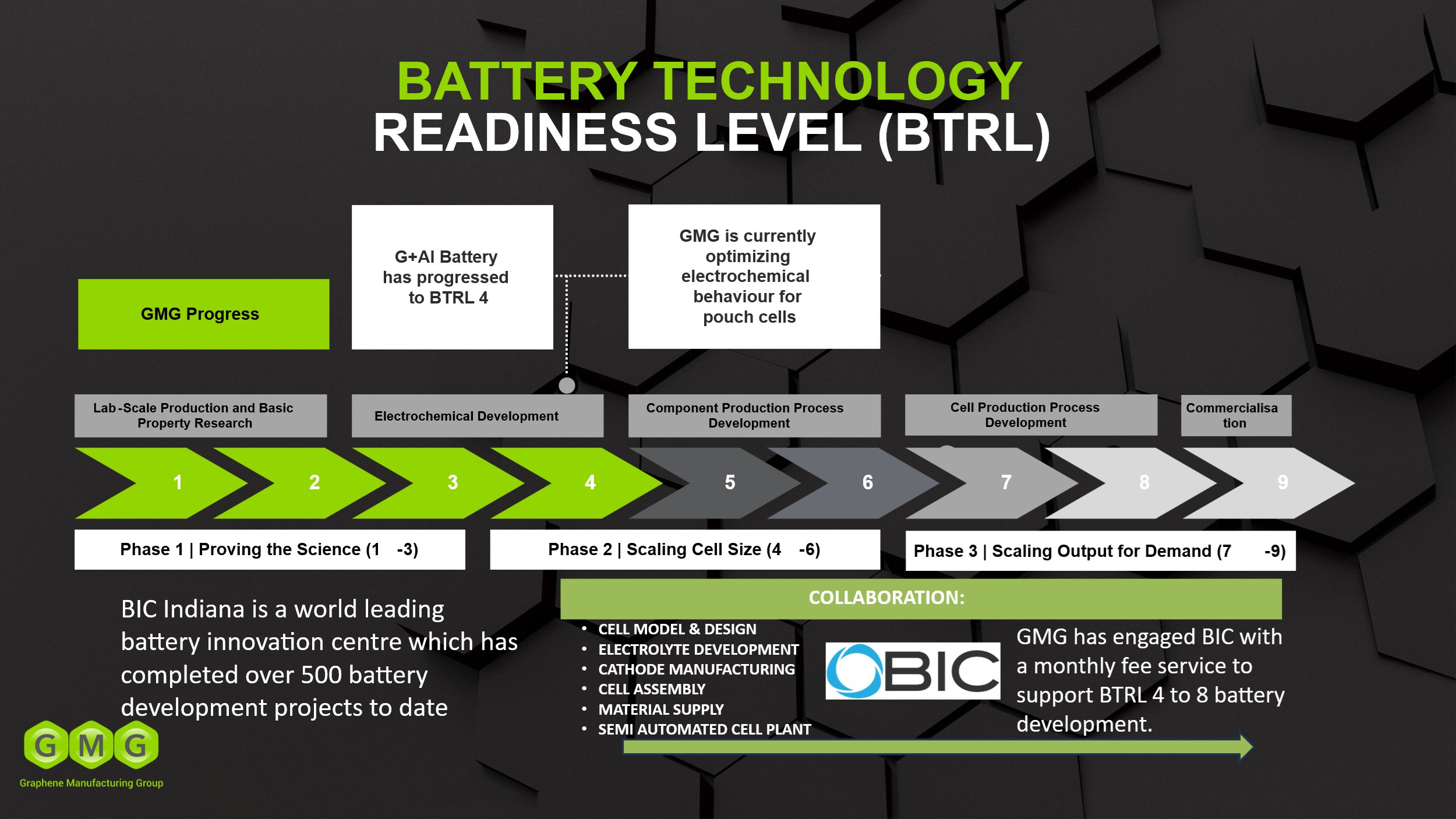
Figure 5: Battery Technology Readiness Level (BTRL)
To view an enhanced version of this graphic, please visit:
https://images.newsfilecorp.com/files/8082/278044_3e8dbe4f44c75b4b_005full.jpg
The Company is confident it can meet the overall timeline, as seen in Figure 6, of its battery cell roadmap that calls for testing of cells with customers in 2026 and small commercial production with support of various partners, including BIC, in 2027.
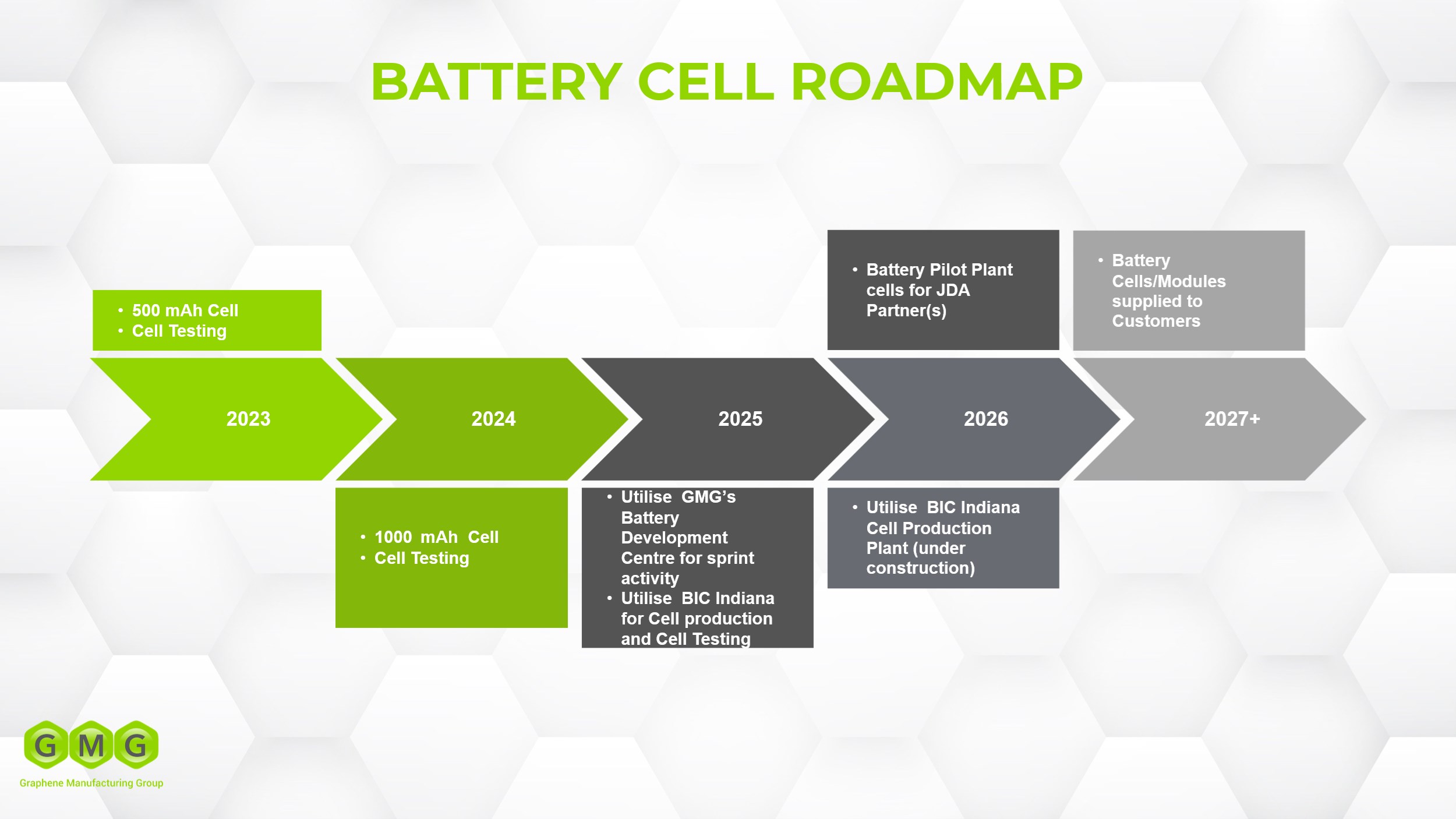
Figure 6: Battery Cell Roadmap
To view an enhanced version of this graphic, please visit:
https://images.newsfilecorp.com/files/8082/278044_3e8dbe4f44c75b4b_006full.jpg
Next Steps Toward Commercialisation & Market Applications
Jack Perkowski, GMG Chairman and Non-Executive Director, commented: "I am extremely proud that GMG has progressed its battery to this stage. It is a significant milestone for the Company because the battery technology has so much opportunity in so many applications - especially in commercial vehicles. I look forward to the next updates as GMG makes further progress in the development of its battery technology."
The Company continues to see a broad range of applications for a completed GMG G+AI Battery - utilising its ultra-high power-density and economic energy density characteristics. Along with Rio Tinto, a range of global companies have confidentially expressed their interest in working with GMG in the following vertical sectors:
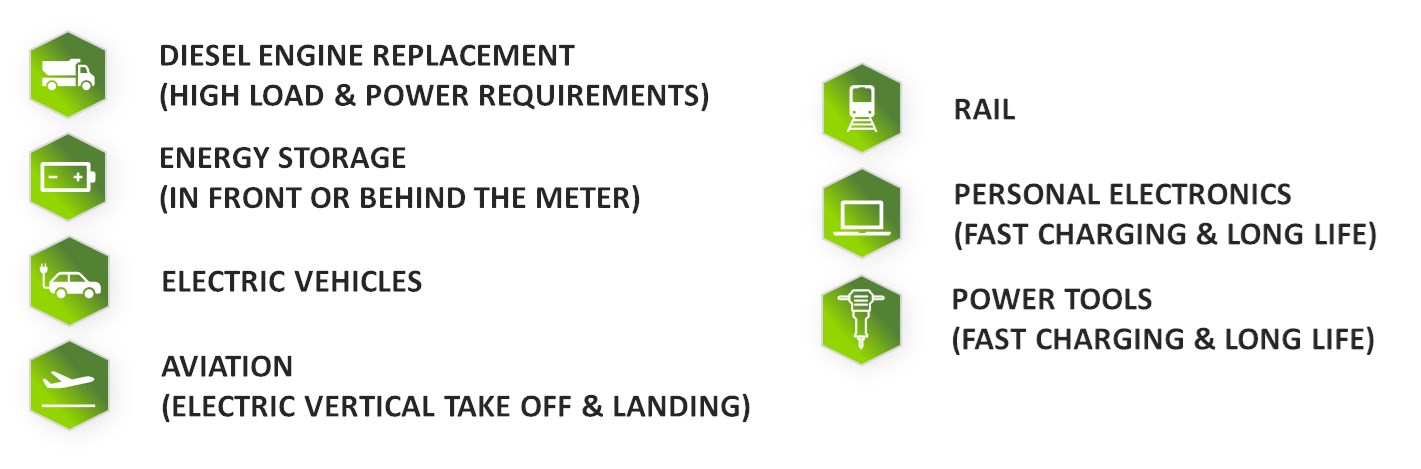
Figure 7: Market Applications
To view an enhanced version of this graphic, please visit:
https://images.newsfilecorp.com/files/8082/278044_3e8dbe4f44c75b4b_007full.jpg
Currently, GMG believes it will use a plastic battery pack design, similar to Figure 8, to hold the battery pouch cells - reducing the weight, cost and complexity of using a metal case. Using a plastic battery pack is possible for two main reasons - GMG believes that its battery will not require a thermal management system or the fireproofing precautions provided by the metal case in a lithium-ion battery. Using plastic will increase the comparative energy density of GMG's G+AI battery packs when compared to lithium-ion batteries.
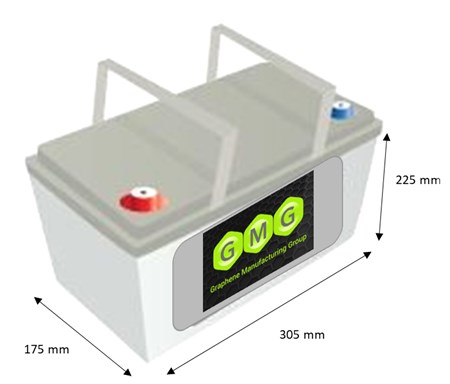
Figure 8: Expected Battery Pack for G+AIB Pouch Cells
To view an enhanced version of this graphic, please visit:
https://images.newsfilecorp.com/files/8082/278044_3e8dbe4f44c75b4b_008full.jpg
Comparison and Market Review: LTO Batteries
As shown in Figure 9 below, the performance of GMG's G+AI battery technology is already very similar to LTO batteries.
Figure 9: Comparison of Graphene Aluminium-Ion Battery (G+AI) to Lithium Titanate Oxide (LTO) Battery
| Parameter | High Power LTO[4] | GMG G+AI Battery |
| Rapid Charging | ||
| Energy Density - 6-minute charge | 37 Wh/kg ( 46 Wh/kg (6 min +) | 26 Wh/kg(Current) Large upside to be confirmed |
| Depth of Discharge | Full Range | Full Range |
| Safety | Safe | Safer (no lithium fire potential) |
| Longevity | To be confirmed | |
| Battery Price | US | Lower price due to lower material costs No lithium, no Titanium |
| Market Size | US | Under development |
LTO batteries are sold at a premium to LFP and LNMC batteries, which are the main chemistries used in electric vehicles and energy storage systems, and are also widely used in other electronic applications due to their high performance and long cycle life. The material and manufacturing costs for GMG's G+AI Battery are expected to be similar to, or less than, the cost to manufacture standard lithium-ion batteries, but substantially lower than the costs to produce LTO batteries.
LTO batteries have energy density ranging from 50 - 80 Wh/kg.[6] The LTO product is sold globally for use in many applications - with a total of US
Further details on applications for the LTO battery from Mordor Intelligence7 are described below. In many of the use cases for LTO batteries, GMG believes that its G+AI Battery can be substituted at a substantially lower cost.
- Commercial Vehicles: Automotive, primarily buses, refuse trucks, and drayage tractors rather than passenger cars, is the largest user of LTO batteries. Fleets realize five-year total-cost-of-ownership parity once fuel savings and lower maintenance offset higher upfront prices.
- Fast-charging Electric Buses and Trucks: Transit authorities need battery systems that accept repeated high-power "opportunity charges" during short layovers. LTO cells replenish
80% capacity in roughly five minutes, allowing operators to shrink fleet size without sacrificing route frequency. U.S. Low-No Emission Bus grants earmark more than US$1.5 billion per year, with bid specifications that explicitly reference rapid-charge capability. Parallel subsidy programs in China reimburse up to CNY 80,000 (US$ 11,396) per new-energy bus, accelerating volume deployment in provincial capitals. - Hybrid and BEV: Regenerative braking and high-C-rate acceleration favour the use of LTO batteries. Use in fast-charge EV stations is growing rapidly as ride-hailing fleets adopt swap-ready models.
- Stationary Storage: Utility-scale batteries now cycle multiple times per day for frequency regulation, peak shaving, and voltage support. Energy-storage-system integrators adopt LTO batteries for grid-frequency response where state-of-charge swings are shallow but frequent.
- Industrial Robotics: LTO batteries are used in continuous-duty forklifts that require partial charges during operator breaks.
- Aerospace and Defense: Unmanned aerial vehicles, missile auxiliaries, and soldier-worn power banks operating from -40 °C to +60 °C ambient.
- 5-minute Battery-Swap Stations: Battery-as-a-service platforms require ultra-fast turnaround and high cycle life. CATL confirmed plans to install 1,000 swap stations in 2025 and 30,000-40,000 by 2030, each requiring packs that tolerate thousands of rapid exchanges without degradation.
- Sub-10 kWh Packs: Cordless construction tools, autonomous ground vehicles, and medical carts select LTO batteries to bypass daily pack swaps.
- 12V starter replacement to Lead acid: GMG's G+AI battery technology would be a viable 12 V starter-battery replacement for lead-acid, offering lower weight, longer cycle life, good low-temperature performance and improved cold-cranking capability, together with excellent tolerance to storage at
0% state of charge. In suitable system designs, the chemistry's stable voltage behaviour can also reduce balancing requirements and simplify battery management, helping to lower overall system cost. - Lifecycle Procurement Preference: Many government procurement frameworks now weigh lifecycle reliability higher than purchase price. For example, New Mexico awarded a US
$ 400 million bus electrification contract that included stringent thermal-runaway resistance metrics. Europe's Clean Industrial Deal allocates capital for storage technologies that stabilize renewables, aligning well with LTO batteries' fast-response profile. - Cylindrical Cells: accounted for
37.7% of LTO battery sales in 2024 as entrenched production lines and robust steel casings satisfied heavy-duty demand. Pouch designs address aerospace weight requirements and constrained dashboards in autonomous robots.
Summary of Important Milestones for GMG's G+AI Battery Development:
About BIC:
BIC is a collaborative initiative designed to incorporate leadership from renowned universities, government agencies, and commercial enterprises. BIC is a public-private partnership and a not-for-profit organization focusing on the rapid development, testing and commercialization of safe, reliable and lightweight energy storage systems for defense and commercial customers. BIC is a unique organization that has been leading battery cell development for world leading battery companies for over 10 years and has carried out over 500 battery development projects.
About GMG
GMG is an Australian based clean-technology company which develops, makes and sells energy saving and energy storage solutions, enabled by graphene manufactured via in house production process. GMG uses its own proprietary production process to decompose natural gas (i.e. methane) into its natural elements, carbon (as graphene), hydrogen and some residual hydrocarbon gases. This process produces high quality, low cost, scalable, 'tuneable' and low/no contaminant graphene suitable for use in clean-technology and other applications.
The Company's present focus is to de-risk and develop commercial scale-up capabilities, and secure market applications. In the energy savings segment, GMG has initially focused on graphene enhanced heating, ventilation and air conditioning ("HVAC-R") coating (or energy-saving coating) which is now being marketed into other applications including electronic heat sinks, industrial process plants and data centres. Another product GMG has developed is the graphene lubricant additive focused on saving liquid fuels initially for diesel engines.
In the energy storage segment, GMG and the University of Queensland are working collaboratively with financial support from the Australian Government to progress R&D and commercialization of graphene aluminium-ion batteries ("G+AI Batteries"). GMG has also developed a graphene additive slurry that is aimed to improve the performance of lithium-ion batteries.
GMG's 4 critical business objectives are:
- Produce Graphene and improve/scale cell production processes
- Build Revenue from Energy Savings Products
- Develop Next-Generation Battery
- Develop Supply Chain, Partners & Project Execution Capability
For further information please contact:
- Craig Nicol, Chief Executive Officer & Managing Director of the Company at craig.nicol@graphenemg.com, +61 415 445 223
- Leo Karabelas at Focus Communications Investor Relations, leo@fcir.ca, +1 647 689 6041
Neither the TSX Venture Exchange nor its Regulation Services Provider (as that term is defined in the policies of the TSX Venture Exchange) accept responsibility for the adequacy or accuracy of this news release.
Cautionary Note Regarding Forward-Looking Statements
This news release includes certain statements and information that may constitute forward-looking information within the meaning of applicable Canadian securities laws. Forward-looking statements relate to future events or future performance and reflect the expectations or beliefs of management of the Company regarding future events. Generally, forward-looking statements and information can be identified by the use of forward-looking terminology such as "intends", "expects" or "anticipates", or variations of such words and phrases or statements that certain actions, events or results "may", "could", "should", "would" or will "potentially" or "likely" occur. This information and these statements, referred to herein as "forward‐looking statements", are not historical facts, are made as of the date of this news release and include without limitation, statements regarding the lower cost to produce GMG G+AI batteries, expectations for GMG G+AI batteries in respect of charging time, energy density, life cycle, safety, thermal runway risk and the need for a thermal management system when development is completed, that the new hybrid electrolyte is chloride free and non-corrosive, that the cathode and anode technology employed enables very fast and stable charging, that GMG G+AI batteries provide significant cost and weight savings relative to copper, that G+AI batteries can achieve over 150 Wh/kg charged over 1 hour and 75 Wh/kg when charged over 6 minutes following further development of cathode, anode, electrolyte and component weights, that G+AI batteries will progress to BTRL 7 and 8, that the timeline for the battery cell roadmap is achievable, that a range of global companies in a variety of industries will be interested in working with GMG, that the battery pack design will be plastic and which offers weight, cost and complexity advantages to a metal case and increased energy density, expectations for the lack of a thermal management system or fireproofing precautions, expectations for material and manufacturing costs, expectations for sales of LTO batteries, expectations for G+AI batteries being substitutable for LTO batteries at lower cost, expectations that G+AI batteries are viable 12V starter battery replacements and the rationale therefor and the advantages of pouch design for aerospace weight requirements and constrained dashboards of autonomous robots.
Such forward-looking statements are based on a number of assumptions of management, including, without limitation, assumptions that GMG G+AI batteries can be produced at lower cost, as to charging time, energy density, life cycle, safety, thermal runway risk and the need for a thermal management system for G+AI batteries, the speed and stability of charging, that G+AI batteries will progress to BTRL 7 and 8, that a range of global companies in a variety of industries will be interested in working with GMG, that the battery pack design will be plastic and offer weight, cost and complexity advantages to a metal case and increased energy density, that the service agreement with the BIC will enable the Company to optimize its cell design and battery manufacturing equipment, and that the Company will be able to meet its overall timeline on the battery cell roadmap. Additionally, forward-looking information involves a variety of known and unknown risks, uncertainties and other factors which may cause the actual plans, intentions, activities, results, performance or achievements of GMG to be materially different from any future plans, intentions, activities, results, performance or achievements expressed or implied by such forward-looking statements. Such risks include, without limitation: that GMG G+AI batteries cannot be produced at lower cost, or any of the assumptions as to charging time, energy density, life cycle, safety, thermal runway risk and the need for a thermal management system for G+AI batteries can not be achieved, G+AI batteries do not offer expected speed and stability of charging, that G+AI batteries will not progress to BTRL 7 and 8, that a range of global companies in a variety of industries will not be interested in working with GMG, that the battery pack design will not be plastic and not offer weight, cost and complexity advantages to a metal case and increased energy density, that the Company will not be able to optimize the electrochemical behaviour of the pouch cell through laboratory experimentation or at all, that the Company will not be able to meet its overall timeline on the battery cell roadmap, that the service agreement with the BIC will not enable the Company to optimize its cell design and battery manufacturing equipment and the risk factors set out under the heading "Risk Factors" in the Company's annual information form dated November 04, 2025 available for review on the Company's profile at www.sedarplus.ca.
Although management of the Company has attempted to identify important factors that could cause actual results to differ materially from those contained in forward-looking statements or forward-looking information, there may be other factors that cause results not to be as anticipated, estimated or intended. There can be no assurance that such statements will prove to be accurate, as actual results and future events could differ materially from those anticipated in such statements. Accordingly, readers should not place undue reliance on forward-looking statements and forward-looking information. Readers are cautioned that reliance on such information may not be appropriate for other purposes. The Company does not undertake to update any forward-looking statement, forward-looking information or financial out-look that are incorporated by reference herein, except in accordance with applicable securities laws.
[1] Lithium Titanate Oxide Battery Market Size, Share & 2030 Growth Trends Report
[2] LFP: https://www.evlithium.com/catl-battery-cell/catl-150ah-lifepo4-battery-cell.html
LNMC: https://keheng-battery.com/product/catl-nmc-3-7v-151ah-high-energy-density-battery-for-ev/
LTO: https://www.global.toshiba/ww/products-solutions/battery/scib/product-next/product/cell/high-power.html
Lead Acid: https://www.altronics.com.au/p/s4530-12v-3.5ah-sealed-lead-acid-sla-battery/?srsltid=AfmBOoqZGMEIsX__YYOuRLC3nvYDFtNkf35qZYuYeoh3ACf4wrrOLISD
[3] https://findingspress.org/article/21459-impact-of-charging-rates-on-electric-vehicle-batt
[4] High-power type cells | SCiB™ Rechargeable battery | Toshiba
[5] https://www.ritarpower.com/industry_information/The-Price-of-50-kWh-Lithium-Ion-Batteries-A-Comprehensive-Analysis_297.html#:~:text=Lithium%20Titanate%20(LTO)%20Batteries%3A,cost%20between%
[6] https://www.grepow.com/blog/battery-energy-density.html
[7] Lithium Titanate Oxide Battery Market Size, Share & 2030 Growth Trends Report

To view the source version of this press release, please visit https://www.newsfilecorp.com/release/278044
FAQ
AI-generated questions and answers. How Rhea-AI works. Not financial advice.