
Greenland Mines More Than Doubles Control Position in the Sarfartoq Rare Earth Magnet District in West Greenland
Greenland Mines moves to more than double its Sarfartoq land position while advancing the higher-value ST1 rare earth magnet project.
Rhea-AI Summary
Greenland Mines (GRML) has applied for a new approximately 262 km² exploration license east of its existing Sarfartoq rare earth license in West Greenland, aiming to create a contiguous project area of about 454 km².
The expanded position would more than double the company’s control over the known rare earth and carbonatite district and support a district-scale development strategy. At the ST1 deposit, a new S-K 1300 Mineral Resource Estimate outlines 6.9 million tons of Indicated resources grading 1.60% TREO and 5.3 million tons of Inferred resources grading 0.96% TREO, for a combined 12.2 million tons at 1.32% TREO. An Initial Assessment for ST1 reports a high-case pre-tax NPV of approximately $2.05 billion, with planned NdPr oxide output modeled at about 34% of 2025 ex-China refined NdPr production.
Positive
- New license application for ~262 km² would expand Sarfartoq to ~454 km², more than doubling the district footprint
- ST1 Indicated MRE of 6.9 million tons grading 1.60% TREO under S-K 1300
- ST1 Inferred MRE of 5.3 million tons grading 0.96% TREO, totaling 12.2 million tons at 1.32% TREO
- High-case pre-tax NPV of approximately $2.05 billion for the ST1 deposit in the Initial Assessment
- Modeled NdPr output represents ~34% of NdPr oxide refined outside China at 2025 consumption levels
- Nd and Pr account for ~84% of the modeled in-concentrate basket value at ST1, highlighting magnet rare earth focus
Negative
- New 262 km² area has no Mineral Resource estimate and is classified only as an exploration opportunity
- Mineral Resources at ST1 are not Mineral Reserves and do not have demonstrated economic viability
- Expanded footprint depends on government approval, as the new license is currently only an application
News Explained
The expansion is proposed, not granted, and currently adds exploration acreage rather than a resource or change to ST1 economics.
Greenland Mines has applied for the new 262 km² area east of Sarfartoq, but the application is not a granted license; the proposed expansion therefore does not yet add to the company’s licensed project position.
The applied-for area is an exploration opportunity only: it has no defined Mineral Resource and is excluded from the current ST1 resource estimate, mine plan, NPV and IRR, so the disclosure does not change ST1’s stated economics.
Details
Market reaction after exploration license application: GRML +135.79%
Following this news, GRML has gained 135.79%, reflecting a significant positive market reaction. Argus tracked a peak move of +2.1% during the session. Our momentum scanner has triggered 92 alerts so far, indicating high trading interest and price volatility. The stock is currently trading at $6.72. Trading volume is exceptionally heavy at 987.0x the average, suggesting very strong buying interest.
Data tracked by StockTitan Argus (15 min delayed). Upgrade to Gold for real-time data.
Key Figures
- New license area
- 262 km²
- Applied-for eastern extension of the Sarfartoq project
- Combined project footprint
- 454 km²
- After increasing from approximately 192 km²
- Indicated resources
- 6.9 million tons at 1.60% TREO
- ST1 Hybrid open-pit and underground MRE
- Inferred resources
- 5.3 million tons at 0.96% TREO
- ST1 Hybrid open-pit and underground MRE
- Combined resources
- 12.2 million tons at 1.32% TREO
- Combined Indicated-plus-Inferred Hybrid scenario
- High-case pre-tax NPV
- $2.05 billion
- Sarfartoq Initial Assessment
- NdPr oxide production share
- 34%
- Of NdPr oxide refined outside China at 2025 consumption levels
Historical Context
-
Closed Sarfartoq acquisition after Greenland approval, adding ST1 resources and economic analysis.
-
Advanced environmental baseline studies and structural mapping around ST1 and nearby rare earth targets.
24h Move is the share-price change in the day after each event; other market factors may also have contributed.
Key Terms
s-k 1300 regulatory
mineral resource estimate technical
carbonatite technical
AI-generated analysis. How Rhea-AI works. Not financial advice.




New 262 km² area creates a contiguous approximately 454 km² project position after evaluation of previous geological work evidenced a potential for further rare earths eastward of the Sarfartoq deposit
District-Scale strategy fast tracks development of ST1’s
Expansion comes days after President Trump’s announcement of a landmark U.S.-Denmark-Greenland Security Agreement that highlights Greenland’s growing strategic importance
CHARLOTTE, N.C., Sept. 21, 2026 (GLOBE NEWSWIRE) -- via IBN -- Greenland Mines Ltd (Nasdaq: GRML) (“Greenland Mines” or the “Company”), a Western-aligned critical-minerals developer, today announced that after significant reconnaissance, it has submitted an application to the Government of Greenland for a new license covering approximately 262 km² immediately east of the Company’s existing Sarfartoq license, MEL 2020-32.
This new license will increase Greenland Mines’ control at Sarfartoq from approximately 192 km² to approximately 454 km² — more than doubling the footprint across the known rare earth and carbonatite district.
Dr. Bo Møller Stensgaard, President of Greenland Mines Ltd. commentary:
“This application is about building Sarfartoq at district scale. At ST1, we now have a new S-K 1300 Mineral Resource Estimate, an independent Initial Assessment with exceptional High-case economics. We are advancing a defined rare earth neodymium and praseodymium dominated development asset — but we do not believe the opportunity ends at ST1.
“Our strategy is straightforward: advance ST1 toward development, unlock the value of the less-developed known ST zones and systematically test the wider district for the next rare earth discovery.”
Developing ST1, Expanding Sarfartoq
The license application follows a series of major technical and operational milestones at Sarfartoq in Western Greenland. Greenland Mines recently delivered a new independent Mineral Resource Estimate (“MRE”) under U.S. Securities and Exchange Commission Regulation S-K Subpart 1300 (“S-K 1300”), and released an independent Initial Assessment focused on the ST1 Neodymium-Praseodymium dominated rare earth deposit at Sarfartoq.
The new Hybrid open-pit and underground MRE comprises 6.9 million tons of Indicated Mineral Resources grading
Sarfartoq’s Initial Assessment includes a high-case pre-tax NPV of approximately
Importantly, the MRE and Initial Assessment relate to ST1 Neodymium-Praseodymium dominated rare earth deposit only. The broader Sarfartoq Carbonatite Complex hosts multiple additional known rare earth occurrences — including ST40, ST19, ST24, ST31 and ST43 — that remain substantially less developed than ST1 and do not contribute to the current ST1 Mineral Resource Estimate or its economic analysis.
Greenland Mines intends to pursue a disciplined two-track strategy at Sarfartoq: advance the ST1 through the next stages of technical, environmental and mine-development work, while systematically evaluating known satellite targets and generating new discoveries across the broader district.
Strategic Rationale
Sarfartoq is a carbonatite-hosted rare earth project enriched in neodymium (Nd) and praseodymium (Pr), the principal rare earth elements used in high-performance permanent magnets. The current ST1 economic analysis is driven predominantly by magnet rare earths, with neodymium and praseodymium accounting for approximately
The area covered by the new license application is not included in the current ST1 MRE, mine plan, NPV or IRR. No Mineral Resource has been estimated within the applied-for area, and the Company has not yet conducted sufficient exploration to define a Mineral Resource or determine whether economically recoverable mineralization is present within the applied-for area. The area should therefore be regarded as an exploration opportunity only.
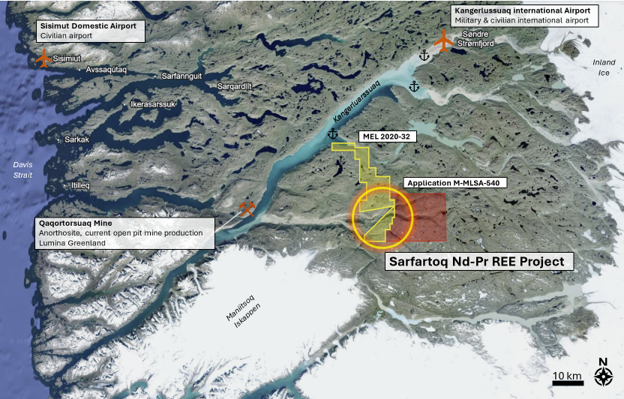
Figure 1. Greenland Mines’ expanding Sarfartoq rare earth district in southwest Greenland. The existing MEL 2020-32 exploration license, outlined in yellow, hosts the Sarfartoq Carbonatite Complex, the ST1 Nd-Pr deposit and several known but less-developed rare earth zones. The new eastern exploration license application, M-MLSA-540, is shown in red. When granted, it would create a more connected project footprint, preserve strategic flexibility for future infrastructure and support the advancement of the southern ST zones. Historical stream-sediment geochemistry, regional aeromagnetic data and geological information also identify the applied-for area as a prospective new frontier for rare earth exploration.
Technical Information
The scientific and technical information relating to the ST1 Mineral Resource Estimate referenced in this release was prepared by Ronald G. Simpson, P.Geo., of GeoSim Services Inc., with technical and engineering support from Hassan Ghaffari, P.Eng., M.A.Sc., of Tetra Tech Canada Inc., each an independent Qualified Person as defined under S-K 1300. The Initial Assessment was prepared by Agricola Mining Consultants Pty Ltd. under the direction of Malcolm Castle, MAusIMM, an independent Qualified Person as defined under S-K 1300. The applicable Technical Report Summaries have an effective date of July 31, 2026.
The interpretation of historical regional stream-sediment, aeromagnetic and geological information concerning the applied-for area is a Company exploration interpretation and is not part of the current ST1 MRE or Initial Assessment.
Cautionary Note Regarding License Grant
The application for the new license area remains subject to review and approval by the Government of Greenland. No assurance can be given regarding the timing, terms or outcome of the application. Greenland exploration licenses are exclusive rights granted for specified areas and carry ongoing exploration commitments; applications are subject to Greenland’s statutory review and consultation process.
Cautionary Note Regarding Mineral Resources
Mineral Resources are not Mineral Reserves and do not have demonstrated economic viability. The Initial Assessment is preliminary in nature and includes Inferred Mineral Resources that are considered too speculative geologically to have the economic considerations applied that would enable them to be categorized as Mineral Reserves. There is no certainty that the results of the Initial Assessment will be realized. No Mineral Reserves have been estimated for the Sarfartoq Project.
Forward-Looking Statements
This news release contains “forward-looking statements” within the meaning of the U.S. Private Securities Litigation Reform Act of 1995 and other applicable securities laws. Forward-looking statements are often identified by words such as “believe,” “expect,” “anticipate,” “intend,” “plan,” “potential,” “could,” “may,” “will,” “should,” “estimate,” “target” and similar expressions.
Forward-looking statements in this release include, but are not limited to, statements concerning: the review, timing, potential grant, terms and anticipated benefits of the M-MLSA-540 exploration license application; the potential for the applied-for area to host rare earth, carbonatite-associated or other mineralization; interpretations of historical stream-sediment, aeromagnetic and geological data; the potential continuity, source or significance of geochemical and geophysical anomalies; possible infrastructure, access, power, logistics and development configurations; future mapping, sampling, geophysical surveys and drilling; the advancement of ST1 and less-developed ST zones; potential resource growth; future environmental assessment and permitting activities; the results and assumptions of the ST1 Mineral Resource Estimate and Initial Assessment; and the Company’s broader strategy and activities in Greenland.
Forward-looking statements are based on current expectations and assumptions and are subject to known and unknown risks and uncertainties that may cause actual results to differ materially. These risks include, among others: the possibility that the exploration license application may be delayed, modified or denied; competing applications or governmental and public-consultation requirements; exploration results that do not confirm current interpretations; uncertainty inherent in historical and regional datasets; geological, metallurgical, environmental, permitting, infrastructure, financing and commodity-price risks; the speculative nature of Inferred Mineral Resources; the absence of Mineral Reserves; and the other risks described in the Company’s filings with the U.S. Securities and Exchange Commission.
The applied-for area does not contain a Mineral Resource, and no assurance can be given that exploration will result in a mineral discovery, a Mineral Resource estimate, a Mineral Reserve, an economically viable development project or production. Readers should not place undue reliance on forward-looking statements. All information in this release is provided as of its date, and the Company undertakes no obligation to update forward-looking statements except as required by applicable law.
About Greenland Mines
Greenland Mines Ltd. (Nasdaq: GRML) is a Western-aligned critical-minerals developer advancing the Sarfartoq neodymium-praseodymium rare earth project in southwest Greenland and the Skaergaard palladium-platinum-gold project in southeast Greenland. The Company’s strategy is focused on advancing high-quality Greenlandic mineral assets capable of supporting diversified and secure Western critical-minerals supply chains.
Investor Contact and Corporate Communications:
ir@greenlandmines.com
Website: www.greenlandmines.com
IBN
Austin, Texas
IBN.Ai
512.354.7000 Office
Editor@IBN.Ai
Attachment

FAQ
AI-generated questions and answers. How Rhea-AI works. Not financial advice.
What is included in Greenland Mines’ existing Sarfartoq license versus the new application area?
The existing Sarfartoq exploration license, MEL 2020-32, hosts the Sarfartoq Carbonatite Complex, the ST1 Nd-Pr deposit and several known but less-developed rare earth zones such as ST40, ST19, ST24, ST31 and ST43. The new application area, M-MLSA-540, lies immediately to the east, is not part of the current ST1 Mineral Resource Estimate, mine plan, NPV or IRR, and currently has no Mineral Resource estimate.
How does Greenland Mines describe its development strategy at Sarfartoq?
The company describes a two-track strategy: advance the ST1 deposit through the next stages of technical, environmental and mine-development work, while systematically evaluating known satellite targets and testing the wider Sarfartoq district for new rare earth discoveries.
Who prepared the ST1 Mineral Resource Estimate and Initial Assessment and when are they effective?
The ST1 Mineral Resource Estimate was prepared by Ronald G. Simpson, P.Geo., of GeoSim Services with support from Hassan Ghaffari, P.Eng., M.A.Sc., of Tetra Tech Canada, each an independent Qualified Person under S-K 1300. The Initial Assessment was prepared by Agricola Mining Consultants under the direction of Malcolm Castle, MAusIMM, also an independent Qualified Person. The related Technical Report Summaries have an effective date of July 31, 2026.
What is the intended benefit of the new eastern exploration license if granted?
The company said that, if granted, the new eastern exploration license would create a more connected project footprint, preserve strategic flexibility for future infrastructure and support advancement of the southern ST zones, while opening a prospective new frontier for rare earth exploration based on historical geochemical, aeromagnetic and geological data.
Does the interpretation of historical data in the new area affect the current ST1 economic analysis?
No. The interpretation of historical regional stream-sediment, aeromagnetic and geological information for the applied-for area is described as a company exploration interpretation only and is not part of the current ST1 Mineral Resource Estimate or Initial Assessment.