
STOCK TITAN

HII Delivers First of the Newest REMUS Variant: 130

(Neutral)
(Very Positive)
Tags

HII (NYSE:HII) delivered the first REMUS 130 unmanned underwater vehicle to a U.S. ally, introducing the third-generation evolution of the REMUS 100 series.

REMUS 130 adds modernized electronics, open-architecture interfaces, modular payloads, and HII’s Odyssey Autonomous Control System to a compact, two-person-portable UUV platform.

Loading...
Loading translation...

Positive

  • None.

Negative

  • None.

News Market Reaction – HII

-0.38%
-0.38% Session close to close

In the Jun 16 session, HII declined 0.38%, reflecting a mild negative market reaction.

Data tracked by StockTitan Argus on the day of publication.

Market Context

This announcement highlights HII’s expansion in autonomous undersea systems, delivering the first RE...
Analysis

This announcement highlights HII’s expansion in autonomous undersea systems, delivering the first REMUS 130 and extending a REMUS fleet of more than 750 vehicles across 14 NATO navies and over 30 countries. It builds on recent ROMULUS USV progress and underscores a strategy focused on modular, open-architecture autonomy. Investors may watch follow-on orders, defense budget trends, and the performance of Odyssey ACS across platforms while noting recent insider net selling of 3,500 shares.

Key Figures

Operational history: more than 25 years Max operating depth: 100 meters Endurance: 10 hours +3 more
6 metrics
Operational history more than 25 years REMUS family operational success
Max operating depth 100 meters REMUS 130 depth capability
Endurance 10 hours REMUS 130 mission endurance
REMUS vehicles delivered more than 750 Global REMUS fleet size
NATO navies using REMUS 14 Defense customer base
Countries with REMUS platforms more than 30 Odyssey ACS deployment footprint

Historical Context

5 past events · Latest: Jun 08 (Positive)
Pattern 5 events
Date Event Sentiment 24h Move Catalyst
Jun 08 Production expansion Positive -0.1% Partner launched dedicated line to accelerate ROMULUS USV production.
Jun 03 Workforce recruitment Positive -2.1% WAVES program brought 50+ high school graduates into shipbuilding roles.
Jun 01 Employee recognition Positive -0.9% Ingalls honored 40 Master Shipbuilders with 40 years of service.
Jun 01 USV testing milestone Positive -3.8% ROMULUS USV advanced to U.S. Navy MUSV at-sea testing phase.
May 22 Hiring event Positive +1.0% Ingalls announced on-site skilled trades hiring event with higher base wages.

24h Move is the share-price change in the day after each event; other market factors may also have contributed.

Pattern Detected

Recent positive operational and workforce news often coincided with flat-to-negative next-day price moves, suggesting limited short-term price responsiveness to such announcements.

Recent Company History

Over the past month, HII has issued several operational and workforce updates, including ROMULUS USV advancing to U.S. Navy at-sea testing on Jun 1, production scaling via Bayou Metals on Jun 8, and hiring and training initiatives in late May and early June. Despite generally positive strategic tone, four of the last five news days saw negative next-day price reactions, with only the May 22 hiring event linked to a 0.97% gain. Today’s REMUS 130 delivery fits the pattern of product and capability milestones.

Key Terms

unmanned underwater vehicle (uuv), autonomous underwater vehicle, open-architecture interfaces, odyssey autonomous control system (acs), +3 more
7 terms
unmanned underwater vehicle (uuv) technical
"delivery of the first REMUS 130 unmanned underwater vehicle (UUV) to a U.S. ally"
An unmanned underwater vehicle (UUV) is a remote-controlled or autonomous robotic craft that travels beneath the surface without a person on board, like a robotic submarine used for inspection, data collection, mapping or transporting small payloads. Investors watch UUVs because they drive business opportunities and risks across defense, offshore energy, shipping and environmental monitoring—comparable to how aerial drones opened new markets and contracts that affect company revenues and valuations.
autonomous underwater vehicle technical
"next generation of the world’s most widely deployed autonomous underwater vehicle"
An autonomous underwater vehicle is an unmanned, self-propelled robotic craft that operates beneath the surface, navigating with sensors and programmed instructions; think of it as a drone for the ocean. Investors care because these vehicles let companies inspect infrastructure, map seabeds, gather scientific or commercial data and reduce human risk and operating costs, so advances or contracts can drive revenue, cut expenses and change competitive positions.
open-architecture interfaces technical
"modernized electronics, open-architecture interfaces and enhanced payload flexibility"
Open-architecture interfaces are design standards and connectors that let different software or hardware pieces plug together easily, like Lego blocks that fit regardless of brand. For investors, they matter because they reduce the cost and time of adding new features, lower dependence on a single supplier, and increase the chance a product will work with other systems — all of which can improve a company’s growth, margins, and resale value.
odyssey autonomous control system (acs) technical
"integrates HII’s proven Odyssey Autonomous Control System (ACS), advanced navigation"
An odyssey autonomous control system (ACS) is an integrated set of sensors, software and hardware that lets a vehicle or machine navigate, make driving decisions and respond to its surroundings without a human at the wheel. Think of it as the vehicle’s pilot, co‑pilot and traffic controller bundled together; for investors it matters because performance, safety and regulatory approval of such a system can drive adoption, revenue potential, liability exposure and competitive positioning in transportation and robotics markets.
collaborative autonomy technical
"Odyssey enables advanced capabilities including collaborative autonomy, sensor fusion"
A way of organizing teams or business units so each can make fast, independent choices while still coordinating with others toward shared goals. Think of it as an orchestra where individual musicians can improvise but follow the same score: it speeds innovation and responsiveness without losing overall direction. Investors watch for this because it can boost productivity and adaptability, potentially improving growth, margins and the company’s ability to execute strategy.
sensor fusion technical
"Odyssey enables advanced capabilities including collaborative autonomy, sensor fusion"
Sensor fusion is the process of combining data from multiple sensors—like cameras, radar, microphones, or motion detectors—to create a single, clearer picture of what’s happening in the real world. For investors, better fusion means products and systems that are safer, more reliable, or smarter (think a car using several eyes and ears to avoid collisions), which can reduce costs, speed product adoption, and improve a company’s competitive edge.
mine countermeasures technical
"missions, including: Oceanographic research ... Search and rescue operations Mine countermeasures"
Mine countermeasures are the tools and activities used to find, disable, remove or avoid explosive mines in water and on the seabed, protecting ships, ports and offshore operations. Think of it like a specialized cleanup crew that detects hidden hazards and clears safe passages; for investors, demand for these services and technologies affects defense contractors, marine-service providers and companies involved in shipping and port security, especially in regions with heightened naval risk.

AI-generated analysis. How Rhea-AI works. Not financial advice.

See more from StockTitan in Google Search and AI answers. Adds StockTitan as a preferred source · opens Google
Add on Google

POCASSET, Mass., June 16, 2026 (GLOBE NEWSWIRE) -- HII (NYSE: HII), America’s largest military shipbuilder and a global leader in autonomous maritime systems, today announced the delivery of the first REMUS 130 unmanned underwater vehicle (UUV) to a U.S. ally, marking a major milestone for the next generation of the world’s most widely deployed autonomous underwater vehicle.

Building on more than 25 years of operational success, REMUS 130 is the latest addition to the REMUS family, which is trusted by the U.S. Navy, allied naval forces, government agencies, research institutions and commercial operators worldwide for critical undersea missions.

As the third generation of the highly successful REMUS 100 series, REMUS 130 combines the reliability, simplicity and mission effectiveness that have defined the REMUS brand with modernized electronics, open-architecture interfaces and enhanced payload flexibility.

“The delivery of the first REMUS 130 represents an important step in the continued evolution of the REMUS family,” said Duane Fotheringham, president of the Unmanned Systems group in HII’s Mission Technologies division. “For decades, customers have relied on REMUS vehicles for their durability, ease of operation and proven performance. REMUS 130 builds on that legacy with a highly capable, modular platform that delivers greater flexibility, interoperability and value while leveraging common architecture across the REMUS fleet.”
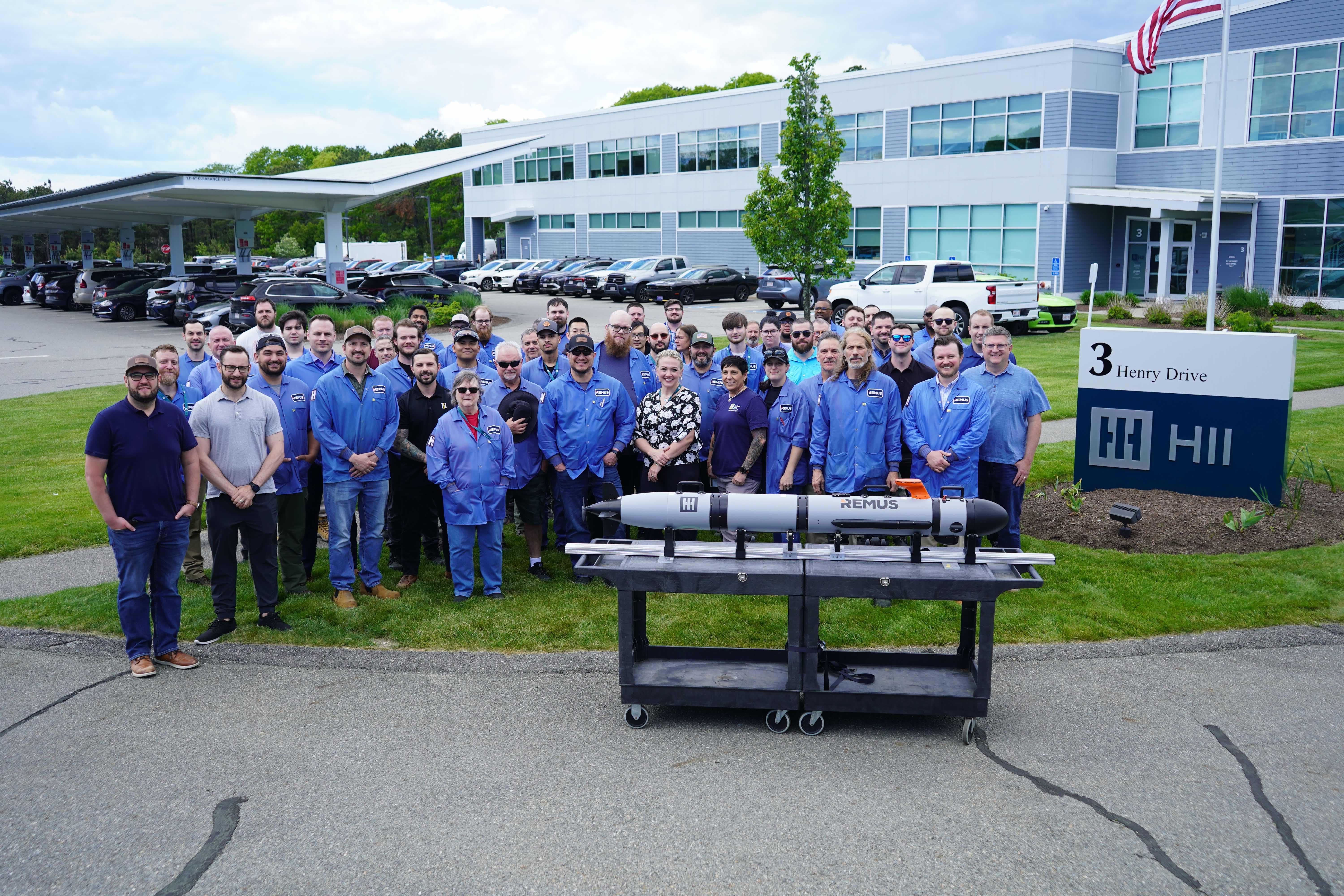
REMUS 130

A photo accompanying this release is available at: https://www.hii.com/news/hii-delivers-first-of-the-newest-remus-variant-130.

Designed to meet growing demand for affordable and adaptable autonomous underwater systems, REMUS 130 features a compact, two-person-portable design, operates at depths of up to 100 meters and provides up to 10 hours of endurance. Field-swappable batteries further increase operational availability and mission readiness.

Built on the same technology foundation as the REMUS 300 and REMUS 620 platforms, REMUS 130 integrates HII’s proven Odyssey Autonomous Control System (ACS), advanced navigation, communications and processing capabilities, and modular interfaces that enable rapid integration of commercial, government and customer-developed payloads.

Odyssey ACS transforms underwater vehicles into intelligent robotic systems through an open-architecture design that supports evolving mission requirements while reducing lifecycle costs and technology risk. Currently deployed on REMUS platforms in more than 30 countries, Odyssey enables advanced capabilities including collaborative autonomy, sensor fusion and enhanced perception across a wide range of vehicles, sensors, payloads and mission profiles.

The REMUS 130 is designed to support a broad spectrum of missions, including:

  • Oceanographic research and data collection
  • Offshore energy and infrastructure inspection
  • Search and rescue operations
  • Mine countermeasures
  • Environmental monitoring and seabed mapping

This delivery further expands HII’s global portfolio of autonomous maritime systems, which includes more than 750 REMUS vehicles delivered worldwide. Today, REMUS systems are operated by 14 NATO navies and have earned a reputation for reliability, longevity and mission versatility across defense, commercial and scientific applications.

About HII

HII is America’s largest shipbuilder, delivering the world’s most powerful ships and all-domain mission technologies, including unmanned systems, to U.S. and allied defense customers. HII is the largest producer of unmanned underwater vehicles for the U.S. Navy and the world.

With a more than 140-year history of advancing U.S. national security, HII builds and integrates defense capabilities extending from the core fleet to C6ISR, AI/ML, EW and synthetic training. Headquartered in Virginia, HII’s workforce is 44,000 strong. For more information, visit:

Contact:

Greg McCarthy
(202) 264-7126
gregory.j.mccarthy@hii-co.com

A photo accompanying this announcement is available at:
https://www.globenewswire.com/NewsRoom/AttachmentNg/4777f67e-28fc-43bb-98f3-203109d4bca5


FAQ

What is the REMUS 130 unmanned underwater vehicle delivered by HII (NYSE:HII)?

REMUS 130 is a third-generation, compact unmanned underwater vehicle in HII’s REMUS family. According to HII, it combines proven REMUS reliability with modernized electronics, open-architecture interfaces, modular payload flexibility, and integration of the Odyssey Autonomous Control System for a wide range of undersea missions.

Why is HII’s first delivery of the REMUS 130 UUV to a U.S. ally important?

The first REMUS 130 delivery to a U.S. ally marks a key milestone for HII’s newest UUV variant. According to HII, it expands the global REMUS fleet, which includes more than 750 vehicles operated in over 30 countries, including 14 NATO navies.

What are the key technical capabilities of HII’s REMUS 130 autonomous underwater vehicle?

REMUS 130 is two-person portable, operates to 100 meters depth, and offers up to 10 hours endurance. According to HII, it features field-swappable batteries, advanced navigation, communications and processing, plus modular interfaces for rapid integration of commercial, government, and customer-developed payloads.

What missions can the HII REMUS 130 (NYSE:HII) support?

REMUS 130 is designed for diverse civil, defense, and commercial missions. According to HII, applications include oceanographic research, offshore energy and infrastructure inspection, search and rescue, mine countermeasures, environmental monitoring, and seabed mapping, leveraging its modular payloads and Odyssey Autonomous Control System.

How does REMUS 130 relate to HII’s REMUS 100, 300, and 620 UUV platforms?

REMUS 130 is the third-generation evolution of the REMUS 100 series and shares technology with REMUS 300 and 620. According to HII, it leverages common architecture and Odyssey ACS to improve flexibility, interoperability, and lifecycle cost efficiency across the REMUS fleet.

What is HII’s Odyssey Autonomous Control System used in the REMUS 130?

Odyssey ACS is HII’s open-architecture control system that turns REMUS vehicles into intelligent robotic platforms. According to HII, it supports collaborative autonomy, sensor fusion, and enhanced perception while reducing lifecycle costs and technology risk across multiple REMUS variants in more than 30 countries.
