
HII’s Newport News Shipbuilding Completes Successful Acceptance Sea Trials of John F. Kennedy (CVN 79)
HII (NYSE:HII) reported that its Newport News Shipbuilding division has successfully completed acceptance sea trials for the nuclear-powered aircraft carrier John F. Kennedy (CVN 79), the second Gerald R. Ford-class carrier.
Sentiment and the balance of points
Rhea-AI Sentiment reads the wording of the document, how positive or negative its language is on a 1 to 5 scale. The balance of points shown with the takes weighs what the document actually discloses, so the two can disagree, for example when a trial that missed its main goal is described in upbeat language.
Rhea-AI Summary
HII (NYSE:HII) reported that its Newport News Shipbuilding division has successfully completed acceptance sea trials for the nuclear-powered aircraft carrier John F. Kennedy (CVN 79), the second Gerald R. Ford-class carrier. The ship returned to Newport News after at-sea testing and evaluation of key systems and components.
The carrier previously completed builder’s sea trials earlier in the year. According to HII, the next step following these acceptance trials is preliminary acceptance, which will allow the U.S. Navy to begin underway test and evaluation of Kennedy’s unique systems.
Details
News Market Reaction – HII
On Aug 17, the first trading day after this news, HII closed 2.86% below the previous close.
Data tracked by StockTitan Argus for the Aug 17 session.
Key Figures
- Ship designation
- CVN 79
- John F. Kennedy aircraft carrier
- Class position
- second
- Gerald R. Ford-class nuclear-powered aircraft carrier
- Announcement date
- Aug. 15, 2026
- Acceptance sea trials announcement
Historical Context
-
Award of $2.2 billion GSA ASTRO IDIQ task order for SOUTHCOM capabilities.
-
Successful completion of DIU PRIME prototype project for Watcher autonomous surface vessel.
-
Production agreements supported up to $900 million in shipbuilding work over seven years.
-
Pilot added intelligent mechanized welding systems at Ingalls Shipbuilding.
-
Chris Helton appointed vice president of infrastructure and sustainability, effective Aug. 31.
24h Move is the share-price change in the day after each event; other market factors may also have contributed.
Key Terms
acceptance sea trials technical
nuclear-powered aircraft carrier technical
builder’s sea trials technical
preliminary acceptance technical
AI-generated analysis. How Rhea-AI works. Not financial advice.




NEWPORT NEWS, Va., Aug. 15, 2026 (GLOBE NEWSWIRE) -- HII (NYSE: HII) announced today that its Newport News Shipbuilding (NNS) division has successfully completed acceptance sea trials of John F. Kennedy (CVN 79), the second Gerald R. Ford-class nuclear-powered aircraft carrier.
Kennedy returned to NNS after further testing and evaluation of important ship systems and components at sea. Earlier this year, Kennedy underwent successful builder’s sea trials.
“It is an honor to take Kennedy to sea to demonstrate the quality work and commitment by our shipbuilders,” said Derek Murphy, NNS vice president of new construction aircraft carrier programs. “This critical set of sea trials is a testament to the entire nuclear shipbuilding enterprise and the work of thousands across our country to prepare CVN 79 to join the fleet.”
The sea trials brought together NNS shipbuilders, John F. Kennedy sailors and Navy personnel to execute the testing and evaluation of ship operations.
CVN 79 continues the legacy of highly capable nuclear-powered aircraft carrier platforms. With the successful completion of acceptance trials, the next step for the ship is preliminary acceptance that will enable the Navy to begin underway test and evaluation of Kennedy’s unique systems.
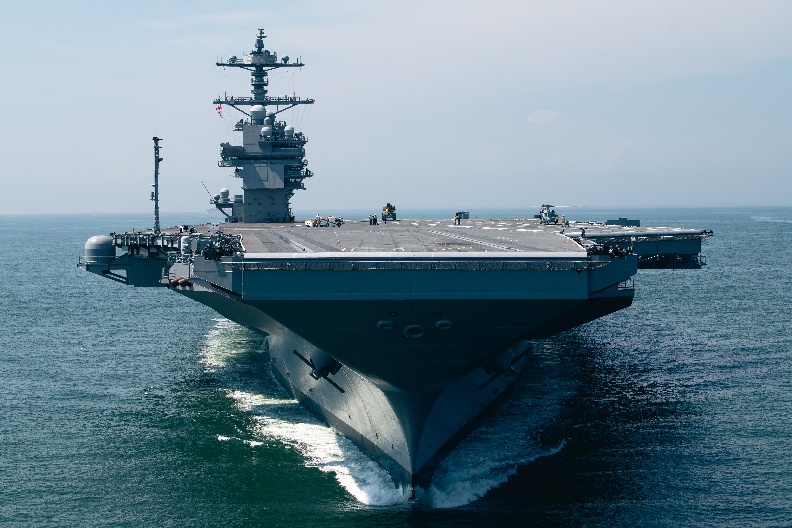
Photos accompanying this release are available at: http://hii.com/news/hiis-newport-news-shipbuilding-completes-successful-acceptance-sea-trials-of-john-f-kennedy-cvn-79/.
About HII
HII is America’s largest shipbuilder, delivering the world’s most powerful ships and all-domain mission technologies, including unmanned systems, to U.S. and allied defense customers. HII is the largest producer of unmanned underwater vehicles for the U.S. Navy and the world.
With a more than 140-year history of advancing U.S. national security, HII builds and integrates defense capabilities extending from the core fleet to C6ISR, AI/ML, EW and synthetic training. Headquartered in Virginia, HII’s workforce is 45,000 strong. For more information, visit:
- HII on the web: https://www.HII.com/
- HII on Facebook: https://www.facebook.com/TeamHII
- HII on X: https://www.twitter.com/WeAreHII
- HII on Instagram: https://www.instagram.com/WeAreHII
- HII on LinkedIn: https://www.linkedin.com/company/wearehii
Contact:
Todd Corillo
Todd.T.Corillo@HII-co.com
(757) 688-3220
A photo accompanying this announcement is available at https://www.globenewswire.com/NewsRoom/AttachmentNg/ae46f4c2-3750-4ec1-94df-c0ec56760376

FAQ
AI-generated questions and answers. How Rhea-AI works. Not financial advice.