
Homeland Assays Confirm Historical Drilled Uranium-Vanadium Grades at Cross Bones
A previously unreported interval adds assay data as Homeland plans a fully permitted 30-hole drill program.
Sentiment and the balance of points
Rhea-AI Sentiment reads the wording of the document, how positive or negative its language is on a 1 to 5 scale. The balance of points shown with the takes weighs what the document actually discloses, so the two can disagree, for example when a trial that missed its main goal is described in upbeat language.
Rhea-AI Summary
Homeland Uranium (HLUCF) reported Cross Bones resampling results, including a previously unreported interval measuring 15.5 metres in historical hole SC-07-06B.
That interval averaged 0.049% U3O8 (uranium oxide) and 0.135% V2O5 (vanadium oxide) from 14.0 to 29.5 metres. Homeland considers it new assay data, not verification of an earlier assay. Four other holes were resampled: uranium grades were higher in two, unchanged in one and lower in one than historical results, over differing intervals.
Homeland plans a fully permitted 30-hole drill program, beginning with 4–6 holes to test historical mineralized intervals and evaluate continuity. Older drill cuttings are unavailable for direct verification. SC-07-06B had 70% recorded core recovery; historical core may have shifted relative to depth markers during transport. BlueRock's historical quality-control procedures could not be verified.
How this balance works
Rhea-AI gives every point it takes from this document a weight. Minor counts 1, Moderate 3 and Major 9, so one Major point outweighs several Minor ones. The bar adds up the weights on each side, and when neither side holds more than 65% of the total the balance reads Mixed.
It reads the document as published, with the same rules for every company, and it does not look at what the market expected or at how the stock traded, so a point can be objectively good on a day the stock falls.
Rhea-AI Sentiment measures something else, the tone of the wording.
Hollow bars mark forward-looking points. How the balance works
Positive
- Moderate point. Forward-looking: it has not happened yet and may not happen.Homeland plans a fully permitted 30-hole program, including drilling alongside some older holes to check historical results.
- Minor pointSC-07-06B returned 15.5 m at 0.049% U3O8 and 0.135% V2O5, from 14.0–29.5 m.
- Minor pointSC-06-01B returned 1.1 m at 0.066% U3O8, 0.009% V2O5 versus historical 1.0 m at 0.047%, 0.005%, respectively.
- Minor pointSC-06-02 returned 4.7 m at 0.034% U3O8, 0.007% V2O5, matching historical grades over 4.8 m.
- Minor pointSC-06-03 returned 1.7 m at 0.035% U3O8, 0.045% V2O5 versus historical 1.8 m at 0.032%, 0.078%, respectively.
- Minor point. Forward-looking: it has not happened yet and may not happen.Phase I is planned for 4–6 drill holes to test historical mineralized intervals and evaluate uranium continuity.
Negative
- Minor pointSC-06-03A returned 3.6 m at 0.031% U3O8, 0.021% V2O5 versus historical 3.0 m at 0.038%, 0.022%, respectively.
- Minor pointSC-07-06B drill logs recorded 70% core recovery, limiting recovered material available for analysis.
- Minor pointHistorical core's unknown transport history means it may have shifted relative to drilling markers and sample tags.
- Minor pointMissing cuttings prevent direct verification of historical assays from Ashland Minerals and Anschultz holes.
- Minor pointBlueRock's historical quality-assurance and quality-control procedures could not be verified.
AI-generated analysis. How Rhea-AI works. Not financial advice.




Previously Unreported Interval in Historical Hole SC-07-06B returns 15.5 m at
Vancouver, British Columbia--(Newsfile Corp. - October 5, 2026) - Homeland Uranium Corp. (TSXV: HLU) (OTCQB: HLUCF) (FSE: D3U) ("Homeland" or the "Company") is pleased to announce results from a recent resampling program designed to verify selected historical assay intervals and a previously unreported interval from historical hole SC-07-06B from the Company's Cross Bones Uranium Project ("Cross Bones" or the "Project") in northwestern Colorado.
The confirmation program resampled drill core from BlueRock Resources' ("BlueRock") 2006-07 exploration program on the Cross Bones Property. BlueRock's historical hole SC-07-06B does not have any historical assay data in the BlueRock datasett acquired by the Company or in any publicly available disclosure identified on SEDARplus.ca. Accordingly, Homeland considers the assay results from SC-07-06B in this news release to represent new assay data, rather than confirmation or check sampling of a historical assay result.
Highlights
Historical hole SC-07-06B returned 15.5 m (50.9 ft) of near surface uranium-vanadium mineralization averaging
0.049% U3O8 and0.135% V2O5from 14.0 to 29.5 m (45.9 to 96.8 ft).Check sampling of selected historical drill core intervals confirms the presence and concentrations of uranium and vanadium mineralization encountered by Bluerock in 2006-07.
Other Homeland resampling comparisons to BlueRock's historical results returned:
0.066% U₃O₈ over 1.1 m in hole SC-06-01B from 160.0 to 161.1 m (524.9 to 528.5 ft) compared to historical resultst of0.047% U₃O₈ over 1.0 m from 160.1 to 161.1 m (525.1 to 528.5 ft)0.035% U₃O₈ over 1.7 m in hole SC-06-03 from 74.8 to 76.5 m (245.4 to 251.0 ft) compared to historical resultst of0.032% U₃O₈ over 1.8 m from 75.0 to 76.8 m (246.0 to 251.9 ft)0.034% U₃O₈ over 4.7 m in hole SC-06-02 from 18.6 to 23.3 m (61.0 to 76.4 ft) compared to historical results t of0.034% U₃O₈ over 4.8 m from 18.6 to 23.5 m (61.1 to 77.0 ft)
Roger Lemaitre, President and CEO of Homeland Uranium, commented: "The close agreement between the historical BlueRock assay results and our 2026 re-sampling program has bolstered our confidence of the Cross Bones Project. Such agreement is particularly validating as the Company located BlueRock's historical drill core and completed re-logging and selected samples for assaying prior to locating, purchasing, and reviewing the historical BlueRock dataset. I am especially encouraged by emerging potential of Cross Bones exhibited by the 15.5 m - 50.9 ft length of uranium mineralization confirmed by our sampling of historical hole SC-07-06B."
Verification of Historical Results
As part of its ongoing technical review, Homeland selected mineralized intervals for resampling and verification from Bluerock's 2006 drill core that was found on a nearby private property in October, 2025. Samples were selected from historically sampled areas in combination with Homeland's scanning of the drill core for radioactivity using a CT007-M handheld instrument. The 2025-2026 resampling program returned uranium and vanadium results that are broadly consistent with corresponding or adjacent assay intervals obtained by Bluerock t (Table 1 and Figure 1). The results provide additional confidence in the historical geological and assay database being incorporated into Homeland's ongoing exploration planning process.
Hole SC-07-06B has no historical assay data in the BlueRock dataset nor was found in BlueRock's news disclosure on SEDARplus.com. Consequently, Homeland considers this result to be new data, not a check of a historical result.
Homeland acquired the historical BlueRock databaset as part of its acquisition and compilation of Cross Bones historical exploration data (see the Company's news release dated February 26, 2026 found on the Homeland website at https://homeland-uranium.com/news-releases/2026/homeland-acquires-historical-data-for-cross-bones-uranium-pr2026-02-26-010502 and on the Company's profile at SEDARplus.ca). The database includes drill hole information, surface sampling, radiometric surveys, and downhole gamma and resistivity data.
The comparison of historical and 2026 Homeland results is summarized below in Table 1:
Table 1: Comparison of 2006 Bluerock drilling/assay sampling and 2025-2026 Homeland resampling results.
| Drill Hole | Elev (m/ft) | Depth (m/ft) | Dip | Azi | Bluerock 2006 Sampling1,2 | HLU 2025-2026 Resampling1,2 | ||||||||
| From (m/ft) | To (m/ft) | Length (m/ft) | % U3O8 | % V2O5 | From (m/ft) | To (m/ft) | Length (m/ft) | % U3O8 | % V2O5 | |||||
| SC-06-01B | 1733.7 | 175.9 | -78 | 38 | 160.1 | 161.1 | 1.0 | 0.047 | 0.005 | 160.0 | 161.1 | 1.1 | 0.066 | 0.009 |
| 5688.0 | 577.0 | 525.1 | 528.5 | 3.4 | 524.9 | 528.5 | 3.6 | |||||||
| SC-06-02 | 1727.9 | 127.4 | -45 | 32 | 18.6 | 23.5 | 4.8 | 0.034 | 0.007 | 18.6 | 23.3 | 4.7 | 0.034 | 0.007 |
| 5669.0 | 418.0 | 61.1 | 77.0 | 15.9 | 61.0 | 76.4 | 15.4 | |||||||
| SC-06-03 | 1735.5 | 120.7 | -45 | 43 | 75.0 | 76.8 | 1.8 | 0.032 | 0.078 | 74.8 | 76.5 | 1.7 | 0.035 | 0.045 |
| 5693.9 | 396.0 | 246.0 | 251.9 | 5.9 | 245.4 | 251.0 | 5.6 | |||||||
| SC-06-03A | 1735.5 | 136.3 | -65 | 30 | 89.1 | 92.0 | 3.0 | 0.038 | 0.022 | 89.1 | 92.7 | 3.6 | 0.031 | 0.021 |
| 5693.9 | 447.0 | 292.2 | 302.0 | 9.8 | 292.3 | 304.1 | 11.8 | |||||||
| SC-07-06B4 | 1730.4 | 34.1 | -56 | 184 | No Assay Data; 20,497 cps3 at 72.1 ft/22 m (60.1 ft/18.3 m) | 14.0 | 29.5 | 15.5 | 0.049 | 0.135 | ||||
| 5677.2 | 112.0 | 45.9 | 96.8 | 50.9 | ||||||||||
| 1 Composited intervals contain geochemical analysis where core was recovered. Intersection interval is composited using a cut-off grade of 0.001 % U3O8. 2 All depths and intervals are reported as drill hole and do not represent true thickness, which is unknown at this time. 3 Natural Gamma CPS measured using Multi-Parameter E-Log Neutron Logging Tool as reported in the BlueRock dataset. 4 Measured core recovery reported in 2006 in the SC-07-06B drill logs of is | ||||||||||||||
The results demonstrate particularly strong agreement in drill holes SC-06-03 and SC-06-03A, where the HLU resampling returned similar uranium and vanadium grades over the similar intervals as the historical Bluerock results, supporting the use of selected historical Bluerock assay data in Homeland's geological interpretation and drill targeting. The Company's check assays from SC-06-02 reproduced the historical uranium and vanadium grades almost exactly as determined by BlueRock, with only a minor difference in the sampled interval length.
Homeland has acquired a previous historical dataset comprised of surface mapping and radiometrics and 94 reverse circulation drill holes ("RCD") with lithology, down-hole radiometrics and resistivity readings completed between 1977 and 1980 by Ashland Minerals and Anschultz on the Cross Bones Project (see the Company's news release dated December 10, 2024 found on the Homeland website at https://homeland-uranium.com/news-releases/2024/valleyview-acquires-key-coyote-basin-red-wash-exploration-dataset and on the Company's profile at SEDARplus.ca). Due to the age of these drill holes, the RCD cuttings have not been found and the Company is unable to directly verify historical assay data from the Ashland Minerals and Anschultz holes. The Company intends to twin some of these holes in its planned and fully permitted 30-hole drill program. Phase I of this program will be comprised of 4-6 drill holes to testing selected historical mineralized intervals and evaluating the continuity of uranium mineralization.
About the Cross Bones Project
The Cross Bones Property hosts the Cross Bones Uranium Deposit (formerly known as the Skull Creek Uranium Deposit). The Cross Bones Property is comprised of 853 BLM mineral claims and three Colorado state leases overlying over 35 km of strike length of the Sego Sandstone unit and other parallel coal units.
The Cross Bones Uranium Deposit is hosted within uranium-prospective Sega Sandstone units of the Mesa Verda Group stratigraphy, is exposed at surface and has historically been traced to depths of approximately 800 feet. Homeland is advancing the project through geological mapping, sampling and drilling designed to validate historical results, confirm continuity of mineralization and provide the technical information required to evaluate the deposit under current NI 43-101 standards.
About Homeland Uranium Corp.
Homeland Uranium is a mineral exploration company focused on becoming a premier US-focused and resource-bearing uranium explorer and developer. The Company is
Sampling and QA/QC
During the Cross Bones 2025-2026 resampling program, samples of historical drill core were taken by Homeland at intervals of anomalous radioactivity determined by counts per second ("cps") values and previously reported uranium-bearing intervals reported by BlueRock in these historical drillholes. Resampling of drill core was either halved or quartered based on available core and ranged from 0.5 ft (~0.15 m) to 7.0 ft (~~2.13 m), dependent on core recovery. Note that, due to the unknown transport history of the BlueRock drill core since 2006, core may have shifted relative to drilling markers and preserved sample tags. Care was taken by field personnel to best represent depths based on available data. Samples were sent to SGS Laboratories in Lakefield, Ontario. Samples were shipped in secure containment for preparation, processing and multi-element analysis by Sodium Peroxide Fusion and Inductively Coupled Plasma Optical Emission Spectrometry (Na2O2; ICP-OES). Blanks, standard reference materials, and repeats are inserted into the sample stream at regular intervals by Homeland and the SGS in accordance with each's respective quality assurance/quality control procedures. SGS Laboratories in Lakefield, Ontario. SGS Lab is certified ISO 17043: General requirements for proficiency testing. All SGS laboratories are required to participate in SGS's internal Proficiency Testing ("PT") program: Laboratory Quality Systems International ("LQSi") program, the largest PT program in the mining world. The SGS LQSi program currently involves over 100 laboratories on a regular basis, both SGS and non-SGS participants. SGS LQSi holds accreditation to the conformity assessment standard ISO 17043: General requirements for proficiency testing.
The Company has reviewed the BlueRock database for the analytical processes used by the historical operator. Natural gamma data collected is recorded as collected using a Natural Gamma CPS measured using Multi-Parameter E-Log Neutron Logging Tool, collected by Century Geophysical Corp. in 2006. Bluerock samples were reported to have been sent to Acme Analytical Laboratories Ltd. in Vancouver, British Columbia and were analyzed using Inductively Coupled Plasma Atomic Emission Spectroscopy (ICP-AES) using a four-acid near-total digestion (HCLO4:HNO3:HCL:HF). The Company has not been able to verify the QA/QC processes used by BlueRock. The historical geochemical data presented in this release were obtained from a database acquired by the previous operator of the Property. The Company has undertaken verification of the historical data through this resampling program and, given the agreement between the historical and recent dataset, considers the data suitable for the purposes for which they are being used. Both datasets are considered valid and can be used by the Company in future disclosures and geological analysis.
Qualified Person
Nancy Normore, P.Geo., the Company's Vice President, Exploration, is a Qualified Person as defined in NI 43-101, and has reviewed and approved the technical content of this news release.
t The BlueRock database consists of BlueRock's internal company memos, assay certificates from Acme Analytical Laboratories, drill logs, surface samples, down-hole radiometric readings, and surface radiometric meetings all pertaining to the work completed by BlueRock between 2005 and 2007. Results of the vast majority of this information has never been publicly disclosed to the knowledge of Homeland Uranium and cannot be located in any publicly accessible data repository.
For further information, please contact:
Roger Lemaitre
President & Chief Executive Officer
Homeland Uranium Corp.
Tel: 306-713-1401
Email: info@homeland-uranium.com
Investor Relations
Kin Communications Inc.
Tel: 604-684-6730
Email: HLU@kincommunications.com
Neither the TSX Venture Exchange nor its Regulation Services Provider (as that term is defined in the policies of the TSX Venture Exchange) accepts responsibility for the adequacy or accuracy of this news release.
Forward-Looking Statements
This news release contains "forward-looking statements" within the meaning of applicable securities legislation. Such forward-looking statements include, without limitation, statements regarding the Company's exploration strategy, interpretation of geological and analytical results, planned drilling and exploration activities at the Cross Bones Project, planned follow-up exploration programs, and the timing, scope and objectives of future exploration programs.
These forward-looking statements reflect the Company's current views with respect to future events and are necessarily based upon a number of assumptions that, while considered reasonable by the Company, are inherently subject to significant operational, business, economic and regulatory uncertainties and contingencies. These assumptions include, among other things: conditions in general economic and financial markets; accuracy and reliability of analytical results; geological interpretations derived from mapping, sampling, radiometric surveys and future drilling; timing and amount of capital expenditures; timely performance of available laboratory and other related services; future operating costs; the availability of skilled labour and no labour related disruptions at any of the Company's operations; no unplanned delays or interruptions in scheduled activities; all necessary permits, licenses and regulatory approvals for operations are received in a timely manner; the ability to secure and maintain title and ownership to properties and the surface rights necessary for operations; and the Company's ability to comply with environmental, health and safety laws. The foregoing list of assumptions is not exhaustive.
The Company cautions the reader that forward-looking statements involve known and unknown risks, uncertainties and other factors that may cause actual results and developments to differ materially from those expressed or implied by such forward-looking statements contained in this news release and the Company has made assumptions and estimates based on or related to many of these factors. Such factors include, without limitation: the timing and content of work programs; results of exploration activities and development of mineral properties; the interpretation and uncertainties of drilling results and other geological data; receipt, maintenance and security of permits and mineral property titles; environmental and other regulatory risks; project costs overruns or unanticipated costs and expenses; availability of funds; and general market and industry conditions.
Forward-looking statements are based on the expectations and opinions of the Company's management on the date the statements are made. The assumptions used in the preparation of such statements, although considered reasonable at the time of preparation, may prove to be imprecise and, as such, readers are cautioned not to place undue reliance on these forward-looking statements, which speak only as of the date the statements were made. The Company undertakes no obligation to update or revise any forward-looking statements included in this news release if these beliefs, estimates and opinions or other circumstances should change, except as otherwise required by applicable law.
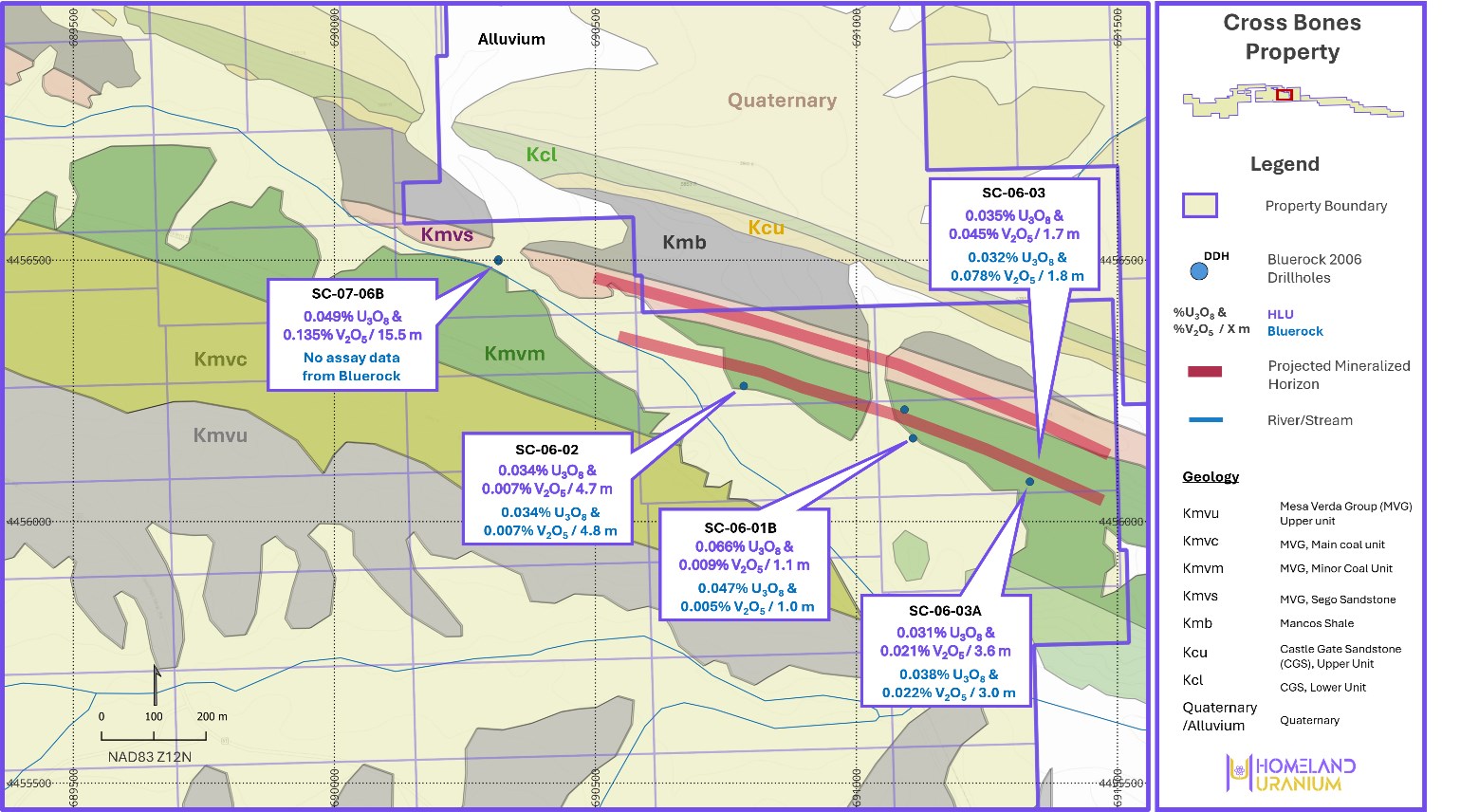
Figure 1: Map showing HLU and BlueRock assay results (Table 1) of resampled historical drilling and projected mineralized horizon with geology underlay.
To view an enhanced version of this graphic, please visit:
https://images.newsfilecorp.com/files/10583/317273_56d09964b4058907_002full.jpg

To view the source version of this press release, please visit https://www.newsfilecorp.com/release/317273
FAQ
AI-generated questions and answers. How Rhea-AI works. Not financial advice.
What did Homeland Uranium find in Cross Bones hole SC-07-06B?
SC-07-06B returned 15.5 m averaging 0.049% U3O8 and 0.135% V2O5 from 14.0 to 29.5 m. Homeland considers this new assay data because no historical assays for the hole were found in the acquired BlueRock dataset or identified public disclosures.
What drilling does Homeland Uranium plan at Cross Bones?
Homeland plans a fully permitted 30-hole drill program, with Phase I comprising 4–6 holes. The initial holes will test selected historical mineralized intervals and evaluate uranium continuity. The company intends to drill alongside some older holes whose missing cuttings prevent direct assay verification.
How were Homeland Uranium's Cross Bones resampling assays tested?
Samples were sent to SGS Laboratories in Lakefield, Ontario for sodium peroxide fusion and inductively coupled plasma optical emission spectrometry, methods used to measure elemental concentrations. Homeland and SGS inserted blanks, reference materials and repeat samples at regular intervals under their respective quality-control procedures.