
Honda Explores Robotics Solution to Support Research Aboard Future Commercial Space Stations
Honda (HMC) is exploring a robotics system with Redwire to support research operations aboard future commercial space stations.
Sentiment and the balance of points
Rhea-AI Sentiment reads the wording of the document, how positive or negative its language is on a 1 to 5 scale. The balance of points shown with the takes weighs what the document actually discloses, so the two can disagree, for example when a trial that missed its main goal is described in upbeat language.
Rhea-AI Summary
Honda (HMC) is exploring a robotics system with Redwire to support research operations aboard future commercial space stations.
The concept would combine Honda’s multi-fingered robotic hand with Redwire’s STAARK robotic arm and experiment locker technology. Honda aims to reduce astronaut time spent on laboratory tasks and increase research capacity through automation. Potential uses include sample handling, materials transfer and equipment operation. Honda’s hand has completed durability testing under varied fingertip loads; separate testing demonstrated Redwire’s arm autonomously tracking and grasping moving objects.
Representatives will discuss potential applications with station developers and prospective partners at IAC on October 5–9, 2026, in Antalya, Türkiye.
AI-generated analysis. How Rhea-AI works. Not financial advice.




- Honda multi-fingered robotic hand combined with Redwire STAARK robotic arm could automate experiment handling and other research operations in orbit
- Robotics solution aims to increase research capacity while reducing crew time for lab tasks
- Honda and Redwire to meet with commercial station developers and prospective partners at the 2026 International Astronautical Congress
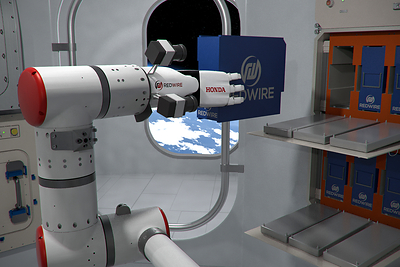
As NASA transitions from the International Space Station (ISS) to commercially operated stations in low Earth orbit, station developers are evaluating how research and routine laboratory activities will be performed in this new operating environment. Future commercial stations are being designed around smaller crews and shorter astronaut stays, increasing the need for automation to support station operations and scientific investigations while reducing demands on crew time.
Dexterous Robotics for In-Orbit Research
Many research activities conducted in orbit require astronauts to retrieve experiments, transfer samples, operate laboratory equipment, and move materials between workstations. These routine tasks consume valuable crew time aboard today's space stations. A robotic system capable of performing these activities could help reduce operational costs while enabling greater use of research facilities and supporting more scientific and commercial research.
Over decades of development, Honda has advanced robotics technologies capable of performing tasks that require human-like dexterity and is now exploring their applications for future space operations. The Honda multi-fingered robotic hand combines actively controlled joints with force and tactile sensing throughout the fingertips and palm, enabling precise contact detection and delicate manipulation. Its design is flexible enough for precise laboratory work, including handling research samples, manipulating small objects, and operating laboratory equipment. The Honda multi-fingered robotic hand has also completed extensive durability testing under varied fingertip loads, demonstrating a practical combination of dexterity, power and durability.
"Honda space initiatives, including our robotic hand, are focused on enabling practical operations in orbit," said Tom Sladek, chief engineer, Space Development Division, Honda Development & Manufacturing of America, LLC. "Working with Redwire, Honda is evaluating how robotics with human-like dexterity could support research activities aboard the next generation of commercial space stations, helping crews accomplish more in an environment with fewer personnel while improving operational efficiency."
With eight facilities currently on the ISS, Redwire has decades of experience on the ISS developing facilities hardware, as well as operating science and technology experiments. Additionally, Redwire has extensive space robotics expertise with STAARK, an affordable, modular, and easily customized robotic system designed for various on-orbit robotics applications. Recent testing successfully demonstrated that the STAARK robotic arm is capable of autonomously tracking and grasping dynamic objects, providing the reach and positioning capability needed to move equipment and access work throughout a station.
"Redwire is excited to explore opportunities with Honda that leverage our proven track record and expertise in robotics and in-space manufacturing technology development to advance the next generation of commercial research in orbit," said Shawn Buckley, executive vice president and chief operating officer at Redwire Space. "Commercial space stations will transform Low-Earth orbit, and advanced space robotics are critical in enabling technologies that will help us unlock the value for our customers."
Together, the technologies could support the full experiment workflow, combining Redwire's robotic reach and station infrastructure with the Honda multi-fingered robotic hand, capable of precise manipulation and adaptable grasping across a wide range of objects and tasks. Such an integrated system has the potential to automate portions of the research workflow, ranging from sample handling and materials transfer to equipment operation and laboratory support tasks. Additional applications may include inventory management, cargo movement, inspection activities, and other station support functions.
Partner Discussions at IAC 2026
Honda and Redwire representatives will attend the International Astronautical Congress (IAC), October 5-9, 2026, in Antalya, Türkiye to discuss potential applications for the combined robotics solution with commercial station developers and prospective industry partners. Organizations interested in learning more about the concept or scheduling a meeting at IAC may contact Space@na.honda.com.
About Honda Research & Development in America
Honda has been conducting research & development operations in America for 50 years, beginning with the establishment of a research facility in California in 1975. Today, Honda conducts R&D activities at 23 facilities across the country responsible for creating advanced products and technologies that provide new value to Honda and Acura customers.
Honda conducts all facets of product development in the U.S., including market and technology research, product styling, engineering design, prototype fabrication and testing, collaboration with parts suppliers, and support for mass production. With major R&D facilities in California, Ohio, and North Carolina, U.S. Honda associates are engaged in the development and testing of Honda and Acura automobiles, Honda powersports and power equipment products, and also play a lead role in the development of leading-edge safety, driver-assistive and environmental technologies.
Explore more of Honda in the Digital FactBook.
Notice: Although the information included in this press release is accurate as of the date of publication, this information is subject to change at any time without notice. American Honda Motor Co., Inc. assumes no responsibility for updating this information.

 View original content to download multimedia:https://www.prnewswire.com/news-releases/honda-explores-robotics-solution-to-support-research-aboard-future-commercial-space-stations-302895805.html
SOURCE American Honda Motor Co., Inc.
FAQ
AI-generated questions and answers. How Rhea-AI works. Not financial advice.
What space station robotics system is Honda developing with Redwire?
Honda is exploring a concept combining its multi-fingered robotic hand with Redwire’s STAARK robotic arm and experiment locker technology. The proposed integrated system could automate portions of research operations aboard future commercial space stations, including handling samples and operating laboratory equipment. It remains a concept being evaluated.