STOCK TITAN

IBM and Lam Research Announce Collaboration to Advance Sub-1nm Logic Scaling

Rhea-AI Impact
(Neutral)
Rhea-AI Sentiment
(Very Positive)
Tags

IBM (NYSE: IBM) and Lam Research announced a five-year collaboration to advance sub-1nm logic scaling using novel materials, advanced etch/deposition, and High‑NA EUV lithography.

Work will validate full process flows for nanosheet and nanostack devices, leveraging IBM's Albany facilities and Lam's Aether, Kiyo, Akara, Striker, and ALTUS toolsets.

Loading...
Loading translation...

Positive

  • Five-year collaboration targets sub-1nm logic scaling
  • Joint focus on High‑NA EUV, novel materials, etch and deposition
  • Builds on past successes including IBM's 2nm node contributions

Negative

  • Project faces significant technical challenges to enable High‑NA EUV and sub-1nm manufacturing

News Market Reaction – IBM

-1.24%
1 alert
-1.24% News Effect

On the day this news was published, IBM declined 1.24%, reflecting a mild negative market reaction.

Data tracked by StockTitan Argus on the day of publication.

Key Figures

Agreement term: five-year agreement Logic scaling target: sub-1nm node 7nm technology: 7nm +2 more
5 metrics
Agreement term five-year agreement Duration of new IBM–Lam Research collaboration
Logic scaling target sub-1nm node Goal to extend logic scaling below 1 nanometer
7nm technology 7nm Earlier logic node generations enabled by prior collaboration
2nm node chip 2nm World’s first 2nm node chip unveiled by IBM in 2021
Collaboration history more than a decade Length of prior IBM–Lam cooperation on logic fabrication

Market Reality Check

Price: $247.68 Vol: Volume 5,168,226 is below...
low vol
$247.68 Last Close
Volume Volume 5,168,226 is below the 20-day average of 7,550,804 (relative volume 0.68). low
Technical Shares at 253.09, trading below 200-day MA of 279.56 and about 22.1% under the 52-week high.

Peers on Argus

IBM was down 2.13% pre-news. Key peers were mixed: ACN (-1.64%), CTSH (-2.06%), ...

IBM was down 2.13% pre-news. Key peers were mixed: ACN (-1.64%), CTSH (-2.06%), FI (-0.17%) declined while INFY (+0.63%) and FIS (+0.62%) gained, pointing to stock-specific rather than broad sector pressure.

Common Catalyst Limited peer news overlap; only INFY also reported an AI-related collaboration.

Historical Context

5 past events · Latest: Mar 05 (Positive)
Pattern 5 events
Date Event Sentiment Move Catalyst
Mar 05 Quantum research result Positive +2.6% First-ever half-Möbius molecule demonstrated using IBM quantum computing.
Feb 25 Government contract win Positive +3.6% Five-year, $112M contract to modernize Defense Commissary ESL systems.
Feb 25 Security report release Neutral +3.6% X-Force Threat Index detailing rising AI-driven attacks and vulnerabilities.
Feb 24 AI collaboration Positive +2.7% Deepgram voice capabilities integrated into IBM watsonx Orchestrate for enterprise AI.
Feb 11 M&A and earnings Positive -4.9% Confluent Q4/FY results plus IBM’s proposed $31/share acquisition of Confluent.
Pattern Detected

Recent IBM announcements on collaborations, contracts, and technology reports have often coincided with positive next-day price moves, except for the Confluent acquisition/earnings item, which saw a decline.

Recent Company History

Over recent months, IBM has highlighted several technology and partnership milestones. On Feb 11, an earnings release for Confluent also disclosed a proposed IBM acquisition, with IBM’s stock falling 4.87%. Subsequent IBM-focused news, including AI collaborations on Feb 24 and the X-Force Threat Index on Feb 25, were followed by gains of about 2.67% and 3.58%. A defense contract win on Feb 25 and a quantum-enabled molecular discovery on Mar 5 also saw positive reactions, framing today’s IBM–Lam Research scaling collaboration within an ongoing innovation-led narrative.

Market Pulse Summary

This announcement outlines a five-year IBM–Lam Research collaboration to push sub-1nm logic scaling ...
Analysis

This announcement outlines a five-year IBM–Lam Research collaboration to push sub-1nm logic scaling using novel materials, advanced etch and deposition, and High NA EUV lithography. It builds on prior work that contributed to 7nm and IBM’s 2nm node chip, extending efforts to nanosheet and nanostack devices and backside power delivery. In context of recent AI and quantum initiatives, this deepens IBM’s semiconductor R&D stack. Investors may track future updates on technical milestones and adoption by manufacturing ecosystems.

Key Terms

high na euv lithography, nanosheet, nanostack, etch, +3 more
7 terms
high na euv lithography technical
"development of novel materials, advanced processes, and High NA EUV lithography techniques"
An advanced chipmaking technology that uses extreme ultraviolet light with a larger “lens opening” (higher numerical aperture) to print much finer patterns on silicon wafers, similar to how a higher-quality camera lens can capture sharper detail. It matters to investors because it enables faster, lower-power, and more densely packed chips—but requires very expensive machines and specialized suppliers, so adoption can reshape competitors’ costs, product leadership and supplier revenues.
nanosheet technical
"early generations of 7nm, nanosheet, and EUV process technologies"
A nanosheet is an ultra-thin layer of material only a few atoms thick, like a single sheet of paper compared with a ream, but made from metals, semiconductors or other compounds. Investors care because nanosheets can change how electronic components, sensors and batteries perform—enabling smaller, faster or more energy-efficient products—which can lower manufacturing costs, create new product advantages and reshape competitive dynamics in technology-related markets.
nanostack technical
"full process flows for nanosheet and nanostack devices and backside power delivery"
A nanostack is a layered combination of materials, tiny components and manufacturing steps engineered at the nanometer scale to deliver a specific function, such as sensing, targeted drug delivery or ultra‑small electronics. Think of it like the layers in a cake or the apps and settings on a smartphone that must all work together; for investors it signals how practical and costly it will be to scale, protect with patents, meet regulations and turn the underlying science into a sellable product.
etch technical
"developing new materials, advanced etch and deposition capabilities"
Etch is a manufacturing process that removes material from a surface to create patterns, shapes or features—commonly done with chemicals, gases or light-based methods. Think of it like carefully carving a design into a metal plate: in chips, displays, or medical devices the process defines tiny structures that determine performance, yield and reliability. For investors, etching affects production cost, product quality and supply capacity, so improvements or problems in etch can change a maker’s competitiveness and margins.
deposition technical
"advanced etch and deposition capabilities for increasingly complex device architectures"
A deposition is a formal, recorded interview of a witness or party conducted outside of court where a lawyer asks questions and the answers are given under oath and transcribed. For investors, depositions matter because they can reveal detailed factual admissions, internal practices, or risks that may affect a company’s finances or reputation — think of it as a taped, on-the-record conversation that can later be used as evidence and influence legal outcomes or market confidence.
backside power delivery technical
"flows for nanosheet and nanostack devices and backside power delivery"
Backside power delivery is a chip design approach that supplies electricity to an integrated circuit from the silicon wafer’s underside instead of routing power across the top, shortening power paths and improving energy efficiency and heat removal. For investors, it matters because the technique can boost a product’s performance and battery life while potentially increasing manufacturing complexity and cost, affecting competitive position, production yields, and profit margins.
advanced packaging technical
"ALTUS Halo deposition systems, and advanced packaging technologies — the teams will build"
Advanced packaging describes modern methods for arranging, connecting and enclosing semiconductor chips so they work together more efficiently in a smaller space—think of stacking and wiring tiny electronic building blocks instead of leaving them as separate items on a circuit board. It matters to investors because these techniques can boost product speed, reduce power use, shrink device size and lower manufacturing costs, all of which influence a maker’s competitiveness, profit margins and market share.

AI-generated analysis. Not financial advice.

Agreement includes development of novel materials, advanced processes, and High NA EUV lithography techniques to enable future logic nodes

ALBANY, N.Y. and FREMONT, Calif., March 10, 2026 /PRNewswire/ -- IBM (NYSE: IBM) and Lam Research Corp. (NASDAQ: LRCX) today announced a collaboration aimed at developing new processes and materials to support sub-1nm logic scaling. Building on a long record of successful partnerships, the new agreement will focus on the joint development of novel materials, fabrication processes, and High NA EUV lithography processes to advance IBM's logic scaling roadmap.

IBM and Lam have collaborated for more than a decade to advance logic fabrication, notably enabling early generations of 7nm, nanosheet, and EUV process technologies. Under this new five-year agreement, the companies intend to extend logic scaling to the sub-1nm node. The work will focus on developing new materials, advanced etch and deposition capabilities for increasingly complex device architectures, and new High NA EUV lithography processes to enable next-generation interconnect and device patterning and accelerate industry adoption.

"Lam has been a critical partner to IBM for over a decade, contributing to key breakthroughs in logic scaling and device architecture such as nanosheet and the world's first 2nm node chip, unveiled by IBM in 2021," said Mukesh Khare, GM of IBM Semiconductors and VP of hybrid cloud, IBM Research. "We are thrilled to be expanding our collaboration to tackle the next set of challenges to enable High NA EUV lithography and sub-1nm nodes."

"As the industry enters a new era of 3D scaling, progress depends on rethinking how materials, processes, and lithography come together as a single, high-density system," said Vahid Vahedi, chief technology and sustainability officer at Lam Research. "We are proud to build on our successful collaboration with IBM to drive High‑NA EUV dry resist and process breakthroughs, accelerating the development of lower power and higher performance transistors that will be critical for AI era."

Using IBM's advanced research capabilities at the NY Creates Albany NanoTech Complex and Lam's end-to-end process tools and innovations — including Aether® dry resist technology, Kiyo® and Akara® etch platforms, Striker® and ALTUS® Halo deposition systems, and advanced packaging technologies — the teams will build and validate full process flows for nanosheet and nanostack devices and backside power delivery. Together, these capabilities are aimed at allowing High‑NA EUV patterns to be reliably transferred into real device layers with high yield and enabling continued scaling, improved performance, and viable paths to production for future logic devices.

About Lam Research
Lam Research Corporation is a global supplier of innovative wafer fabrication equipment and services to the semiconductor industry. Lam's equipment and services allow customers to build smaller and better-performing devices. In fact, today, nearly every advanced chip is built with Lam technology. We combine superior systems engineering, technology leadership, and a strong values-based culture, with an unwavering commitment to our customers. Lam Research (Nasdaq: LRCX) is a FORTUNE 500® company headquartered in Fremont, Calif., with operations around the globe. Learn more at www.lamresearch.com.

About IBM
IBM is a leading global provider of hybrid cloud and AI, and consulting expertise. We help clients in more than 175 countries capitalize on insights from their data, streamline business processes, reduce costs and gain the competitive edge in their industries. Thousands of government and corporate entities in critical infrastructure areas such as financial services, telecommunications and healthcare rely on IBM's hybrid cloud platform and Red Hat OpenShift to affect their digital transformations quickly, efficiently and securely. IBM's breakthrough innovations in AI, quantum computing, industry-specific cloud solutions and consulting deliver open and flexible options to our clients. All of this is backed by IBM's long-standing commitment to trust, transparency, responsibility, inclusivity and service. Visit www.ibm.com for more information.

IBM Contact
Willa Hahn
IBM Research communications
willa.hahn@ibm.com 

Lam Research Contacts
Laura Bakken
Lam Research Media Relations
+1 (510) 572-9021
laura.bakken@lamresearch.com

Ram Ganesh 
Investor Relations 
+1 (510) 572-1615 
investor.relations@lamresearch.com
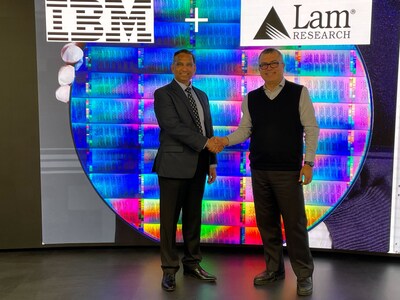
 

L-R: Mukesh Khare, GM of IBM Semiconductors and VP of hybrid cloud at IBM Research; Vahid Vahedi, chief technology and sustainability officer at Lam Research. 
IBM and Lam Research have announced a collaboration to enable continued scaling, improved performance, and viable paths to production for sub-1nm logic devices.


Cision View original content to download multimedia:https://www.prnewswire.com/news-releases/ibm-and-lam-research-announce-collaboration-to-advance-sub-1nm-logic-scaling-302709180.html

SOURCE Lam Research Corporation

FAQ

What is the scope of IBM (NYSE: IBM) and Lam Research's five-year collaboration announced March 10, 2026?

They will jointly develop processes, materials, and High‑NA EUV lithography for sub-1nm logic scaling. According to IBM, the work includes etch, deposition, and process-validation for nanosheet and nanostack devices using Lam's toolsets.

How will the IBM (NYSE: IBM) and Lam Research collaboration use High‑NA EUV lithography?

High‑NA EUV will be developed to enable next-generation patterning and interconnects for sub-1nm nodes. According to IBM, the effort aims to reliably transfer High‑NA EUV patterns into real device layers with high yield.

Which Lam Research tools will be used in the IBM (NYSE: IBM) partnership to advance logic scaling?

The collaboration will use Lam's Aether dry resist, Kiyo and Akara etch platforms, Striker and ALTUS Halo deposition systems. According to IBM, these tools will support full process flows and validation for new device architectures.

What device architectures will IBM (NYSE: IBM) and Lam Research focus on during the collaboration?

The teams will focus on nanosheet and nanostack devices and backside power delivery development. According to IBM, the work targets scalable process flows to improve performance and enable production paths for future logic devices.

What is the expected industry significance of IBM (NYSE: IBM) and Lam Research's sub-1nm collaboration?

The collaboration aims to accelerate adoption of next-generation logic nodes and lower-power, higher-performance transistors. According to IBM, combining materials, processes, and High‑NA EUV could enable viable production paths for future AI-era devices.
International Business Machines Corp

NYSE:IBM

View IBM Stock Overview

IBM Rankings

IBM Latest News

IBM Latest SEC Filings

IBM Stock Data

233.45B
933.89M
Information Technology Services
Computer & Office Equipment
Link
United States
ARMONK