
Illumina launches StrataMap Spatial Solution, a powerful end-to-end spatial whole transcriptome research solution
Illumina (NASDAQ:ILMN) launched the StrataMap Spatial Solution, an end-to-end, sequencing-based spatial whole-transcriptome platform for single-cell resolution research across large tissue areas.
Rhea-AI Summary
Illumina (NASDAQ:ILMN) launched the StrataMap Spatial Solution, an end-to-end, sequencing-based spatial whole-transcriptome platform for single-cell resolution research across large tissue areas.
The system offers up to 2x more unique genes per sample than probe-based panels, supports >2000 samples annually, integrates with NovaSeq/NextSeq, and includes DRAGEN and Illumina Connected Multiomics software for scalable spatial and multiomic analysis. An FFPE-focused version is targeted for initial customer enablement in 2027.
Positive
- Whole-transcriptome spatial profiling detects about 2x more genes per sample than panel-based methods
- Large 7.5 cm2 capture area supports serial sections and multidimensional tissue mapping
- Throughput designed to process more than 2000 samples per year
- Time from sample to analysis insight can be under 5 days
- Runs on existing NovaSeq and NextSeq systems, reducing need for new hardware investment
- Integrated DRAGEN and Connected Multiomics pipeline supports high-scale spatial and multiomic analysis
Negative
- FFPE-specific StrataMap Spatial solution is still in development, targeted for 2027 availability
- Forward-looking statements highlight risks in new product development, manufacturing scale-up, and customer adoption
Details
News Market Reaction – ILMN
In the Jun 8 session, ILMN declined 2.64%, reflecting a moderate negative market reaction.
Data tracked by StockTitan Argus on the day of publication.
Key Figures
- Gene detection uplift
- 2x more unique genes per sample
- Whole-transcriptome profiling vs probe-based technologies
- Capture area
- 7.5 cm2
- StrataMap Spatial tissue capture area for serial sections
- Throughput
- more than 2000 samples per year
- Annual processing capacity of StrataMap Spatial
- Sequencing time
- 22 hours
- Minimum sequencing time per run in StrataMap Spatial workflow
- Sample-to-insight time
- less than 5 days
- Including imaging, sequencing, and analysis
- FFPE solution target year
- 2027
- Target for initial customer enablement of FFPE-specific solution
- Current price
- $162.27
- Pre-news trading level vs 52-week high $177.22 and low $81.755
- Price move
- -3.42%
- 24h change ahead of StrataMap Spatial launch news
Historical Context
-
Collaboration with IDT for end-to-end somatic oncology research workflows.
-
Launch of fireflyGO benchtop automation for targeted oncology NGS workflows.
-
Introduction of distributed whole-genome MRD research solution for tumors and blood cancers.
-
Election of David P. King to the board, replacing several retiring directors.
-
Release of 2025 Corporate Responsibility Report highlighting access, sustainability, and new products.
24h Move is the share-price change in the day after each event; other market factors may also have contributed.
Key Terms
spatial transcriptomics medical
whole-transcriptome profiling medical
single cell resolution medical
pseudogenes medical
vdj clonotypes medical
multiomic medical
tumor microenvironment medical
ngs technical
AI-generated analysis. How Rhea-AI works. Not financial advice.




StrataMap Spatial gives researchers access to spatial biology at true single cell resolution for discovery without boundaries
Whole-transcriptome profiling across a large tissue capture area can generate 2x more unique genes per sample than probe-based technologies
"Spatial biology offers a new perspective on how our genetic code manifests in our bodies," said Steve Barnard, PhD, chief technology officer of Illumina. "Our customers are already using StrataMap Spatial's unparalleled discovery power to map intricate tissues and study tumor development. This launch pairs our new spatial solution with our tailored bioinformatics pipeline, reinforcing Illumina's commitment to an insight ecosystem where data-at-scale becomes discovery without boundaries."
Highest sensitivity spatial technology provides comprehensive transcriptomic insights
StrataMap Spatial gives customers a spatial solution with a large, flexible capture area, single-cell resolution, and unbiased whole-transcriptome profiling. Together, these features allow customers to holistically evaluate spatial relationships across cells, regions, and structures, for a more detailed view of tissue architecture and function. StrataMap Spatial's sequencing-based approach detects twice as many genes per sample than alternative, panel-based technologies. The solution goes beyond the coding transcriptome to detect noncoding genes and pseudogenes, uncovering the hidden signals that drive tissue function and disease. StrataMap Spatial is compatible with enrichment techniques, including those researchers use to identify relevant immune response markers like VDJ clonotypes.
StrataMap Spatial meets the growing demand for scalable spatial biology studies from research and biopharma customers, through features such as:
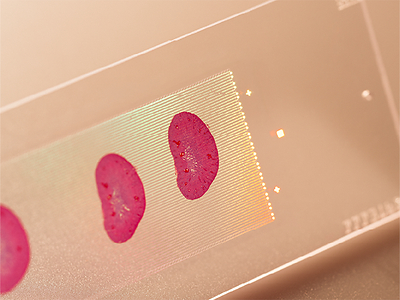
- Capture area: The 7.5 cm2 capture area accommodates serial sections for researchers to create a multidimensional understanding of tissues. Users can also profile multiple fresh frozen tissue sections of varying sizes and shapes simultaneously. The solution is species-agnostic and accommodates a broad range of eukaryotic tissue samples and tissue RNA quality. Illumina is actively developing an FFPE-specific solution and targets initial customer enablement in 2027.
- Scale: StrataMap Spatial can process more than 2000 samples per year.
- Speed: Multiple slides can be run in parallel, with library preparation and sequencing following traditional NGS methods. Sequencing takes as few as 22 hours. Including imaging, sequencing, and analysis, customers can move from sample to insight in less than 5 days.
- Accessibility: Instead of investing in expensive, specialized systems, customers can integrate StrataMap Spatial into their existing histopathology workflows. StrataMap Spatial then runs on the NovaSeq and NextSeq platforms, giving existing customers an accessible entry point into spatial biology.
Spatial-specific software provides powerful, scalable multiomic analysis
StrataMap Spatial includes access to end-to-end bioinformatics that take customers from initial imaging through analysis. DRAGEN and Illumina Connected Multiomics efficiently process the large volume of resulting spatial data, maintaining the depth, resolution, and sensitivity produced by StrataMap Spatial. The DRAGEN StrataMap pipeline simplifies spatial exploration with machine-learning-driven cell segmentation, transcript assignment, and initial clustering. Illumina Connected Multiomics enables interactive, data‑driven spatial analysis by combining tissue‑level visualization with filtering, clustering refinement, and downstream biological interpretation. The platform enables the integration of transcriptomic data with genomic, epigenetic, and proteomic datasets. Layering these omics creates a more comprehensive understanding of the biological dynamics that shape human health.
Early work with StrataMap Spatial examines tumor microenvironments, charts development of complex tissues
In a pilot, researchers from Beth Israel Deaconess Medical Center (BIDMC) used StrataMap Spatial to map historically challenging lymphatic tissues and produced the first whole transcriptome spatial datasets for human lymphatic collector vessels. Dr. Ioannis Vlachos, PhD, director of the Spatial Technologies Unit within BIDMC, and his team reconstructed 3D models of tissue organization at cellular resolution from serial sections imaged on StrataMap Spatial.
"Illumina's StrataMap Spatial exhibited high sensitivity, which enabled us to shed light on these exceptionally challenging samples, said Dr. Vlachos, "StrataMap's large capture area permitted us to place multiple serial sections to establish whole transcriptome, single cell resolution, 3D maps of these exceptionally precious tissues and unlock novel biology."
Researchers at Cancer Research
"Until now, we were unable to study large tissue sections in CNS and other cancer types at a whole-transcriptome, single-cell level," said Ania Piskorz, PhD, the Head of Genomics at the Cancer Research
Ania Piskorz is presenting the group's early work on June 10 at the European Association for Cancer Research meeting. You can also visit Illumina's booth at EACR from June 8-11 to learn how StrataMap Spatial can amplify your cancer research.
StrataMap Spatial is available to order this month.
You can read more about StrataMap Spatial here.
Use of forward-looking statements
This release may contain forward-looking statements that involve risks and uncertainties. Among the important factors to which our business is subject that could cause actual results to differ materially from those in any forward-looking statements are: (i) challenges inherent in developing and launching new products and services, including modifying and scaling manufacturing operations, and reliance on third-party suppliers for critical components; (ii) our ability to manufacture robust instrumentation and consumables and develop reliable software solutions; and (iii) the acceptance and adoption by customers of our newly launched or updated products, which may or may not meet our and their expectations, together with other factors detailed in our filings with the Securities and Exchange Commission, including our most recent filings on Forms 10-K and 10-Q, or in information disclosed in public conference calls, the date and time of which are released beforehand. We undertake no obligation, and do not intend, to update these forward-looking statements, to review or confirm analysts' expectations, or to provide interim reports or updates on the progress of the current quarter.
About Illumina
Illumina is improving human health by unlocking the power of the genome. Our focus on innovation has established us as a global leader in DNA sequencing and array-based technologies, serving customers in the research, clinical, and applied markets. Our products are used for applications in the life sciences, oncology, reproductive health, agriculture, and other emerging segments. To learn more, visit illumina.com and connect with us on X, Facebook, LinkedIn, Instagram, TikTok, and YouTube.
Contacts
Investors:
Illumina Investor Relations
858-291-6421
IR@illumina.com
Media:
Christine Douglass
PR@illumina.com
 View original content to download multimedia:https://www.prnewswire.com/news-releases/illumina-launches-stratamap-spatial-solution-a-powerful-end-to-end-spatial-whole-transcriptome-research-solution-302793726.html
SOURCE Illumina, Inc.
FAQ
AI-generated questions and answers. How Rhea-AI works. Not financial advice.