
IMC Rare Earths Discovers New High-Grade, Near-Surface Terbium Zone Beyond Existing 1.1 Billion Tonne Resource at Block H, Itarantim
Block H remains outside the current resource, while Block D drilling stopped with mineralization still continuing.
Sentiment and the balance of points
Rhea-AI Sentiment reads the wording of the document, how positive or negative its language is on a 1 to 5 scale. The balance of points shown with the takes weighs what the document actually discloses, so the two can disagree, for example when a trial that missed its main goal is described in upbeat language.
Rhea-AI Summary
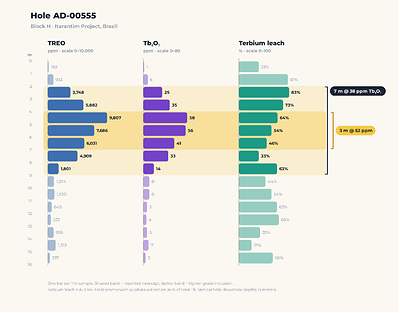
IMC Rare Earths (IMC) discovered a shallow terbium-rich zone at Block H, outside its existing Itarantim mineral resource in Brazil. Hole AD-00555 intersected seven meters beginning two meters below surface, grading 5,695 parts per million (ppm) total rare earth oxides, 38 ppm terbium oxide and 258 ppm dysprosium oxide. A three-meter interval within it graded 7,841 ppm total rare earth oxides and 52 ppm terbium oxide. Initial testing extracted 64%–83% of terbium from the enriched zone's upper three meters.
Block H is outside the existing 1.1 billion tonne resource; its size and continuity remain to be defined. At Block D, a hole intersected 20 meters of mineralization and ended in mineralization at the auger rig's depth limit. IMC plans follow-up drilling at both blocks and expects an updated resource estimate later in 2026. Processing studies will assess whether shallow zones could support earlier, lower-capital development.
Positive
- Minor pointBlock H discovery opens a new area to test for growth beyond the existing 1.1 billion tonne resource.
- Minor pointBlock H seven-meter interval starts two meters deep: 5,695 ppm total rare earth oxides, 38 ppm terbium oxide.
- Minor pointBlock H three-meter subinterval grades 7,841 ppm total rare earth oxides, 52 ppm terbium oxide, 357 ppm dysprosium oxide.
- Minor pointInitial terbium extraction of 64%–83% came from the enriched zone's upper three meters.
- Minor pointDysprosium and terbium oxides comprise 5.2% of total rare earth oxides in the Block H interval.
8 minor points
- Minor pointBlock D 20-meter interval grades 4,098 ppm total rare earth oxides and 24 ppm terbium oxide.
- Minor pointBlock D six-meter subinterval grades 6,574 ppm total rare earth oxides and 42 ppm terbium oxide.
- Minor pointBlock D nine-meter interval averages 24 ppm terbium oxide and 72% terbium extraction, from 14–23 meters.
- Minor point. Forward-looking: it has not happened yet and may not happen.Block H infill and step-out drilling is planned to test extent, thickness and grade continuity.
- Minor point. Forward-looking: it has not happened yet and may not happen.Block D diamond and step-out drilling is planned to test deeper and up-slope extensions.
- Minor point. Forward-looking: it has not happened yet and may not happen.Processing-method evaluation is planned, supported by metallurgical testing at ANSTO in Australia.
- Minor point. Forward-looking: it has not happened yet and may not happen.Updated resource estimate is expected later in 2026; Block A infill drilling targets higher-confidence Indicated classification.
- Minor pointBroader Itarantim mineralogical work identified negligible deleterious elements in leached solution.
Negative
- Minor pointBlock H size and continuity remain undefined; one hole does not establish the new zone's scale.
- Minor pointBlock D auger depth limit of approximately 30 meters prevented testing the mineralized zone's deeper continuation.
Key Figures
- Block H intercept
- 7 m at 5,695 ppm TREO; 38 ppm Tb4O7; 258 ppm Dy2O3
- Hole AD-00555
- Higher-grade Block H interval
- 3 m at 7,841 ppm TREO; 52 ppm Tb4O7; 357 ppm Dy2O3
- Included within the 7 m intercept
- Mineralization depth
- Begins 2 m below surface
- Block H
- Terbium recovery
- 64%–83%
- Initial ammonium sulphate leach testing from the upper 3 m of the enriched zone
- Heavy rare earth oxide share
- 5.2% of TREO
- Dysprosium and terbium oxides in the Block H interval
- Updated Mineral Resource estimate
- Expected later in 2026
- The company said ongoing drilling will support the update
Key Terms
ammonium sulphate leach testing technical
infill drilling technical
step-out drilling technical
qa/qc technical
AI-generated analysis. How Rhea-AI works. Not financial advice.




New terbium-rich discovery highlights significant resource growth potential outside IMC's current 1.1-billion-tonne Mineral Resource, with mineralization beginning just two meters below surface.
SÃO PAULO, Oct. 8, 2026 /PRNewswire/ -- IMC Rare Earths Ltd (NYSE American: IMC) ("IMC" or the "Company") today announced a new shallow, high-grade, terbium-rich ionic clay discovery at Block H of its Itarantim rare earth project in
The combination of shallow depth, strong grades, elevated terbium and dysprosium values, and high leachability makes Block H a potentially important new area within the Itarantim Project. As drilling continues to define the scale and continuity of mineralization, management believes the area has the potential to contribute to future resource growth while offering the potential advantages of shallow, easily accessible mineralization.
Highlights
- New high-grade discovery at Block H: seven meters grading at 5,695 ppm TREO, 38 ppm Tb4O7, and 258 ppm Dy2O3, beginning just two meters below surface, including three meters at 7,841 ppm TREO, 52 ppm Tb4O7 and 357 ppm Dy2O3.
- Shallow and easily accessible: mineralization starts just two meters below surface, beneath minimal cover, in the near-surface clay horizon, making the discovery readily accessible for further drilling and evaluation.
- Strong terbium extraction: initial ammonium sulphate leach testing recovered
64% –83% of the terbium from the upper three meters of the enriched zone. - Rich in high-value heavy rare earths: dysprosium and terbium oxides make up
5.2% of TREO in the Block H interval. - Outside the existing Mineral Resource: Block H is not included in the current 1.1 billion tonne Mineral Resource, giving IMC a new area to test for potential resource growth.
- Next steps: (1) infill and step-out drilling to define the size and continuity of the new Block H discovery; (2) diamond and extension drilling at Block D, where the enriched zone is interpreted to continue and thicken beyond the depth reached by current auger drilling.
"Block H is exactly what we have been looking for: high-grade, terbium-rich clay starting just two meters from surface, with initial terbium extraction ranging from
"Our second priority is Block D, where we have already intersected 20 meters of continuous mineralization, including nine meters at 24 ppm Tb4O7 averaging
Block H Discovery: A New Shallow, High-Grade Terbium Zone
Hole AD-00555, drilled vertically to 16 meters, intersected a continuous 7-meter mineralized interval beginning just two meters below surface. The mineralized interval includes a higher-grade 3-meter zone from four to seven meters, and an individual 1-meter sample returned 58 ppm Tb4O7. The shallow depth and concentration of terbium make Block H a priority for follow-up drilling. Assay results are summarized in Table 1 and shown in Figure 1.
Table 1. Significant intercept, hole AD-00555, Block H (grades in ppm)
|
From (m) |
To (m) |
Length (m) |
TREO |
MREO |
Nd2O3 |
Pr6O11 |
Dy2O3 |
Tb4O7 |
Y2O3 |
|
2.0 |
9.0 |
7.0 |
5,695 |
990 |
549 |
145 |
258 |
38 |
2,052 |
|
Including |
|||||||||
|
4.0 |
7.0 |
3.0 |
7,841 |
1,376 |
765 |
202 |
357 |
52 |
2,836 |
|
TREO: La2O3 + CeO2 + Pr6O11 + Nd2O3 + Sm2O3 + Eu2O3 + Gd2O3 + Tb4O7 + Dy2O3 + Ho2O3 + Er2O3 + Tm2O3 + Yb2O3 + Lu2O3 + Y2O3. MREO (magnet rare earth oxides): Pr6O11 + Nd2O3 + Tb4O7 + Dy2O3. Intervals are downhole lengths; all holes are vertical, so intervals approximate true thickness. |
Initial leach testing recovered
Block D: Thick, Continuous High-Grade Mineralization Extending Up-Slope
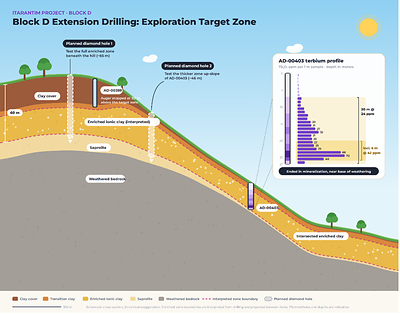
Block D provides IMC with a second potential area for resource growth. Hole AD-00403 illustrates the opportunity: it intersected 20 meters and ended while still in mineralization. Because mechanical auger drilling is limited to approximately 30 meters, IMC plans to use diamond drilling to test the continuation of the enriched zone at greater depth. Within the broader interval was a 9-meter interval from 14 to 23 meters averaging 24 ppm Tb4O7 with an average terbium extraction of
Table 2. Significant intercept, hole AD-00403, Block D (grades in ppm)
|
From (m) |
To (m) |
Length (m) |
TREO |
MREO |
Nd2O3 |
Pr6O11 |
Dy2O3 |
Tb4O7 |
Y2O3 |
|
7.0 |
27.0 |
20.0 |
4,098 |
1,244 |
846 |
231 |
143 |
24 |
927 |
|
Including |
|||||||||
|
20.0 |
26.0 |
6.0 |
6,574 |
1,863 |
1,225 |
334 |
262 |
42 |
1,801 |
|
See Table 1 notes. |
Next Steps at Block H and Block D
The Company's exploration program is now focused on two priorities intended to test the growth potential identified at Blocks H and D:
- Block H — define the size of the new discovery. Infill and step-out drilling around AD-00555 will test the extent, thickness and grade continuity of the shallow high-grade zone, with ammonium sulphate leach testing on all mineralized samples and collection of representative material for metallurgical (column leach) testwork. The objective is to define the size and continuity of the Block H discovery and determine whether it can ultimately be added to the Itarantim Mineral Resource.
- Block D — extension drilling. Diamond drilling to test the continuation of the enriched zone below the approximately 30-meter limit of auger drilling and up-slope from AD-00403, where the zone is interpreted to thicken (Figure 2). Step-out drilling will also test how far the thick, high-grade mineralization extends beyond AD-00403. The objective is to support potential growth of the existing 1.1 billion tonne Mineral Resource.
In parallel, the Company is selecting an engineering firm to evaluate potential processing methods for Itarantim, including vat, heap and in-situ leaching, supported by metallurgical testwork at ANSTO in
Why Terbium and Yttrium Matter
Terbium is a heavy rare earth used in small quantities to help high-performance permanent magnets retain their strength at high temperatures. These magnets are important in electric vehicles, wind turbines and industrial equipment including data centers. Yttrium is used in advanced ceramics, optical applications and heat-resistant coatings for aerospace and energy.
Drilling, Sampling and QA/QC
The Company's technical team supervises drilling, with samples logged, photographed and processed under the Company's exploration procedures. All holes are vertical (−90°) and sampled at one-meter intervals from surface. Samples are submitted to ALS in Vespasiano,
Qualified Person
The scientific and technical information in this news release, including the Exploration Target statement, has been reviewed and approved by Alexandre Rocha da Rocha, MSc, a Qualified Person as defined in Subpart 1300 of Regulation S-K. Mr. da Rocha is a geologist with more than 40 years of mineral exploration experience in
About IMC Rare Earths Ltd
IMC Rare Earths Ltd is a mineral exploration and development company focused on the exploration, development and long-term supply of rare earth elements. Its principal project is the Itarantim Project, an ionic adsorption clay rare earth deposit in the states of Bahia and Minas Gerais, Brazil.
Cautionary statement regarding Exploration Targets
The potential quantity and grade of Block H and Block D are conceptual in nature. There has been insufficient exploration to estimate a mineral resource in these areas, and it is uncertain whether further exploration will result in the estimation of a mineral resource. The Exploration Targets should not be construed to be, and do not represent, an estimate of a mineral resource or mineral reserve.
Forward-Looking Statements
Certain statements in this press release constitute forward-looking statements, including statements regarding the potential extent, grade and continuity of mineralization at Block H and Block D; the Exploration Targets; the potential for Block H to provide an early, high-grade source of feed or a starter area; terbium recovery and its variability; impurity characteristics; future drilling and metallurgical work; future resource additions and conversions; recovery, separation and product development; demand for and supply of rare earths; and the effects of export controls and geopolitical developments.
The Exploration Targets are conceptual in nature and there has been insufficient exploration to define a mineral resource at Block H or the Block D extensions. The Company has not established that reported exploration grades or laboratory extraction results will translate into commercially recoverable products or an economically viable operation, and no economic study has been completed on Block H.
Although the Company believes that the expectations expressed in these forward-looking statements are reasonable, it cannot assure you that such expectations will turn out to be correct, and actual results, including drilling and resource conversion outcomes, may differ materially from those anticipated. These forward-looking statements are subject to a number of risks and uncertainties, including, but not limited to: the economic viability of the Itarantim Project; the need for significant capital resources for its development; our ability to begin and sustain mining operations; our ability to manage our development, growth and operating expenses; our lack of operating history; the availability of suitable infrastructure and labor; delays or failures in the performance of third parties on which we rely; our ability to obtain and maintain necessary permits and licenses; outbreaks, epidemics or pandemics; mining industry operational risk; severe adverse weather conditions; reputational harm; our relationships with local communities and other stakeholders; changes in environmental and mining laws and regulations; the prices of or demand for rare earth elements; an adverse change in trade relations between the U.S. and Brazil; and those risk factors discussed in the Company's filings with the Securities and Exchange Commission.
If any of these risks materialize or the assumptions prove incorrect, actual results could differ materially from those implied by these forward-looking statements. The Company undertakes no obligation to update or revise publicly any forward-looking statements, except as may be required by law.
Investor Relations Contact:
IMC Rare Earths Ltd, Investor Relations — info@imcrareearths.com

 View original content to download multimedia:https://www.prnewswire.com/news-releases/imc-rare-earths-discovers-new-high-grade-near-surface-terbium-zone-beyond-existing-1-1-billion-tonne-resource-at-block-h-itarantim-302901796.html
SOURCE IMC Rare Earths
FAQ
AI-generated questions and answers. How Rhea-AI works. Not financial advice.
What did IMC Rare Earths discover at Block H?
IMC discovered a seven-meter rare earth mineralized interval starting two meters below surface, outside its existing 1.1 billion tonne Itarantim resource. The interval grades 5,695 ppm total rare earth oxides, 38 ppm terbium oxide and 258 ppm dysprosium oxide. Initial testing extracted 64%–83% of terbium from the enriched zone's upper three meters.
When does IMC Rare Earths expect an updated Itarantim resource estimate?
IMC expects an updated mineral resource estimate later in 2026. Ongoing drilling will support the estimate, including infill drilling at two Block A areas aimed at upgrading portions of the current resource to the higher-confidence Indicated category.
How will IMC Rare Earths test Block H and evaluate processing options?
IMC plans ammonium sulphate leach testing on all mineralized samples from Block H follow-up drilling and collection of representative material for column leach testwork. The company is selecting an engineering firm to evaluate vat, heap and in-situ leaching, supported by ANSTO testwork. These approaches involve extracting metals using solutions in containers, piles or directly within the deposit.