
Immuron Advances IMM-529 (Clostridioides difficile infection) Partnering Strategy
Immuron (NASDAQ: IMRN, ASX: IMC) engaged Pullan Consulting to secure a strategic partner for IMM-529, an oral polyclonal antibody candidate for Clostridioides difficile infection (CDI).
Sentiment and the balance of points
Rhea-AI Sentiment reads the wording of the document, how positive or negative its language is on a 1 to 5 scale. The balance of points shown with the takes weighs what the document actually discloses, so the two can disagree, for example when a trial that missed its main goal is described in upbeat language.
Rhea-AI Summary
Immuron (NASDAQ: IMRN, ASX: IMC) engaged Pullan Consulting to secure a strategic partner for IMM-529, an oral polyclonal antibody candidate for Clostridioides difficile infection (CDI). IMM-529 has FDA-cleared IND 32095 and is Phase 2 trial–ready, with protocol, sites, principal investigator and drug product prepared.
The planned randomized, double-blind, placebo-controlled study will enroll up to 60 CDI patients to assess safety, tolerability and efficacy alongside standard of care. A Lumanity opportunity assessment projects base-case annual revenue of US$400M if IMM-529 proves efficacious and is positioned at first recurrence, with ~98,000 eligible patients.
Positive
- FDA-cleared IND 32095 enables Phase 2 clinical development of IMM-529 for CDI
- Phase 2 trial design, sites, principal investigator and clinical drug product already in place
- Lumanity projects base-case annual IMM-529 revenue of US$400M if efficacious
- Opportunity to treat up to ~98,000 first-recurrence CDI patients in projected positioning
- Engagement of Pullan Consulting, which completes 5–12 partnering deals per year
- Historical CDI deals show potential for US$1–50M upfront and up to US$570M milestones
Negative
- IMM-529 remains at planned Phase 2 stage, with clinical efficacy yet to be demonstrated
- CDI development risk highlighted by Ridinilazole Phase 3 program not meeting superiority vs vancomycin
- Some prior microbiome partnerships in gastrointestinal indications were later unwound or exited
Details
News Market Reaction – IMRN
On Jul 6, the day this news came out, IMRN closed 1.82% above the previous close. Argus tracked a peak move of +5.5% during that session. Argus tracked a trough of -20.3% from its starting point during tracking. Our momentum scanner recorded 9 alerts for this stock that day. Relative volume reached 3.0x the daily average during tracking.
Data tracked by StockTitan Argus for the Jul 6 session.
Key Figures
- Planned enrollment
- Up to 60 subjects
- IMM-529 Phase 2 CDI trial design
- Randomization ratio
- 2:1
- IMM-529 + SOC vs placebo + SOC
- Eligible CDI patients
- Up to 98k patients
- If IMM-529 positioned at first recurrence
- Projected yearly revenue
- US$400M
- Base case IMM-529 opportunity assessment
- Upfront payment range
- USD$1–$50M
- Historical CDI-focused licensing deals
- Milestone payment range
- USD$25–$570M
- Historical CDI-focused licensing deals
- Primary disease prevention
- 80% (p=0.0052)
- IMM-529 pre-clinical infection model
- Primary disease treatment
- 78.6% (p<0.0001)
- IMM-529 pre-clinical treatment model
Historical Context
-
Bullish research note maintained Buy-Extended rating and raised price target.
-
Reported double-digit Q3 sales growth across key regions with higher YTD sales.
-
First-half FY2026 results with revenue growth, narrowed loss and cash runway into 2027.
-
CEO conference presentation highlighting company story and providing investor access.
-
HY26 results, cash position and strategic reset emphasizing partnering clinical programs.
24h Move is the share-price change in the day after each event; other market factors may also have contributed.
Key Terms
investigational new drug regulatory
clinical trial notification (ctn) scheme regulatory
randomized, double blind, placebo-controlled medical
standard of care medical
hyperimmune bovine colostrum medical
AI-generated analysis. How Rhea-AI works. Not financial advice.




Key Points
- Immuron Engages Pullan Consulting to Advance IMM-529 Partnering Strategy
- Immuron is seeking a partner to support clinical development through regulatory approval and commercialization
- Immuron has U.S. Food and Drug administration (FDA) approval for IMM-529 Investigational New Drug (IND) application
- IND 32095 is Immuron’s Investigational new drug (IND) application for clinical development of IMM-529 as a product to specifically prevent or treat Clostridioides difficile infection (CDI)
MELBOURNE, Australia, July 06, 2026 (GLOBE NEWSWIRE) -- Immuron Limited (ASX: IMC; NASDAQ: IMRN) is pleased to announce that it has engaged Pullan Consulting to provide business development services to assist in securing a strategic partnership for IMM-529.
Pullan Consulting is a highly regarded life sciences advisory firm with a strong track record of executing between five and twelve partnering transactions annually over the past 20 years. The firm specializes in guiding biotechnology and pharmaceutical companies through the partnering process, from strategy development and partner identification to negotiation and transaction execution. Pullan Consulting's expertise is expected to support Immuron in maximizing the value of IMM-529 while advancing the program toward commercialization.
Immuron has U.S. Food and Drug administration (FDA) approval for IMM-529 Investigational New Drug (IND) application (IND 32095) for clinical development of IMM-529 as a product to specifically prevent or treat Clostridioides difficile infection (CDI) in a Phase 2 clinical trial.
IMM-529 has a validated biological target. FDA-approved monoclonal antibody Bezlotoxumab was developed as a first‑in‑class therapy designed to prevent recurrence of Clostridioides difficile infection (CDI) by neutralizing toxin B, the major driver of recurrent disease. IMM-529’s polyclonal antibodies offer multivalent defense compared with monoclonal single-epitope antibodies (Bezlotoxumab). IMM-529 also has an advantage over current standard of care antibiotic treatments that disrupt microbiota. IMM-529 decolonizes the gut facilitating clearance of the pathogen, recovery of the microbiome and prevention of recurrent infection.
Immuron has completed an Investigational Brochure and clinical protocol and has secured a principal investigator and three Australian sites. This trial is eligible for Australia’s Clinical Trial Notification (CTN) scheme, a fast-track method for initiating trials.1 Immuron has manufactured and released drug product for supply of a clinical trial.
The trial protocol is for a randomized, double blind, placebo-controlled clinical study of IMM-529 with Standard of Care (SOC) for the treatment of CDI in subjects with first episode CDI or recurrent CDI. Up to 60 subjects will be enrolled in the study. Subjects would be randomly assigned to IMM-529 + SOC or placebo + SOC in a 2:1 ratio at multiple sites. The primary objective would be to evaluate the safety and tolerability of IMM-529 together with SOC in patients with CDI or recurrent CDI. Determination of efficacy would be assessed by the measurement and comparison of mortality rate, disease symptoms and recurrence rate for each treatment group.
Opportunity assessment by Lumanity indicates that if efficacious, IMM-529 will be positioned as early in treatment algorithm as payers will allow. It is anticipated that first-episode and recurrent patients will be recruited in the IMM-529 Phase 2 clinical trial design. Up to ~98k patients would be eligible if IMM-529 is positioned at the first recurrence. Based on the estimated market size, anticipated payer restrictions, pricing, and competition, base case yearly revenue for IMM-529 is projected at US
The Company is seeking partners to advance clinical development of IMM-529. Under a licensing model, the licensee typically funds development, registration, and commercialization costs. Common licensing agreements include upfront fees upon execution of the document, as well as developmental milestone payments and royalties on product sales. Terms from select historical CDI-focused deals that show a range of possible transaction structures are shown below. With upfront payments ranging from USD
| Year | Licensor / Asset Owner | Licensee / Acquirer | Licensed Asset | Financial terms (public) | Stage at deal | Status |
| 2023 | Destiny Pharma | Sebela Pharmaceuticals | NTCD-M3 (nontoxigenic C. difficile strain, live biotherapeutic) | Upfront | Phase 3 ready | Phase 3 preparation continues, including work on a more patient friendly capsule formulation and regulatory alignment on Phase 3 design. |
| 2017 | Summit Therapeutics | Eurofarma | Ridinilazole (small molecule antibiotic) | Phase 2/3 | Phase 3 program did not meet superiority vs vancomycin; Summit later focused its strategy on oncology (ivonescimab). (Fierce Biotech) | |
| 2017 | Assembly Biosciences | Allergan (later AbbVie) | Microbiome GI programs (often cited as ABI-M201, ABI-M301; not CDI specific) | Preclinical | Partnership was later unwound and the microbiome candidates returned; Assembly ultimately exited microbiome work. Note: public deal descriptions emphasize UC and Crohn’s, not CDI. (Fierce Biotech) | |
The increased incidence of antibiotic resistant ‘superbugs’ has amplified the use of broad-spectrum antibiotics worldwide. An unintended consequence of antimicrobial treatment is disruption of the gastrointestinal microbiota, resulting in susceptibility to opportunistic pathogens, such as Clostridioides difficile (C. diff). Paradoxically, treatment of Clostridioides difficile infection (CDI) also involves antibiotic use, and the heavy reliance on antibiotics to control C. diff does not allow for the gut flora to regenerate and predisposes the patient to relapsing CDI. C. diff is currently the most common pathogen in healthcare-associated infections and was deemed an urgent threat in the Center for Disease Control and Prevention’s report on antibiotic resistance threats in the United States (CDC, 2019). CDI affects over 400,000 people in the US on a yearly basis, contributing to over 30,000 deaths in the US alone annually. This serious health threat has led to an urgent call for the development of new therapeutics to reduce or replace the use of antibiotics to treat bacterial infections.
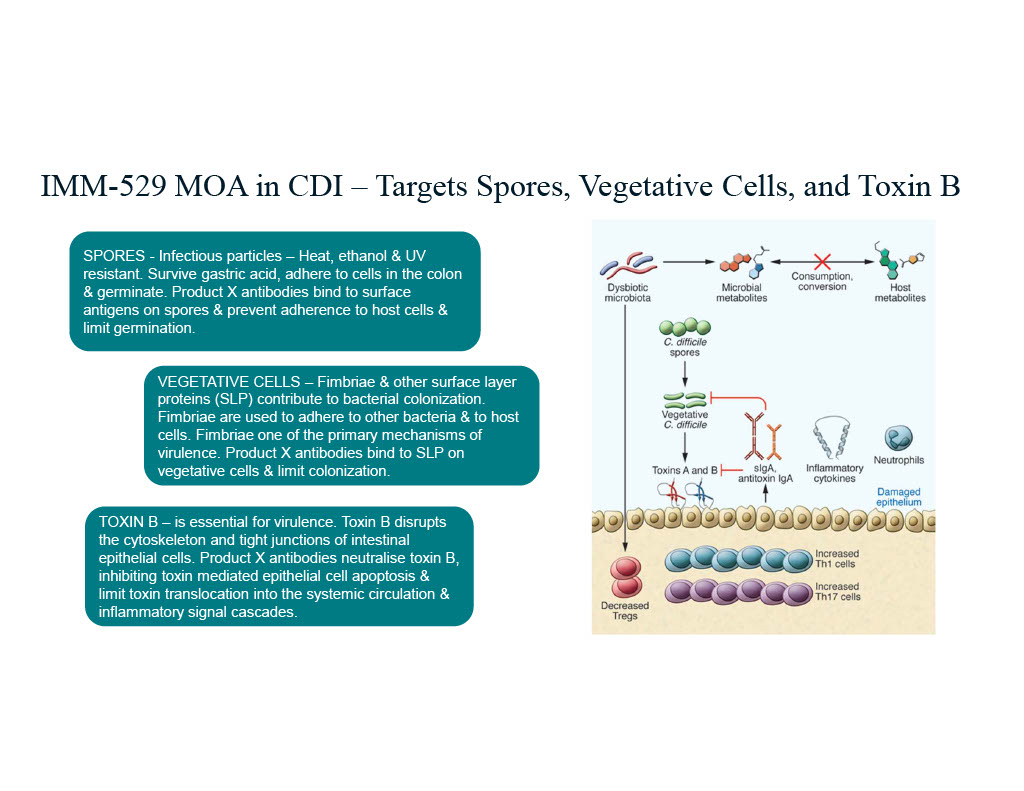
Immuron collaborated with Dr. Dena Lyras and her team at Monash University, Australia to develop vaccines to produce bovine colostrum-derived antibodies. Dairy cows were immunised to generate hyperimmune bovine colostrum (HBC) that contains antibodies targeting three essential C. diff virulence components. IMM-529 targets Toxin B (TcB), the spores, and the surface layer proteins of the vegetative cells (refer to MOA schematic - below).
This unique 3-target approach has yielded promising results in pre-clinical infection and relapse models, including (1) Prevention of primary disease (
To our knowledge, IMM-529 is, to date, the only investigational drug that has shown therapeutic potential in all three phases of the disease. https://doi.org/10.1038/s41598-017-03982-5
 This release has been authorized by the directors of Immuron Limited.
| COMPANY CONTACT: Steven Lydeamore Chief Executive Officer steve@immuron.com | PULLAN CONSULTING CONTACT: Kristine Dorward https://pullanconsulting.com/ kristine@pullanconsulting.com |
About Immuron
Immuron Limited (ASX: IMC, NASDAQ: IMRN), is an Australian biopharmaceutical company focused on developing and commercializing orally delivered targeted polyclonal antibodies for the treatment of infectious diseases.
Immuron Platform Technology
Immuron’s proprietary technology is based on polyclonal immunoglobulins (IgG) derived from engineered hyper-immune bovine colostrum. Immuron has the capability of producing highly specific immunoglobulins to any enteric pathogen and our products are orally active. Bovine IgG can withstand the acidic environment of the stomach and is resistant to proteolysis by the digestive enzymes found in the Gastrointestinal (GI) tract. Bovine IgG also possesses this unique ability to remain active in the human GI tract delivering its full benefits directly to the bacteria found there. The underlying nature of Immuron’s platform technology enables the development of medicines across a large range of infectious diseases. The platform can be used to block viruses or bacteria at mucosal surfaces such as the Gastrointestinal tract and neutralize the toxins they produce.
References
1. The Clinical Trial Notification (CTN) pathway is Australia’s primary, fast-track method for initiating trials with unapproved therapeutic goods. It involves HREC ethics approval and institutional governance review, followed by an online notification to the TGA (4-8 week process), rather than direct regulatory review, facilitating rapid start-up.
Hutton, M.L., Cunningham, B.A., Mackin, K.E. et al. Bovine antibodies targeting primary and recurrent Clostridium difficile disease are a potent antibiotic alternative. Sci Rep 7, 3665 (2017). https://doi.org/10.1038/s41598-017-03982-5
For more information visit: https://www.immuron.com.au/
Subscribe to Immuron’s InvestorHub: Here
FORWARD-LOOKING STATEMENTS:
This press release may contain “forward-looking statements” within the meaning of Section 27A of the Securities Act of 1933 and Section 21E of the Securities Exchange Act of 1934, each as amended. Such statements include, but are not limited to, any statements relating to our growth strategy and product development programs and any other statements that are not historical facts. Forward-looking statements are based on management’s current expectations and are subject to risks and uncertainties that could negatively affect our business, operating results, financial condition, and stock value. Factors that could cause actual results to differ materially from those currently anticipated include: risks relating to our growth strategy; our ability to obtain, perform under and maintain financing and strategic agreements and relationships; risks relating to the results of research and development activities; risks relating to the timing of starting and completing clinical trials; uncertainties relating to preclinical and clinical testing; our dependence on third-party suppliers; our ability to attract, integrate and retain key personnel; the early stage of products under development; our need for substantial additional funds; government regulation; patent and intellectual property matters; competition; as well as other risks described in our SEC filings. We expressly disclaim any obligation or undertaking to release publicly any updates or revisions to any forward-looking statements contained herein to reflect any change in our expectations or any changes in events, conditions, or circumstances on which any such statement is based, except as required by law.
A photo accompanying this announcement is available at https://www.globenewswire.com/NewsRoom/AttachmentNg/370fa174-acba-4d7e-8a26-a9b677fa0ce1

FAQ
AI-generated questions and answers. How Rhea-AI works. Not financial advice.