
Intensity Therapeutics, Inc. to Present INVINCIBLE-4 Neoadjuvant Triple-Negative Breast Cancer Study Data for the First Seven (7) Patients After INT230-6 Treatment (Cohort A) in an ePoster Presentation at the European Society of Medical Oncology (ESMO) Meeting
Dose-limiting local skin reactions prompted a change to one injection at a lower drug-volume-to-tumor-volume ratio.
Sentiment and the balance of points
Rhea-AI Sentiment reads the wording of the document, how positive or negative its language is on a 1 to 5 scale. The balance of points shown with the takes weighs what the document actually discloses, so the two can disagree, for example when a trial that missed its main goal is described in upbeat language.
Rhea-AI Summary
Intensity Therapeutics (INTS) reported pathological complete responses in five of seven patients receiving INT230-6 plus standard-of-care treatment in its INVINCIBLE-4 study. The randomized, open-label phase 2 trial evaluates early-stage, operable triple-negative breast cancer. The response rate was 71% (95% confidence interval 29–96%), meaning no invasive cancer remained in the breast or affected lymph nodes.
All seven patients showed tumor tissue death after one or two injections. Pre-surgery MRI showed four complete and three partial responses after neoadjuvant immuno-chemotherapy, treatment given before surgery. Dose-limiting local skin reactions prompted a protocol amendment to one injection at a lower drug-volume-to-tumor-volume ratio. The Swiss Cancer Institute will present the first seven Cohort A patients' data through an ESMO ePoster.
How this balance works
Rhea-AI gives every point it takes from this document a weight. Minor counts 1, Moderate 3 and Major 9, so one Major point outweighs several Minor ones. The bar adds up the weights on each side, and when neither side holds more than 65% of the total the balance reads Mixed.
It reads the document as published, with the same rules for every company, and it does not look at what the market expected or at how the stock traded, so a point can be objectively good on a day the stock falls.
Rhea-AI Sentiment measures something else, the tone of the wording.
Positive
- Minor pointPathological complete response reached 71% in five of seven combination-treatment patients; 95% confidence interval was 29–96%.
- Minor pointSix of seven patients had no invasive cancer in axillary lymph nodes after treatment; five were initially node-positive.
- Minor pointTumor tissue death occurred after one or two injections in all seven Cohort A patients.
- Minor pointPre-surgery MRI after immuno-chemotherapy showed four complete responses (57%) and three partial responses (43%).
- Minor pointAll seven patients met breast-conserving surgery criteria; one underwent mastectomy owing to a high-risk germline mutation.
- Minor pointAll other adverse events in Cohort A were low grade (<2).
Negative
- Moderate pointDose-limiting local skin reactions led to one injection at a lower drug-volume-to-tumor-volume ratio.
Key Figures
- Pathological complete response
- 5 of 7 patients (71%; 95% CI 29-96%)
- Cohort A; breast and affected lymph nodes
- No invasive cancer in axillary lymph nodes
- 6 of 7 patients
- Cohort A after INT230-6 treatment
- Tumor necrosis
- All 7 patients
- After 1 or 2 injections
- Radiological response
- 4 patients (57%) complete response; 3 (43%) partial response
- Pre-surgery MRI after neoadjuvant immuno-chemotherapy
- Dose-limiting skin reactions
- Dose associated with local skin reactions
- Cohort A
- Other adverse events
- All other adverse events were low grade (<2)
- Cohort A
Historical Context
-
Fourteen-patient INVINCIBLE-4 update reported 71% pCR with combination versus 42% standard care.
24h Move is the share-price change in the day after each event; other market factors may also have contributed.
Key Terms
pcr medical
tnbc medical
neoadjuvant immuno-chemotherapy medical
recist 1.1 medical
sentinel lymph node biopsy medical
AI-generated analysis. How Rhea-AI works. Not financial advice.


- Pathological complete response (pCR) achieved in the breast (ypT0/Tis) and affected lymph nodes (ypN0) in 5 out of 7 patients (
71% ;95% CI 29-96% ) in the INT230-6 plus standard-of-care cohort - No invasive breast cancer cells were detected in the axillary lymph nodes in 6 of the 7 INT230-6 patients after INT230-6 treatment, despite 5 (
71% ) of the patients were initially biopsy-proven node-positive
INVINCIBLE-4 (SAKK 66/22) is a randomized, open-label multicenter phase 2 clinical study. There are two cohorts designed to determine the clinical activity, safety, and tolerability of INT230-6 in patients with early-stage, operable TNBC: (i) INT230-6 in combination with standard-of-care neoadjuvant immuno-chemotherapy (NAIC) (Cohort A), and (ii) NAIC alone (Cohort B).
Early activity signals of INT230-6 efficacy in Cohort A are encouraging, with pCR achieved in the breast (ypT0/Tis) and affected lymph nodes (ypN0) in 5 of 7 patients (
Results also show tumor necrosis after 1 or 2 injections in all 7 Cohort A patients. In the pre-surgery MRI at the completion of NAIC four (
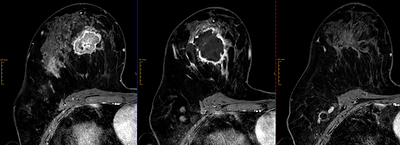
Below are MRI images at 3 timepoints for one Cohort A patient who had 2 injections. This patient achieved a radiological and pathological complete response (CR).
All 7 patients in Cohort A met the criteria for breast-conserving surgery, but one proceeded with mastectomy owing to a high-risk germline mutation. Six (
The trial includes patients with newly diagnosed, previously untreated, locally advanced non-metastatic TNBC stage cT1c N1-3 M0 or cT2-4c N0-3 M0 per American Joint Committee on Cancer (AJCC) version 8, defining TNBC as
About Triple Negative Breast Cancer in the Presurgical Setting
Women with aggressive forms of breast cancer, such as TNBC, are often counseled to undergo neoadjuvant (presurgical) systemic therapy to reduce the risk of the disease returning. Having a pathological complete response, meaning the absence of live cancer at the time of surgery, has been shown to result in a lower risk of disease recurrence from
About INT230-6
INT230-6, Intensity's lead proprietary investigational product candidate, is designed for direct intratumoral injection. INT230-6 was discovered using Intensity's proprietary DfuseRx℠ technology platform. The drug consists of two proven, potent anti-cancer agents, cisplatin and vinblastine sulfate, and a diffusion and cell penetration enhancer molecule ("SHAO") that non-covalently conjugates to the two payload drugs, facilitating the dispersion of potent cytotoxic drugs throughout tumors and allowing the active agents to diffuse into cancer cells. These agents remain in the tumor, resulting in a favorable safety profile. In addition to local disease control and direct tumor killing, INT230-6 causes a release of a bolus of neoantigens specific to the malignancy, leading to immune system engagement and systemic anti-tumor effects. Importantly, these effects are mediated without immunosuppression, which often occurs with systemic chemotherapy.
About Intensity Therapeutics
Intensity is a late-stage clinical biotechnology company whose novel engineered chemistry enables aqueous cytotoxic-containing drug formulations to mix and saturate a tumor's dense, high-fat, pressurized environment following direct intratumoral injection. As a result of the saturation, Intensity's clinical trials have demonstrated the ability of INT230-6 to kill tumors and elicit an adaptive immune response within days of injection, representing a new approach to cancer cell death that holds the potential to shift the treatment paradigm and turn many deadly cancers into chronic diseases, even for malignancies that do not respond to conventional immunotherapy. Intensity has completed two clinical studies that enrolled over 200 patients using INT230-6: a Phase 1/2 dose-escalation study in metastatic cancers including sarcomas (NCT03058289), and a Phase 2 randomized controlled clinical trial in locally advanced breast cancer (the "INVINCIBLE-2 Study") (NCT04781725) in women without undergoing chemotherapy prior to their surgery. The Company initiated a Phase 3 trial in soft tissue sarcoma (the "INVINCIBLE-3 Study") (NCT06263231), testing INT230-6 as second- or third-line monotherapy compared with SOC, with overall survival as an endpoint. Intensity also initiated a Phase 2 study in collaboration with The Swiss Group for Clinical Cancer Research, formerly SAKK and now the Swiss Cancer Institute (the "INVINCIBLE-4 Study") (NCT06358573), as part of a Phase 2/3 program evaluating INT230-6 followed by SOC immunochemotherapy and SOC alone for patients with presurgical triple-negative breast cancer. pCR is the endpoint. For more information about Intensity, including publications, papers, and posters about its novel approach to cancer therapeutics, visit www.intensitytherapeutics.com or review our SEC filings.
Forward-Looking Statements
Certain statements in this press release may constitute "forward-looking statements" within the meaning of the United States Private Securities Litigation Reform Act of 1995, as amended to date. These statements include, but are not limited to, statements relating to the Company's expected future plans, cash runway, development activities, projected milestones, business activities or results. When or if used in this communication, the words "may," "could," "should," "anticipate," "believe," "estimate," "expect," "intend," "plan," "predict" and similar expressions and their variants, as they relate to the Company or its management, may identify forward-looking statements. The forward-looking statements contained in this press release are based on management's current expectations and projections about future events. Nevertheless, actual results or events could differ materially from the plans, intentions, and expectations disclosed in, or implied by, the forward-looking statements. These risks and uncertainties, many of which are beyond our control, include: the initiation, timing, progress and results of future preclinical studies and clinical trials and research and development programs; the need to raise additional funding before the Company can expect to generate any revenues from product sales; plans to develop and commercialize product candidates; the timing or likelihood of regulatory filings and approvals; the ability of the Company's research to generate and advance additional product candidates; the risk that product candidates that appear promising in early research and clinical trials do not demonstrate safety and/or efficacy in larger-scale or later clinical trials; the implementation of the Company's business model, strategic plans for the Company's business, product candidates and technology; commercialization, marketing and manufacturing capabilities and strategy; the rate and degree of market acceptance and clinical utility of the Company's system; the Company's competitive position; the Company's intellectual property position; developments and projections relating to the Company's competitors and its industry; the Company's ability to maintain and establish collaborations or obtain additional funding; expectations related to the use of cash and cash equivalents and investments; our potential inability to satisfy the Nasdaq Capital Market's requirements for continued listing and be subject to delisting; estimates regarding expenses, future revenue, capital requirements and needs for additional financing; and other risks described in the section entitled "Risk Factors" in the Company's Annual Report on Form 10-K for the year ended December 31, 2025 and in the Company's subsequent SEC filings, which can be obtained on the SEC website at www.sec.gov. Readers are cautioned not to place undue reliance on the forward-looking statements, which speak only as of the date on which they are made and reflect management's current estimates, projections, expectations and beliefs. The Company does not plan to update any such forward-looking statements and expressly disclaims any duty to update the information contained in this press release except as required by law.
Investor Relations Contact:
Justin Kulik
CORE IR
INTS@coreir.com
(516) 222-2560
Media Contact:
Matt Cossel
CORE IR
PR@coreir.com

 View original content to download multimedia:https://www.prnewswire.com/news-releases/intensity-therapeutics-inc-to-present-invincible-4-neoadjuvant-triple-negative-breast-cancer-study-data-for-the-first-seven-7-patients-after-int230-6-treatment-cohort-a-in-an-eposter-presentation-at-the-european-society-of-m-302917587.html
SOURCE Intensity Therapeutics Inc.
FAQ
AI-generated questions and answers. How Rhea-AI works. Not financial advice.
What did Intensity Therapeutics report for INT230-6 in the INVINCIBLE-4 breast cancer study?
Five of seven Cohort A patients achieved pathological complete response in the breast and affected lymph nodes, a rate of 71% with a 95% confidence interval of 29–96%. These patients received INT230-6 with standard-of-care neoadjuvant immuno-chemotherapy in the randomized, open-label phase 2 study.
Why was the INT230-6 dosing protocol changed in Intensity Therapeutics' INVINCIBLE-4 study?
Dose-limiting local skin reactions were associated with the INT230-6 dose. The protocol was amended to one injection at a lower drug-volume-to-tumor-volume ratio. All other adverse events in Cohort A were low grade (<2).
Who is eligible for Intensity Therapeutics' INVINCIBLE-4 trial?
The trial includes patients with newly diagnosed, previously untreated, locally advanced, non-metastatic triple-negative breast cancer at stage cT1c N1-3 M0 or cT2-4c N0-3 M0. Patients must have measurable breast disease with at least one lesion ≥1.5 cm that is evaluable under RECIST v1.1 response criteria, visible on ultrasound and injectable. Multifocal and multicentric primary tumors are allowed.