Rhea-AI Sentiment reads the wording of the document, how positive or negative its language is on a 1 to 5 scale. The balance of points shown with the takes weighs what the document actually discloses, so the two can disagree, for example when a trial that missed its main goal is described in upbeat language.
IQM will deliver an IQM Radiance R3, a 54-qubit quantum computer, to QAI, a South Korean quantum-AI data center and cloud infrastructure company, by the end of 2027.
Once operational, QAI expects to offer the system to its customers through its Quantum-as-a-Service (QaaS) offering to explore industry use cases.
The order is IQM’s second quantum computer sale in South Korea, following the IQM Spark system at Chungbuk National University.
SEOUL, South Korea & ESPOO, Finland--(BUSINESS WIRE)--
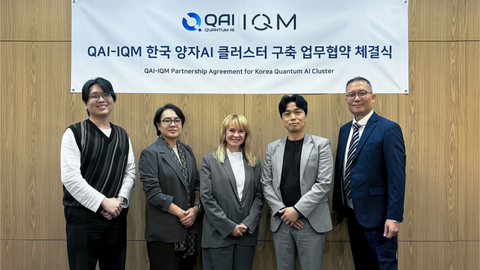
IQM Quantum Computers (Nasdaq: IQMX), a global leader in superconducting quantum computers, is partnering with QAI Co., Ltd., a South Korean quantum-AI data center and cloud infrastructure company, to deliver an IQM Radiance R3 54-qubit quantum computer. The order covers a complete on-premises quantum computing solution for QAI’s data center, including an IQM Radiance R3 system and associated services.
IQM Quantum Computers partners with QAI, a South Korean quantum-AI company to deploy a quantum computer in their private AI data center in Korea.
The 54-qubit quantum computer will be the first IQM quantum computer deployed to a private data center in Asia. The deal brings on-premises quantum computing into QAI’s commercial data center environment, where it will help build applications and a resilient, competitive infrastructure within South Korea’s quantum ecosystem. The IQM Radiance R3 is expected to be delivered and installed on-premises at QAI’s data center in Seoul by the end of 2027.
"We are proud to partner with QAI as they bring an IQM Radiance R3 54-qubit quantum computer to their data center in Seoul," said Sylwia Barthel de Weydenthal, Chief Commercial Officer at IQM Quantum Computers. "This sale marks an important milestone for quantum computing in South Korea. With on-premises access to IQM Radiance, QAI will be able to accelerate research, develop commercial applications for businesses and support sovereign quantum capabilities that keep critical technology and data under national control. We look forward to working closely with QAI to build a thriving quantum ecosystem in Korea and across the Asia-Pacific region."
QAI builds data centers that combine GPU-based AI computing with quantum computing resources. Once the system is operational, QAI plans to make it available to its customers through its Quantum-as-a-Service (QaaS) offering. This would give Korean enterprises, research institutions and public organizations access to the IQM Radiance R3 quantum computer hosted in South Korea. The system will initially be used to explore industry use cases in compute-intensive fields such as drug discovery, next-generation materials, including batteries, financial portfolio optimization and scheduling optimization for logistics and energy infrastructure.
"By bringing IQM Radiance R3 into our data center in Seoul, we are creating a place where Korean companies and researchers can use GPUs and a quantum computer together to solve real problems,” said Ui-tae Kim, Co-CEO and CTO of QAI. “Together with IQM, we will build an environment where Korea’s industry and research community can work with quantum computing hands-on."
IQM Radiance is IQM's most powerful on-premises quantum computer, designed for integration into high-performance computing (HPC) environments, where installing it on site reduces latency for hybrid quantum-classical workloads. The 54-qubit system offers high-fidelity gates and tunable couplers between the qubits, arranged in a square lattice with the highest connectivity available at this scale. Its layout natively supports surface-code error correction. Customers own and operate the system on site, with pulse-level access and the option to upgrade with the latest chips and components as IQM's technology develops.
South Korea has made quantum technology a national priority. Under its Sixth Basic Plan for Science and Technology, the government plans to invest more than 200 trillion South Korean won (approximately EUR 135 billion) in research and development between 2026 and 2030, with quantum named as one of ten national strategic technology fields. In January 2026, the Ministry of Science and ICT also set out its first comprehensive plan for the quantum science, technology and industry, which aims to give Korea the world's highest utilization rate of quantum computers by 2035, alongside training 10,000 quantum professionals and fostering 2,000 quantum companies. Reaching those goals will require businesses and researchers in Korea to have hands-on access to quantum computers. With IQM's quantum computer installed on-premises and integrated into its data center offering, QAI will be able to provide that access as a service to customers across Korea.
IQM's first quantum computer in South Korea, an IQM Spark at Chungbuk National University, was the first commercial quantum computer installed through the Korean government's official procurement process. IQM opened its Seoul office in June 2025. The QAI order will further extend IQM's installed base across Asia-Pacific, following systems already delivered in South Korea, Taiwan and Japan.
About IQM Quantum Computers
IQM Quantum Computers (Nasdaq: IQMX) is a global leader in integrated quantum computing, delivering full-stack superconducting quantum computers to enterprises, research institutions, universities, high-performance computing centers and national laboratories worldwide. With more on-premises systems sold than any other manufacturer, IQM gives customers direct ownership and control of quantum computers that integrate with their supercomputing and AI infrastructure, with cloud access also available through IQM Resonance. From processors made in its own fabrication facility to an open software stack, IQM is advancing toward fault-tolerant quantum computing. Founded in 2018 and headquartered in Espoo, Finland, with major operations in Munich, Germany, IQM employs more than 450 people across Europe, Asia and North America. IQM is the first publicly listed European quantum company on the Nasdaq Stock Market.
About QAI
QAI Co., Ltd. is a South Korean quantum-AI infrastructure company. QAI builds hybrid data centers that connect GPU-based AI computing with QPU-based quantum computing in a single workflow. On top of this infrastructure, QAI aims to provide a full-stack quantum platform spanning middleware and algorithms and quantum cloud services for Korean enterprises and researchers. QAI is led by Co-CEOs Se-man Im and Ui-tae Kim.
A qubit is the basic unit of information used in quantum computers, like a coin that can be heads, tails or both at once until you look; this lets quantum machines process many possibilities simultaneously. For investors, qubits matter because their number, quality and stability determine how powerful a quantum computer can be, affecting which companies might gain an edge in fields such as cryptography, drug discovery, materials design or complex financial modeling.
quantum-as-a-servicetechnical
Quantum-as-a-service is a cloud delivery model that lets businesses and researchers rent access to quantum computers and related software instead of buying the expensive hardware outright. Like renting a specialized, super-powerful calculator over the internet, it matters to investors because it lowers the barrier to experimenting with quantum advantages, concentrates commercialization through service providers, and can speed adoption while concentrating technical and financial risk in a few vendors.
high-performance computingtechnical
A cluster of very powerful computers, special chips and fast networks designed to tackle huge, complex calculations far faster than a normal PC — like replacing a single delivery van with a synchronized fleet to move a city’s worth of packages. For investors, high-performance computing matters because it enables faster product development, more accurate simulations and data analysis, and new revenue streams for hardware, software and services, making firms that supply or use it potentially more competitive and scalable.
surface-code error correctiontechnical
A quantum error-correction method that encodes quantum information across a two-dimensional grid of qubits and detects errors by measuring groups of neighboring qubits. The measurements reveal where errors may have occurred without directly measuring the encoded information, allowing errors to be corrected while the information is protected.