
IsoEnergy Resumes Summer Drilling at Hurricane South Trend with Strong Initial Results; 11,075 cps over 3.5 m, Including 43,160 cps Over 0.5 m, Intersected on South Trend
IsoEnergy (NYSE American: ISOU) resumed its 8,000 m summer diamond drilling program at the Larocque East project’s Hurricane South Trend after a precautionary wildfire suspension.
Sentiment and the balance of points
Rhea-AI Sentiment reads the wording of the document, how positive or negative its language is on a 1 to 5 scale. The balance of points shown with the takes weighs what the document actually discloses, so the two can disagree, for example when a trial that missed its main goal is described in upbeat language.
Rhea-AI Summary
IsoEnergy (NYSE American: ISOU) resumed its 8,000 m summer diamond drilling program at the Larocque East project’s Hurricane South Trend after a precautionary wildfire suspension. Four of 20 planned holes are complete, all intersecting mineralization, including 11,075 cps over 3.5 m with a 0.5 m interval at 43,160 cps on the L Fault Zone, confirming continuity along strike.
The Hurricane deposit hosts an indicated resource of 48.6 Mlb U3O8 at 34.5% U3O8 and inferred of 2.7 Mlb U3O8 at 2.2% U3O8. IsoEnergy also staked 61,830 ha and optioned 31,293 ha, bringing total eastern Athabasca Basin exposure to about 344,812 ha.
Positive
- LE26-250 returned 11,075 cps over 3.5 m, including 43,160 cps over 0.5 m
- Mineralization or elevated radioactivity intersected in all four completed summer drill holes
- Summer Hurricane South Trend program targets 8,000 m across up to 20 drill holes
- Hurricane deposit hosts 48.6 Mlb U3O8 indicated at 34.5% U3O8 and 2.7 Mlb inferred at 2.2% U3O8
- IsoEnergy staked 61,830 ha in 2026 across multiple Athabasca Basin projects
- Option on Larocque West Extension adds 31,293 ha, expanding highly prospective structural corridor coverage
- Total eastern Athabasca Basin land position and access now approximately 344,812 ha
Negative
- Summer drilling was temporarily suspended and site evacuated due to nearby wildfires
Details
Market move: ISOU +3.06% in the Jul 8 session. Hurricane South Trend drilling update
On Jul 8, the day this news came out, ISOU closed 3.06% above the previous close. Our momentum scanner recorded 2 alerts for this stock that day.
Data tracked by StockTitan Argus for the Jul 8 session.
Key Figures
- Radioactivity intercept
- 11,075 cps over 3.5 m
- LE26-250 on Hurricane South Trend
- Peak radioactivity
- 43,160 cps over 0.5 m
- LE26-250 on L Fault Zone
- Summer drill program
- 8,000 m in up to 20 holes
- 2026 Hurricane South Trend campaign
- Indicated resource
- 48.6 Mlb U3O8 at 34.5% U3O8
- Hurricane deposit Mineral Resource
- Inferred resource
- 2.7 Mlb U3O8 at 2.2% U3O8
- Hurricane deposit Mineral Resource
- Newly staked ground
- 61,830 ha
- 2026 staking across multiple Athabasca projects
- Optioned claims
- 31,293 ha
- Larocque West Extension option from GEM Oil Inc.
- Total land position
- 344,812 hectares
- Eastern Athabasca Basin holdings and JV interests
Historical Context
-
Temporary suspension and evacuation at Larocque East due to nearby wildfire risk.
-
Completion of Toro Energy acquisition, issuing new shares and adding Wiluna project.
-
Launch of 8,000 m, 20‑hole summer drill campaign at Hurricane South Trend.
-
AGM approvals and strong shareholder support for Toro acquisition scheme of arrangement.
-
High‑grade U3O8 assays on Hurricane South Trend supporting potential resource expansion.
24h Move is the share-price change in the day after each event; other market factors may also have contributed.
Key Terms
u3o8 technical
unconformity technical
graphitic pelite technical
spectrometer technical
AI-generated analysis. How Rhea-AI works. Not financial advice.




Hurricane hosts a current Mineral Resource of 48.6 Mlb U3O8 at
Highlights
- Mineralization Confirmed Along Strike on the L Fault Zone: LE26-250, drilled approximately 75 m east of the high-grade winter 2026 intercept in LE26-248 (
4.21% U3O8 over 3.5 m, including11.61% U3O8 over 1.0 m), intersected 11,075 cps over 3.5 m, including 43,160 cps over 0.5 m (all radioactivity reported herein are averages of three points measured over 0.5 m on drill core with an RS-125 spectrometer), extending the continuity of mineralization east of LE26-248 along strike on the L Fault Zone on the Hurricane South Trend. - Mineralization Intersected in Every Completed Hole: All four completed drill holes returned elevated radioactivity, reinforcing the continuity and prospectivity of the Hurricane South Trend identified during the 2025 and winter 2026 results along the Hurricane South Trend.
- Summer Drilling Resumes: Approximately 2,100 m of drilling had been drilled across four completed holes and two in progress prior to the temporary suspension due to nearby wildfire, with two additional holes in progress. The Company remains on track to complete the ~8,000 m, 20-hole summer program as planned.
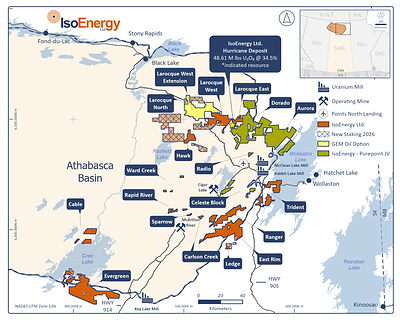
- Strategic Land Position Strengthened: 61,830 ha were added through staking in 2026 across the Dorado Joint Venture and IsoEnergy's Larocque West, Hawk, Evergreen, East Rim and Ledge projects, enhancing exposure to prospective uranium targets across the eastern
Athabasca Basin (Figure 2). - Coverage of Prospective Corridors Expanded: The addition of 31,293 ha under option from GEM Oil Inc. extends the Larocque West project, increasing coverage of highly prospective structural corridors and regional exploration targets.
Dan Brisbin, Vice President of Exploration, stated, "Our team is excited to resume drilling on the Hurricane South Trend, where early results from the summer program continue to reinforce the prospectivity of the trend. Every completed hole has intersected anomalous radioactivity, including 43,160 cps over 0.5 m. These results continue to demonstrate the potential to expand Hurricane mineralization beyond the current resource footprint. With the immediate fire risk abated, we anticipate completing the 8,000 m summer drill program as designed. In addition, we have expanded and consolidated coverage of prospective corridors though staking and through an option agreement."
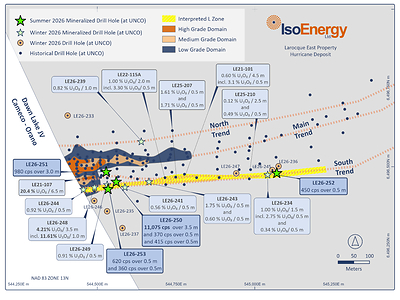
Drilling Resumes on the Hurricane South Trend
LE26-250, drilled approximately 75 m to the east of LE26-248, which returned
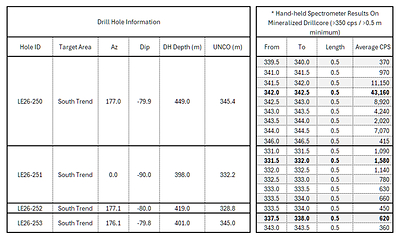
The sandstone is strongly bleached with white interstitial clay below 193.0 m. A 1.5 m (all widths reported herein are widths along the drill hole which are not necessarily true widths) fault zone from 208.1 to 209.6 m is broken and blocky and is grey in colour due to pervasive sooty pyrite alteration, with weak hydrothermal hematite-clay alteration. Below the fault, the sandstone is more intensely bleached, with a pervasive overprint of white interstitial clay, with weak, fracture-controlled quartz dissolution localized to fracture zones. A 43.6-metre-wide interval of several local half metre-scale zones of broken and blocky core was intersected above a fault zone, with local zones of weak quartz dissolution from 264.5 to 308.1 m. A 10.2 m-wide fault zone was intersected from 308.1 to 318.3 m. Its top, from 308.1 to 309.6 m, is characterized by broken core with a strong sooty pyrite overprint and brick red hematitic clay. Below the fault, the sandstone is strongly bleached with strong white interstitial clay, giving the core a chalky appearance. The base of the fault, from 312.3 to 318.3 m, is characterized by several clay-coated fractures oriented nearly parallel to the core axis, one of which is associated with a pervasive brick-red hydrothermal hematite clay. Below the fault, the sandstone remains strongly bleached with moderate white interstitial clay, and overprinted by pervasive brick-red hematite to 334.8 m. Below 334.8 m, the sandstone remains relatively competent with a moderate, pervasive sooty pyrite overprint from 334.8 to 340.9 m that strengthens from 340.9 to 344.0 m. This interval returned a maximum of 43,160 cps over 0.5 m from 342.0 to 342.5 m (Table 1), which includes a 0.3 m zone of unconsolidated core, within a broader interval averaging 11,075 cps over 3.5 m (341.0 – 344.5 m) above the unconformity at 345.4 m. The sooty pyrite overprint is moderate from 344.0 m to the unconformity. Graphitic cordierite pelite was intersected below the unconformity to 361.8 m followed by pegmatite, semipelite, and pelite to the end of the hole at 449.0 m. Weakly elevated radioactivity (415 cps over 0.5 m) was intersected between 346.0 m and 346.5 m.
LE26-251 tested the J Fault approximately 45 m to the east of LE21-107, which intersected 6.5 m averaging
The sandstone is moderately to strongly bleached below 179.0 m, coincident with moderate pervasive hematite staining, which weakens below 221.0 m. A 13.5-metre-wide fault zone from 211.3 to 224.8 m is characterized by broken, blocky and fractured core with weak fracture-controlled quartz dissolution and minor fracture-hosted hematite. From 224.8 to 278.9 m the sandstone is relatively competent and moderately bleached, with weak to moderate interstitial clay, minor fracture zones, and 0.3 m-scale zones of increased quartz dissolution. A second 32.1-metre-wide fault zone from 278.9 to 311.0 m is similar to the fault above but is characterized by a stronger sooty pyrite overprint, which strengthens in intervals of stronger quartz dissolution and in fracture zones. Below 311.0 m the core is relatively competent, strongly bleached, and overprinted by white interstitial clay, with minor pervasive limonite staining. A 2.5 m-wide fault zone from 323.5 to 326.0 m is characterized by broken and blocky core throughout with strong quartz dissolution from 323.4 to 323.8 m. Below the fault, the core is moderately silicified to 328.1 m, below which the sandstone is more competent and overprinted by sooty pyrite (reduced) to the unconformity at 332.2 m. Elevated radioactivity up to 1,580 cps was intersected over 0.5 m from 331.5 m to 332.0 m within an interval with strong sooty pyrite alteration, and within a broader interval straddling the unconformity which averages 980 cps over 3.0 m from 331.0 m to 334.0 m.
Semipelite to pelite was intersected below the unconformity, with graphitic pelite from 344.4 m to the end of hole at 398.0 m. A 3.4 m fault was intersected within the graphitic pelite from 353.4 to 356.8 m. The intersection of graphitic pelite and the interpreted target fault in the basement suggests LE26-251 was positioned slightly hanging wall of the optimal target.
LE26-252 was drilled 30 m east of LE26-234 which intersected
The sandstone is moderately bleached below 143.5 m. A 21.8-metre-wide fault zone from 221.0 to 242.8 m is characterized by broken and blocky core with strong quartz dissolution around fracture zones and strong white interstitial clay that gives the core a chalky appearance, with minor limonite present within fracture zones and intervals with increased quartz dissolution within the fault. Below the fault, the sandstone is more competent and strongly bleached with a weak pervasive limonite overprint from 242.8 m to 314.0 m, with limonite stronger in local fracture zones. From 314.0 m the sandstone is strongly bleached with lesser limonite and moderate interstitial clay, with strong clay alteration closer to a 0.9 metre-wide fault zone from 316.1 to 317.0 m. The fault is characterized by broken and blocky core with increased quartz dissolution. Below the fault, from 317.0 m to the unconformity, the core is relatively competent with minor local zones of strong quartz dissolution, a weak limonite overprint, and moderate to strong interstitial white clay. Minor local zones of pervasive brick-red hematite are present around fractures from 324.3 to 325.4 m. The unconformity was intersected at 329.8 m.
Below the unconformity, semipelite to pelite with intercalated pegmatite extend to the end of the hole at 419 m. The basement rocks are moderately to strongly clay altered to 337.7 m, with weakly elevated radioactivity intersected within the clay altered zone (450 cps over 0.5 m from 333.5 m to 334.0 m).
LE26-253 intersected the unconformity 11 m south of LE26-249 and 44 m east of LE21-103.
The sandstone is moderately to strongly bleached below 208.5 m and strongly bleached below 261.8 m, with weak to moderate interstitial clay. The core is competent to 290.0 m, below which several localized (0.2–0.5 m scale) faults characterized by clay gouge to 314.0 m. The localized faults below 310.8 m are overprinted by brick-red hematite staining, with lesser limonite. Below the fault zone the core is strongly bleached, weakly overprinted by sooty pyrite, and is relatively competent to 329.5 m, with the exception of a 1.0 metre-wide broken and rubbly fault zone with increased quartz dissolution from 318.7 to 319.7 m. Below 329.5 m the sandstone is overprinted by moderate to strong interstitial clay to the unconformity at 340.5 m, with a moderate pervasive hydrothermal hematite and lesser limonite overprint from 336.2 m to the unconformity. Elevated radioactivity averaging 620 cps over 0.5 m was recorded between 337.5 and 338.0 m, about 3 m above the unconformity.
Graphitic pelite was intersected in the basement to 349.2 m, including an interval of weakly radioactivity (360 cps over 0.5 m between 343.0 and 343.5 m). Intercalated pelite and semipelite were intersected below the graphite to the end of the drillhole at 401.0 m.
LE26-253 tested ideal target as the drillhole intersected the L-fault at the unconformity.
Expansion and Consolidation of Land Tenure
IsoEnergy has expanded and consolidated its land position along prospective corridors in the eastern
Concurrently, IsoEnergy has elected to divest its Bulyea River property. Following the divestment, recent staking, and the GEM Oil option, IsoEnergy now holds or has access to approximately 344,812 hectares of land in the eastern
Qualified Person Statement
The scientific and technical information contained in this news release was reviewed and approved by Dr. Dan Brisbin, P.Geo., IsoEnergy's Vice President, Exploration, who is a "Qualified Person" (as defined in NI 43-101 – Standards of Disclosure for Mineral Projects). See the April 6, 2026 press release for information on quality assurance/quality control procedures, as well as the complete exploration results from the previous programs disclosed herein. Dr. Brisbin has verified the data disclosed herein. Data verification procedures included comparing radioactivity measured on core with the RS-125 spectrometer to radioactivity measured downhole with Mt. Sopris 2PGA-1000 and AlphaNuclear high flux (ANHF) probes, comparing RS-125 data to cps values marked on core boxes in core photos, and checking reported composite lengths and cps values.
For additional information regarding the Company's Larocque East Project, including the current mineral resource estimate for IsoEnergy's Hurricane Deposit, please see the technical report entitled "Technical Report on the Larocque East Project,
About IsoEnergy Ltd.
IsoEnergy (NYSE American: ISOU; TSX: ISO) is a leading, globally diversified uranium company with substantial current and historical mineral resources in top uranium mining jurisdictions of Canada, the U.S. and Australia at varying stages of development, providing near-, medium- and long-term leverage to rising uranium prices. IsoEnergy is currently advancing its Larocque East project in Canada's Athabasca basin, which is home to the Hurricane deposit, boasting the world's highest-grade indicated uranium mineral resource.
IsoEnergy also holds a portfolio of permitted past-producing, conventional uranium and vanadium mines in Utah with a toll milling arrangement in place with Energy Fuels. These mines are currently on standby, ready for rapid restart as market conditions permit, positioning IsoEnergy as a near-term uranium producer.
X: @IsoEnergyLtd
www.isoenergy.ca
Cautionary Statement Regarding Forward-Looking Information
This press release contains forward-looking statements" within the meaning of the United States Private Securities Litigation Reform Act of 1995 and "forward-looking information" within the meaning of applicable Canadian securities legislation (collectively, referred to as "forward-looking information"). Generally, forward-looking information can be identified by the use of forward-looking terminology such as "plans", "expects" or "does not expect", "is expected", "budget", "scheduled", "estimates", "forecasts", "intends", "anticipates" or "does not anticipate", or "believes", or variations of such words and phrases or state that certain actions, events or results "may", "could", "would", "might" or "will be taken", "occur" or "be achieved". These forward-looking statements or information may relate to statements with respect to the activities, events or developments that the Company expects or anticipates will or may occur in the future, including, without limitation, planned exploration activities for 2026 and the anticipated timing and results thereof. Generally, but not always, forward-looking information and statements can be identified by the use of words such as "plans", "expects", "is expected", "budget", "scheduled", "estimates", "forecasts", "intends", "anticipates", or "believes" or the negative connotation thereof or variations of such words and phrases or state that certain actions, events or results "may", "could", "would", "might" or "will be taken", "occur" or "be achieved" or the negative connotation thereof.
Forward-looking statements are necessarily based upon a number of assumptions that, while considered reasonable by management at the time, are inherently subject to business, market and economic risks, uncertainties and contingencies that may cause actual results, performance or achievements to be materially different from those expressed or implied by forward-looking statements. Such assumptions include, but are not limited to, assumptions that the results of planned exploration activities are as planned and will be reported when anticipated; the anticipated mineralization of IsoEnergy's projects being consistent with expectations and the potential benefits from such projects and any upside from such projects; the price of uranium; that general business and economic conditions will not change in a materially adverse manner; that financing will be available if and when needed and on reasonable terms; that third party contractors, equipment and supplies and governmental and other approvals required to conduct the Company's planned activities will be available on reasonable terms and in a timely manner. Although IsoEnergy has attempted to identify important factors that could cause actual results to differ materially from those contained in forward-looking information, there may be other factors that cause results not to be as anticipated, estimated or intended. There can be no assurance that such information will prove to be accurate, as actual results and future events could differ materially from those anticipated in such statements. Accordingly, readers should not place undue reliance on forward-looking information.
Such statements represent the current views of IsoEnergy with respect to future events and are necessarily based upon a number of assumptions and estimates that, while considered reasonable by IsoEnergy, are inherently subject to significant business, economic, competitive, political and social risks, contingencies and uncertainties. Risks and uncertainties include, but are not limited to the following: negative operating cash flow and dependence on third party financing; uncertainty of additional financing; no known mineral reserves; aboriginal title and consultation issues; reliance on key management and other personnel; actual results of exploration activities being different than anticipated; changes in exploration programs based upon results; availability of third party contractors; availability of equipment and supplies; failure of equipment to operate as anticipated; accidents, effects of weather and other natural phenomena; other environmental risks; changes in laws and regulations; regulatory determinations and delays; stock market conditions generally; demand, supply and pricing for uranium; other risks associated with the mineral exploration industry, and general economic and political conditions in Canada, the United States and other jurisdictions where the Company conducts business. Other factors which could materially affect such forward-looking information are described in the risk factors in IsoEnergy's most recent annual management's discussion and analysis and annual information form and IsoEnergy's other filings with the securities regulators which are available under the Company's profile on SEDAR+ at www.sedarplus.ca and on EDGAR at www.sec.gov. IsoEnergy does not undertake to update any forward-looking information, except in accordance with applicable securities laws.
Cautionary Note to United States Investors Regarding Presentation of Mineral Resource Estimates
The mineral resource estimates included in this press release have been prepared in accordance with the requirements of the securities laws in effect in Canada and Australia, as applicable, which differ in certain material respects from the disclosure requirements promulgated by the U.S. Securities and Exchange Commission (the "SEC"). Accordingly, information contained in this press release may not be comparable to similar information made public by U.S. companies reporting pursuant to SEC disclosure requirements.

 View original content to download multimedia:https://www.prnewswire.com/news-releases/isoenergy-resumes-summer-drilling-at-hurricane-south-trend-with-strong-initial-results-11-075-cps-over-3-5-m-including-43-160-cps-over-0-5-m-intersected-on-south-trend-302820219.html
SOURCE IsoEnergy Ltd.
FAQ
AI-generated questions and answers. How Rhea-AI works. Not financial advice.