
Jaguar Mining Reports Commencement of Directional Drilling Program at Pilar Gold Mine, Minas Gerais, Brazil
Jaguar Mining (JAGGF) has started a 5,000-metre directional drilling program at the Pilar gold mine in Minas Gerais, Brazil.
Sentiment and the balance of points
Rhea-AI Sentiment reads the wording of the document, how positive or negative its language is on a 1 to 5 scale. The balance of points shown with the takes weighs what the document actually discloses, so the two can disagree, for example when a trial that missed its main goal is described in upbeat language.
Rhea-AI Summary
Jaguar Mining (JAGGF) has started a 5,000-metre directional drilling program at the Pilar gold mine in Minas Gerais, Brazil. The program targets three mineralized zones (BA, LPA, BF) below current 1.1 km mine workings over 10–12 months.
This work is part of a 227,200-metre, 5-year exploration plan. According to Jaguar, Pilar produced over 40,000 ounces of gold in 2025, with similar output expected in 2026, and grades, widths and ounces per vertical metre have been increasing at depth.
Positive
- 5,000 metres of directional drilling targeting three zones below 1.1 km
- Part of a 227,200-metre, 5-year exploration drilling program
- Pilar mine produced over 40,000 ounces of gold in 2025
- Directional drilling expected to run for 10–12 months
- Company targets extending Pilar’s current eight-year mine life at depth
- Grades, widths and oz/vm ratio reported as increasing at depth
Negative
- None.
Details
News Market Reaction – JAGGF
On Jul 9, the day this news came out, JAGGF closed 2.19% above the previous close.
Data tracked by StockTitan Argus for the Jul 9 session.
AI-generated analysis. How Rhea-AI works. Not financial advice.




- 5,000 metres of directional drilling planned to target three mineralized zones below the current mine workings
TORONTO, ON / ACCESS Newswire / July 9, 2026 / Jaguar Mining Inc. ("Jaguar" or the "Company") is pleased to announce that the planned directional drilling program at the Company's Pilar gold mine began earlier this week. The 5,000 metres of specialized drilling will explore three mineralized zones below the current Pilar mine workings which now extend to a depth of 1,100 metres (1.1km).
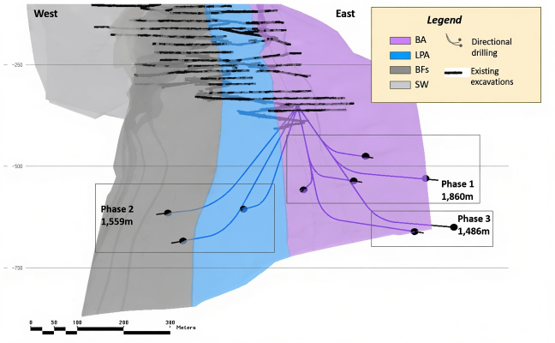
Drilling to be conducted across three zones, identified at the BA Zone, the LPA Zone and the BF Zone, will be completed in three phases as indicated in Figure 1. This program is part of the 227,200-metre, 5-year exploration drilling program the Company announced last month (see Jaguar Mining press release dated June 10, 2026), engaging both Geosol and Major Drilling companies, to focus on both green and brown field exploration. The Pilar drill program is expected to continue for the next 10-12 months.
"The objective of Pilar's directional drilling program is to significantly extend the mineral resource potential at depth, thereby extending the life-of-mine beyond the current eight years," commented CEO Luis Albano Tondo. "The Pilar Mine is the steady 'workhorse' of Jaguar's gold production, producing over 40,000 ounces in 2025 with similar production anticipated for 2026.
"Jaguar's overall strategic plan is defined as three pillars of growth. The first pillar focuses on maximizing the Company's core assets and resources, meaning we want to utilize the operating mills which all have excess capacity. To that end, we have the second pillar that encompasses both green and brown field exploration, under which this drill program at the Pilar mine falls. The third pillar targets accretive acquisition opportunities," continued Tondo. "While each of these growth pillars is important, extending Pilar's mine life is one of the key components in achieving longer-term success of this strategy and allowing Jaguar to reach its ultimate goal of becoming a major gold producer in Brazil's Iron Quadrangle where we operate."
Grade Increasing at Depth in Pilar Mine
Both current mining and conventional drilling at the Pilar mine have proven that both grade and mineralization widths have been increasing at depth. Recent drilling results (see Jaguar Mining Press Release dated June 15, 2026) successfully targeted the down-plunge extensions of the BA Zone within the Pilar mine, demonstrating that high-grade mineralization remains robust and predictably continuous at depth. These results support a key component of the Company's strategy to de-risk and convert its current exploration targets into formal mineral resources.
"Currently, the geometry of the BA, LPA, and BF ore bodies at the Pilar mine exhibits an east-west (E-W) elongation trend. As a result, the tight folds observed in the upper levels progressively transition into more open fold geometries at depth, leading to an increase in the mineralized area. In addition, the mineralized horizons show a noticeable thickening associated with a reduction in structural constriction," explained Massacatto. "With respect to grade distribution, both mining exposures and drilling data indicate an overall increase in grade at depth when compared to the upper levels of the deposit. A direct consequence of this elongation is the geometry of additional mineralized lenses and a corresponding increase in grade variability. However, when both the mineralized area and grade are considered together, the ounces per vertical metre (oz/vm) ratio continues to increase, indicating gains in both mineralized mass and grade tenor at depth."
Figure 1 - The current workings in the Pilar mine conclude at a depth of 1.1km. Directional drilling will begin at this level.
Directional Drilling vs Conventional Drilling
While conventional drilling pushes straight down in a single vertical path, frequently requiring multiple drill rigs and a larger drill area footprint to access a large target, directional drilling intentionally steers the drill bit, allowing operators to curve, angle, and branch multiple boreholes from a single surface location to precisely intercept complex ore bodies.
Cautionary Disclosure
The Company believes that the property has the potential for additional ounces below the extent of the current active underground workings. This is based on previous exploration on the property, including over 2,873 historic drill holes. The exploration target potential was derived by modeling the identified vein systems, and their surrounding "halo" mineralization, as evidenced by drill intercepts in the exploration target area, across vertical long sections of the mine area. There has been insufficient exploration to define a mineral resource with respect to the exploration target, and the Company cautions that there is a risk further exploration will not result in the delineation of a mineral resource.
About the Iron Quadrangle (Quadrilátero Ferrífero)
The Pilar mine is located in the Iron Quadrangle (Quadrilátero Ferrífero), a world-class, prolific greenstone belt in the state of Minas Gerais, Brazil. This region is renowned for its significant iron and gold deposits, hosted within Archean and Paleoproterozoic sequences. Jaguar's strategic land package in this district continues to offer substantial exploration upside.
Qualified Person
The scientific and technical information contained in this news release has been reviewed and approved by Armando José Massucatto, Geologist, PhD, General Manager of Exploration for Jaguar Mining, and a "Qualified Person" as defined by National Instrument 43-101.
About Jaguar Mining Inc.
Jaguar Mining Inc. is a Canadian-listed junior gold mining, development, and exploration company operating in Brazil with three gold mining complexes and a large land package with significant upside exploration potential from mineral claims. The Company's principal operating assets are located in the Iron Quadrangle, a prolific greenstone belt in the state of Minas Gerais and include the MTL complex (Turmalina mine and plant) and Caeté complex (Pilar and Roça Grande mines, and Caeté plant). The Roça Grande mine has been on temporary care and maintenance since April 2019. The Company also owns the Paciência complex (Santa Isabel mine), which had been on care and maintenance since 2012 and is now undergoing development work to restart in 2026. Additional information is available on the Company's website at www.jaguarmining.com.
For further information please contact:
Luis Albano Tondo
Chief Executive Officer
Jaguar Mining Inc.
investors@jaguarmining.com
Naomi Nemeth
Vice President Investor Relations
Jaguar Mining Inc.
investors@jaguarmining.com
+1 647 882 4257
Forward-Looking Statements
Certain statements in this news release constitute "forward-looking information" within the meaning of applicable Canadian securities legislation. Forward-looking statements and information are provided for the purpose of providing information about management's expectations and plans relating to the future. All of the forward-looking information made in this news release is qualified by the cautionary statements below and those made in our other filings with the securities regulators in Canada. Forward-looking information contained in forward-looking statements can be identified by the use of words such as "are expected," "is forecast," "is targeted," "approximately," "plans," "anticipates," "projects," "anticipates," "continue," "estimate," "believe" or variations of such words and phrases or statements that certain actions, events or results "may," "could," "would," "might," or "will" be taken, occur or be achieved. All statements, other than statements of historical fact, may be considered to be or include forward-looking information. This news release contains forward-looking information regarding, among other things, exploration plans and strategy, resource expansion strategy; potential mineralization; converting the Company's current exploration targets into formal mineral resources; potential Life of Mine expansion; potential mineral resources; growth plans and strategy; the potential for a significant number of ounces being contained within the ore zones below the extent of the current active underground workings; and the success of the Company's exploration, development and mining activities. The Company has made numerous assumptions with respect to forward-looking information contained herein, including, among other things, the possibility that future exploration (including drilling) or development results will not be consistent with the Company's expectations, the estimated timeline for the exploration and development of the Company's exploration targets; the supply and demand for, and the level and volatility of the price of, gold; the accuracy of reserve and resource estimates and the assumptions on which the reserve and resource estimates are based; the receipt of necessary permits; market competition; ongoing relations with employees and impacted communities; political and legal developments in any jurisdiction in which the Company operates being consistent with its current expectations including, without limitation, the impact of any potential power rationing, tailings facility regulation, exploration and mine operating licenses and permits being obtained and renewed and/or there being adverse amendments to mining or other laws in Brazil and any changes to general business and economic conditions. Forward-looking information involves a number of known and unknown risks and uncertainties, including among others: the risk of Jaguar not meeting the forecast plans regarding its operations and financial performance; uncertainties with respect to the price of gold, labour disruptions, mechanical failures, increase in costs, environmental compliance and change in environmental legislation and regulation, weather delays and increased costs or production delays due to natural disasters, power disruptions, procurement and delivery of parts and supplies to the operations; uncertainties inherent to capital markets in general (including the sometimes volatile valuation of securities and an uncertain ability to raise new capital) and other risks inherent to the gold exploration, development and production industry, which, if incorrect, may cause actual results to differ materially from those anticipated by the Company and described herein. In addition, there are risks and hazards associated with the business of gold exploration, development, mining and production, including environmental hazards, tailings dam failures, industrial accidents and workplace safety problems, unusual or unexpected geological formations, pressures, cave-ins, flooding, chemical spills, procurement fraud and gold bullion thefts and losses (and the risk of inadequate insurance, or the inability to obtain insurance, to cover these risks). Accordingly, readers should not place undue reliance on forward-looking information.
For additional information with respect to these and other factors and assumptions underlying the forward-looking information made in this news release, see the Company's most recent Annual Information Form (which is dated March 31, 2026) and Management's Discussion and Analysis, as well as other public disclosure documents that can be accessed under the issuer profile of "Jaguar Mining Inc." on SEDAR+ at www.sedarplus.ca. The forward-looking information set forth herein reflects the Company's reasonable expectations as at the date of this news release and is subject to change after such date. The Company disclaims any intention or obligation to update or revise any forward-looking information, whether as a result of new information, future events or otherwise, other than as required by law. The forward-looking information contained in this news release is expressly qualified by this cautionary statement.
SOURCE: Jaguar Mining, Inc.
View the original press release on ACCESS Newswire
FAQ
AI-generated questions and answers. How Rhea-AI works. Not financial advice.