
Kirkland Lake Discoveries Hits 2.13 g/t Au over 29.0 m and 2.11 g/t Au over 14.1 m Extending Near Surface Mineralization at Mirado
Kirkland Lake Discoveries (OTCQB: KLKLF) reported assay results from four drill holes at the Mirado gold system in Ontario, extending mineralization in both the South and North Zones.
Sentiment and the balance of points
Rhea-AI Sentiment reads the wording of the document, how positive or negative its language is on a 1 to 5 scale. The balance of points shown with the takes weighs what the document actually discloses, so the two can disagree, for example when a trial that missed its main goal is described in upbeat language.
Rhea-AI Summary
Kirkland Lake Discoveries (OTCQB: KLKLF) reported assay results from four drill holes at the Mirado gold system in Ontario, extending mineralization in both the South and North Zones. South Zone holes KLM26-029 and KLM26-031 returned 2.13 g/t Au over 29.0 m and 2.11 g/t Au over 14.1 m, respectively, from separate collars that extend the interpreted zone westward.
North Zone-focused hole KLM26-027 cut 4.76 g/t Au over 6.65 m from 8.0 m depth, while dual-zone hole KLM26-028 intersected several South Zone intervals and 3.89 g/t Au over 2.14 m near 401.3 m, extending the North Zone to about 365 m vertical depth. Assays from 19 additional holes remain pending.
Positive
- South Zone intercept 2.13 g/t Au over 29.0 m in KLM26-029, including 3.37 g/t Au over 17.5 m, extending interpreted mineralization westward
- Second South Zone intercept 2.11 g/t Au over 14.1 m in KLM26-031, including 2.74 g/t Au over 10.1 m and a 1.1 m interval at 12.71 g/t Au
- Shallow North Zone hit 4.76 g/t Au over 6.65 m from 8.0 m depth in hole KLM26-027
- North Zone depth extension 3.89 g/t Au over 2.14 m at about 365 m vertical depth in KLM26-028, significantly deepening the interpreted zone
- Ongoing exploration pipeline assays pending for 19 additional holes across Mirado, the MZ target area, and regional targets
Negative
- None.
Details
News Market Reaction – KLKLF
On Aug 26, the day this news came out, KLKLF closed 0.80% above the previous close.
Data tracked by StockTitan Argus for the Aug 26 session.
AI-generated analysis. How Rhea-AI works. Not financial advice.




Toronto, Ontario--(Newsfile Corp. - August 26, 2026) - Kirkland Lake Discoveries Corp. (TSXV: KLDC) (OTCQB: KLKLF) ("KLDC" or the "Company") reports assay results from four drill holes at the Mirado gold system. South Zone holes KLM26-029 and KLM26-031 extend the zone westward, returning 2.13 g/t Au over 29.0 m and 2.11 g/t Au over 14.1 m, respectively. These results are part of the ongoing drill program at KL South, 18 km south of Kirkland Lake, Ontario, with an additional 19 holes pending.
Highlights
KLM26-029 - 2.13 g/t Au over 29.0 m from 173 m including 3.37 g/t Au over 17.5 m
KLM26-031 - 2.11 g/t Au over 14.1 m from 157 m including 2.74 g/t Au over 10.1 m
KLM26-027 - 4.76 g/t Au over 6.65 m from 8 m
KLM26-028 - 3.89 g/t Au over 2.14 m from 401.3 m
19 holes pending results
Nine from Mirado
Six from MZ target area
Four regional targets
Drill Program Discussion
Recent drilling has successfully identified two distinct growth vectors at the Mirado project, expanding the South Zone to the west and extending the North Zone at depth, see Figures 1 and 2. Holes KLM26-029 and KLM26-031 intersected broad, gold-bearing intervals from separate collars, extending the interpreted South Zone westward with principal composites of 29.0 m (estimated 23 m true width) and 14.1 m (estimated 11 m true width). Furthermore, hole KLM26-028 successfully encountered mineralization in both interpreted zones, intersecting the South Zone in the upper portion of the hole and the North Zone near the bottom. This deeper intercept, beginning at 401.3 m downhole, significantly extends the North Zone to approximately 365 m vertical depth and further supports the interpreted stacked geometry of the deposit.
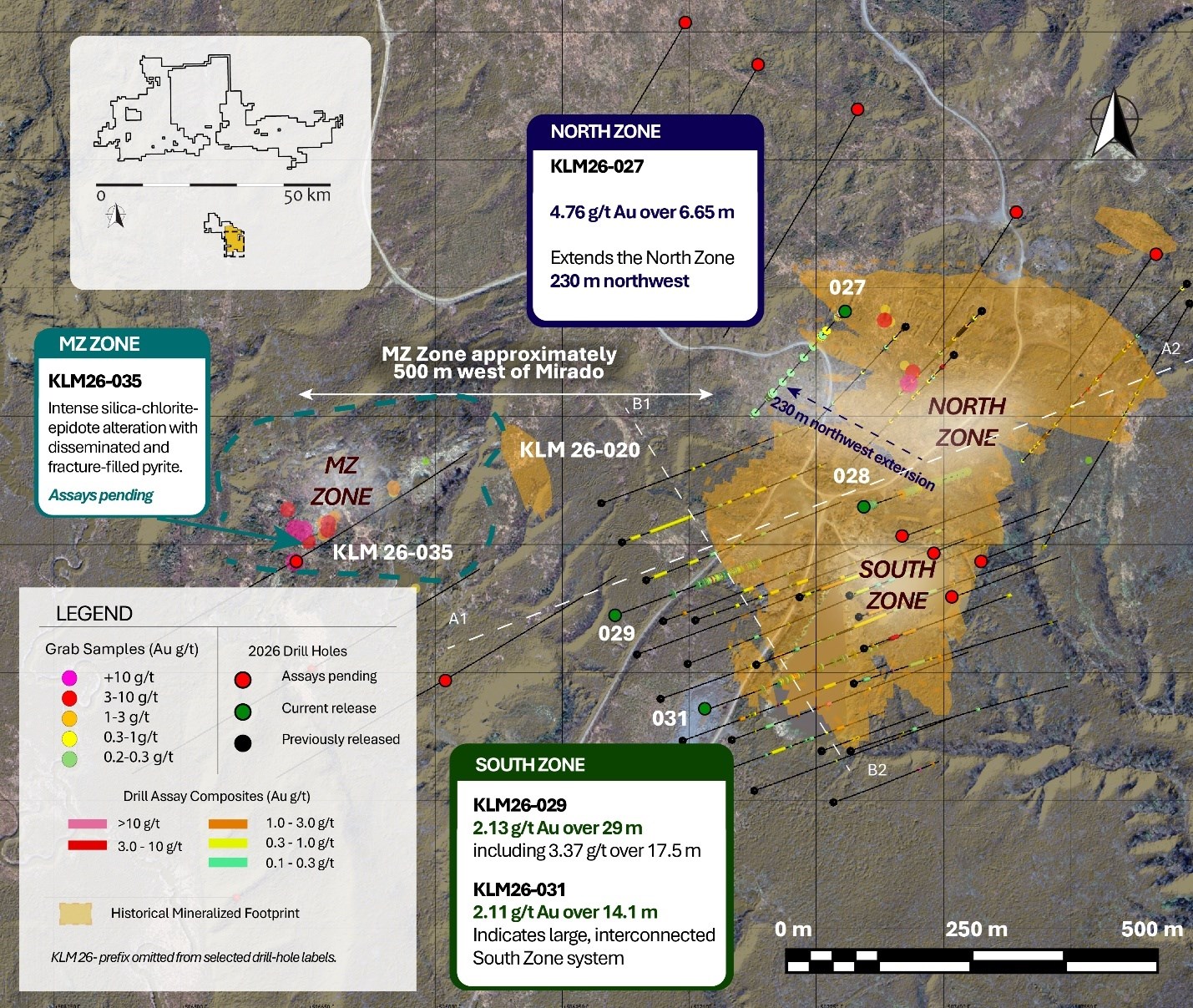
Figure 1 - Plan map of the Mirado and MZ Zones showing 2026 drilling, gold assay composites, historical surface sampling and the historical mineralized footprint.
To view an enhanced version of this graphic, please visit:
https://images.newsfilecorp.com/files/5701/311551_15227b503410c9f5_001full.jpg
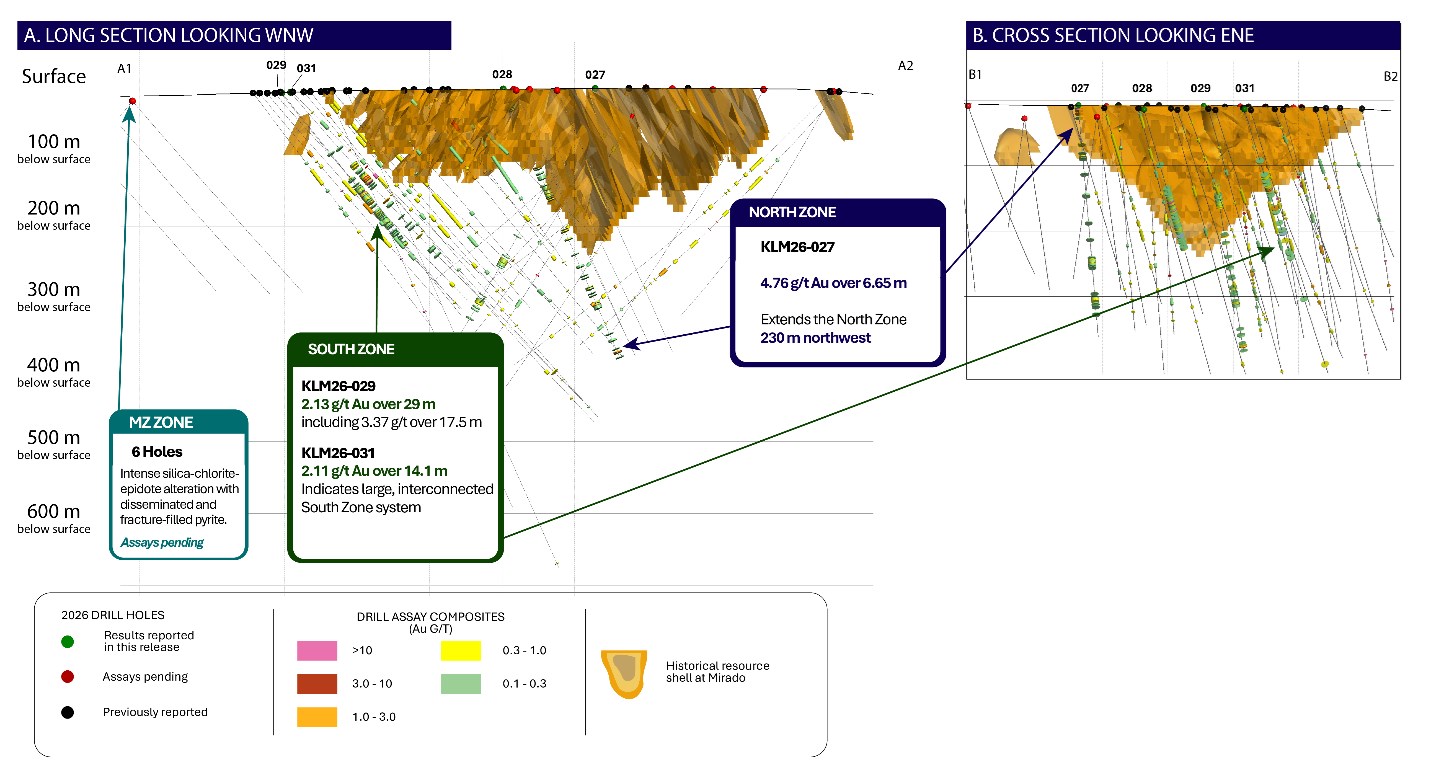
Figure 2 - Simplified cross-section and long-section views of drilling at Mirado. The historical mineralized shell is shown in orange, with current release drill holes highlighted in green and drill assay composites coloured by gold grade.
To view an enhanced version of this graphic, please visit:
https://images.newsfilecorp.com/files/5701/311551_15227b503410c9f5_002full.jpg
The technical significance of these four holes lies in their repeatability across separate collars and the immediate expansion of the project's mineralized footprint. The broad widths in the South Zone and the depth extension of the North Zone provide a strong basis for follow-up exploration. These uncut, length-weighted composites are currently being incorporated into an updated 3D model to refine strike, true-width estimates, and open directions, which will be used to rank future drill collars. Exploration momentum continues at the project, with assays currently pending for 19 additional holes, including nine at Mirado, six at the MZ target area, and four regional targets.
"We continue to expand the Mirado system in multiple directions," said Stefan Sklepowicz, Chief Executive Officer of KLDC. "These results continue to push the system to the west with broad near-surface mineralization and high-grade deeper in the north. We eagerly await assays from the regional test holes that are well outside historic boundaries"
Complete assays are reported for North Zone hole KLM26-027, dual-zone hole KLM26-028 and South Zone holes KLM26-029 and KLM26-031. KLM26-029 and KLM26-031 provide the principal South Zone results, while KLM26-028 provides both an upper South Zone intersection and a deeper North Zone intersection, see Table 1.
KLM26-029 returned 2.13 g/t Au over 29.0 m from 173.0 m to 202.0 m. KLM26-031 returned 2.11 g/t Au over 14.1 m from 157.0 m to 171.1 m. The two holes were drilled from separate collars and extend the current South Zone interpretation westward.
KLM26-028 intersected gold mineralization in the South Zone in the upper part of the hole, including 0.21 g/t Au over 20.0 m from 150.0 m to 170.0 m, and returned 3.89 g/t Au over 2.14 m from 401.3 m to 403.44 m in the North Zone near the bottom of the hole. The lower intersection is interpreted at approximately 365 m vertical depth and extends the North Zone at depth. KLM26-027 returned 4.76 g/t Au over 6.65 m from 8.0 m to 14.65 m in the North Zone.
Table 1 - Mirado Drill Results
| Drill Hole | From (m) | To (m) | Interval (m) | Au (g/t) | Zone |
| KLM26-027 | 8.0 | 14.65 | 6.65 | 4.76 | North Zone |
| and | 66.47 | 67.88 | 1.41 | 0.53 | North Zone |
| and | 88.30 | 89.26 | 0.96 | 0.73 | North Zone |
| and | 269.5 | 280.5 | 11.0 | 0.35 | North Zone |
| and | 336.57 | 342.0 | 5.43 | 0.43 | North Zone |
| KLM26-028 | 10.0 | 16.0 | 6.0 | 0.17 | South Zone |
| and | 25.0 | 27.0 | 2.0 | 0.34 | South Zone |
| and | 119.0 | 120.3 | 1.3 | 2.21 | South Zone |
| and | 150.0 | 170.0 | 20.0 | 0.21 | South Zone |
| and | 216.5 | 218.3 | 1.8 | 0.82 | South Zone |
| and | 228.5 | 230.0 | 1.5 | 0.37 | South Zone |
| and | 305.0 | 306.8 | 1.8 | 0.38 | South Zone |
| and | 327.0 | 334.86 | 7.86 | 0.88 | South Zone |
| and | 401.3 | 403.44 | 2.14 | 3.89 | North Zone |
| KLM26-029 | 173.0 | 202.0 | 29.0 | 2.13 | South Zone |
| including | 183.0 | 200.5 | 17.5 | 3.37 | South Zone |
| and | 213.65 | 223.48 | 9.83 | 0.20 | South Zone |
| and | 229.0 | 236.0 | 7.0 | 0.23 | South Zone |
| and | 240.0 | 243.0 | 3.0 | 0.26 | South Zone |
| and | 275.85 | 278.0 | 2.15 | 0.41 | South Zone |
| KLM26-031 | 136.5 | 141.55 | 5.05 | 0.33 | South Zone |
| and | 157.0 | 171.1 | 14.1 | 2.11 | South Zone |
| including | 161.0 | 171.1 | 10.1 | 2.74 | South Zone |
| including | 170.0 | 171.1 | 1.1 | 12.71 | South Zone |
| and | 205.0 | 212.5 | 7.5 | 0.36 | South Zone |
Data Verification & Quality Assurance/Quality Control (QA/QC)
Gold analyses were completed on half-core NQ samples at Paragon Geochemical using Chrysos PhotonAssay technology. PhotonAssay is a non-destructive method that uses high-energy X-rays to measure gold in large approximately 500 g samples, reducing sampling variability associated with coarse gold mineralization and allowing the retained material to remain available for additional analysis.
Table 2 - Paragon Sample Preparation and Analytical Methods
| Analysis | Code | Location |
| Preparation | PREP-PKG | Timmins, Ontario, Canada |
| Photon and Fire Assay | PA-AU01, Au-SCR1K | Surrey, British Columbia | Hamilton, Ontario, Canada |
| Multi-Element | 33MA-OES | Sparks, Nevada, USA |
Samples returning gold values above the 350 g/t upper detection limit of the PhotonAssay method are reanalyzed using a 1 kg screen fire assay. The sample is sieved at 110 microns, the coarse fraction is analyzed gravimetrically, and the fine fraction is analyzed in duplicate by AAS; the combined result provides a representative total gold value for samples that may contain coarse gold.
Drill program design, QA/QC and interpretation of results are conducted by qualified persons consistent with National Instrument 43-101 and industry best practices. Certified reference standards and blanks are inserted into the sample stream at regular intervals, approximately one control sample per twenty samples, to monitor analytical accuracy and precision.
Reported intervals are calculated using length-weighted average grades with a nominal 0.2 g/t Au cutoff. To reflect continuity within the broader mineralized system, up to 6.9 m of consecutive internal dilution below cutoff is included within selected composites. Reported assays are uncut and no top cut has been applied. All intervals are reported as downhole core lengths. True widths at Mirado are estimated at approximately
Qualified Person
The technical information contained in this news release has been reviewed and approved by Benjamin Cleland, P.Geo., Vice-President Exploration, who is a Qualified Person as defined by National Instrument 43-101 - Standards of Disclosure for Mineral Projects.
About Kirkland Lake Discoveries Corp.
Kirkland Lake Discoveries Corp. (TSXV: KLDC) (OTCQB: KLKLF) has assembled a 420-km2 exploration portfolio in the Kirkland Lake region of Ontario's Abitibi Greenstone Belt, one of the most prolific mining districts in the world. The Company's properties span key fault zones, geophysical anomalies and volcanic-sedimentary contacts within the Blake River Group, a highly prospective assemblage known to host both gold and polymetallic massive-sulphide deposits.
With exploration permits in place, KLDC is positioned to advance a pipeline of drill-ready targets at KL South, KL West and KL East, supported by anomalous soil trends, historical mineral showings and structurally controlled intersections.
For additional information, please contact:
Stefan Sklepowicz
Chief Executive Officer
Phone: +1 226-979-3515
Email: stefan@kirklandlakediscoveries.com
Website: www.kirklandlakediscoveries.com
Neither TSX Venture Exchange nor its Regulation Services Provider (as that term is defined in policies of the TSX Venture Exchange) accepts responsibility for the adequacy or accuracy of this release.
Forward-Looking Statements
This news release contains "forward-looking statements" within the meaning of applicable securities legislation. All statements, other than statements of historical fact, are forward-looking statements. Forward-looking statements in this news release include, but are not limited to, statements concerning updating the Mirado 3D model, interpretation of mineralized continuity and geometry, selection of follow-up drill targets and future exploration at Mirado. Generally, forward-looking statements can be identified by terminology such as "plans", "expects", "is expected", "estimates", "intends", "anticipates", "believes", "may", "could", "would", "might" or "will".
Forward-looking statements are subject to known and unknown risks, uncertainties and other factors that may cause actual results, performance or achievements to differ materially from those expressed or implied, including the results and interpretation of exploration and drilling activities, the reliability of historical data, commodity prices and general economic, market or business conditions. There can be no assurance that forward-looking statements will prove accurate, as actual results and future events could differ materially from those anticipated. Readers should not place undue reliance on forward-looking statements. The Company does not undertake to update such statements except in accordance with applicable securities laws.
Additional information is available under the Company's profile on SEDAR+ (www.sedarplus.ca).
Table 3 - Mirado Drill-Hole Collars and Assay Coverage
| Drill Hole | Easting | Northing | Azimuth (deg) | Dip (deg) | Final Length (m) | Target | Assay Status |
| KLM26-027 | 587281 | 5318673 | 220 | -65 | 405 | North Zone | Results reported |
| KLM26-028 | 587304 | 5318442 | 70 | -50 | 411 | South / North Zones | Results reported |
| KLM26-029 | 587013 | 5318317 | 70 | -50 | 408 | South Zone | Results reported |
| KLM26-031 | 587119 | 5318206 | 70 | -50 | 600 | South Zone | Results reported |

To view the source version of this press release, please visit https://www.newsfilecorp.com/release/311551
FAQ
AI-generated questions and answers. How Rhea-AI works. Not financial advice.