
Algo Grande Reports Results from Completed Phase I Drill Program at Cerro Grande Skarn
Algo Grande Copper (OTC:ALGRF, TSX-V:ALGR) reported Phase I drill results from the Cerro Grande skarn, confirming an outcropping, vertically extensive Cu-Ag-Au skarn with five stacked skarn horizons and strong metal zonation.
Rhea-AI Summary
Algo Grande Copper (OTC:ALGRF, TSX-V:ALGR) reported Phase I drill results from the Cerro Grande skarn, confirming an outcropping, vertically extensive Cu-Ag-Au skarn with five stacked skarn horizons and strong metal zonation.
Highlights include an 18.2 m intercept at 1.8% CuEq (AG_GC_003), a cumulative 104.76 m above 0.8% CuEq across four holes, and molybdenum peaks to 2,820 ppm, supporting a porphyry-skarn model and a planned Phase II program starting May 2026.
Positive
- 18.2 m @ 1.8% CuEq intercept in AG_GC_003
- Total 104.76 m above 0.8% CuEq across four holes
- Five distinct stacked skarn horizons identified
- Molybdenum values up to 2,820 ppm, suggesting porphyry vectoring
- Phase II drill program scheduled for May 2026
Negative
- AG_GC_001 returned no significant mineralization
- Reported intervals are downhole lengths; true widths unknown
- CuEq calculations assume 80% recoveries and specific metal prices, not metallurgical confirmation
Key Figures
- High-grade intercept
- 18.2 m @ 1.8% CuEq (1.2% Cu, 28.2 g/t Ag, 0.7 g/t Au)
- Hole AG_GC_003 Phase I drill program at Cerro Grande Skarn
- Very high-grade interval
- 3.5 m @ 3.9% CuEq (2.4% Cu, 61.1 g/t Ag, 1.8 g/t Au)
- Within AG_GC_003 broad high-grade skarn zone
- Stacked high-grade thickness
- 57 m above 1.8% CuEq
- Multiple vertically stacked skarn intervals in Phase I drilling
- Total mineralized length
- 104.76 m above 0.8% CuEq
- Combined mineralization across four Phase I drill holes
- Phase I program length
- 4 drill holes totaling 1,998 metres
- Inaugural Cerro Grande Skarn Phase I drill program
- Peak molybdenum value
- 2,820 ppm Mo
- AG_GC_002 molybdenum-bearing interval indicative of porphyry vectoring
- Core recovery
- Greater than 95%
- Average core recovery across all Phase I drill holes
- Skarn corridor length
- 6-kilometre corridor
- Planned Phase II drilling along broader skarn trend
Historical Context
-
Upsized non-brokered financing to fund Phase II Adelita exploration drilling.
-
Reported strong skarn copper intercepts and porphyry indicators from AG_GC_002.
-
Announced AGM details and added a technical director to strengthen oversight.
-
Engaged AI-Metals for 12‑month AI integration to refine 32 targets.
-
Identified 32 priority targets and advanced ground magnetics and drilling plans.
24h Move is the share-price change in the day after each event; other market factors may also have contributed.
Key Terms
cueq technical
ppm technical
diamond core drilling technical
icp-ms technical
fire assay technical
national instrument 43-101 regulatory
qualified person regulatory
otc markets financial
AI-generated analysis. How Rhea-AI works. Not financial advice.




Highlights:
Hole AG_GC_003 intersected a broad zone of strong copper-gold-silver mineralization, including 18.2 m @
1.8% CuEq (1.2% Cu, 28.2 g/t Ag, 0.7 g/t Au), including 3.5 m @3.9% CuEq (2.4% Cu, 61.1 g/t Ag, 1.8 g/t Au).Consistent Cu-Au-Ag mineralization with 57 m above
1.8% CuEq between multiple intervals, confirming a vertically stacked high-grade skarn system (see Table 1)Five skarn horizons identified, including three newly discovered horizons
Increased Molybdenum values identified in intrusive-related intervals, defining a metal zonation pattern consistent with a porphyry-skarn system
System remains open along strike and at depth, with vectors for expansion and discovery
VANCOUVER, BC / ACCESS Newswire / April 2, 2026 / Algo Grande Copper Corp. ("Algo Grande" or the "Company") (TSX-V:ALGR)(OTC:ALGRF)(FRA:KM00) reports assay results from the remaining three drill holes of its inaugural Phase I drill program at the Cerro Grande Skarn target within the Adelita Project, Sonora, Mexico.
The Phase I program consisted of four drill holes totaling 1,998 metres, designed to confirm high-grade skarn mineralization at depth. A review of historical data suggested the skarn zone may be thicker than previously understood, and results from this program confirm that mineralization extends beyond the limits of earlier drilling, which only partially tested the system, highlighting expansion potential at depth and along the broader footprint.
These results confirm the presence of an outcropping, vertically extensive copper-silver-gold skarn system, with increasing evidence supporting a genetically related porphyry system at depth.
Table 1 - Significant Intersects
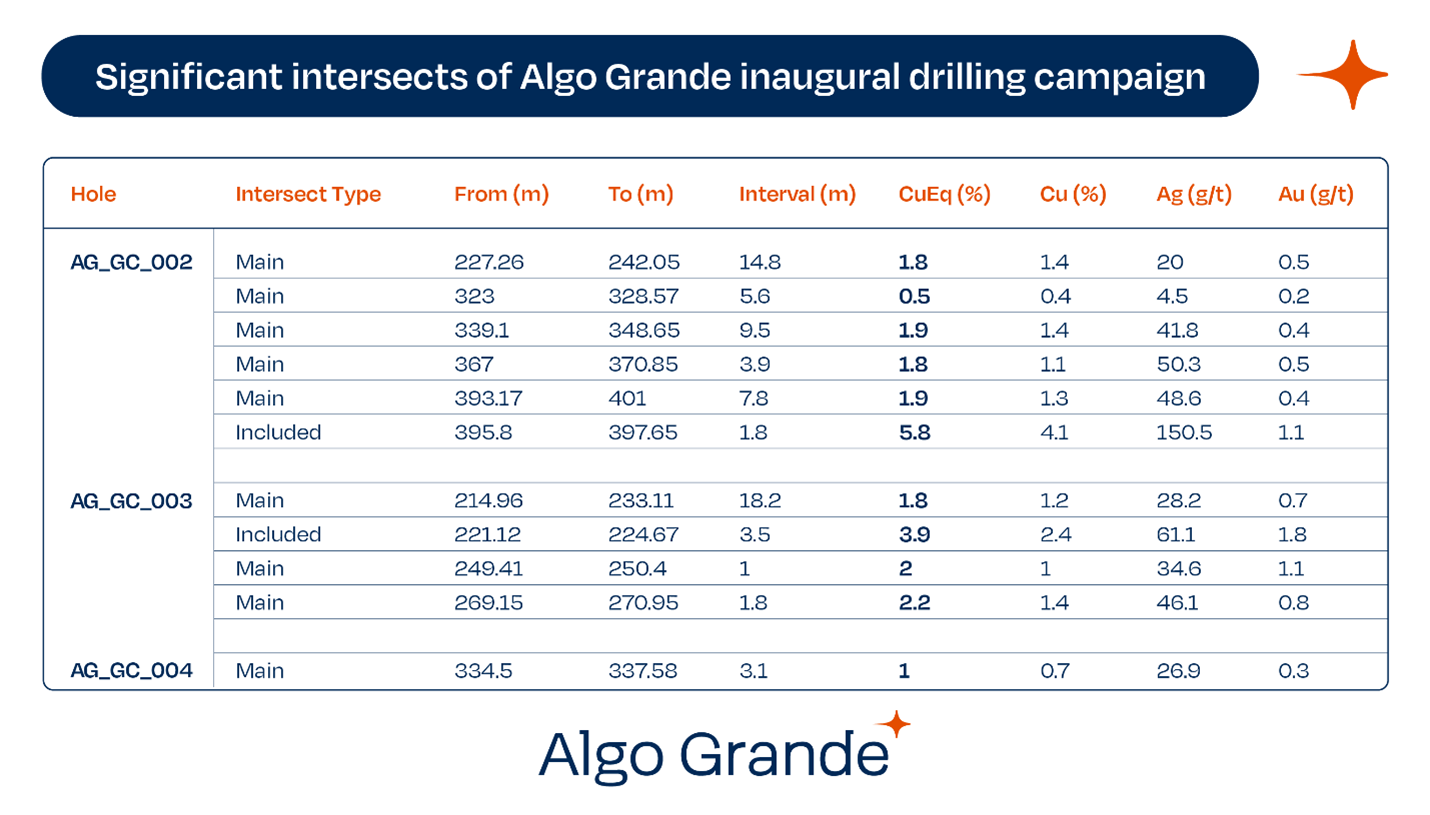
Note: Copper equivalent (CuEq) for drill intersections is calculated based on US
Drilling was completed using diamond core drilling techniques. Core recovery for all drill holes averaged greater than
Enrico Gay, CEO of Algo Grande Copper, commented: "These results validate our thesis that the Cerro Grande Skarn has the potential to scale into a large, high-grade skarn system.The identification of multiple stacked skarn horizons, combined with strong metal zonation and molybdenum vectoring, reinforces our view that we are operating within a large-scale porphyry-skarn system. With Phase I complete, we are now advancing toward Phase II drilling, focused on expanding the Cerro Grande footprint along strike, testing additional skarn targets across the broader 6-kilometre corridor, and advancing toward the potential porphyry source at depth."
Confirmation of a Multi-Horizon Skarn System
Drill holes AG_GC_001 through AG_GC_004 collectively confirm the presence of a copper-silver-gold skarn system at Cerro Grande (Figure 1). While AG_GC_001 did not intersect significant mineralization, holes AG_GC_002, AG_GC_003, and AG_GC_004 intersected multiple intervals of skarn-hosted mineralization, confirming both lateral and vertical continuity of the system (Figure 2). Notably, hole AG_GC_003 returned the strongest intercept of the program, despite experiencing drilling deviation and not fully reaching the planned target zone.
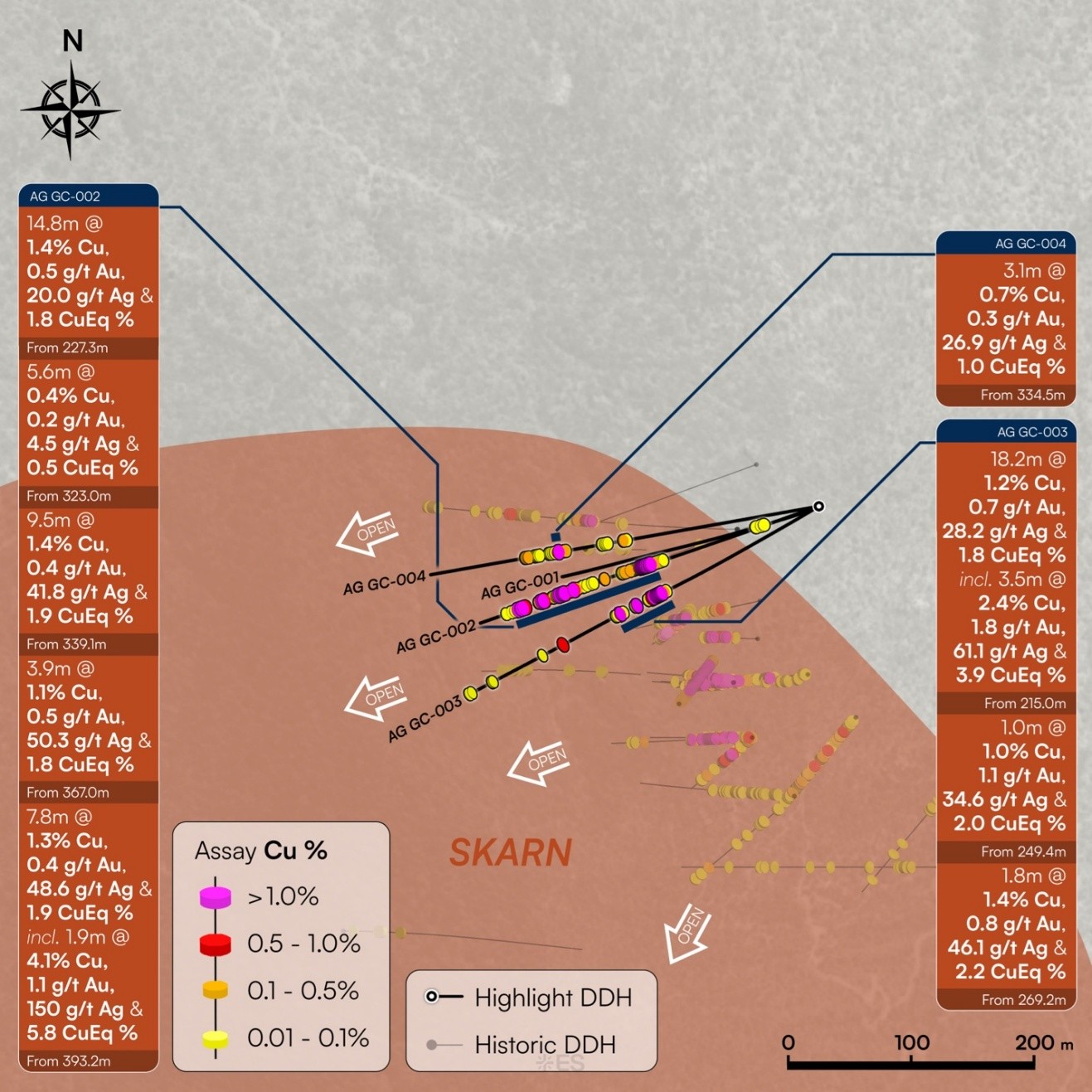
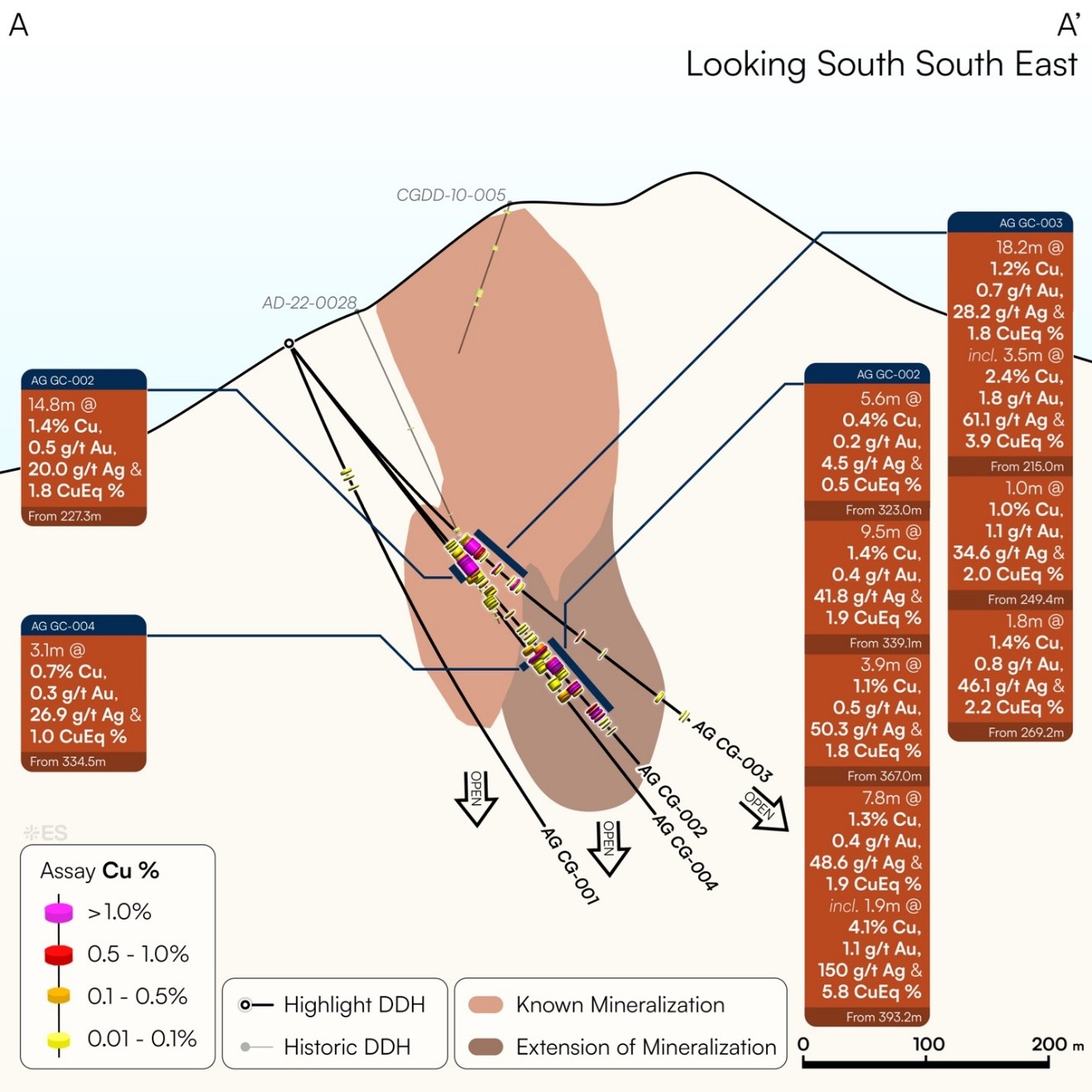
Note: Certain drill hole data presented herein is historical in nature and was completed by previous operators, including Minaurum Gold Inc., Ocean Park Ventures Corp., and Infinitum Copper Corp., between 2010 and 2023. The historical drilling consists of diamond drill holes, with samples analyzed at ALS laboratories in Hermosillo, Mexico and Vancouver, Canada, and by ALG Global Geochemistry using ICP-MS and Fire Assay methods.
A Qualified Person has reviewed and verified the historical data, including drill collar locations, downhole orientation (dip and azimuth), sampling procedures, and assay methodologies. Collar locations and drill orientations were validated in the field, and the analytical methods used are consistent with industry-standard practices. The Qualified Person has also reviewed the available QA/QC information and considers the data to be of acceptable quality for the purposes of this disclosure.
While the historical data is considered reliable and suitable for geological interpretation and targeting, a Qualified Person has not completed sufficient work to classify the historical information as current mineral resources or mineral reserves, and the issuer is not treating the historical data as current mineral resources or mineral reserves.
Mineralization is hosted within two dominant skarn types: (i) magnetite-rich skarns characterized by abundant chalcopyrite, and (ii) garnet-dominant skarns hosting chalcocite and bornite as the principal copper sulphides. This variation in mineral assemblages reflects evolving conditions within the hydrothermal system and is consistent with metal zonation typically observed in porphyry-related skarn environments.
When considering all the mineralization intersected, a total of 104.76 meters above
Importantly, drilling has now defined at least five distinct skarn horizons within the system. The presence of multiple stacked skarn horizons is significant, as it materially increases the vertical extent and potential tonnage of the system relative to a single-horizon model. In analogous porphyry-skarn systems, stacked horizons reflect multiple mineralizing events and evolving fluid pathways, and can locally coalesce into thicker, higher-grade mineralized zones.
The Cerro Grande skarn system is exposed at surface, confirming that mineralization is not deeply buried and allowing direct observation and targeting of the system. The combination of surface exposure, demonstrated vertical continuity, and multiple stacked horizons supports the interpretation of a large-scale, long-lived hydrothermal system with strong potential for tonnage growth through both lateral expansion and depth extension.
Metal Zonation and Porphyry Vectoring
The drilling results highlight a clear metal zonation within the system. The strongest skarn intercepts are characterized by elevated copper, silver, and gold grades, consistent with typical skarn deposits proximal to porphyry centers.
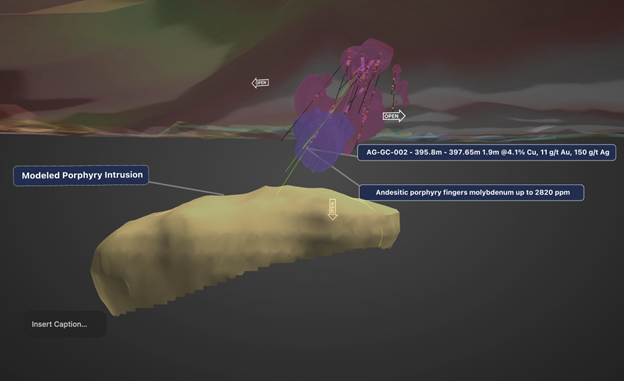
Several molybdenum-bearing intervals (AG_GC_002: 288.40 m to 289.44 - 1.04 m @ 1440 Mo; 333.0m to 333.8m - 0.8 @ 2820 Mo; 545.83m - 546.35 0.52m @ 1000 ppm Mo; AG_GC_004: 274.5 -275.4 0.9m @ 521 ppm Mo) have been identified across the drill holes, with values reaching up to 2,820 ppm on AG_GC_002 and above 500ppm on AG_GC_004. These intervals are spatially distinct from the highest-grade copper-silver-gold skarn mineralization and are commonly associated with intrusive phases, including andesitic porphyry fingers and potassic alteration halos around quartz-calcite veins (Figure 3).
This decoupling of molybdenum from skarn-hosted copper mineralization is consistent with established porphyry-skarn systems, where molybdenum enrichment occurs closer to or within the causative intrusive center. These results provide a strong geochemical vector toward a potential porphyry source at depth.
Exploration Implications
The results from the inaugural drill program confirm that Cerro Grande is an outcropping, vertically extensive, multi-horizon skarn system with clear evidence of metal zonation and a potential porphyry driver.
Importantly, the system remains open laterally and at depth, with mineralization now confirmed well below historical drilling limits and along the extent of the currently defined strike.
Key implications include:
Increased confidence in the continuity and scale of skarn mineralization;
Expansion of the mineralized footprint both laterally and vertically;
Discovery of new mineralization at depth beyond historical drilling;
Identification of robust geochemical vectors toward a potential porphyry system; and
Enhanced targeting framework for follow-up drilling
Building on the success of Phase I, the Company is now advancing a systematic, district-scale exploration strategy across the Adelita Project. Upcoming milestones are expected to include completion of property-wide LiDAR and drone magnetic surveys, results from a systematic soil geochemistry program, and the definition of new drill targets along the 6-kilometre skarn corridor.
The Phase II drill program, scheduled to commence in May 2026, will focus on step-out drilling to expand known skarn horizons, deeper drilling to test porphyry targets, and initial testing of newly defined district-scale targets.
QUALITY ASSURANCE / QUALITY CONTROL
All drill core samples were prepared and analyzed at ALS Laboratories, an independent, internationally accredited laboratory, located in Hermosillo, Mexico and Vancouver, Canada. Sample preparation was completed using ALS preparation methods CRU-31 (crushing), SPL-31 (splitting), and PUL-31 (pulverizing), resulting in a nominal pulp with at least
Multi-element analyses were completed using the ME-MS61L method, which involves a four-acid digestion (hydrochloric, nitric, perchloric, and hydrofluoric acids) followed by analysis using ICP-MS and ICP-AES techniques. The four-acid digestion is considered a near-total digest for most base metal sulfides and associated gangue minerals. Gold was analyzed using the AU-AA24 method, consisting of a 30-gram fire assay fusion with an atomic absorption spectroscopy (AAS) finish. Samples returning results above the upper detection limits of the ME-MS61L method were re-assayed using appropriate over-limit procedures, including AG-OG62 for silver and ME-OG62, Cu-OG62, Pb-OG62, and Zn-OG62 for base metals, as applicable.
ALS Laboratories employ internal quality control procedures including the routine insertion of certified reference materials, blanks, and duplicates at regular intervals. Additionally, the Company implemented an independent quality assurance and quality control program through the systematic insertion of blind certified reference materials and blank samples into the sample stream. Results from QA/QC samples were reviewed on receipt and found to be within acceptable limits.
Qualified Person
The scientific and technical information disclosed in this news release has been reviewed and approved by João Rocha, EurGeol, Vice President of Exploration of Algo Grande Copper Corp., a Qualified Person as defined by National Instrument 43-101.
The Qualified Person has conducted appropriate data verification procedures on both current and historical drilling data disclosed herein. Verification activities included review of drill collar locations, downhole survey data, sampling procedures, and analytical results. Collar locations and drill orientations were validated in the field, and assay data were reviewed for consistency and compliance with industry-standard analytical methods, including ICP-MS and fire assay. The Qualified Person also reviewed available QA/QC data and considers the data to be of acceptable quality for the purposes of this disclosure.
The Qualified Person considers the data verification procedures undertaken to be appropriate and sufficient to support the scientific and technical information disclosed in this news release.
OTC Symbol Change
Algo Grande is additionally pleased to announce a symbol change from "KNDYF" to "ALGRF" on the OTC Markets ("OTC"). Algo Grande's common shares trade under the new symbol on OTC effective as of April 1, 2026. Algo Grande's common shares continue to trade on the TSX Venture Exchange under the symbol "ALGR". U.S. investors can find current financial disclosure and Real-Time Level 2 quotes for the Company on www.otcmarkets.com.
About Algo Grande Copper Corp.
Algo Grande Copper Corp. is a growth-focused mineral exploration company advancing the Adelita Project, a district-scale, multi-system copper-silver-gold opportunity positioned in the prolific Arizona-Sonora copper belt.
The company is dedicated to unlocking the full mineral potential of this under-explored corridor through disciplined data-driven exploration, technical excellence, and a firm commitment to value creation for shareholders. The 5,895-hectare Adelita Project is anchored by the high-grade Cerro Grande Cu-Ag-Au skarn discovery, which exhibits strong continuity along a defined corridor extending over 6 kilometers. Reprocessing of legacy geophysical data and field mapping indicate the presence of a potential porphyry system at depth, suggesting a classic skarn-porphyry mineralization model similar to major deposits found throughout northwestern Mexico.
ON BEHALF OF ALGO GRANDE COPPER CORP.
Enrico Gay
Chief Executive Officer
For more information, please contact:
E-mail: info@algo-grande.com
Website: www.algo-grande.com
NEITHER THE TSX VENTURE EXCHANGE NOR ITS REGULATION SERVICES PROVIDER (AS THAT TERM IS DEFINED IN THE POLICIES OF THE TSX VENTURE EXCHANGE) ACCEPTS RESPONSIBILITY FOR THE ADEQUACY OR ACCURACY OF THIS RELEASE.
Cautionary Statement on Forward-Looking Information
This news release contains statements and information that, to the extent that they are not historical fact, constitute "forward-looking information" within the meaning of applicable securities legislation. Forward-looking information is based on the reasonable assumptions, estimates, analysis and opinions of management made in light of its experience and its perception of trends, current conditions and expected developments, as well as other factors that management believes to be relevant and reasonable in the circumstances at the date that such statements are made, but which may prove to be incorrect. Forward-looking information involves known and unknown risks, uncertainties and other factors that may cause the actual results, performance or achievements of the Algo Grande to differ materially from any future results, performance or achievements expressed or implied by the forward-looking information, including, but not limited to, statements relating to the Company's exploration plans including the planned Phase II drilling program, and those listed in filings made by Algo Grande with the Canadian securities regulatory authorities (which may be viewed at www.sedarplus.ca). Accordingly, readers should not place undue reliance on any such forward-looking information. Further, any forward-looking statement speaks only as of the date on which such statement is made. New factors emerge from time to time, and it is not possible for Algo Grande's management to predict all of such factors and to assess in advance the impact of each such factor on Algo Grande's business or the extent to which any factor, or combination of factors, may cause actual results to differ materially from those contained in any forward- looking statements. Algo Grande does not undertake any obligation to update any forward-looking information to reflect information, events, results, circumstances or otherwise after the date hereof or to reflect the occurrence of unanticipated events, except as required by law including securities laws.
SOURCE: Algo Grande Copper Corp.
View the original press release on ACCESS Newswire
FAQ
AI-generated questions and answers. How Rhea-AI works. Not financial advice.