
KULR Technology Group Advances Next-Generation Drone Battery Integration with Factorial Cells
KULR Technology Group (NYSE American: KULR) is advancing next-generation drone battery pack integration using Factorial solid-state and lithium-metal cells.
Sentiment and the balance of points
Rhea-AI Sentiment reads the wording of the document, how positive or negative its language is on a 1 to 5 scale. The balance of points shown with the takes weighs what the document actually discloses, so the two can disagree, for example when a trial that missed its main goal is described in upbeat language.
Rhea-AI Summary
KULR Technology Group (NYSE American: KULR) is advancing next-generation drone battery pack integration using Factorial solid-state and lithium-metal cells. KULR supports U.S. unmanned aircraft systems by optimizing Factorial cells for demanding flight environments through its battery safety, thermal management, pack design, and mission-critical energy expertise.
KULR and Factorial demonstrated initial battery packs at XPONENTIAL 2026 in Detroit, targeting aerospace, defense, robotics, and autonomous systems. This work aligns with the expansion of the KULR ONE and KULR ONE Air platforms for advanced drone, UAS, eVTOL, and electric aviation applications.
Details
News Market Reaction – KULR
On May 21, the day this news came out, KULR closed 6.91% above the previous close.
Data tracked by StockTitan Argus for the May 21 session.
Key Figures
- Q1 2026 revenue
- $4.85M
- First quarter 2026; up 98% year over year
- Revenue growth
- 98%
- Year-over-year increase in Q1 2026 revenue
- Gross margin
- 29%
- Q1 2026 gross margin after mix shift to higher-margin systems
- Net loss
- $28.12M
- Q1 2026 net loss impacted by bitcoin mark-to-market
- Bitcoin MTM loss
- $20.77M
- Non-cash mark-to-market loss on bitcoin holdings in Q1 2026
- Cash balance
- $19.0M
- Cash as of May 13, 2026 reported in 8-K
- Operating loss
- $7.39M
- Q1 2026 loss from operations after SG&A and R&D reductions
- Credit facility
- $20.0M
- Bitcoin-secured credit facility, with $5.0M drawn in Q1 2026
Historical Context
-
Selected to supply KULR ONE Space batteries for orbital transport mission.
-
Q1 revenue nearly doubled but net loss widened on bitcoin-related charges.
-
Scheduled Q1 2026 earnings call and outlined logistics for investor participation.
-
Announced initial KULR ONE Air orders and 2026 opportunity exceeding $5 million.
-
Appointed new directors, streamlined board, and emphasized margin and efficiency focus.
24h Move is the share-price change in the day after each event; other market factors may also have contributed.
Key Terms
solid-state technical
lithium-metal technical
unmanned aircraft systems technical
uas technical
evtol technical
AI-generated analysis. How Rhea-AI works. Not financial advice.




HOUSTON, May 21, 2026 (GLOBE NEWSWIRE) -- KULR Technology Group, Inc. (NYSE American: KULR) (the "Company" or "KULR"), an energy-systems platform company that enables the safe, certifiable deployment of ultra-high-power lithium battery systems for space and defense programs, mobility applications, hyperscale AI data centers, and telecom infrastructure OEMs, today announced that it is advancing next-generation drone battery pack integration using Factorial Inc.’s solid-state and lithium-metal battery cell technologies.
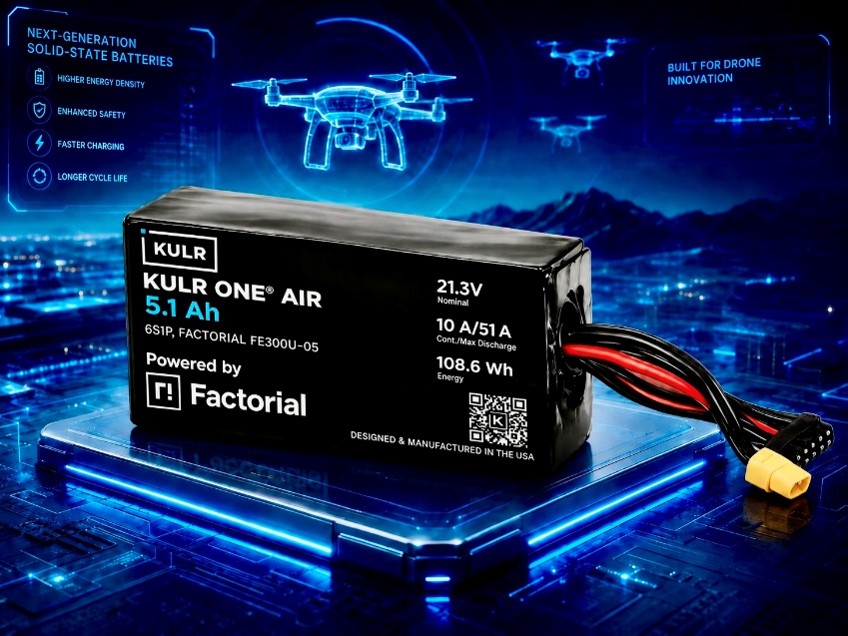
The initiative is part of a broader global effort by Factorial to accelerate deployment of its next-generation battery platform across drone systems in the United States, Europe, and Asia-Pacific. In the United States, KULR is supporting integration work focused on optimizing Factorial cells for demanding unmanned aircraft systems (“UAS”) flight environments through KULR’s expertise in battery safety, thermal management, pack design, and mission-critical energy systems.
As drone missions become longer-range, more autonomous, and increasingly important across commercial, industrial, and defense applications, conventional lithium-ion battery systems can face limitations in endurance, weight, and pulse power. KULR’s work with Factorial cells is intended to support the development of battery pack solutions that can help address these constraints while maintaining a focus on safety, reliability, and manufacturability.
“Factorial is pushing the frontier of solid-state and lithium-metal battery innovation, and its next-generation cell technologies have the potential to meaningfully expand what is possible across electrified flight applications,” said Michael Mo, Chief Executive Officer of KULR Technology Group. “By integrating Factorial’s cells into KULR's advanced battery pack architectures, we believe these technologies can help support higher-energy, higher-power solutions for drone platforms operating in demanding environments, where performance, safety, and reliability are becoming increasingly important.”
“We couldn't be more excited to have KULR as a strategic partner," said Siyu Huang, CEO of Factorial. "They bring best-in-class battery platform and pack integration capabilities to a U.S. drone market that is scaling faster than ever. Solid-state and lithium-metal technology is ready for deployment at scale — and partners like KULR are the ones bringing it into the field.”
KULR and Factorial recently showcased initial battery pack demonstrations at XPONENTIAL 2026 in Detroit, one of the world’s leading events for robotics, autonomy, and uncrewed systems. The demonstration highlighted the potential for Factorial cell-powered battery packs to support next-generation UAS applications across aerospace, defense, robotics, and autonomous system markets.
KULR’s role in the U.S. integration effort builds on its broader strategy to expand the KULR ONE platform into mission-critical battery applications where performance, safety, certification readiness, and manufacturability are essential design requirements. The Company’s KULR ONE Air platform is being developed to support advanced drone, UAS, eVTOL, and electric aviation applications.
About KULR Technology Group, Inc.
KULR Technology Group, Inc. (NYSE American: KULR) is an energy-systems platform company delivering certifiable battery safety, vibration-mitigation, and thermal control solutions that enable ultra-high-power lithium-ion systems and sensitive electronics to operate reliably across space and defense missions, mobility applications, hyperscale AI data centers, and telecom infrastructure OEMs. Learn more at KULR.ai.
Find KULR: Website | X | Telegram | LinkedIn | Instagram | TikTok | Facebook
Investor Relations:
KULR Technology Group, Inc.
Phone: 858-866-8478 x 847
Email: ir@kulr.ai
Safe Harbor Statement
This release contains certain forward-looking statements based on our current expectations, intentions and assumptions that involve risks and uncertainties. Forward-looking statements in this release are based on information available to us as of the date hereof. Our actual results may differ materially from those stated or implied in such forward-looking statements, due to risks and uncertainties associated with our business, which include the risk factors disclosed in our Form 10-K filed with the Securities and Exchange Commission on March 31, 2026, as may be amended or supplemented by other reports we file with the Securities and Exchange Commission from time to time. Forward-looking statements include statements regarding our expectations, beliefs, intentions, or strategies regarding the future and can be identified by forward-looking words such as “anticipate,” “believe,” “could,” “estimate,” “expect,” “intend,” “may,” “should,” and “would” or similar words. All such forward-looking statements that are provided by management in this release are based on information available at this time, and management expects that internal expectations may change over time. These statements are not guarantees of future performance and are subject to known and unknown risks, uncertainties and other factors that could cause actual results to differ materially from those expressed or implied by such forward-looking statements. Except as otherwise required by applicable law, we assume no obligation to update the information included in this press release, whether as a result of new information, future events or otherwise.
A photo accompanying this announcement is available at https://www.globenewswire.com/NewsRoom/AttachmentNg/1c70dd55-cb3e-4cd6-8569-f07d2842bd13

FAQ
AI-generated questions and answers. How Rhea-AI works. Not financial advice.