
Lode Gold Receives Three-year Drill Permit at Flagship Fremont Gold Mine, California
Lode Gold (OTCQB: LODFF) received a three-year Administrative Use Permit from Mariposa County, authorizing surface exploration and drilling on its 100% privately owned patented land at the flagship Fremont Gold Mine in California.
Sentiment and the balance of points
Rhea-AI Sentiment reads the wording of the document, how positive or negative its language is on a 1 to 5 scale. The balance of points shown with the takes weighs what the document actually discloses, so the two can disagree, for example when a trial that missed its main goal is described in upbeat language.
Rhea-AI Summary
Lode Gold (OTCQB: LODFF) received a three-year Administrative Use Permit from Mariposa County, authorizing surface exploration and drilling on its 100% privately owned patented land at the flagship Fremont Gold Mine in California. The permit supports a planned 3,500–4,500 m drilling program in the second half of 2026 to advance technical work for a Prefeasibility Study targeted for 2027.
The summer 2026 campaign will focus on metallurgical optimization (building on prior 91% gold recovery test work), geotechnical and rock mechanics studies, infill drilling to support potential Indicated-to-Reserve conversion, and dual-purpose hydrogeological drilling. Lode Gold also highlights exploration upside across a 4 km strike and reports a 2023 PEA at Fremont based on 1.16 Moz at 1.90 g/t Au Indicated and 2.02 Moz at 2.22 g/t Au Inferred, plus additional resources at its Dingman project in Ontario.
Positive
- Three-year drill permit granted for Fremont patented land, enabling surface exploration and drilling
- Permit supports a 3,500–4,500 m drilling program planned for H2 2026
- Historical metallurgical studies reported 91% gold recoveries for Fremont mineralization
- Fremont PEA (2023) based on 1.16 Moz at 1.90 g/t Au Indicated and 2.02 Moz at 2.22 g/t Au Inferred
- Updated 2026 MRE indicates about 89% of ounces remain unmined versus historical production
- Dingman project hosts a 2013 MRE of 376,000 oz at 0.94 g/t (M&I) and 47,000 oz at 0.71 g/t (Inferred)
Negative
- None.
Details
News Market Reaction – LODFF
On Aug 10, the day this news came out, LODFF closed 8.13% below the previous close.
Data tracked by StockTitan Argus for the Aug 10 session.
AI-generated analysis. How Rhea-AI works. Not financial advice.




Vancouver, British Columbia--(Newsfile Corp. - August 10, 2026) - Lode Gold Resources Inc. (TSXV: LOD) (OTCQB: LODFF) ("Lode Gold" or the "Company") announces that Mariposa County has officially approved the Company's Application for an Administrative Use Permit ("AUP"). Valid for a period of three years, the permit authorizes surface mineral exploration and comprehensive drilling activities across the Company's
The approval of the AUP enables the Company to initiate a planned 3,500 to 4,500-meter drilling program for the second half of 2026. This campaign is designed to advance the project's technical baseline in preparation for a Prefeasibility Study (PFS) to be completed in 2027.
Technical Initiatives and Summer 2026 Drilling Program
The upcoming drilling program, slated to commence on this Summer, will collect geological, geotechnical, and hydrologic data vital to defining early milestones and deliverables. The Company intends to utilize this targeted drilling campaign to advance several key technical initiatives required for advanced development studies, including:
Metallurgical Optimization: Completing dedicated metallurgical core drilling (yellow markers, Figure 2) to update and refine historical processing parameters, building upon positive baseline technical studies from 2014 which demonstrated gold recoveries of
91% .Geotechnical & Rock Mechanics: To optimize the underground mine design and dimensioning in the upcoming PFS, comprehensive rock mechanics studies using large-diameter core will be conducted, which is anticipated to support a safer design layout and expedite local permitting processes.
Resource Classification & Reserve Conversion: Executing strategic infill drilling within the defined Indicated Resource areas of the Pine Tree - Josephine zones. This program is engineered to provide the technical continuity and density required to support the future conversion of current Indicated Resources to Mineral Reserves during the PFS.
Dual-Purpose Hydrogeological Drilling: Concurrently, vertical hydrogeological drillholes (blue markers, Figure 2) will intersect the main mineralized body to conduct systematic permeability testing and rock mass characterization. These holes are intentionally positioned in wide-spaced sectors with limited historical data, allowing them to dual-function as hydrogeological test wells and exploratory holes.
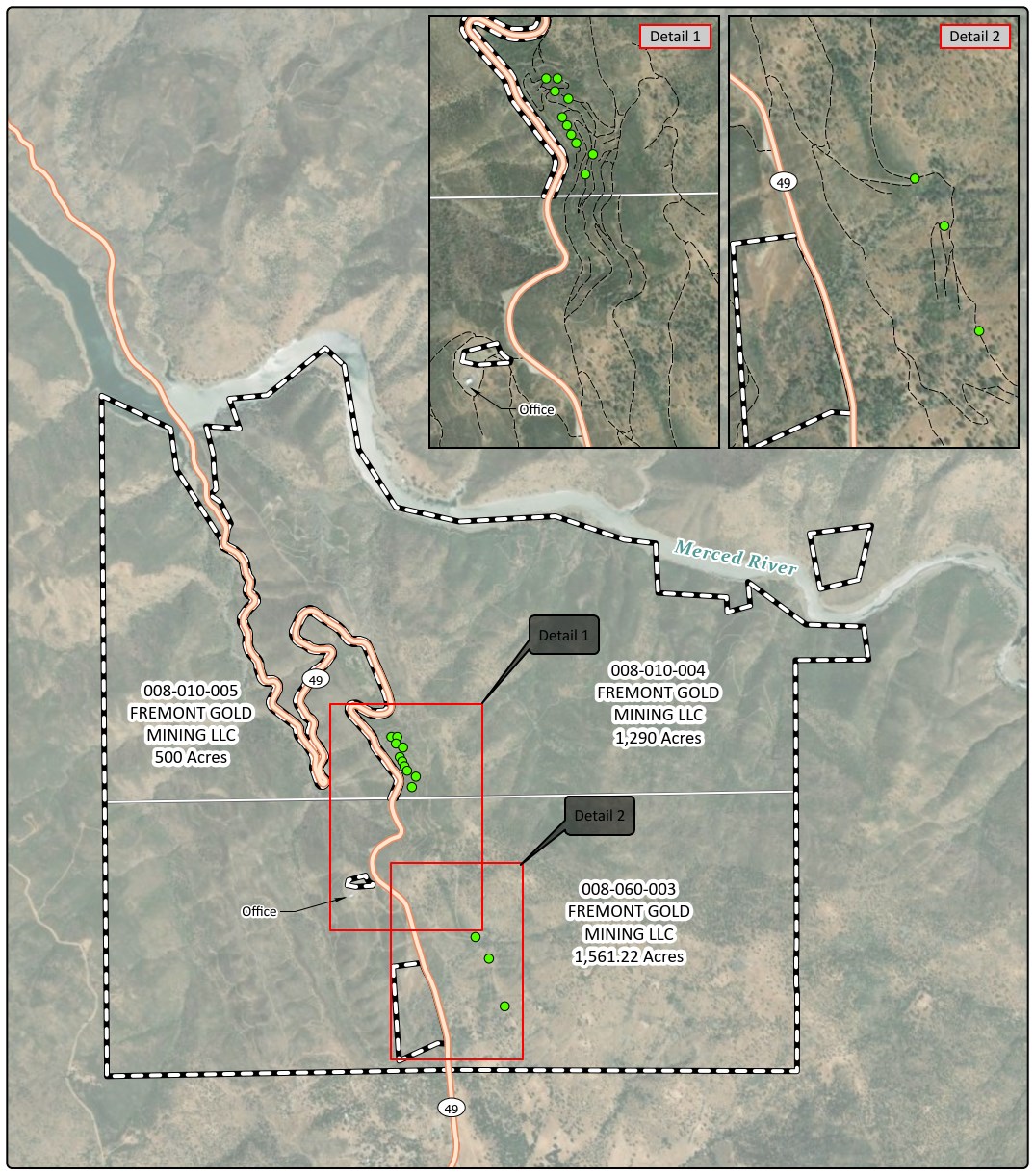
Figure 1: Location of the drilling pads for the 2026 drilling campaign.
To view an enhanced version of this graphic, please visit:
https://images.newsfilecorp.com/files/4064/308915_bc993f57946359b0_001full.jpg
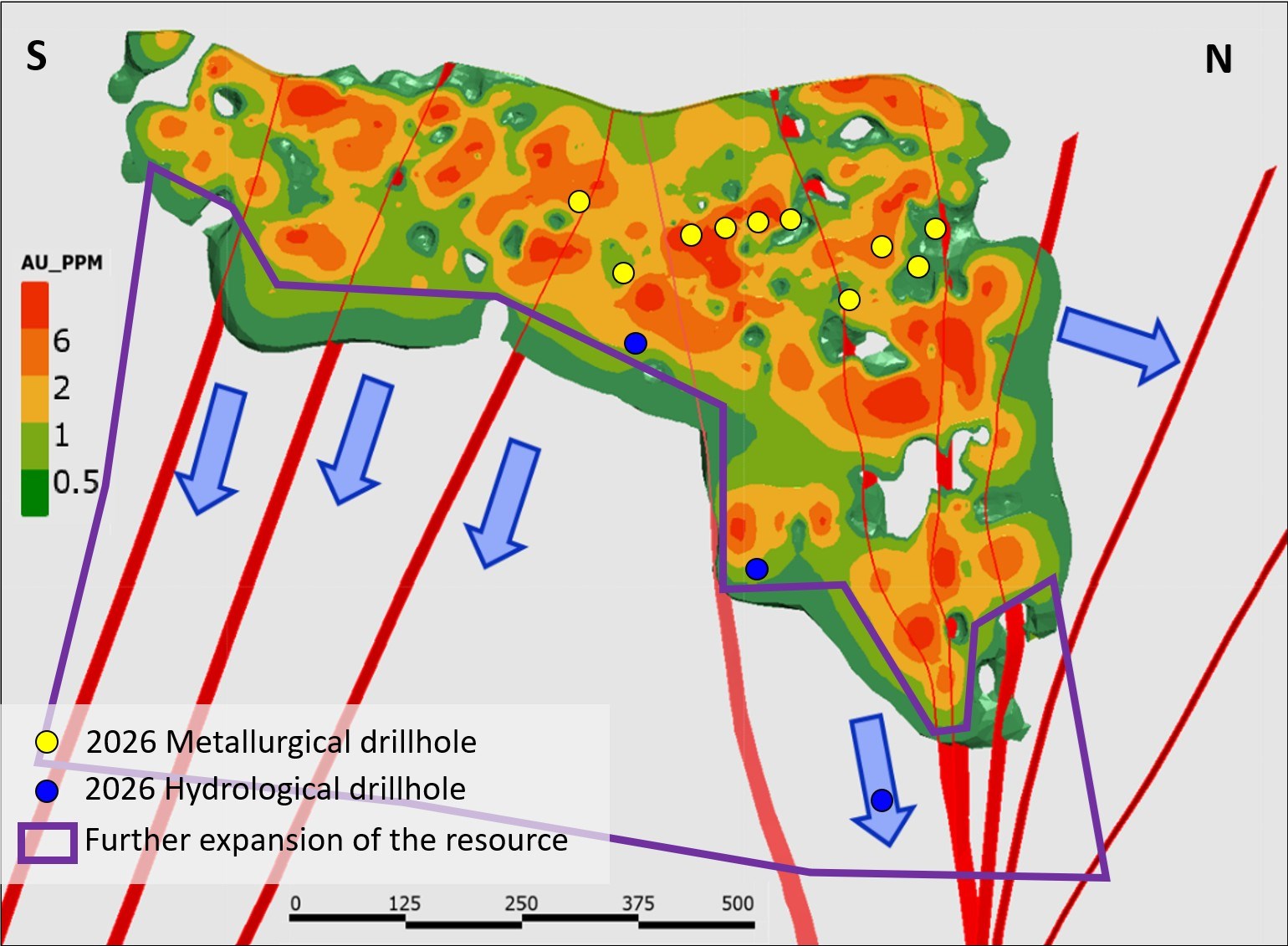
Figure 2: Longitudinal section of the Pine Tree - Josephine deposit showing the statistical envelopes (gold grades), perpendicular normal faults (red planes), extension of potential mineralization (purple boundary), location of the designed intercepts of the metallurgical drillholes (yellow markers) and hydrological drillholes (blue markers)
To view an enhanced version of this graphic, please visit:
https://images.newsfilecorp.com/files/4064/308915_bc993f57946359b0_002full.jpg
Fremont Exploration Upside and District Scale Potential
Beyond the immediate technical baseline work for the 2027 PFS, the Fremont Gold Mine exhibits significant, untested exploration potential across its 4-kilometer strike:
Pine Tree - Josephine Deep Resource Expansion: As delineated by the structural extension vectors (purple boundary, Figure 2), a significant portion of usually tabular orogenic deposit remains open at depth and along strike. This geometry is structurally defined by normal faults perpendicular to the main orogenic gold trend. Three step out holes as deep as 1300m hit structure and were mineralized, confirming this deposit as a typical orogenic deposit with structural controls. This deep future expansion zone is integrated into long-term planning and is slated for targeted underground exploration via a planned decline ramp following the conclusion of the PFS.
Chicken Gulch Infill and Expansion: Due to the limited density of historical drilling at the Chicken Gulch target, exploration activities will focus on executing targeted infill drilling. This program is specifically designed to expand the footprint and confidence of the current Inferred Resource base, rather than immediate upgrade to the Indicated category.
Queen Specimen Target Development: The Queen Specimen target represents a significant component of the project's current footprint, hosting approximately
10% of the overall existing resource. Long-term development plans establish that this target will be explored by comprehensive drilling and evaluation post-PFS during the construction of an underground decline ramp, which is anticipated to connect directly with the main Pine Tree - Josephine operations.Upside Potential - Regional Targets and Prospects: Advanced evaluation is currently underway on nine greenfield prospects across the broader property footprint, including the high-priority Rosie Jane and Drunken Gulch areas, to confirm structural controls and generate new drill targets. The exploration potential and geological modeling of these regional sectors, alongside other 7 distinct property-wide targets, have been further supported by structural data from artificial intelligence (AI) predictive models.
Wendy T. Chan, CEO and Director of Lode Gold, commented:
"Securing the 3-year AUP provides the regulatory framework required to systematically advance Fremont. This upcoming drilling campaign is focused on the core mineralized zones that will form the basis of our 2027 Pre-feasibility Study. By evaluating grade continuity along strike, testing extensions at depth, and advancing our regional exploration targets, we aim to deliver the technical data necessary to define the project's development path."
About Lode Gold
Lode Gold has key assets in Canada and United States.
Fremont Gold Mine Project (Fremont Gold Mining LLC) is a brownfield project in Mariposa, California with 43,000 m drilled, 10,000 underground channel samples, 14 adits and 2 shafts. Mining halted in 1942 due to the gold mining prohibition during WW II. It was mined at 10.7 g/t when price was gold was
Dingman Property is an orogenic deposit in Ontario, Canada with over 22,000 m drilled, with a 2013 PEA, MRE (link to report) : 376,000 oz at 0.94 g/t (M&I) and 47,000 oz at 0.71 g/t (Inferred).
Qualified Person
The technical information contained in this press release was reviewed and approved by Gary Wong, P.Eng., Vice President of Exploration of Lode Gold, designated as a qualified person under National Instrument 43-101.
ON BEHALF OF THE COMPANY
Wendy T. Chan
CEO & Director
info@lode-gold.com
+1(604) 977-GOLD (4653)
Kevin Shum
Investor Relations
kevin@lode-gold.com
+1(604) 977-GOLD (4653)
Cautionary Statement Regarding Forward-Looking Information
Neither the TSX Venture Exchange nor its Regulation Services Provider (as that term is defined in the policies of the TSX Venture Exchange) accepts responsibility for the adequacy or accuracy of this release.
This news release includes "forward-looking statements" and "forward-looking information" within the meaning of Canadian securities legislation. All statements included in this news release, other than statements of historical fact, are forward-looking statements including, without limitation, statements with respect to the use of proceeds, advancement and completion of resource calculation, feasibility studies, and exploration plans and targets. Forward-looking statements include predictions, projections and forecasts and are often, but not always, identified by the use of words such as "anticipate", "believe", "plan", "estimate", "expect", "potential", "target", "budget" and "intend" and statements that an event or result "may", "will", "should", "could" or "might" occur or be achieved and other similar expressions and includes the negatives thereof.
Forward-looking statements are based on a number of assumptions and estimates that, while considered reasonable by management based on the business and markets in which the Company operates, are inherently subject to significant operational, economic, and competitive uncertainties, risks and contingencies. These include assumptions regarding, among other things: the status of community relations and the security situation on site; general business and economic conditions; the availability of additional exploration and mineral project financing; the supply and demand for, inventories of, and the level and volatility of the prices of metals; relationships with strategic partners; the timing and receipt of governmental permits and approvals; the timing and receipt of community and landowner approvals; changes in regulations; political factors; the accuracy of the Company's interpretation of drill results; the geology, grade and continuity of the Company's mineral deposits; the availability of equipment, skilled labour and services needed for the exploration and development of mineral properties; and currency fluctuations.
There can be no assurance that forward-looking statements will prove to be accurate and actual results, and future events could differ materially from those anticipated in such statements. Important factors that could cause actual results to differ materially from the Company's expectations include a deterioration of security on site or actions by the local community that inhibits access and/or the ability to productively work on site, actual exploration results, interpretation of metallurgical characteristics of the mineralization, changes in project parameters as plans continue to be refined, future metal prices, availability of capital and financing on acceptable terms, general economic, market or business conditions, uninsured risks, regulatory changes, delays or inability to receive required approvals, business disruptions, and other exploration or other risks detailed herein and from time to time in the filings made by the Company with securities regulators, including those described under the heading "Risks and Uncertainties" in the Company's most recently filed MD&A. The Company does not undertake to update or revise any forward-looking statements, except in accordance with applicable law.
[1] 0.25 g/t for oxide, 0.45 g/t for open pit mineralization and 1.45 g/t for underground mineralization

To view the source version of this press release, please visit https://www.newsfilecorp.com/release/308915
FAQ
AI-generated questions and answers. How Rhea-AI works. Not financial advice.