
Lipocine Announces Positive Oral Brexanolone Quantitative EEG Results
Lipocine Inc. (NASDAQ: LPCN) announced positive data from its quantitative Electroencephalogram (qEEG) study of oral brexanolone, a neuroactive steroid being developed for post-partum depression (PPD).
Rhea-AI Summary
Lipocine Inc. (NASDAQ: LPCN) announced positive data from its quantitative Electroencephalogram (qEEG) study of oral brexanolone, a neuroactive steroid being developed for post-partum depression (PPD). The study, conducted on 12 healthy postmenopausal females, showed robust central nervous system (CNS) activity with concentration- and time-dependent post-dose changes in qEEG.
Key findings include:
- Significant increases in theta and alpha1 band power in posterior cortical regions
- Decrease in alpha2 band power
- Considerable beta band amplitude increase across all cortical brain areas
- Rapid onset of effects (as early as 2 hours) with maximum impact at 4 hours post-dose
- Effects lasting up to 12 hours post-dose
These results confirm GABAA positive allosteric modulation and support the potential utility of oral brexanolone in treating various neuropsychiatric indications, including depression, anxiety, essential tremor, and epilepsy. The safety profile was consistent with previous clinical studies, showing minimal CNS depressant effects.
Positive
- Positive qEEG results confirming target engagement of oral bioidentical brexanolone
- Potential utility in treating multiple psychiatry and neurology indications
- Rapid onset of effects (as early as 2 hours) with lasting impact up to 12 hours post-dose
- Favorable safety profile with minimal CNS depressant effects
Negative
- None.
Details
News Market Reaction – LPCN
In the trading session that priced this news, LPCN gained 0.58%, reflecting a mild positive market reaction.
Data tracked by StockTitan Argus on the day of publication.
AI-generated analysis. How Rhea-AI works. Not financial advice.




- Quantitative Electroencephalogram (qEEG) in healthy subjects administered single doses of oral brexanolone, a neuroactive steroid (NAS), confirmed GABAA modulation
- Rapid and durable CNS target engagement confirms effective oral delivery of bioidentical brexanolone
- Promising results support continued development of oral brexanolone for the treatment of neuropsychiatric disorders
"We are pleased with the qEEG results that confirm target engagement of oral bioidentical brexanolone, which suggests potential utility in treating numerous psychiatry indications, including depression and anxiety, and neurology indications such as essential tremor and epilepsy," said Dr. Mahesh Patel, President and CEO of Lipocine Inc. "These positive biomarker results and favorable safety profile support further development of oral brexanolone."
This Phase 1 study evaluated qEEG spectral power changes after administration of oral brexanolone. Healthy postmenopausal females (N=12) were administered single doses of oral brexanolone. EEG recordings and blood samples were collected pre- and post-dose (2, 4 and 12 hours). EEG recordings were obtained using a wireless, 19-electrode EEG monitoring device (Zeto Inc.,
Following a single clinically relevant dose of oral brexanolone, subjects showed mean changes in all oscillatory spectral power bands. As shown in Fig. 1, theta and alpha1 band power were significantly increased in posterior cortical regions, while alpha2 band power decreased. There was considerable beta band amplitude increase, including significant increase in beta2 amplitude across all cortical brain areas Most of the treatment-related EEG changes were rapid occurring as early as 2 hours, with maximum and significant mean contrast values at 4 hours post dose (consistent with Tmax) with appreciable effects lasting 12 hours post-dose.
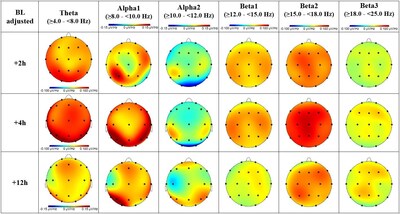
The observed qEEG changes following oral brexanolone administration are consistent with therapies effective in managing depression, anxiety, tremor, and seizures.1-5
Oral brexanolone was well-tolerated in this Phase 1 study. The safety profile was consistent with safety data from clinical studies previously conducted by Lipocine with minimal CNS depressant effects.
Lipocine plans to present the additional details and analyses from this EEG study at upcoming scientific meetings.
About Quantitative Electroencephalogram (qEEG)
Quantitative Electroencephalogram (qEEG) is an advanced neuroimaging technique used to measure electrical activity in the brain with a high degree of precision and detail. qEEG uses mathematical and statistical methods to analyze the electrical signals generated by the brain and convert them into quantitative metrics. By translating these signals into a digital format, qEEG allows for the identification and assessment of specific brain wave frequencies -- such as delta, theta, alpha, beta, and gamma waves -- associated with different states of cognition, emotion, and behavior. This analysis allows researchers to detect subtle changes in brain function that may be induced by a drug, providing important insights into its mechanism of action. In the context of drug development, qEEG is used to evaluate the effect of new therapies on the central nervous system (CNS) by monitoring shifts in brain wave patterns that correlate with therapeutic outcomes. This helps determine whether the drug is acting on the desired neural circuits, provides early evidence of efficacy, and may support dose selection for future clinical trials.
About Lipocine
Lipocine is a biopharmaceutical company leveraging its proprietary technology platform to augment therapeutics through effective oral delivery to develop differentiated products. Lipocine has drug candidates in development as well as drug candidates for which we are exploring partnerships. Our drug candidates represent enablement of differentiated, patient friendly oral delivery options for favorable benefit to risk profile which target large addressable markets with significant unmet medical needs.
Lipocine's clinical development candidates include: LPCN 1154, oral brexanolone, for the potential treatment of postpartum depression, LPCN 2101 for the potential treatment of epilepsy, LPCN 2203 an oral candidate targeted for the management of essential tremor, LPCN 2401 an oral proprietary anabolic androgen receptor agonist, as an adjunct therapy to incretin mimetics, as an aid for improved body composition in obesity management and LPCN 1148, a novel androgen receptor agonist prodrug for oral administration targeted for the management of symptoms associated with liver cirrhosis. Lipocine is exploring partnering opportunities for LPCN 1107, our candidate for prevention of preterm birth, LPCN 1154, for rapid relief of postpartum depression, LPCN 2401 for obesity management, LPCN 1148, for the management of decompensated cirrhosis, and LPCN 1144, our candidate for treatment of non-cirrhotic NASH. TLANDO, a novel oral prodrug of testosterone containing testosterone undecanoate developed by Lipocine, is approved by the FDA for conditions associated with a deficiency of endogenous testosterone, also known as hypogonadism, in adult males. For more information, please visit www.lipocine.com.
Forward-Looking Statements
This release contains "forward-looking statements" that are made pursuant to the safe harbor provisions of the Private Securities Litigation Reform Act of 1995 and include statements that are not historical facts regarding our product development efforts, our strategic plans for developing products, our ability to monetize product candidates, including through entering into partnering arrangements, our product candidates and related clinical trials, the achievement of milestones within and completion of clinical trials, the timing and completion of regulatory reviews, outcomes of clinical trials of our product candidates, and the potential uses and benefits of our product candidates. Investors are cautioned that all such forward-looking statements involve risks and uncertainties, including, without limitation, the risks that we may not be successful in developing product candidates, we may not have sufficient capital to complete the development processes for our product candidates, we may not be able to enter into partnerships or other strategic relationships to monetize our non-core assets, the FDA will not approve any of our products, risks related to our products, expected product benefits not being realized, clinical and regulatory expectations and plans not being realized, new regulatory developments and requirements, risks related to the FDA approval process including the receipt of regulatory approvals, and our ability to utilize a streamlined approval pathway for LPCN 1154, the results and timing of clinical trials, patient acceptance of Lipocine's products, the manufacturing and commercialization of Lipocine's products, and other risks detailed in Lipocine's filings with the SEC, including, without limitation, its Form 10-K and other reports on Forms 8-K and 10-Q, all of which can be obtained on the SEC website at www.sec.gov. Lipocine assumes no obligation to update or revise publicly any forward-looking statements contained in this release, except as required by law.
- Meltzer-Brody et al. Lancet 2018; 392(10152): 1058-1070.
- Buchsbaum et al. Biol Psychiatry 1985; 20(8): 832-842.
- Ibanez et al. Plos One 2014; 9(3): e93159.
- Huang and Shen Clin Electroencephalography 1994; 24(4): 179-187
- Biondi et al. Sci Rep 2022; 12(1): 1919.

 View original content to download multimedia:https://www.prnewswire.com/news-releases/lipocine-announces-positive-oral-brexanolone-quantitative-eeg-results-302272247.html
SOURCE Lipocine Inc.
FAQ
AI-generated questions and answers. How Rhea-AI works. Not financial advice.