
Lithium Africa Discovers New Lithium Pegmatite System at Jackal Water, 11 km from the Norrabees Cluster, Highlighting District-Scale Potential at Springbok
Sentiment and the balance of points
Rhea-AI Sentiment reads the wording of the document, how positive or negative its language is on a 1 to 5 scale. The balance of points shown with the takes weighs what the document actually discloses, so the two can disagree, for example when a trial that missed its main goal is described in upbeat language.
Rhea-AI Summary
Lithium Africa (LTAFF) discovered a lithium-bearing pegmatite system at Jackal Water, 11 km southwest of the Norrabees cluster at its Springbok Project in South Africa.
All eight initial holes intersected 11 m to 56 m of pegmatite along the drill holes. The first lab results returned up to 2.21% lithium oxide over 1.0 m at Jackal Water. True widths are unknown, and the logged rock lengths do not measure lithium grade. Assays are pending for five initial holes, parts of two others and three follow-up holes. Lithium Africa plans more drilling to test the system's extent.
At Norrabees I, a hole inside the five-hectare mining permit returned 9.05 m at 1.19% lithium oxide from 1.95 m downhole. Springbok has mapped lithium-bearing pegmatites along an approximately 50 km trend on a single 1,675 km² license, but Springbok has no mineral resource estimate.
Positive
- Minor pointJackal Water discovery identified lithium-bearing pegmatite 11 km southwest of the Norrabees cluster.
- Minor pointJackal Water I assays returned 1.0 m at 2.21% lithium oxide from 10 m and 1.0 m at 0.89% from 15 m downhole.
- Minor pointNorrabees I drilling returned 9.05 m at 1.19% lithium oxide from 1.95 m downhole, including 6.00 m at 1.44%.
- Minor pointJackal Water II assays returned 1.0 m at 1.35% lithium oxide from 45 m downhole.
- Minor pointInitial Jackal Water drilling intersected 11 m to 56 m of logged pegmatite downhole across all eight holes.
5 minor points
- Minor pointMapped lithium-bearing pegmatites span an approximately 50 km trend on a single 1,675 km² license.
- Minor pointNorrabees V drilling returned 5.0 m at 0.53% lithium oxide from 8.0 m downhole.
- Minor pointNorrabees VIII drilling returned 4.0 m at 0.66% lithium oxide from 3.0 m downhole, including 1.0 m at 1.03%.
- Minor pointSpringbok drilling reached 138 holes across 14 targets for approximately 4,330 m in 2026, including three Jackal Water follow-up holes.
- Minor point. Forward-looking: it has not happened yet and may not happen.Further Jackal Water drilling is planned to test the extent of the pegmatites.
Negative
- Minor pointSpringbok has no mineral resource estimate.
- Minor pointJackal Water assays are pending for five initial holes, parts of two others and all three follow-up holes.
- Minor pointJackal Water I hole JW1RC26-003 returned no significant intercept.
- Minor pointRemaining assayed pegmatite in Jackal Water II hole JW2RC26-003 returned less than 0.25% lithium oxide.
- Minor point. Forward-looking: it has not happened yet and may not happen.District-wide interpretation based on cesium, tantalum and rubidium enrichment is preliminary and needs further drilling and assays.
2 minor points
- Minor pointNorrabees drilling returned no significant intercepts in several holes across Norrabees I, V and VIII.
- Minor pointAssays from other Springbok targets are pending.
AI-generated analysis. How Rhea-AI works. Not financial advice.


Cape Town, South Africa--(Newsfile Corp. - November 19, 2026) - Lithium Africa Corp. (TSXV: LAF) (FSE: 6MQ) (OTCQB: LTAFF) ("Lithium Africa" or the "Company"), the hard-rock lithium explorer and developer targeting district-scale opportunities across Africa, is pleased to report the discovery of a new lithium-bearing pegmatite system at Jackal Water, 11 km southwest of the Norrabees cluster at its Springbok Project in the Northern Cape of South Africa (the "Springbok Project" or "Springbok"). The first holes intersected stacked pegmatites with up to 56 meters ("m") of logged pegmatite downhole and returned lithium grades of up to
Highlights
A new discovery by Lithium Africa's team: Jackal Water was identified using the Company's proprietary, machine-learning-assisted targeting method, developed in-house. The pegmatites are 11 km southwest of the Norrabees cluster and have no known record of previous exploration or drilling (Figure 1).
Thick, stacked pegmatites with lithium: all eight reverse circulation ("RC") holes intersected pegmatite, with 11 m to 56 m of logged pegmatite downhole. First assays, received from three of the eight holes, returned 1.0 m intervals of
2.21% ,1.35% , and0.89% Li2O (Table 1, Appendix). The remaining pegmatite assayed to date returned no significant intercepts, assays are pending from five of the eight holes, and true widths are not yet known.Wide pegmatites along a 50 km trend: spodumene-bearing pegmatites at Springbok are 9 m to 30 m wide in outcrop (not true thickness), along a trend of approximately 50 km on a single 1,675 km² license, and drilling at Jackal Water intersected up to 56 m of logged pegmatite downhole (true width not yet known). For context, Sigma Lithium reports that its Xuxa pegmatite in Brazil's Lithium Valley averages 12 m to 13 m thick; this is not necessarily indicative of mineralization at Springbok.
Additional near-surface lithium at Norrabees I: diamond hole NB1DD26-006 returned 9.05 m at
1.19% Li2O from 1.95 m downhole, including 6.0 m at1.44% Li2O, inside the Company's five-hectare mining permit (Table 1, Appendix).
"Our discovery at Jackal Water takes Springbok from a cluster to a district," said Thomas R. Benson, Ph.D., CEO of Lithium Africa. "Eleven kilometers from Norrabees, our first holes intersected up to 56 m of logged pegmatite downhole and returned up to
Jackal Water Discovery
The Jackal Water pegmatites (Figure 1) were identified through the Company's in-house targeting method, which combines satellite imagery with machine-learning-assisted analysis of handheld pXRF data, and were confirmed by field mapping. They have no known record of previous exploration or drilling. Eight RC holes (308 m) tested the Jackal Water I and Jackal Water II pegmatites, and all eight intersected pegmatite: 11 m to 24 m downhole at Jackal Water I and 12 m to 56 m downhole at Jackal Water II.
At Jackal Water I, JW1RC26-002 returned 1.0 m at
The Company interprets the enrichment in cesium, tantalum, and rubidium as an indication that highly fractionated pegmatites with the potential to host lithium mineralization occur at both the Norrabees cluster and Jackal Water. This interpretation is preliminary and remains to be tested by further drilling and assays. Intervals and logged pegmatite thicknesses are downhole lengths; true widths are not yet known, and logged pegmatite thickness is not a measure of lithium grade. Collar details are in Table 2 (Appendix).
Three follow-up RC holes (189 m) have since been drilled at Jackal Water, with assays pending, and the Company plans further drilling to test the extent of the pegmatites.
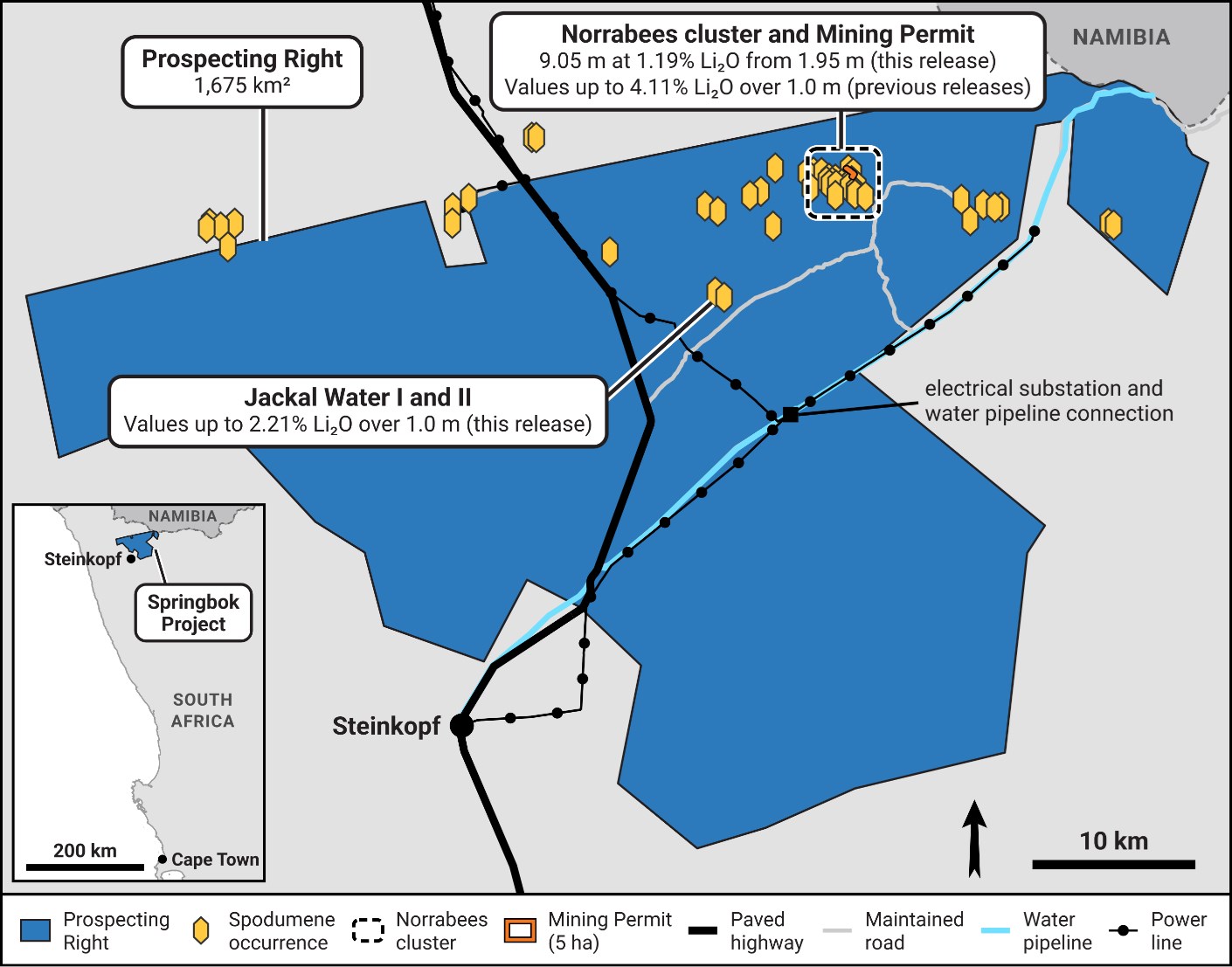
Figure 1: The Springbok Project Prospecting Right (1,675 km²), Northern Cape, South Africa, showing the Jackal Water I and II discovery, the Norrabees cluster and five-hectare mining permit, mapped spodumene occurrences, and key infrastructure. Callouts show selected results from this release and a previously reported result from Norrabees I (see news release dated September 30, 2026). Intervals are downhole lengths, and true widths are not yet known (Table 1, Appendix). Inset shows the Springbok Project location.
To view an enhanced version of this graphic, please visit:
https://images.newsfilecorp.com/files/11554/324825_d935e21414d28b19_001full.jpg
District-Scale Exploration Potential and Comparison to Brazil's Lithium Valley
Spodumene-bearing pegmatites at Springbok are 9 m to 30 m wide in outcrop, as described in the Company's technical report dated July 21, 2026, along a trend of approximately 50 km on a single 1,675 km² license (Figure 2). Drilling at Jackal Water intersected up to 56 m of logged pegmatite downhole (true widths are not yet known), which the Company believes further supports the potential for thick lithium-bearing pegmatites across the district. For context, Sigma Lithium Corporation's technical report dated March 31, 2025 on its Grota do Cirilo project in Brazil's Lithium Valley describes pegmatites that average 12 m to 13 m thick at Xuxa and are 30 m to 35 m thick at Barreiro, and Pedrosa-Soares et al. (2025, Economic Geology, v. 120, no. 5) describe the pegmatites mined at Cachoeira since 1992 as decimeters to 30 m thick. This information is from the public sources cited and has not been verified by the Company or its Qualified Person. Outcrop widths and downhole intervals are not true thicknesses and are not on the same basis as the thicknesses reported in Brazil, and the comparison is of pegmatite thickness only, not of strike length, grade, tonnage, or mineralogy. The Springbok Project has no mineral resource estimate, and mineralization in Brazil is not necessarily indicative of mineralization at Springbok.
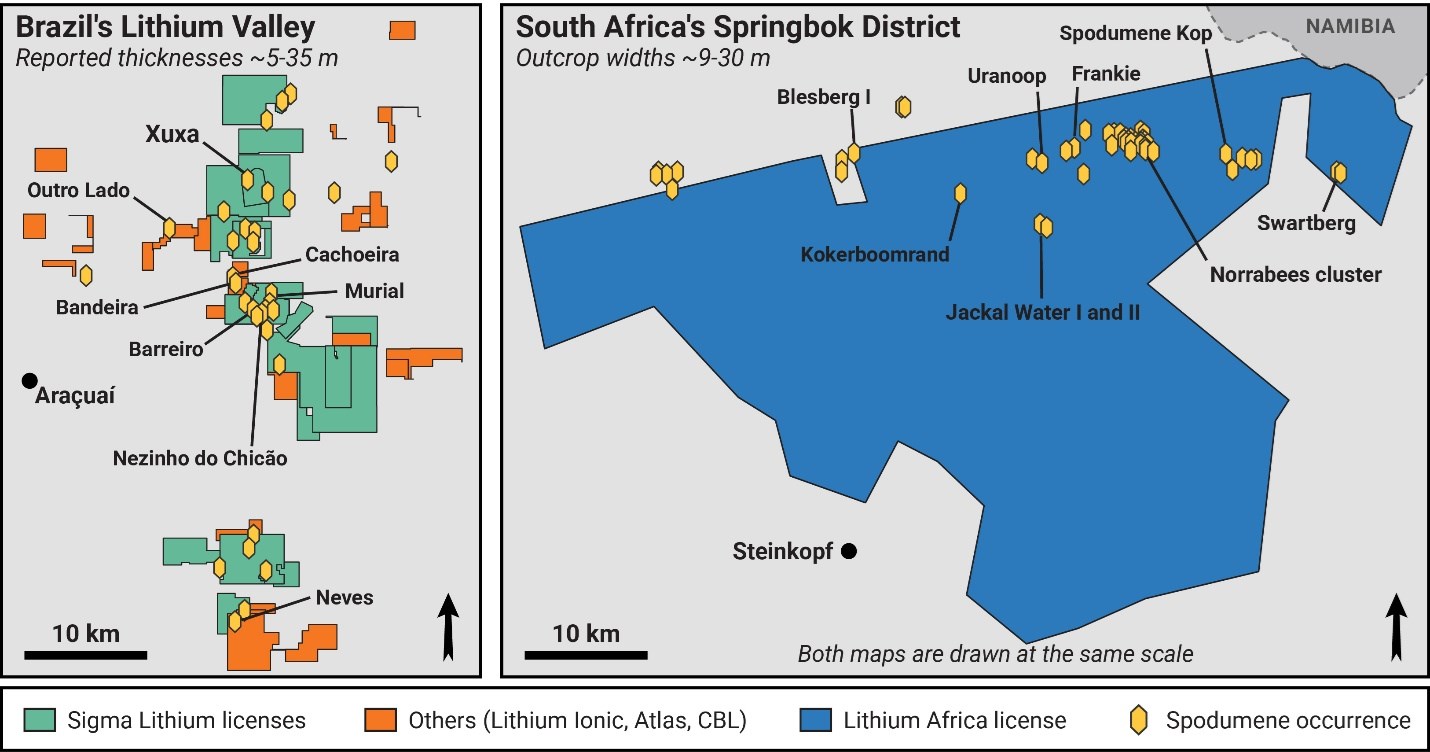
Figure 2: Brazil's Lithium Valley (Minas Gerais) and South Africa's Springbok District (Northern Cape) at the same map scale, showing license areas, mapped spodumene occurrences, and selected pegmatites. Thicknesses shown for Brazil are from Sigma Lithium Corporation's technical report dated March 31, 2025, and Pedrosa-Soares et al. (2025); Springbok outcrop widths are from the Company's technical report dated July 21, 2026, and are not true thicknesses. Information on Brazil is from public sources, has not been verified by the Company or its Qualified Person, and is not necessarily indicative of mineralization at Springbok, which has no mineral resource estimate.
To view an enhanced version of this graphic, please visit:
https://images.newsfilecorp.com/files/11554/324825_d935e21414d28b19_002full.jpg
Drilling Continues Across the Springbok District
Drilling is continuing across the Springbok District to further define the potential of the Springbok Project. In 2026 the Company has drilled 138 holes across 14 pegmatite targets for approximately 4,330 m, including three follow-up holes (189 m) at Jackal Water and holes at Blesberg I (five holes, 105 m), Uranoop (seven holes, 182 m), Frankie (seven holes, 161 m), Kokerboomrand (eight holes, 280 m), and Spodumene Kop (16 holes, approximately 520 m) (Figure 2). Assays are pending, and results will be reported as they are received and validated.
At Norrabees I, diamond hole NB1DD26-006, collared inside the Company's five-hectare mining permit, returned 9.05 m at
Sampling, Analysis, QA/QC and Data Verification
RC drilling was completed by Van Zyl Drilling using a face-sampling hammer. RC samples were collected over 1 m intervals through a riffle splitter, and a representative chip sample from each interval was retained in chip trays for logging. Diamond core from NB1DD26-005 and NB1DD26-006 was logged and sampled at nominal 1 m intervals adjusted to lithological contacts, and half-core was submitted for analysis. Sampling covered the logged pegmatite and 1 m to 2 m of adjacent host rock on either side of each pegmatite interval. Samples of approximately 2 kg were bagged, ticketed and sent to SGS South Africa (Randfontein) ("SGS"), an independent commercial laboratory accredited by SANAS to ISO/IEC 17025. Lithium was analyzed by sodium peroxide fusion with an ICP-AES finish (GE_ICP90A50) and a multi-element suite including cesium, rubidium and tantalum by sodium peroxide fusion with an ICP-MS finish (GE_IMS90A50).
The Company inserted a certified reference material every 20 samples, a blank every 50 samples, and a field duplicate every 10 samples. All certified reference material lithium results were within three standard deviations of the certified values, and all blanks returned lithium below or at the 10 ppm detection limit. Field duplicates showed acceptable repeatability, other than two core duplicate pairs from the spodumene-bearing interval in NB1DD26-006 and pairs below 200 ppm Li, where relative differences are large close to the detection limit. SGS's internal standards, blanks and repeats were also reviewed. Collar locations were recorded by handheld GPS.
The Qualified Person, Benjamin Gelber, P.Geo., has verified the assay database against the original laboratory certificates and considers the QA/QC results acceptable for the purpose of this release.
Qualified Person
The technical and scientific information in this news release was reviewed, verified and approved by Benjamin Gelber, P.Geo., a consultant of the Company and a practicing Professional Geologist registered with Engineers & Geoscientists British Columbia (EGBC, Licence No. 33258), who is a non-independent "Qualified Person" as defined by National Instrument 43-101 - Standards of Disclosure for Mineral Projects. The information on Brazil in this news release is taken from the public sources cited and has not been verified by the Qualified Person, and drill collar locations were recorded by handheld GPS. No other limitations on, or failures of, verification were identified.
About Lithium Africa Corp.
Lithium Africa Corp. is a lithium exploration and development company building a portfolio of hard-rock lithium assets across Africa. The Company holds the Springbok Project in South Africa directly and its exploration interests in West and Southern Africa, including the Adzopé District in Côte d'Ivoire, through a 50/50 joint venture with GFL International Co., Ltd., an affiliate of Ganfeng Lithium. For more information, please visit www.li-africa.com.
ON BEHALF OF THE BOARD OF DIRECTORS OF LITHIUM AFRICA CORP.
Thomas R. Benson, Ph.D., Chief Executive Officer & Director
For further information regarding the Company contact:
Jeanne Liu, Corporate Communications at investors@li-africa.com, 1.604.771.7125.
Cautionary Note Regarding Third-Party Public Data and Information
The third-party public data and information contained or incorporated by reference in this news release is based upon information from publicly available sources. Although the Company believes these sources to be generally reliable, such third-party public data and information are subject to interpretation and cannot be verified with complete certainty due to limits on the availability and reliability of raw data, the voluntary nature of the data gathering process and other limitations and uncertainties inherent in any survey. Actual outcomes may vary materially from those contained in such third-party public data and information, and the prospect for material variation can be expected to increase as the length of time from the date of such third-party data and information increases. While the Company believes such third-party public data and information to be generally reliable, the Company has not independently verified any of the data and information from third-party sources referred to or incorporated by reference in this news release and accordingly, the accuracy and completeness of such data is not guaranteed.
Cautionary Note Regarding Forward-Looking Statements
Statements contained in this news release that are not historical facts may be forward-looking statements within the meaning of applicable securities legislation. Forward-looking statements in this news release include statements relating to the Company's planned exploration activities, including the drill program at the Springbok Project and the timing of results from the remaining holes, the continuity of mineralization at the Springbok Project, the interpretation of drill results, the interpretation of geochemical results at Jackal Water, planned follow-up drilling at Jackal Water, the comparison of the Springbok District to lithium districts in Brazil, and the potential for the Springbok Project to host multiple mineralized pegmatites. The Company has not completed a mineral resource estimate or any preliminary economic assessment, pre-feasibility or feasibility study at the Springbok Project, and has not made a production decision. There is no certainty that any production will be achieved. There is significant risk that the forward-looking statements will not prove to be accurate, that the management's assumptions may not be correct and that actual results may differ materially from such forward-looking statements. Accordingly, readers should not place undue reliance on the forward-looking statements. Generally, forward-looking statements can be identified by the use of terminology such as "anticipate", "will", "expect", "may", "continue", "could", "estimate", "forecast", "plan", "potential" and similar expressions. These forward-looking statements are based on a number of assumptions which may prove to be incorrect which, without limiting the generality of the following, include the ability to raise funds through private or public equity financings or at the project level; the timely receipt of assay results; the availability of drilling contractors and equipment; the ability of the Company to complete its planned drilling and exploration at the Springbok Project, as contemplated or at all; general business, economic, competitive, political and social uncertainties; delay or failure to receive regulatory approvals; risks inherent in exploration activities; the impact of exploration competition; unexpected geological conditions; changes in government regulations and policies, including trade laws and policies; failure to obtain necessary permits and approvals from government authorities; volatility and sensitivity to market prices; volatility and sensitivity to capital market fluctuations; environmental and safety risks including increased regulatory burdens; weather and other natural phenomena; and other exploration, development, operating, financial market and regulatory risks. The forward-looking statements contained in this news release are made as of the date hereof or the dates specifically referenced in this news release, where applicable. Except as required by applicable securities laws and regulation, the Company disclaims any intention or obligation to update or revise any forward-looking statement, whether as a result of new information, future events or otherwise, except as required by applicable securities laws. All forward-looking statements contained in this news release are expressly qualified by this cautionary statement.
Neither the TSX Venture Exchange nor its Regulation Services Provider (as that term is defined in the policies of the TSX Venture Exchange) accepts responsibility for the adequacy or accuracy of this release.
Appendix: Drill Results and Collar Table
Table 1: Significant Intercepts - Jackal Water and Norrabees I, V, and VIII Drill Holes
| Hole ID | From (m) | To (m) | Interval (m) | Li₂O (%) | Max Li₂O (%) |
| Jackal Water I | |||||
| JW1RC26-001 | Assays pending | ||||
| JW1RC26-002 | 10.0 | 11.0 | 1.0 | 2.21 | 2.21 |
| and | 15.0 | 16.0 | 1.0 | 0.89 | 0.89 |
| JW1RC26-003 | NSI | ||||
| JW1RC26-004 | Assays pending | ||||
| Jackal Water II | |||||
| JW2RC26-001 | Assays pending | ||||
| JW2RC26-002 | Assays pending | ||||
| JW2RC26-003 | 45.0 | 46.0 | 1.0 | 1.35 | 1.35 |
| JW2RC26-004 | Assays pending | ||||
| Norrabees I | |||||
| NB1DD26-005 | NSI | ||||
| NB1DD26-006 | 1.95 | 11.00 | 9.05 | 1.19 | 2.35 |
| including | 4.00 | 10.00 | 6.00 | 1.44 | 2.35 |
| Norrabees V | |||||
| NB5RC26-001 | NSI | ||||
| NB5RC26-002 | 8.0 | 13.0 | 5.0 | 0.53 | 0.89 |
| NB5RC26-003 | NSI | ||||
| NB5RC26-004 | NSI | ||||
| Norrabees VIII | |||||
| NB8RC26-001 | NSI | ||||
| NB8RC26-002 | NSI | ||||
| NB8RC26-004 | 3.0 | 7.0 | 4.0 | 0.66 | 1.03 |
| including | 3.0 | 4.0 | 1.0 | 1.03 | 1.03 |
| NB8RC26-005 | NSI | ||||
Notes: Intervals are downhole lengths and have not been corrected for true width. Intercepts are length-weighted averages reported at a
Table 2: Drill Collar Details - Drill Holes Reported
| Hole ID | Easting (m) | Northing (m) | Elev. (m) | Az. (°) | Dip (°) | Depth (m) | Status |
| Jackal Water I | |||||||
| JW1RC26-001 | 782286 | 6786486 | 743 | 210 | −45 | 35 | Assays pending |
| JW1RC26-002 | 782286 | 6786487 | 743 | 210 | −60 | 28 | Partly reported |
| JW1RC26-003 | 782320 | 6786450 | 744 | 232 | −45 | 49 | Reported |
| JW1RC26-004 | 782272 | 6786485 | 742 | 090 | −45 | 28 | Assays pending |
| Jackal Water II | |||||||
| JW2RC26-001 | 782266 | 6786589 | 747 | 022 | −45 | 42 | Assays pending |
| JW2RC26-002 | 782266 | 6786587 | 747 | 022 | −60 | 35 | Assays pending |
| JW2RC26-003 | 782430 | 6786470 | 749 | 214 | −45 | 63 | Partly reported |
| JW2RC26-004 | 782298 | 6786547 | 746 | 205 | −45 | 28 | Assays pending |
| Norrabees I | |||||||
| NB1DD26-005 | 790460 | 6794010 | 648 | 015 | −70 | 121.9 | Reported |
| NB1DD26-006 | 790484 | 6794012 | 634 | 310 | −38 | 19.65 | Reported |
| Norrabees V | |||||||
| NB5RC26-001 | 789171 | 6793444 | 658 | 030 | −45 | 21 | Reported |
| NB5RC26-002 | 789170 | 6793443 | 657 | 030 | −60 | 21 | Reported |
| NB5RC26-003 | 789164 | 6793465 | 656 | 111 | −45 | 14 | Reported |
| NB5RC26-004 | 789190 | 6793437 | 655 | 276 | −45 | 21 | Reported |
| Norrabees VIII | |||||||
| NB8RC26-001 | 788818 | 6793495 | 664 | 052 | −45 | 35 | Reported |
| NB8RC26-002 | 788818 | 6793495 | 664 | 050 | −60 | 21 | Reported |
| NB8RC26-004 | 788820 | 6793509 | 665 | 127 | −45 | 21 | Reported |
| NB8RC26-005 | 788810 | 6793522 | 664 | 360 | −45 | 7 | Reported |
Notes: Coordinates are in WGS 84 / UTM Zone 33S and were located by handheld GPS. Azimuth and dip are collar orientations. Depth is the end-of-hole depth.

To view the source version of this press release, please visit https://www.newsfilecorp.com/release/324825
FAQ
AI-generated questions and answers. How Rhea-AI works. Not financial advice.