
NexMetals Reports New Third Zone at Selebi Main Returning 6.30 Metres of 2.67% Cu and 1.85% Ni in SMD-26-217
Sentiment and the balance of points
Rhea-AI Sentiment reads the wording of the document, how positive or negative its language is on a 1 to 5 scale. The balance of points shown with the takes weighs what the document actually discloses, so the two can disagree, for example when a trial that missed its main goal is described in upbeat language.
Rhea-AI Summary
NexMetals Mining (NEXM) reported a new third mineralized zone below the Lower Zone at its Selebi Main deposit in Botswana. Hole SMD-26-217 returned 6.30 metres grading 2.67% copper and 1.85% nickel in the Third Zone, including 4.30 metres grading 2.98% copper and 2.38% nickel. The hole extended the interpreted high-grade trend by approximately 100 metres toward Selebi North, bringing its interpreted length to approximately 1.5 kilometres.
Both reported holes also intersected the Main and Lower zones. Results from SMD-26-216-W1, drilled to fill a gap on the north side of the resource model, support NexMetals’ interpretation that the zones continue laterally. The results follow a 72% increase in Selebi Main’s inferred mineral resource to 32.47 million tonnes grading 1.53% copper and 0.97% nickel.
How this balance works
Rhea-AI gives every point it takes from this document a weight. Minor counts 1, Moderate 3 and Major 9, so one Major point outweighs several Minor ones. The bar adds up the weights on each side, and when neither side holds more than 65% of the total the balance reads Mixed.
It reads the document as published, with the same rules for every company, and it does not look at what the market expected or at how the stock traded, so a point can be objectively good on a day the stock falls.
Rhea-AI Sentiment measures something else, the tone of the wording.
Positive
- Major pointSelebi Main inferred mineral resource rose 72% to 32.47 million tonnes grading 1.53% copper and 0.97% nickel
- Moderate pointNew Third Zone in SMD-26-217 returned 6.30 metres grading 2.67% copper, 1.85% nickel and 0.09% cobalt
- Moderate pointInterpreted high-grade trend extended approximately 100 metres toward Selebi North to approximately 1.5 kilometres
- Moderate pointLower Zone in SMD-26-217 returned 6.60 metres grading 1.35% copper, 1.95% nickel and 0.06% cobalt
- Moderate pointMain Zone in SMD-26-217 returned 3.15 metres grading 3.14% copper, 0.86% nickel and 0.04% cobalt
- Moderate pointLower Zone in SMD-26-216-W1 returned 3.45 metres grading 2.86% copper, 1.52% nickel and 0.06% cobalt
10 minor points
- Minor pointHigher-grade interval within the Third Zone returned 4.30 metres grading 2.98% copper, 2.38% nickel and 0.11% cobalt
- Minor pointLower Zone interval within that SMD-26-217 intercept returned 4.25 metres grading 1.33% copper, 2.37% nickel and 0.11% cobalt
- Minor pointMain Zone interval within that SMD-26-217 intercept returned 1.95 metres grading 3.36% copper, 1.28% nickel and 0.06% cobalt
- Minor pointHigher-grade interval within that SMD-26-216-W1 intercept returned 1.45 metres grading 3.61% copper, 1.94% nickel and 0.08% cobalt
- Minor pointMain Zone in SMD-26-216-W1 returned 1.00 metre grading 2.98% copper, 1.07% nickel and 0.04% cobalt
- Minor pointNorthern infill drilling in SMD-26-216-W1 supports the interpretation that mineralization continues laterally
- Minor pointLower Zone intersections across three holes support NexMetals’ interpretation that the zone extends laterally and vertically
- Minor pointBorehole electromagnetic surveys indicate potential for additional mineralization to the sides and farther down the trend
- Minor pointDrilling and geological modelling are underway to test the extent of all three mineralized zones
- Minor pointTechnical studies are advancing to support a preliminary economic assessment
Negative
- Minor pointGeological structure appears more complex as drilling approaches Selebi North, in NexMetals’ interpretation
Key Figures
- Third Zone intercept
- 6.30 metres at 2.67% Cu and 1.85% Ni
- SMD-26-217
- Included Third Zone interval
- 4.30 metres at 2.98% Cu and 2.38% Ni
- Within SMD-26-217's Third Zone intercept
- High-Grade Trend extension
- approximately 100 metres
- Toward Selebi North
- Interpreted High-Grade Trend length
- approximately 1.5 kilometres
- Selebi Main
Historical Context
-
SMD-26-217 visually showed three mineralized zones, with assays pending before this release.
24h Move is the share-price change in the day after each event; other market factors may also have contributed.
Key Terms
borehole electromagnetic surveying technical
ni 43-101 regulatory
icp-aes technical
fire assay technical
AI-generated analysis. How Rhea-AI works. Not financial advice.


Vancouver, British Columbia--(Newsfile Corp. - November 19, 2026) - NexMetals Mining Corp. (TSXV: NEXM) (NASDAQ: NEXM) ("NexMetals" or the "Company") is pleased to report assay results from drill holes SMD-26-217 and SMD-26-216-W1, part of its ongoing surface drilling program at the Selebi Main deposit in Botswana (see Figure 1). The results indicate a newly encountered third mineralized zone below the Lower Zone (the "Third Zone") and extension of the interpreted high-grade trend by approximately 100 metres toward Selebi North, bringing its interpreted length to approximately 1.5 kilometres (the "High-Grade Trend").
SMD-26-217 intersected three distinct mineralized zones. The Main Zone returned 3.15 metres grading
SMD-26-216-W1 was an in-fill hole testing a sparsely drilled area approximately 165 metres north of the High-Grade Trend. The hole intersected 1.00 metre grading
Why This Matters
New Third Zone expands the exploration opportunity at Selebi Main. NexMetals' first significant intersection below the Lower Zone returned higher copper grades than the Lower Zone in the same hole, alongside strong nickel grades, and indicates increased structural complexity as drilling advances toward Selebi North.
The High-Grade Trend has been extended toward Selebi North. SMD-26-217 extendsthe High-Grade Trend to 1.5 kilometres and extended it by approximately 100 metres toward Selebi North while SMD-26-216-W1 supports lateral continuity in the up-dip direction.
Lower Zone is demonstrating increasing continuity at depth. Results from SMD-26-213 (7.45 metres grading
2.52% Cu,1.54% Ni, see news release dated July 22, 2026), SMD-26-219 (7.55 metres grading2.70% Cu and1.83% Ni, see news release dated September 23, 2026, together with SMD-26-217 (6.60 metres grading1.35% Cu and1.95% Ni, current release) support the interpretation of a laterally and vertically extensive Lower Zone.The system remains open, with further targets to test. Borehole electromagnetic surveying ("BHEM") indicates additional potential mineralization laterally and down plunge. Ongoing drilling and geological modelling are intended to test the extent of all three mineralized zones and target additional areas of thick massive sulphide mineralization.
Sean Whiteford, CEO and Director of the Company, commented: "Our first intersection of the Third Zone returned strong copper and nickel grades below the Lower Zone, providing an additional target for follow-up drilling. Building on the recent
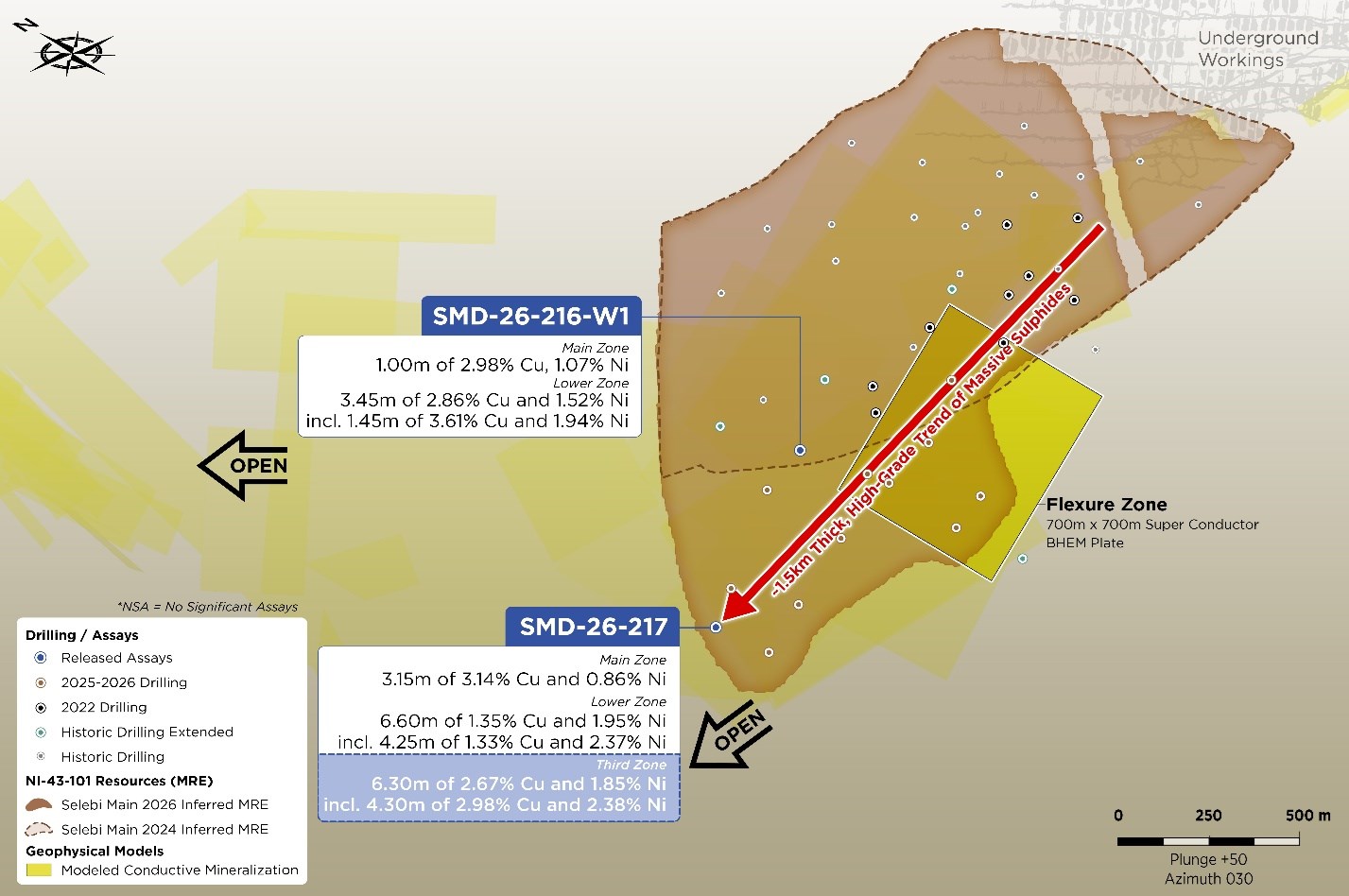
Figure 1: Inclined long section of Selebi Main highlighting the location of drill holes SMD-26-217 and SMD-26-216-W1. The 2026 Inferred Mineral Resource reference in Figure 1 is presented in accordance with NI 43-101, which may not be identical to Inferred Mineral Resource references under Subpart 1300 of Regulation SK.
To view an enhanced version of this graphic, please visit:
https://images.newsfilecorp.com/files/7759/324734_492577313441494f_002full.jpg
Table 1: 2026 Surface Drilling Results SMD-26-216-W1 and SMD-26-217
| Hole-ID | From (m) | To (m) | Length (m) | Est. True Thickness1 | Cu (%) | Ni (%) | Co (%) | Zone |
| SMD-26-216-W1 | 1624.10 | 1625.10 | 1.00 | 0.99 | 2.98 | 1.07 | 0.04 | Main Zone |
| SMD-26-216-W1 | 1683.35 | 1686.80 | 3.45 | 3.40 | 2.86 | 1.52 | 0.06 | Lower Zone |
| including | 1685.35 | 1686.80 | 1.45 | 1.43 | 3.61 | 1.94 | 0.08 | |
| SMD-26-217 | 1931.85 | 1935.00 | 3.15 | 3.11 | 3.14 | 0.86 | 0.04 | Main Zone |
| including | 1931.85 | 1933.80 | 1.95 | 1.93 | 3.36 | 1.28 | 0.06 | |
| SMD-26-217 | 1974.75 | 1981.35 | 6.60 | 6.52 | 1.35 | 1.95 | 0.06 | Lower Zone |
| including | 1974.75 | 1979.00 | 4.25 | 4.20 | 1.33 | 2.37 | 0.11 | |
| SMD-26-217 | 1994.60 | 2000.90 | 6.30 | 6.22 | 2.67 | 1.85 | 0.09 | Third Zone |
| including | 1996.60 | 2000.90 | 4.30 | 4.25 | 2.98 | 2.38 | 0.11 |
1Length refers to drillhole length and not true width. True widths are estimated where density of drilling is sufficient for an estimation.
To view core photos from drill hole SMD-26-217, click here: Selebi Core Samples - NexMetals Mining Corp.
Table 2: Surface Drilling Collar Information
| Hole-ID | UTM East | UTM North | Elevation | Dip | True North Azimuth | Hole Length (m) | Comment |
| SMD-26-216-W1 | 582793.8 | 7563698.8 | 902.0 | -73.0 | 105.4 | 1763.6 | Surveyed collar |
| SMD-26-217 | 582546.8 | 7564008.6 | 906.0 | -73.9 | 92.7 | 2050.9 | Surveyed collar |
Qualified Person
All scientific and technical information in this news release has been reviewed and approved by Sharon Taylor, V.P. Geophysics of the Company, MSc, P.Geo, and a "qualified person" for the purposes of National Instrument 43-101 and Subpart 1300 of Regulation S-K.
Quality Control and Data Verification
The program is being executed using three Company-owned underground Zinex U5 drills which were converted into surface A5 drills, and two Marcotte HTM2500 drills purchased by the Company capable of drilling to depths of 2,550 metres (NQ core).
Drill core samples are either NQ (47.75 mm diameter) or BQ (36.40 mm diameter). All samples are ½ core samples cut by a diamond saw on site and the remaining half of the core is retained for reference purposes. Samples are generally 1.0 to 1.5 metre intervals or less at the discretion of the site geologists. Sample preparation and lab analysis were completed at ALS Geochemistry in Johannesburg, South Africa. Commercially prepared blank samples and certified Cu/Ni sulphide analytical control standards with a range of grades are inserted in every batch of 20 samples or a minimum of one set per sample batch. Analyses for Ni, Cu and Co are completed using a peroxide fusion preparation and ICP-AES finish (ME-ICP81). Analyses for Pt, Pd, and Au are by fire assay (30 grams nominal sample weight) with an ICP-AES finish (PGM-ICP23).
Holes are numbered as follows: SMD (Selebi Main Deposit) + year + hole number starting at 201.
The Qualified Person has verified the data disclosed in this news release, including the sampling, analytical and test data underlying the information, through contribution to the core handling and sampling procedures, visits to the drill and core processing facilities, monitoring of core logging results and sample selection, review of core assay and QA/QC results.
For further information regarding the effective date of the 2026 Inferred Mineral Resource Estimate at Selebi Main and the key assumptions, parameters and methods used in its estimation, please refer to the technical report comprising the estimates for the Selebi Main and Selebi North deposits entitled "NI 43-101 Technical Report - October 2026 Mineral Resource Estimate, Selebi Mines Copper-Nickel-Cobalt Project, Botswana", prepared by The MSA Group (Pty) Ltd. with an effective date of October 16, 2026. The technical report has been filed under the Company's profile on SEDAR+ at www.sedarplus.ca, furnished under the Company's profile on EDGAR at www.sec.gov and is also available on the Company's website. The Company has also filed a related Regulation S-K 1300-compliant technical report summary as an exhibit to its Quarterly Report on Form 10-Q for the period ended September 30, 2026.
BHEM Surveys
The BHEM surveys at Selebi utilize the Crone PEM system operated by local Botswana staff. Survey data is collected using a 3-component fluxgate probe collecting full waveform data. Surveys have been collected using timebases between 50 and 1000ms (0.25 Hz to 5 Hz). The data has been processed to a calculated residual step response to better quantify the conductive sources. This added processing has proven to be highly valuable because of the size of the highly conductive mineralized system.
About NexMetals Mining Corp.
NexMetals Mining Corp. is a TSX.V and NASDAQ listed mineral exploration and development company focused on redeveloping the past-producing Selebi copper-nickel-cobalt mines in Botswana and the Selkirk copper-nickel-cobalt-platinum group element mines in Botswana. NexMetals has confirmed the scale of mineralization is larger than historical estimates, supported by NI 43-101 and Regulation S-K 1300-compliant resource estimates, with ongoing down-hole geophysics, drilling, and metallurgical programs aimed at expanding resources and supporting future economic studies. The Company is led by an experienced management and technical team with a proven track record in global mineral projects, emphasizing disciplined execution, transparent governance, and long-term stakeholder value creation.
For further information about NexMetals Mining Corp., please contact:
Sean Whiteford
CEO
info@nexmetalsmining.com
1-866-794-NEXM (6396)
Neither the TSX Venture Exchange and its Regulation Services Provider (as that term is defined in the policies of the TSX Venture Exchange) nor the Nasdaq Stock Market LLC accepts responsibility for the adequacy or accuracy of this news release. No stock exchange, securities commission or other regulatory authority has approved or disapproved the information contained herein.
Follow Us
X: https://x.com/NexMetalsCorp
LinkedIn: https://www.linkedin.com/company/NexMetalsMiningCorp
Facebook: https://www.facebook.com/NexMetalsMiningCorp
Cautionary Note Regarding Forward-Looking Statements
This news release contains "forward-looking statements" within the meaning of the United States federal securities laws and "forward-looking information" within the meaning of applicable Canadian securities legislation (collectively, "forward-looking information") based on expectations, estimates and projections as at the date of this news release. Forward-looking information involves risks, uncertainties and other factors that could cause actual events, results, performance, prospects and opportunities to differ materially from those expressed or implied by such forward-looking information. For the purposes of this release, forward looking information includes, but is not limited to, the implementation of the objectives, goals and future plans of the Company; the Company's interpretation of the Third Zone as a new mineralized zone, its identification as an additional target for follow-up drilling and the potential for its lateral and down-plunge expansion; the interpretation that higher copper grades in the Third Zone may indicate remobilization and increasing structural complexity toward Selebi North; the extension, length and continuity of the High-Grade Trend and the Company's plans to test its continued extent; the interpreted lateral and vertical continuity of the Lower Zone; the potential mineralization indicated by BHEM surveying and the planned use of BHEM, drilling and geological modelling to evaluate the extent of all three mineralized zones and identify further areas of thick massive sulphide mineralization; the expansion and growth potential of the Selebi Main deposit; the Company's technical and trade-off studies and the preparation and timing of the preliminary economic assessment; planned exploration drilling; future resource modelling and potential mine planning; and the Company's plans to redevelop the Selebi and Selkirk mines and undertake future economic studies. Forward-looking information is based on a number of material assumptions, including that the Company's geological interpretations are accurate; that drilling equipment, contractors and qualified personnel will be available as planned; that financing will be available on acceptable terms; that required approvals will be obtained in a timely manner; and that commodity prices and general economic conditions will remain consistent with current expectations. These forward-looking statements, by their nature, require the Company to make certain assumptions and necessarily involve known and unknown risks and uncertainties that could cause actual results to differ materially from those expressed or implied in these forward-looking statements. Factors that could cause actual results to differ materially from such forward-looking information include, but are not limited to, capital and operating costs varying significantly from estimates; the preliminary nature of drilling and metallurgical test results; the ability of exploration results to predict mineralization; the risk that geological interpretations, including of the Third Zone and the High-Grade Trend, may change with further drilling; uncertainties inherent in mineral resource estimates, including that Inferred Mineral Resources are not mineral reserves and have not demonstrated economic viability; assay and QA/QC risks; the ability of the Company to implement its drilling, geoscience and metallurgical work on its properties and work plans generally; the results of future preliminary economic assessments, prefeasibility or feasibility studies; delays in obtaining or failures to obtain required governmental, environmental or other project approvals; political, permitting and title risks in Botswana; the availability of equipment, contractors and key personnel; uncertainties relating to the availability and costs of financing needed in the future; changes in equity markets; inflation; fluctuations in commodity prices; delays in the development of projects; the other risks involved in the mineral exploration and development industry; and those risks set out in the Company's filings with the SEC on EDGAR (www.sec.gov) and public disclosure record on SEDAR+ (www.sedarplus.ca), in each case, under NEXM's issuer profile. Although the Company believes that the assumptions and factors used in preparing the forward-looking information in this news release are reasonable, undue reliance should not be placed on such information, which only applies as of the date of this news release, and no assurance can be given that such events will occur in the disclosed time frames or at all. The Company disclaims any intention or obligation to update or revise any forward-looking information, whether as a result of new information, future events or otherwise, other than as required by law.
To view the source version of this press release, please visit https://www.newsfilecorp.com/release/324734
FAQ
AI-generated questions and answers. How Rhea-AI works. Not financial advice.