
Mako Mining Intersects 26.98 g/t Au over 6.8 m Estimated True Width at Las Conchitas, Extending an Area Fully Permitted for Mining to Over 450 m of Strike
Mako (Nasdaq:MAKO) reports new drilling at Las Conchitas, San Albino, intersecting high-grade gold including 26.98 g/t Au over 6.8 m ETW and extending mineralization >450 m of strike within an area fully permitted for mining.
Sentiment and the balance of points
Rhea-AI Sentiment reads the wording of the document, how positive or negative its language is on a 1 to 5 scale. The balance of points shown with the takes weighs what the document actually discloses, so the two can disagree, for example when a trial that missed its main goal is described in upbeat language.
Rhea-AI Summary
Mako (Nasdaq:MAKO) reports new drilling at Las Conchitas, San Albino, intersecting high-grade gold including 26.98 g/t Au over 6.8 m ETW and extending mineralization >450 m of strike within an area fully permitted for mining. Drilling shows continuity along strike and at depth and supports potential pit expansion; development planned southwest of the Candelaria fault after the rainy season ends in Q4 2026.
Positive
- High-grade intercept: 26.98 g/t Au over 6.8 m ETW
- Mineralization extended to >450 m of continuous strike
- Area is fully permitted for mining enabling near-term development planning
- Geotechnical holes completed to support potential pit design
Negative
- Drill results are exploration-stage and not yet proven economical
- Planned development delayed until after rainy season in Q4 2026
Details
News Market Reaction – MAKO
On May 4, the day this news came out, MAKO closed 0.80% above the previous close.
Data tracked by StockTitan Argus for the May 4 session.
Key Figures
- Gold grade intercept
- 26.98 g/t Au over 7.0 m (6.8 m ETW)
- Las Conchitas South, Candelaria zone
- Gold grade intercept
- 21.79 g/t Au over 5.0 m (4.0 m ETW)
- Drill hole LC26-RC1091, 34 m from surface
- Gold grade intercept
- 17.89 g/t Au over 2.0 m (1.5 m ETW)
- Drill hole LC26-RC1094, 82 m from surface
- Gold grade intercept
- 29.18 g/t Au over 5.1 m (ETW)
- Geotechnical hole LC26-GEOTEC-07, 31.5 m from surface
- Strike extent
- 450 m
- Continuous high-grade mineralization along strike at Candelaria zone
- District land package
- 224 km2
- Regional drill program land position
- Current share price
- $7.49
- Pre-news price, <b>10.94%</b> below 52-week high of $8.41
- Q1 2026 revenue
- US$68.6M
- Record production quarter reported on Apr 15, 2026
Historical Context
-
Record Q1 gold production and strong revenue with solid cash position.
-
Robust Q4 revenue, EBITDA, net income and year-end liquidity metrics.
24h Move is the share-price change in the day after each event; other market factors may also have contributed.
Key Terms
reverse circulation technical
diamond drilling technical
fire assay technical
gravimetric technical
AI-generated analysis. How Rhea-AI works. Not financial advice.




VANCOUVER, BC / ACCESS Newswire / May 4, 2026 / Mako Mining Corp. (Nasdaq:MAKO)(TSXV:MKO) ("Mako" or the "Company") is pleased to report additional exploration results from the ongoing reverse circulation ("RC") and diamond drilling Program at Mako's newest mining area at its San Albino Project, Las Conchitas, located immediately south of the Company's San Albino gold mine in northern Nicaragua.
The objectives of this drilling program are two fold:
To test extensions of high-grade gold mineralization directly adjacent to current and future mining phases, but outside of the pit limits defined by the Company's 2023 mineral resource estimate (the "MRE") for the San Albino Project (see press release dated June 13th, 2024); and
To test additional high-grade mineralization, as a part of the Company's regional drill program on its 224 km2 district-scale, underexplored land package.
The drill results reported in this release are from the Candelaria zone located within the Las Conchitas South (LC-S) area. Drilling targeted the southwest extension of gold mineralization proximal to the existing Limon-Mango-Bayacun ("LMB") pit. This area is fully permitted for mining and drilling has demonstrated gold mineralization that extends beyond the current pit limits defined by the MRE. The Company's objective is to define additional mineral resources to support expansion of the San Albino operation and extend the mine life.
Key Observations
Drilling conducted within a permitted mine area
High-grade mineralization defined proximal to existing pits and mine infrastructure
Near-surface gold mineralization with width and grade of intercepts that compare favorably to existing mining areas at San Albino
Strong gold grade and structural continuity which support potential for pit expansion
Drilling confirms mineralization is open along strike and at depth
Drilling Highlights
26.98 grams per tonne ("g/t") gold ("Au") and 48.4 g/t silver ("Ag") over 7.0 m (6.8 m Estimated True Width ("ETW"))
21.79 g/t Au and 23.0 g/t Ag over 5.0 m (4.0 m ETW)
17.89 g/t Au and 31.6 g/t Ag over 2.0 m (1.5 m ETW)
29.18 g/t Au and 39.8 g/t Ag over 5.1 m (ETW)
Akiba Leisman, CEO of Mako states that "these drill results at the San Albino Project are among the most significant over the past six years of mining. We intersected multiple 100 gram-meter intercepts over 450 meters of continuous strike, including those being mined on the northeast side of the Candelaria fault. The current LMB pit remains open at depth, therefore if these results are proven economical, they have the potential to make the current LMB pit significantly larger. Located in a permitted area, we plan to begin development to the southwest of the Candelaria fault once rainy season ends in Q4 2026."
The drilling campaign at the Candelaria zone within the LC-S area has increased the footprint of gold mineralization from the LMB pit to the southwest. Current drilling has extended mineralization over 450 m along strike and remains open to the southwest and down dip to the northwest.
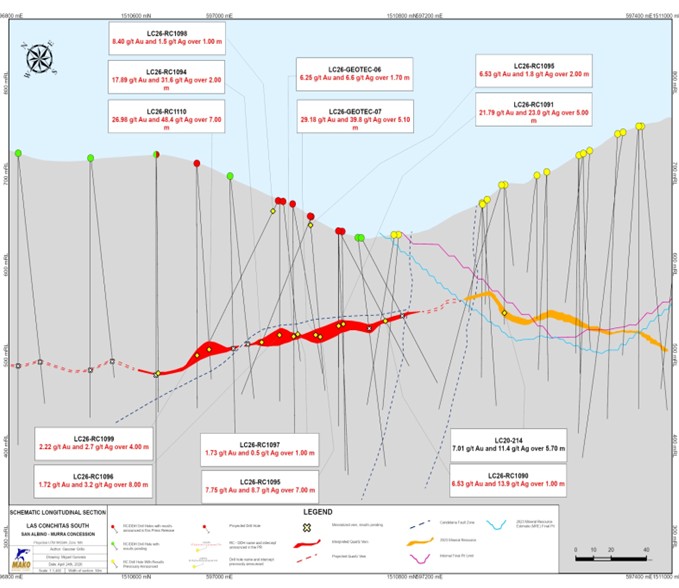
Drill hole LC26-RC1091 intersected a wide, high-grade vein of 21.79 g/t Au and 23.0 g/t Ag over 5.0 m (4.0 m ETW), 34 m from surface. This intercept is located 67.6 m from the 2023 MRE Final Pit (see Table & Figures below) and continues to support the expansion of high-grade gold mineralization outside the pit limits defined by the MRE. This drill hole was designed to extend the mineralization defined by hole LC20-214 which intersected 7.01 g/t Au and 11.4 g/t Ag over 5.7 m (3.1 m ETW) (see press release dated June 15, 2020).
In conjunction with the exploration program, the Company completed eight geotechnical drill holes within the same area to optimize possible future pit design and to ensure pit slope stability. LC26-GEOTEC-07 intersected 29.18 g/t Au and 39.8 g/t Ag over 5.1 m (ETW), 31.5 m from surface. This drill hole confirmed a 21.0 m strike extension from LC26-RC1091 described above.
LC26-RC1094 intersected 17.89 g/t Au and 31.6 g/t Ag over 2.0 m (1.5 m ETW), 82 m from surface and 61.2 m down-dip from drill hole LC26-GEOTEC-07 described above and 141.1 m from the final MRE pit limit. This drill hole confirms down dip continuity and extends well below the limits of the current resource model.
Drill hole LC26-RC1110 intersected 26.98 g/t Au and 48.4 g/t Ag over 7.0 m (6.8 m ETW), 90.3 m below surface and 188 m from the MRE final pit limit. This intersect confirms 450 m of high-grade mineralization along strike and remains open, showing potential for further expansions to the southwest.
Table - Assay Results Reported in This Press Release
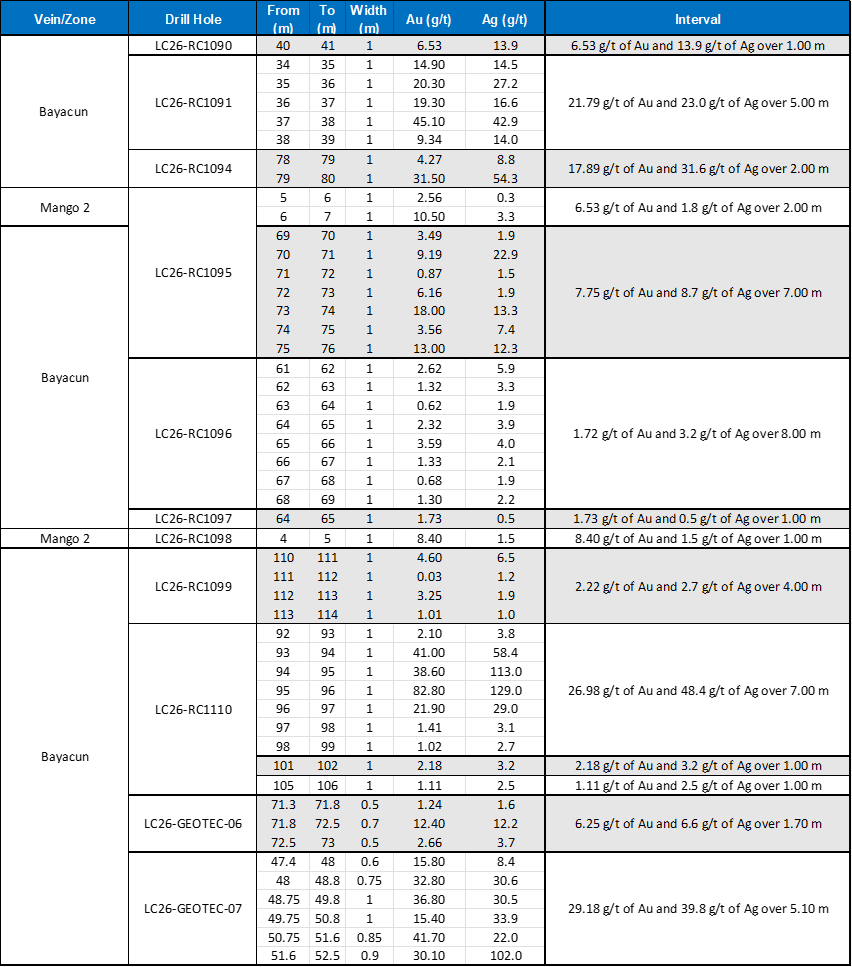
Notes:
RC drill holes are denoted by "RC" prior to the drill hole name. Diamond only holes do not have a prefix prior to the drill hole number. Combination holes of RC & Diamond are denoted by "C" prior to the drill hole number.
The mineralized intervals shown above utilize a 1.0 g/t gold cut-off grade with not more than 1.0 m of internal dilution. Widths are reported as drill hole lengths. Estimated True Width is estimated from interpreted sections. In addition to the drill holes presented in the table above, the following drill holes returned only anomalous values: LC26-RC1093, LC26-C048 and LC26-588. In addition to the drill holes presented in the table above, the following drill holes returned no significant values: LC26-RC1092. Drill hole LC26-C047 was abandoned.
Figure 1 - Drill Hole Plan for Las Conchitas South
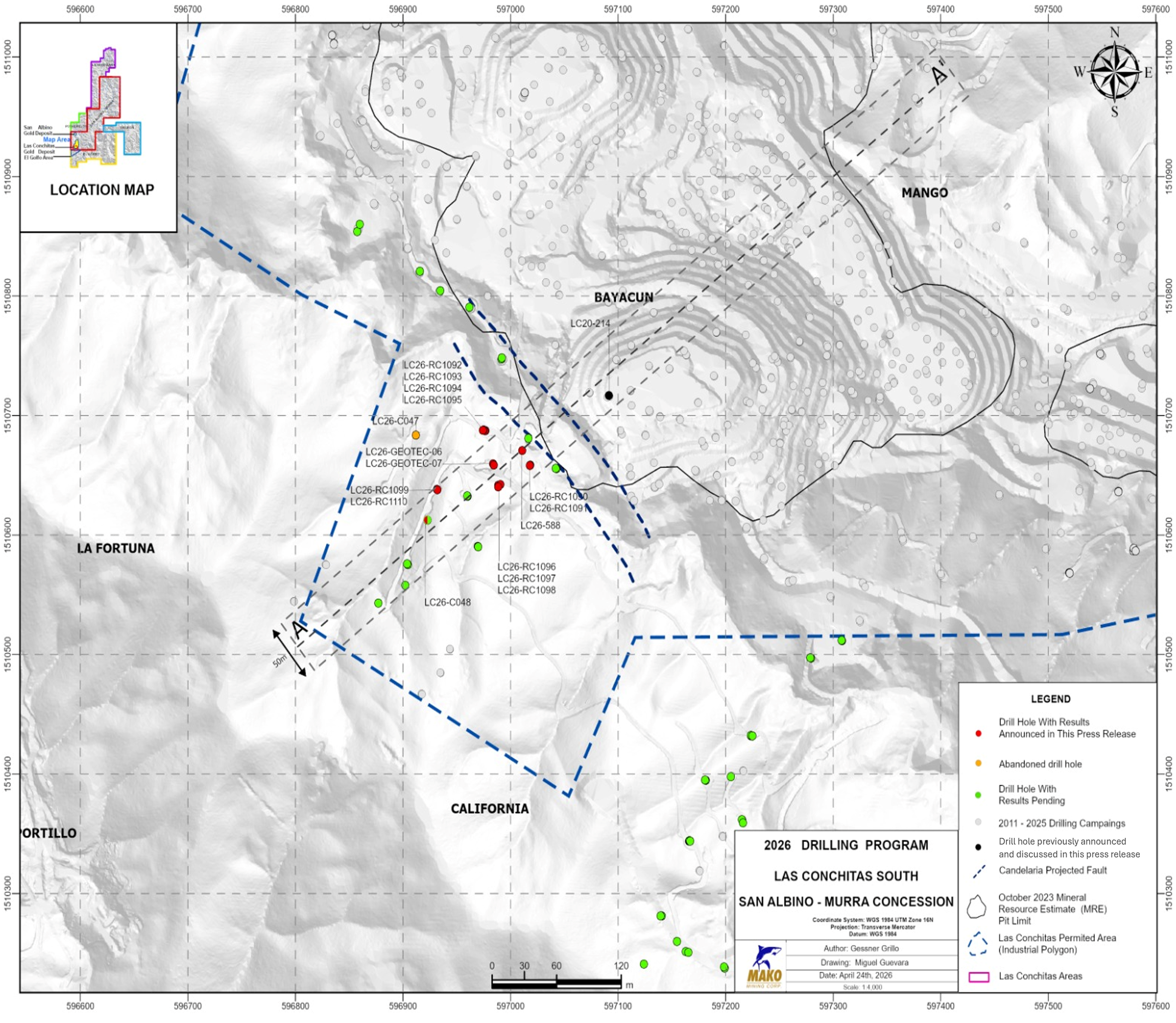
Figure 2 - Longitudinal Section for Las Conchitas South
Sampling, Assaying, QA/QC and Data Verification
Drill core was continuously sampled from inception to termination of the entire drill hole. Sample intervals were typically one meter. Drill core diameter was HQ (6.35 centimeters). Geologic and geotechnical data was captured into a digital database, core was photographed, then one-half split of the core was collected for analysis and one-half was retained in the core library. Drill core samples were kept in a secured logging and storage facility until such time that they were delivered to the Managua facilities of the independent Bureau Veritas laboratory and pulps were sent to the independent Bureau Veritas laboratory in Vancouver for analysis. All RCholes were drilled dry (i.e above the water table and no water or other fluids were injected into the hole). RC drill samples were collected every 1 meter using a center-return hammer and samples were obtained from a Gilson chip splitter which is cleaned using compressed air after each sample. Samples were bagged and labeled at the drill site under a geologist's supervision and are logged on site by a geologist who visually selects potential mineralized intervals for fire assay. The mineralized interval(s) including 3-5 samples above and below, the selected interval are continuously sampled and shipped to the Bureau Veritas Lab in Managua, respecting the best chain of custody practices. Pulps are sent by Bureau Veritas to their laboratory in Vancouver under their chain of custody for analysis. Gold was analyzed by standard fire assay fusion, 30 gr aliquot, AAS finish. Samples returning over 10.0 g/t gold are analyzed utilizing standard Fire Assay-Gravimetric method. The Company follows industry standards in its quality assurance and quality control procedures. Control samples consisting of duplicates, standards and blanks were inserted into the sample stream at a minimum ratio of 1 control sample per every 10 samples. Analytical results of control samples confirmed reliability of the assay data.
Qualified Person
Brian Ray, M.Sc., P.Geo, a geologist and qualified person (as defined under NI 43-101) has read and approved the technical information contained in this press release. Mr. Ray is an independent consultant to the Company.
On behalf of the Board,
Akiba Leisman
Chief Executive Officer
About Mako
Mako Mining Corp. is a publicly listed gold mining, development and exploration company. The Company operates the high-grade San Albino gold mine in Nueva Segovia, Nicaragua, which ranks as one of the highest-grade open pit gold mines globally and offers district-scale exploration potential. Mako also owns two assets in the US: the Moss Mine in Arizona, an open pit gold mine in northwestern Arizona and the Mt. Hamilton Project, a permitted heap leach project in Nevada. Mako also holds a
For further information: Mako Mining Corp., Akiba Leisman, Chief Executive Officer, E-mail: aleisman@makominingcorp.com, phone: (917) 558-5289 or visit our website at www.makominingcorp.com and SEDARPLUS www.sedarplus.ca.
Forward-Looking Information: Some of the statements contained herein may be considered "forward-looking information" within the meaning of applicable securities laws. Forward-looking information can be identified by words such as, without limitation, "estimate", "project", "believe", "anticipate", "intend", "expect", "plan", "predict", "may" or "should" or variations thereon or comparable terminology. The forward-looking information contained herein reflects the Company's current beliefs and expectations, based on management's reasonable assumptions, and includes, without limitation, that the Company's drilling campaign at Las Conchitas has demonstrated gold mineralization that extends beyond the current pit limits defined by the MRE and that the Company's objective is to define additional mineral resources to support expansion of the San Albino operation and extend the mine life. Such forward-looking information is subject to a variety of risks and uncertainties which could cause actual events or results to differ materially from those reflected in the forward-looking information, including, without limitation, changes in the Company's exploration and development plans; higher risk of economic or technical failure due to the fact that Mako did not base its production decision for San Albino on a feasibility study of mineral reserves demonstrating economic and technical viability for the project; the impact of economic and political conditions; ; unanticipated costs; the impact of economic and political conditions; fluctuating gold prices, currency exchange rates (including the United States Dollar, the Nicaraguan Córdoba and the Guyanese dollar exchange rates); risks related to conducting business operations in foreign jurisdictions, particularly emerging markets; environmental risks; title disputes or claims; limitations on insurance coverage;current government sanctions having impacts on business operations not current expected, or new sanctions being imposed by the U.S. Treasury Department or other government entity in Nicaragua in the future; as well as other risk factors discussed or referred in the Company's annual information form and annual report on Form 40-F, the most recent management's discussion and analysis and other disclosure filed with the securities regulatory authorities in Canada and available under the Company's profile on SEDAR+ at www.sedarplus.ca and on EDGAR at www.sec.gov. Although the Company has attempted to identify important factors that could cause actual actions, events or results to differ materially from those described in forward-looking statements, there may be other factors that cause actions, events or results not to be anticipated, estimated or intended. There can be no assurance that forward-looking statements will prove to be accurate, as actual results and future events could differ materially from those anticipated in such statements. The Company undertakes no obligation to update forward-looking statements if circumstances or management's estimates, assumptions or opinions should change, except as required by applicable law. The reader is cautioned not to place undue reliance on forward-looking statements. The forward-looking information contained herein is presented for the purpose of assisting investors in understanding the Company's exploration results, plans and objectives and may not be appropriate for other purposes.
Cautionary Note to U.S. Investors Regarding Technical Disclosure
NI 43-101 is a rule of the Canadian Securities Administrators which establishes standards for all public disclosure an issuer makes of scientific and technical information concerning mineral projects. Technical disclosure contained in this news release has been prepared in accordance with NI 43-101 and the Canadian Institute of Mining, Metallurgy and Petroleum Classification System. These standards differ from the requirements of the U.S. Securities and Exchange Commission ("SEC") and technical information contained in this news release may not be comparable to similar information disclosed by domestic United States companies subject to the SEC's reporting and disclosure requirements.
Neither the TSX Venture Exchange nor its Regulation Services Provider (as that term is defined in the policies of the TSX Venture Exchange) accepts responsibility for the adequacy or accuracy of this release.
SOURCE: Mako Mining Corp.
View the original press release on ACCESS Newswire
FAQ
AI-generated questions and answers. How Rhea-AI works. Not financial advice.