STOCK TITAN

MDA Space UK Selected by OHB to Provide Advanced Lunar Landing Sensors for European Space Agency's Argonaut Mission

(Moderate)
(Positive)
Tags

MDA Space (TSX: MDA, NYSE: MDA) announced that its UK business has received a Pre-Authorisation to Proceed (PATP) contract from OHB System AG to supply critical lunar landing sensors for the European Space Agency’s Argonaut spacecraft.

The PATP allows MDA Space to immediately start engineering work and procure long-lead items in the UK, with support from the UK Space Agency, ahead of an anticipated full contract with OHB. Under that definitive agreement, MDA Space is expected to deliver two flight units of its UK-developed LEIA LiDAR sensor for Argonaut’s inaugural lunar mission. LEIA will form a central part of the Hazard Detection and Avoidance system, providing real-time 3D terrain mapping over a 40-degree field of view to autonomously identify safe landing zones regardless of lighting conditions.

Loading...
Loading translation...

Positive

  • PATP contract from OHB enables immediate engineering and procurement activities
  • Two LEIA LiDAR flight units expected for Argonaut’s inaugural lunar mission
  • UK Space Agency support backing LEIA development and UK-based work
  • Selection for ESA Argonaut mission reinforces MDA Space’s lunar sensor track record

Negative

  • None.

Market reaction after Argonaut contract award: MDA +5.23% in the Jul 21 session

+5.23%
7 alerts
+5.23% Session close to close
+3.1% Peak in 8 hr 28 min
$4.90B Market Cap
0.6x Rel. Volume

In the Jul 21 session, MDA gained 5.23%, reflecting a notable positive market reaction. Argus tracked a peak move of +3.1% during that session. Our momentum scanner triggered 7 alerts that day, indicating moderate trading interest and price volatility.

Data tracked by StockTitan Argus on the day of publication.

Market Context

The stock moved +5.2% in the session following this news. MDA's July 14 offering closure was followe...
Analysis

The stock moved +5.2% in the session following this news. MDA's July 14 offering closure was followed by a 6.1% 24-hour gain. In a strong-positive scenario, the Argonaut sensor award added a program milestone, while the platform's low short-interest level provided limited evidence of short-driven positioning.

Key Figures

Flight Units: two flight units Field of View: 40-degree field of view Scan Time: five seconds +2 more
5 metrics
Flight Units two flight units Expected full contract for Argonaut's inaugural mission
Field of View 40-degree field of view LEIA LiDAR sensor scanning capability
Scan Time five seconds Time to cover the 40-degree field of view
Thales Ownership 67% Thales ownership of the Thales Alenia Space joint venture
Leonardo Ownership 33% Leonardo ownership of the Thales Alenia Space joint venture

Historical Context

5 past events · Latest: Jul 16 (Neutral)
Pattern 5 events
Date Event Sentiment 24h Move Catalyst
Jul 16 Earnings call notice Neutral -5.4% Second-quarter earnings release and conference call scheduled for August 7
Jul 14 Offering closing Negative +6.1% Upsized bought deal closed with 23 million shares issued
Jul 09 Offering increase Negative -8.5% Bought deal increased to 23 million common shares
Jul 08 Bought deal offering Negative -8.5% Company announced 20 million common shares at US$35.60
Jul 08 Acquisition announcement Positive -8.5% Firm offer announced for approximately 70% of Collecte Localisation Satellites

24h Move is the share-price change in the day after each event; other market factors may also have contributed.

Pattern Detected

Recent news reactions were mixed: offering-related items ranged from -8.48% to +6.1%, while acquisition and scheduling news had negative reactions.

Key Terms

pre-authorisation to proceed, lidar, hazard detection and avoidance, guidance, navigation and control
4 terms
pre-authorisation to proceed financial
"it has received a Pre-Authorisation to Proceed (PATP) contract from OHB"
A formal approval from a regulator, ethics committee, or payer that must be obtained before starting a specific activity—commonly a clinical trial step, medical procedure, or reimbursable service—allowing the sponsor or provider to proceed. It matters to investors because getting this green light unlocks planned work, spending, or payments and reduces the risk of delays, unexpected costs, or halted programs, similar to needing a permit before construction can begin.
lidar technical
"its LEIA Light Detection and Ranging (LiDAR) sensor for Argonaut"
Lidar, which stands for Light Detection and Ranging, is a technology that uses laser beams to create detailed, three-dimensional maps of the environment. It works like a sophisticated eye that measures distances by bouncing light off objects, helping machines see and understand their surroundings. For investors, lidar is important because it enables advancements in autonomous vehicles, robotics, and mapping, which can drive innovation and growth in related industries.
hazard detection and avoidance technical
"LEIA will be a central component of the spacecraft's Hazard Detection and Avoidance"
Hazard detection and avoidance is a system or set of technologies that finds dangers in an environment—like obstacles, collisions, or unsafe conditions—and takes action to reduce or eliminate risk, using sensors, software, and control mechanisms. For investors, it matters because the effectiveness and reliability of these systems affect product safety, regulatory approval, liability exposure, and market acceptance in sectors such as transportation, robotics, and industrial equipment; think of it as a vehicle’s brakes and eyes combined.
guidance, navigation and control technical
"OHB is responsible for delivering three critical subsystems: Guidance, Navigation and Control"
Guidance, navigation and control (GNC) are the three linked systems that let a vehicle or device know where it is, decide where to go, and make the steering or thrust adjustments to follow that plan. Think of it as a driver’s map and GPS plus the steering wheel: navigation finds position, guidance plots the path, and control executes corrections. For investors, GNC capability signals technical complexity, product performance and suitability for safety‑critical or regulatory environments, which can affect contracts and market value.

AI-generated analysis. How Rhea-AI works. Not financial advice.

See more from StockTitan in Google Search and AI answers. Adds StockTitan as a preferred source · opens Google
Add on Google

Technology developed in the UK will enable safe, autonomous lunar landings for Europe's flagship moon mission

LONDON, July 21, 2026 /PRNewswire/ -- MDA Space Ltd. (TSX: MDA) (NYSE: MDA), a trusted mission partner to the rapidly expanding global space industry, today announced it has received a Pre-Authorisation to Proceed (PATP) contract from OHB System AG (OHB), a leading European space systems provider, to deliver critical lunar landing sensors for the European Space Agency's (ESA) Argonaut spacecraft.

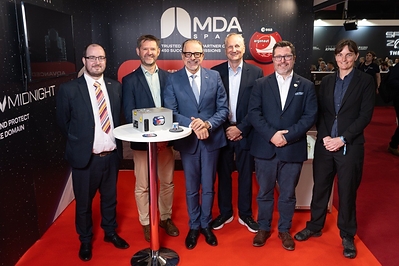
Pictured left to right at the Farnborough International Airshow are Matthew Archer, UK Space Agency Deputy Director Launch & SDA; Andrew Stanniland, MDA Space UK Managing Director; Dr. Josef Aschbacher, European Space Agency Director General; Dr. Timo Stuffler, OHB System AG Director Business Development; Richard Thorburn, CEO of Thales Alenia Space in the UK; and Kim Lake, OHB Space UK Head of Science and Exploration (Photo Credit: Andrew Lunn)

The contract was formalised during the Farnborough International Airshow, where representatives of OHB and MDA Space celebrated the start of the collaboration. The PATP contract allows MDA Space to immediately begin engineering activities and procure long-lead items from its UK base of operations with support from the UK Space Agency, ahead of the anticipated full contract. Under the full contract with OHB, subject to execution of a definitive agreement, MDA Space is expected to supply two flight units of its LEIA Light Detection and Ranging (LiDAR) sensor for Argonaut's inaugural mission to the Moon. 

The Argonaut programme, led by ESA, represents Europe's first independent lunar landing capability. This flagship mission will transport cargo and scientific instruments to the Moon in support of a sustained lunar presence, in coordination with NASA's Artemis programme. The Lunar Descent Element is being developed under the prime contractorship of Thales Alenia Space, a joint venture between Thales (67%) and Leonardo (33%), together with a core industrial team that includes OHB System AG. OHB is responsible for delivering three critical subsystems for the success of the mission: Guidance, Navigation and Control (GNC); Telemetry, Tracking and Command (TT&C) and Electrical Power Subsystem (EPS).

"This partnership with OHB underscores our expertise in autonomous landing technologies and demonstrates the strength and innovation of the UK space sector," said Andrew Stanniland, Managing Director, MDA Space UK. "By providing LEIA, our advanced 3D sensor technology, MDA Space will contribute directly to enabling Europe's independent access and sustained presence on the Moon for the first time."

Developed in the UK with support from the UK Space Agency, LEIA will be a central component of the spacecraft's Hazard Detection and Avoidance (HDA) system. The MDA Space sensor will enable Argonaut to identify and navigate surface hazards such as craters, boulders, and rough terrain during descent to the lunar surface. LEIA's 3D scanning LiDAR generates real-time terrain maps, allowing the spacecraft to autonomously select a safe landing site. Unlike camera-based systems, LEIA provides fast and precise mapping regardless of lighting conditions, enhancing landing safety and mission assurance. The sensor's adaptive scan pattern is able to compensate for lander motion, covering a 40-degree field of view in five seconds, with a compact, low-mass design that is designed to offer differentiation relative to comparable space LiDAR systems.

"The selection of MDA Space for the Argonaut mission is a testament to Britain's growing leadership in lunar technology and exploration. This milestone shows the UK has the expertise to underpin Europe's lunar ambitions – from precision landing sensors developed in Didcot to descent engines tested in Buckinghamshire," said Liz Lloyd, UK Space Minister. "We're proud to back MDA Space to unlock new opportunities for the future for science and ultimately our economy."

MDA Space brings established expertise in lunar exploration and landing technologies, with reliable and standardised sensors supporting missions ranging from lunar landings and orbital debris removal to rendezvous, docking, and Earth observation. Its lunar landing sensors, including LEIA and FLARE, the Full Wave Laser Range Finder, have been chosen for multiple commercial lunar missions.

FORWARD-LOOKING STATEMENTS

This press release may contain forward–looking information within the meaning of applicable securities legislation, which reflects MDA Space's current expectations regarding future events. Such forward-looking information includes, but is not limited to, the expected scope, timing and progression under the Authorisation to Proceed contract, the anticipated execution and value of the full contract with OHB, including the supply of flight units, the development, performance and integration of MDA Space's lunar landing sensor technologies, the planned Argonaut mission and its currently anticipated timeline, and the expected role and contributions of MDA Space in supporting the mission. Forward-looking statements are based on certain assumptions and analyses made by MDA Space in light of management's experience and perception of historical trends, current conditions and expected future developments and other factors it believes are appropriate, and are subject to risks and uncertainties and other factors which may cause the actual results, performance or achievements of MDA Space to differ materially from those anticipated in such forward-looking statements for a variety of reasons, including without limitation the risks and uncertainties detailed under the "Risk Factors" section of MDA Space's annual information form dated March 4, 2026.

Although MDA Space believes that the assumptions underlying these statements are reasonable, they may prove to be incorrect and there can be no assurance that actual results will be consistent with the forward-looking statements. There are a number of additional risks and uncertainties affecting or that could affect MDA Space, which could cause actual results and developments to differ materially from those described in, expressed or implied by these forward-looking statements. Accordingly, readers should not place undue reliance on any forward-looking statements or information included within this press release. These forward-looking statements speak only as of the date of this news release. Except as required by law, MDA Space is not under any obligation, and expressly disclaims any intention or obligation, to update or revise any forward-looking statements, whether as a result of new information, future

ABOUT MDA SPACE

Building the space between proven and possible, MDA Space (TSX:MDA) (NYSE:MDA) is a trusted mission partner to the global defence and space industry. A robotics, satellite systems and geointelligence pioneer with a 55-year+ story of world firsts and more than 450 missions, MDA Space is a global leader in communications satellites, Earth and space observation, and space exploration and infrastructure. The global MDA Space team of more than 4,000 space experts has the knowledge and know-how to turn an audacious customer vision into an achievable mission – bringing to bear a one-of-a-kind mix of experience, engineering excellence and wide-eyed wonder that's been in our DNA since day one. For those who dream big and push boundaries on the ground and in the stars to change the world for the better, we'll take you there. For more information, visit mda.space.

SOCIAL MEDIA

LinkedIn: LinkedIn.com/company/MDAspace 
X: X.com/MDA_space 
Facebook: Facebook.com/MDAspace
YouTube: YouTube.com/c/MDAspace
Instagram: instagram.com/MDA_space

MDA Space Logo

Cision View original content to download multimedia:https://www.prnewswire.com/news-releases/mda-space-uk-selected-by-ohb-to-provide-advanced-lunar-landing-sensors-for-european-space-agencys-argonaut-mission-302831003.html

SOURCE MDA Space

FAQ

What did MDA (TSX: MDA) announce on July 21, 2026 about the ESA Argonaut mission?

MDA Space announced a Pre-Authorisation to Proceed contract from OHB System AG to supply LEIA lunar landing sensors. According to MDA Space, this supports ESA’s Argonaut spacecraft, enabling immediate UK-based engineering work and procurement ahead of an anticipated full contract for two LEIA LiDAR units.

What role will MDA Space’s LEIA sensor play on ESA’s Argonaut lunar mission (MDA)?

LEIA will serve as a central component of Argonaut’s Hazard Detection and Avoidance system, providing 3D terrain mapping. According to MDA Space, its LiDAR scans a 40-degree field of view in five seconds, helping the spacecraft autonomously select safe landing sites regardless of lighting conditions.

How does the OHB PATP contract benefit MDA Space UK and its shareholders (MDA)?

The PATP lets MDA Space UK begin engineering and long-lead procurement immediately, accelerating project execution. According to MDA Space, this early start, backed by the UK Space Agency, positions its LEIA LiDAR for Argonaut’s inaugural mission and strengthens its UK lunar technology footprint.

How many LEIA LiDAR sensors is MDA Space expected to supply for ESA’s Argonaut mission?

MDA Space is expected to supply two LEIA LiDAR flight units under the full contract with OHB. According to MDA Space, these advanced 3D sensors will support Argonaut’s first lunar mission by enabling hazard detection and autonomous landing site selection on the Moon’s surface.

How is the UK Space Agency involved in MDA Space’s Argonaut sensor contract (MDA)?

The UK Space Agency supports both the development of LEIA and MDA Space’s UK-based activities for Argonaut. According to MDA Space, this backing helps fund UK technology that will enable safe, autonomous lunar landings and underpins Europe’s independent lunar exploration ambitions.

What makes MDA Space’s LEIA LiDAR different from camera-based lunar landing systems (MDA)?

LEIA uses LiDAR to generate real-time 3D terrain maps, unlike camera systems that depend on lighting. According to MDA Space, LEIA offers fast, precise mapping with an adaptive scan pattern, compact low-mass design, and consistent performance to enhance landing safety and mission assurance.