
North Arrow Traces Broad Gold Mineralization at Tlou; KR26-108 Returns 0.63 g/t Au over 48 Metres and Deepest Hole Ends in Mineralization, Kraaipan Gold Project, Botswana
Sentiment and the balance of points
Rhea-AI Sentiment reads the wording of the document, how positive or negative its language is on a 1 to 5 scale. The balance of points shown with the takes weighs what the document actually discloses, so the two can disagree, for example when a trial that missed its main goal is described in upbeat language.
Rhea-AI Summary
North Arrow Minerals (NHAWF) reported final Rotation 4 drill results from the Tlou and Nkwe targets at its Kraaipan Gold Project in Botswana. At Tlou, infill hole KR26-108 returned 0.63 grams of gold per tonne over 48 metres from 20 metres down the hole, including 0.91 grams per tonne over 23 metres. All 14 Rotation 4 holes at Tlou intersected gold mineralization, and North Arrow has traced it along approximately 750 metres. The deepest Tlou hole ended in mineralization, returning 0.57 grams per tonne over 15 metres. The zone remains open along its length and at depth.
At Nkwe, two holes hit narrow zones of gold mineralization, extending near-surface mineralization to more than 550 metres along the trend. North Arrow is planning core drilling at Tlou in 2027 to test the zone’s shape, continuity and depth.
How this balance works
Rhea-AI gives every point it takes from this document a weight. Minor counts 1, Moderate 3 and Major 9, so one Major point outweighs several Minor ones. The bar adds up the weights on each side, and when neither side holds more than 65% of the total the balance reads Mixed.
It reads the document as published, with the same rules for every company, and it does not look at what the market expected or at how the stock traded, so a point can be objectively good on a day the stock falls.
Rhea-AI Sentiment measures something else, the tone of the wording.
Hollow bars mark forward-looking points. How the balance works
Positive
- Moderate pointTlou infill hole KR26-108 returned 0.63 g/t gold over 48 metres, including 0.91 g/t over 23 metres.
- Moderate pointTlou mineralization was intersected in all 14 Rotation 4 holes, with company drilling tracing approximately 750 metres along the trend.
- Moderate pointNkwe near-surface mineralization now extends more than 550 metres along the trend.
- Minor pointDeepest Tlou hole KR26-105 returned 0.57 g/t gold over 15 metres, including 1.68 g/t over the final 2 metres.
- Minor pointTlou hole KR26-107 returned 0.64 g/t gold over 26 metres, including 0.96 g/t over 14 metres.
5 minor points
- Minor pointTlou hole KR26-106 returned 0.48 g/t gold over 27 metres, including 0.96 g/t over 7 metres.
- Minor pointNorthern step-out KR26-102 extended Tlou mineralization northward, returning 0.31 g/t gold over 10 metres, including 0.51 g/t over 2 metres.
- Minor point. Forward-looking: it has not happened yet and may not happen.Gold in additional host rocks gives North Arrow more rock types to consider in future drilling targets.
- Minor point. Forward-looking: it has not happened yet and may not happen.2027 core drilling is being planned to test the shape, continuity and depth of mineralization at Tlou.
- Minor point. Forward-looking: it has not happened yet and may not happen.Property-wide exploration will continue with surface prospecting, soil sampling and ground geophysics.
Negative
- Moderate point2026 exploration budget was previously raised to US$2.86 million from US$2.3 million for more drilling and sampling. 41% of market cap
- Minor pointNkwe drill hits were narrow: KR26-104 returned 0.96 g/t gold over 2 metres and KR26-103 returned 0.44 g/t over 1 metre.
- Minor pointSand cover at northern Tlou means drilling may not yet have tested the full rock sequence there.
AI-generated analysis. How Rhea-AI works. Not financial advice.


Final assays from 2026 RC Program Continue to Expand Deposit's Dimensions
Vancouver, British Columbia--(Newsfile Corp. - November 19, 2026) - North Arrow Minerals Inc. (TSXV: NAR) (OTCQB: NHAWF) (FSE: 9TB) ("North Arrow" or the "Company") today reports results from the final seven of sixteen reverse circulation ("RC") holes completed during Rotation 4 at the Kraaipan Gold Project ("Kraaipan") in southern Botswana. Five holes were drilled at Tlou (Target AE): one infill hole and one step-out to the north, one deeper hole testing the down-dip extent of mineralization, and two scissor holes to help define its geometry. All five intersected gold mineralization with four intersecting broad zones of mineralization comparable to earlier 2026 results at Tlou. Two holes at Nkwe (Target AF) tested the southern extension of Grid 1 and intersected narrow zones of mineralization.
With these results, all 14 Rotation 4 holes at Tlou have intersected gold mineralization. North Arrow drilling has now traced the mineralized trend over approximately 750 metres of strike, from KR26-099 in the south to KR26-102 in the north, and historical drilling by previous operators intersected the same favourable contact a further 200 m to the south. Mineralization at Tlou remains open along strike and at depth.
Key Highlights
- Consistent, broad mineralization along close to one kilometre of strike - Rotation 4 drilling has returned wide zones of gold mineralization from surface along the Tlou trend, including 1.17 g/t Au over 42 m in KR26-095 (reported November 4, 2026) and 0.63 g/t Au over 48 m in KR26-108 (reported today).
- KR26-108 infill hole returns 0.63 g/t Au over 48 m from 20 m depth, including 0.91 g/t Au over 23 m. KR26-108 was drilled between KR26-043 (0.57 g/t Au over 35 m) and KR26-100 (0.36 g/t Au over 45 m).
- Deepest hole at Tlou ends in mineralization - KR26-105 returned 0.57 g/t Au over 15 m from 121 m down hole, including 1.68 g/t Au over the final 2 m, extending mineralization to more than 100 m vertical depth. Quartz veining with fresh pyrite was logged at the end of the hole.
- Scissor holes support a steep to sub-vertical geometry - KR26-107 returned 0.64 g/t Au over 26 m, including 0.96 g/t Au over 14 m, and KR26-106 returned 0.48 g/t Au over 27 m, including 0.96 g/t Au over 7 m.
- Gold is not restricted to banded iron formation - much of the higher-grade interval in KR26-108 lies within a unit logged as altered possible mafic rock interbedded with approximately equal proportions of ferruginous chert. Together with earlier results in altered mafic rocks and hematite-altered iron-rich rocks, this enhances the understanding of gold mineralization associations with the KGB and will assist in effective targeting.
CEO Commentary
Eira Thomas, Chief Executive Officer of North Arrow, stated:
"Tlou continues to develop into a coherent discovery. Every hole we have drilled on this trend in Rotation 4 has intersected zones of gold mineralization, and our drilling now traces those zones over approximately 750 metres, within a trend of close to one kilometre that remains open along strike and at depth. Our deepest hole ended in mineralization, and we are seeing gold in what are possibly mafic rocks as well as in banded iron formation, which deepens our understanding of gold mineralization associations within the Kraaipan Greenstone Belt. Broad zones of gold associated with BIF, quartz veining and pyrite are characteristic of Harmony's Kalgold mine, 40 kilometres to the south, and that is the model we are now testing. We finish 2026 with three discoveries - Tlou, Nkwe and Tau - and a clear set of targets for core drilling in 2027."
Drilling Summary
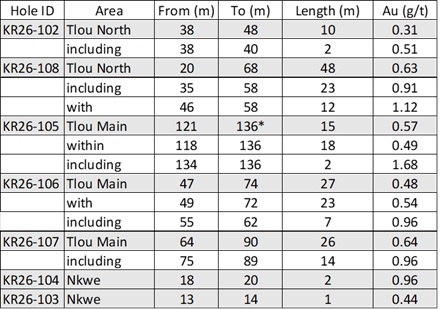
Sixteen RC drill holes, totalling 1,075 m were completed during Rotation 4: 14 at Tlou (968 m) and two at Nkwe (107 m). Results for the first nine holes, all at Tlou, were reported on November 4, 2026. Table 1 summarizes all 16 holes, Figure 1 shows the locations of the three discoveries, Figure 2 shows hole locations at Tlou and Table 2 summarizes assay results for the seven holes reported today.
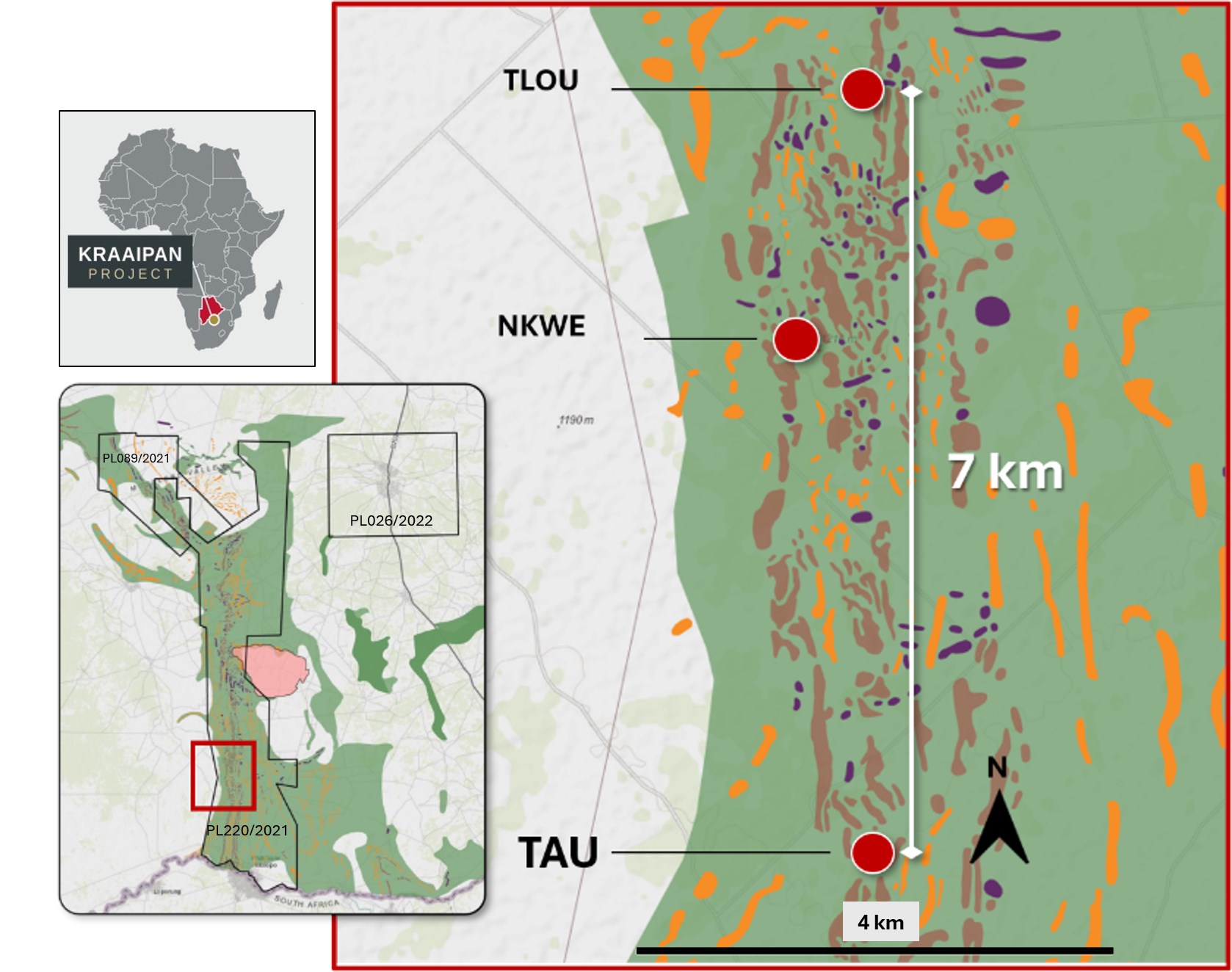
Figure 1: Location of the Tlou, Nkwe and Tau discoveries, Kraaipan Gold Project
To view an enhanced version of this graphic, please visit:
https://images.newsfilecorp.com/files/3881/324843_865b4cc50455cb43_001full.jpg
Table 1: Rotation 4 RC drill hole summary
| Hole ID | Area | Easting | Northing | Elev. (m) | Az. | Dip | Ovb. (m) | Length (m) | Geology summary | Results |
| KR26-102 | Tlou North | 307497 | 7166823 | 1219 | 286 | -60 | 1 | 52 | BIF, ferruginous chert, felsic gneiss | Table 2 |
| KR26-108 | Tlou North | 307489 | 7166689 | 1222 | 287 | -60 | 0.5 | 85 | BIF, ferruginous chert, mafic, felsic | Table 2 |
| KR26-105 | Tlou Main | 307522 | 7166610 | 1224 | 278 | -60 | 0 | 136 | BIF, mafic rock, mafic schist, greenstone | Table 2 |
| KR26-106 | Tlou Main | 307428 | 7166618 | 1220 | 102 | -60 | 7 | 100 | Foliated mafic, mafic schist, ferruginous chert, | Table 2 |
| KR26-107 | Tlou Main | 307422 | 7166581 | 1220 | 109 | -60 | 7 | 100 | Mafic schist, ferruginous chert, BIF | Table 2 |
| KR26-103 | Nkwe | 307014 | 7163993 | 1219 | 239 | -60 | 10 | 58 | Foliated mafic, ferruginous chert | Table 2 |
| KR26-104 | Nkwe | 307033 | 7163967 | 1219 | 235 | -60 | 10.5 | 49 | Foliated mafic | Table 2 |
| KR26-093 | Tlou South | 307499 | 7166393 | 1225 | 272 | -60 | 0 | 49 | BIF, ferruginous chert, sheared mafic | Nov 4, 2026 |
| KR26-094 | Tlou South | 307500 | 7166363 | 1226 | 277 | -60 | 0 | 52 | BIF, ferruginous chert, sheared mafic | Nov 4, 2026 |
| KR26-095 | Tlou South | 307481 | 7166310 | 1227 | 329 | -60 | 0 | 70 | BIF, ferruginous chert, sheared mafic | Nov 4, 2026 |
| KR26-096 | Tlou South | 307466 | 7166261 | 1227 | 277 | -60 | 0 | 55 | BIF, ferruginous chert, mafic schist | Nov 4, 2026 |
| KR26-097 | Tlou South | 307456 | 7166194 | 1227 | 278 | -60 | 0 | 52 | BIF, ferruginous chert, foliated mafic | Nov 4, 2026 |
| KR26-098 | Tlou South | 307476 | 7166128 | 1228 | 278 | -60 | 0 | 58 | BIF, ferruginous chert, foliated mafic | Nov 4, 2026 |
| KR26-099 | Tlou South | 307464 | 7166069 | 1226 | 286 | -60 | 0 | 46 | BIF, mafic rock, ferruginous chert | Nov 4, 2026 |
| KR26-100 | Tlou North | 307499 | 7166705 | 1221 | 277 | -60 | 0 | 76 | BIF, iron-rich rock, ferruginous chert, foliated | Nov 4, 2026 |
| KR26-101 | Tlou North | 307489 | 7166765 | 1220 | 277 | -60 | 5 | 37 | BIF, BIF breccia, foliated mafic rock | Nov 4, 2026 |
Coordinates UTM Zone 35S. Dip reported as planned (-60°).
Tlou RC Drilling Results
Five holes reported today complete the 14-hole Tlou program. The program was designed to test the northern and southern strike extent of the mineralization first drilled in May 2026 (see news release dated July 15, 2026), to test its down-dip extent and to help resolve its geometry (Figures 2 and 3).
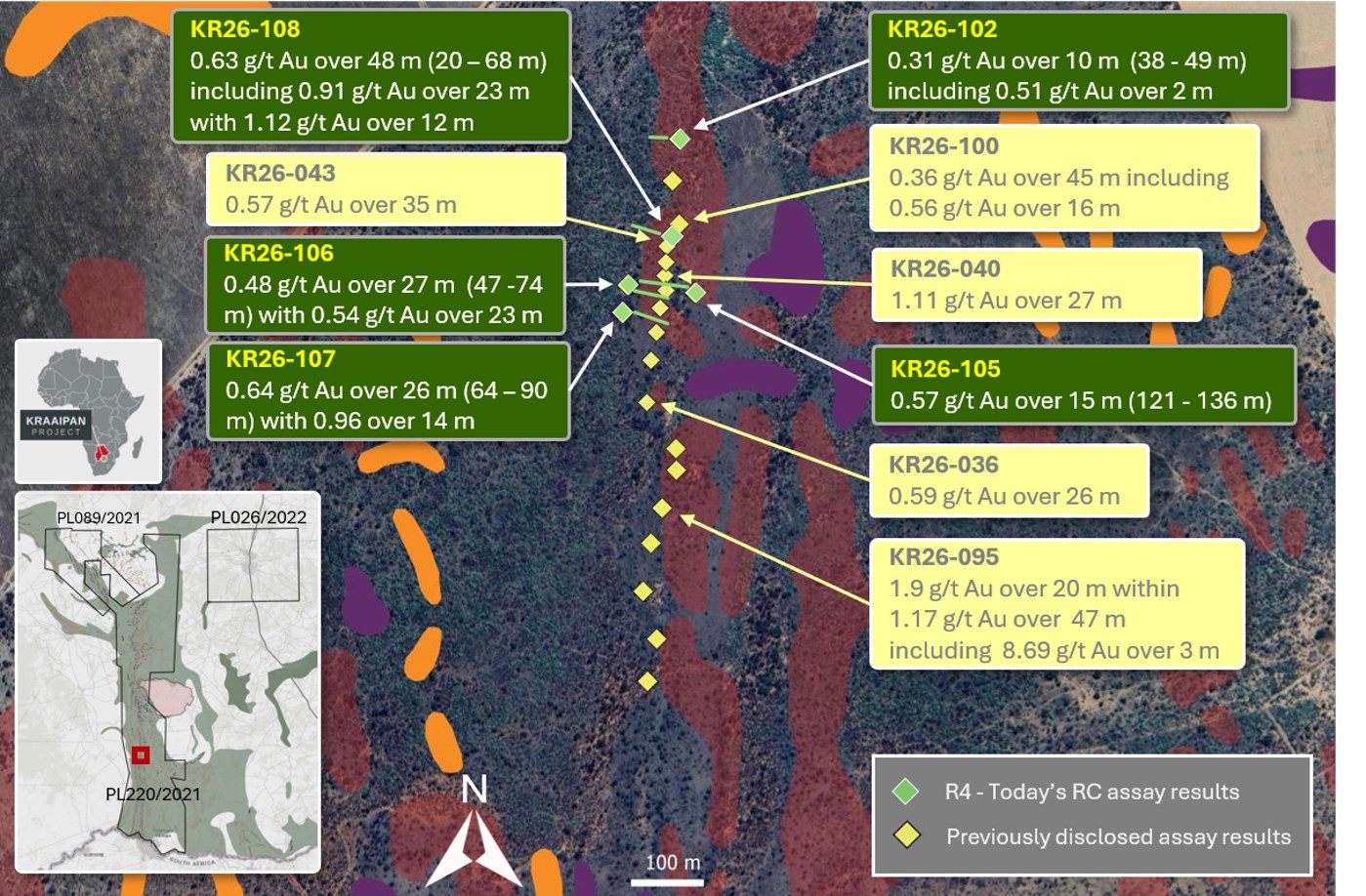
Figure 2: Tlou Rotation 4 RC drill holes, select results
To view an enhanced version of this graphic, please visit:
https://images.newsfilecorp.com/files/3881/324843_865b4cc50455cb43_002full.jpg
Tlou North
KR26-108 was drilled as an infill hole between KR26-043 (0.57 g/t Au over 35 m, including 1.72 g/t Au over 7 m) and KR26-100 (0.36 g/t Au over 45 m). It returned 0.63 g/t Au over 48 m from 20 m down hole, including 0.91 g/t Au over 23 m, consistent with the wide intervals in neighbouring holes. Much of the 23-metre interval lies within a unit logged altered possible mafic rock interbedded with approximately equal proportions of ferruginous chert.
KR26-102 was collared 60 m north of KR26-101 and returned 0.31 g/t Au over 10 m, including 0.51 g/t Au over 2 m. The hole confirms that the mineralized system continues northward. The footwall rock package becomes more varied to the north, and the sand cover in this area means the full package may not yet have been tested.
Tlou Main: down-dip and scissor holes
KR26-105 was drilled from the east to test mineralization below KR26-039 and KR26-040 (1.11 g/t Au over 27 m). It returned 0.57 g/t Au over 15 m from 121 m down hole, including 1.68 g/t Au over the final 2 m, and ended in mineralization at 136 m. The interval lies approximately 105-118 m below surface, the deepest mineralization intersected at Tlou to date. The lower part of the hole intersected chert-rich BIF with dense quartz veining, chlorite alteration and disseminated pyrite. Mineralization remains open at depth.
KR26-106 and KR26-107 were drilled from the west as scissor holes. Both passed through variably altered and sheared mafic rocks before intersecting altered ferruginous chert and BIF. KR26-107 returned 0.64 g/t Au over 26 m, including 0.96 g/t Au over 14 m, and KR26-106 returned 0.48 g/t Au over 27 m, including 0.96 g/t Au over 7 m. Together with KR26-105, these holes indicate that the mineralized zone is steep to sub-vertical, or dips steeply west, at this location (Figure 3). Logging suggests locally thickening of the alteration and veining, and further work is needed to define these controls.
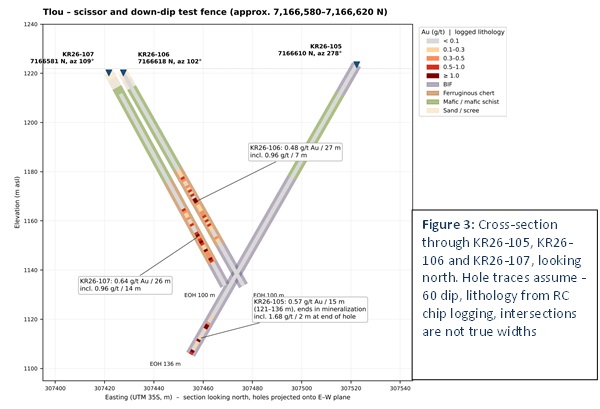
Figure 3: Cross-section through KR26-105, KR26-106 and KR26-107, looking north. Hole traces assume -60 dip, lithology from RC chip logging, intersections are not true widths
To view an enhanced version of this graphic, please visit:
https://images.newsfilecorp.com/files/3881/324843_na1.jpg
Gold in Multiple Host Rocks
BIF and ferruginous chert remain the primary exploration target at Kraaipan, as they are at Kalgold. Drilling at Tlou now shows that gold also occurs in other rock types:
- Mafic rocks: much of the 0.91 g/t Au over 23 m interval in KR26-108 lies within a unit comprising a mixture of altered possible mafic rock and ferruginous chert. KR26-095 returned 0.84 g/t Au over 4 m from an altered, quartz-veined mafic unit (November 4, 2026).
- Iron-rich, hematite-altered rocks: KR26-100 returned 0.56 g/t Au over 16 m from a massive, hematite-altered, variably magnetic unit with no discernible quartz veining.
- Quartz veins: outcropping northwest-trending quartz veins with shallow to moderate northeast dips cut the north-trending stratigraphy. Gold is associated with these veins and their altered selvages in drill holes, and in surface samples at Tlou, Nkwe and Tau (Aug 24 2026, July 15 2026, April 16 2026, Feb 27,2026).
Fresh pyrite in KR26-105 confirms the association of sulphides with altered vein selvages and with silicified, iron-flooded ferruginous chert and BIF. The presence of quartz veining, sulphides and potentially replacement-style alteration in other altered rocks (possibly mafics) expands the potential host units for mineralization beyond BIF and ferruginous chert. These observations assist in better understanding the gold associations and will inform future targeting. The relationship between mineralization in non-BIF units and the regional structure will be a focus of mapping and geochemical interpretation.
Nkwe RC Drilling
Two holes were drilled south of Grid 1 at Nkwe to test the strike extent of mineralization intersected in KR26-021 (4.04 g/t Au over 9 m; see news release dated July 15, 2026). KR26-104 returned 0.96 g/t Au over 2 m and KR26-103 returned 0.44 g/t Au over 1 m, both in narrow zones of altered, quartz-veined ferruginous chert and foliated mafic rock, extending near-surface mineralization at Nkwe to more than [550] metres of strike.
Table 2: Summary of assay results
To view an enhanced version of this graphic, please visit:
https://images.newsfilecorp.com/files/3881/324843_na2.jpg
Lengths are down-hole lengths; true widths are not yet known. *End of hole.
2026 Exploration Budget
As previously reported, the 2026 exploration budget was increased from US
Next Steps
- Interpretation of Tlou results and planning of a 2027 core drilling program to test the geometry, continuity and depth extent of mineralization.
- Integration of RC results into regional targeting, incorporating the improved understanding of the gold associations generated from 2026 results.
- Hyperspectral scanning of representative 2025 and 2026 RC chips was completed in early Q4 2026; results are being compiled.
- Surface prospecting, soil sampling and ground geophysics will continue across the property.
About the Kraaipan Gold Project
The Kraaipan Project comprises approximately 724 km² of mineral concessions covering the entire ~60 km northern extension of the Kraaipan Greenstone Belt, a highly prospective Archean greenstone terrain straddling the Botswana-South Africa border. Over
North Arrow can earn up to
Sampling, Laboratory Analyses and QA/QC
RC and surface rock samples collected in the field were driven to Mineral Services' facility in Gaborone to be sorted and prioritized for assay. Samples were allocated unique random sample numbers, sealed and shipped to ALS's laboratory in Johannesburg, South Africa using industry-standard chain-of-custody protocols. Following an initial coarse crush (CRU-21), the entire sample is then pulverized (PUL-21) to better than
QA/QC protocols include ALS laboratory's own internal quality assurance controls as well as Rockman's field controls, including the insertion of duplicates and certified reference materials (CRM), each at a rate of roughly one per 20 samples. QA/QC data are evaluated on receipt for failures, and appropriate action is taken if results for duplicates, CRMs and blanks fall outside allowed tolerances.
About North Arrow Minerals
North Arrow Minerals is a Vancouver-based exploration company focused on evaluating the Kraaipan Gold Project. Management and advisors bring significant global exploration and mining experience. North Arrow's exploration programs are conducted under the direction of Dr. John Armstrong, Ph.D., P.Geo. (NWT/NU), President and Chief Operating Officer of North Arrow and a Qualified Person under National Instrument 43-101 - Standards of Disclosure for Mineral Projects. Dr. Armstrong has reviewed and approves the contents of this press release.
North Arrow Minerals Inc.
/s/ "Eira Thomas"
Eira Thomas, Chief Executive Officer
For further information, please contact:
Nick Thomas, Manager of Investor and Community Relations
Tel: 778-229-7194 | Email: nthomas@northarrowminerals.com
Website: www.northarrowminerals.com
Neither the TSX Venture Exchange nor its Regulation Services Provider accepts responsibility for the adequacy or accuracy of this release.
Forward-Looking Statements
This news release contains "forward-looking statements" including but not limited to statements with respect to North Arrow's plans, the estimation of a mineral resource and the success of exploration activities. Forward-looking statements, while based on management's best estimates and assumptions, are subject to risks and uncertainties that may cause actual results to be materially different from those expressed or implied by such forward-looking statements. These risks and uncertainties include, but are not restricted to, the amount of geological data available, the uncertain reliability of drilling results and geophysical and geological data and the interpretation thereof, and the need for adequate financing for future exploration and development efforts. There can be no assurance that such statements will prove to be accurate. Actual results and future events could differ materially from those anticipated in such statements. The Company assumes no obligation to update forward-looking statements except as required by law.
To view the source version of this press release, please visit https://www.newsfilecorp.com/release/324843
FAQ
AI-generated questions and answers. How Rhea-AI works. Not financial advice.