
NEVADA KING INTERCEPTS 6.28 G/T AU OVER 54.9M HOSTED ENTIRELY BY INTRUSIVE ROCKS, EXTENDS MINERALIZATION UNDERNEATH THE SOUTH QUARTZITE RIDGE OPENING UP EXTENSIVE NEW TARGET AREAS AT ATLANTA
Nevada King Gold Corp. (TSXV: NKG) (OTCQX: NKGFF) announced significant drill results from its Atlanta Gold Mine Project in Nevada.
Rhea-AI Summary
Nevada King Gold Corp. (TSXV: NKG) (OTCQX: NKGFF) announced significant drill results from its Atlanta Gold Mine Project in Nevada. Hole AT24HG-41 intercepted 6.28 g/t Au over 54.9m in intrusive rocks beneath a quartzite cap, extending mineralization southward under the South Quartzite Ridge Target (SQRT). This high-grade intercept opens up new exploration potential in the 2.5km long SQRT area, which was previously untested. The mineralization is hosted in altered rhyolitic intrusive rocks, suggesting potential for a significant gold system similar to the Round Mountain mine. The results highlight the importance of testing for blind mineralization under the quartzite unit and expand the prospective area for the Atlanta resource.
Positive
- High-grade intercept of 6.28 g/t Au over 54.9m in hole AT24HG-41
- Extension of mineralization southward under the South Quartzite Ridge Target (SQRT)
- Opening of new 2.5km long exploration target area
- Potential for significant intrusive-hosted gold system similar to Round Mountain mine
- Expansion of prospective area for Atlanta resource
Negative
- None.
Details
News Market Reaction – NKGFF
The recorded move for NKGFF in the trading session of this news was +17.29%.
Data tracked by StockTitan Argus. Session date unavailable.
AI-generated analysis. How Rhea-AI works. Not financial advice.




Highlights:
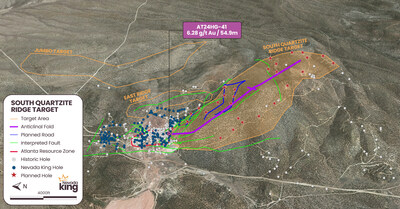
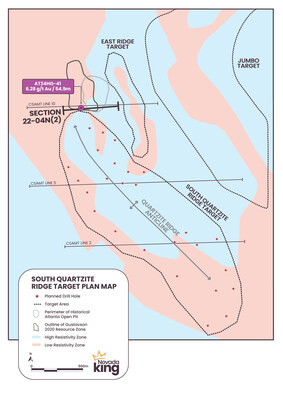
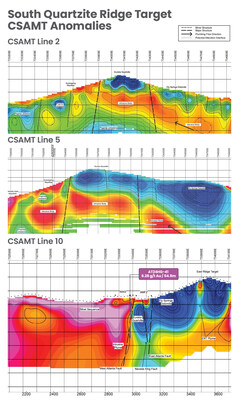
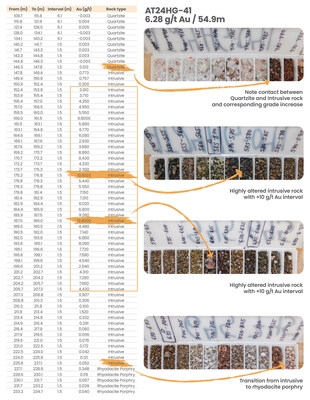
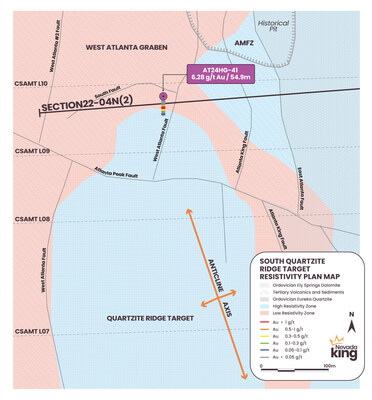
- Today's intercept of 6.28 g/t Au over 54.9m occurs in strongly altered intrusive rock starting 147.9m downhole, immediately below a non-mineralized, massive quartzite unit that caps the top of the South Quartzite Ridge Anticline (Figures 1 and 4). The hole was steeply angled at -85o southward along the anticlinal axis of the SQRT to test a large, low resistivity CSAMT anomaly occurring underneath the highly resistive quartzite cap (Figure 3). This axial zone aligns with major, high-angle faults controlling felsic intrusions and associated gold mineralization further north within the resource zone and is most likely a southern extension of the WAGZ.
Hole No. | From (m) | To (m) | Interval (m) | Au (g/t) | Ag (g/t) |
AT24HG-41^ | 147.8 | 216.4 | 68.6 | 5.14 | 16.0 |
Includes | 152.4 | 207.3 | 54.9 | 6.28 | 17.9 |
Table 1. Hole reported today. Mineralization occurs within an irregularly shaped intrusive body with true mineralized thicknesses estimated to be
- This hole is significant for several reasons:
- The high-grade gold mineralization in this hole has remarkably consistent grade over the 55m interval (see Figure 6) with the mineralization interpreted to have been focused in the intrusive host by the pooling of mineralizing fluids under the impermeable quartzite unit. Previous work provided indication for the potential for blind mineralization under the quartzite unit, particularly because gold mineralization was identified approximately 2.5km apart underneath its lateral boundaries. With these new results, testing for blind, high-grade mineralization underneath the SQRT will be a focus of future drilling.
- The extension of high-grade oxide mineralization southward beneath the Eureka Quartzite strongly enhances potential for extending the
Atlanta resource zone into the areally extensive SQRT, which possesses a 2.5km strike length and ranges up to 1km wide. The SQRT is contiguous to theAtlanta resource zone and on trend with the major faults that are interpreted as the primary plumbing for the mineralizing fluids that deposited high-grade gold atAtlanta . These major feeder structures include theWest Atlanta ,West Atlanta #1 and #2, and East Atlanta Faults. - The northerly trending SQRT coincides with the broad South Quartzite Ridge Anticline (Figure 4), which formed a structural trap or cap above the underlying intrusive rock, thus concentrating gold-bearing fluids and subsequent mineralization along the anticline's axial portion. This is clearly evident from the hole assays shown in Figure 6, where gold values in the quartzite are almost non-existent compared to the strong Au mineralization immediately below it in the intrusive rocks. Axial portions of anticlines constitute important traps for gold mineralization within
Nevada and elsewhere throughout the world, and the quartzite forming the South Quartzite Ridge Anticline could potentially be concealing a significant mineralized body that has never been drill-tested nor been revealed with surface sampling due to its highly impermeable nature. - The oxide gold in AT24HG-41 is hosted within an intrusive suite consisting of variably silicified and argillized rhyolitic dikes and adjacent rhyolite-dominated explosive tuff dike breccia bodies. The sustained, consistent high gold grades seen in these intrusive units are very unusual at
Atlanta , and when compared to the intrusive-hosted mineralization seen in holes further north along the WAGZ, the much higher grades encountered in AT24HG-41 demonstrate an abrupt southward strengthening of gold mineralization. Today's hole demonstrates that felsic intrusive rocks atAtlanta are capable of hosting a type of high-grade mineralization that can potentially produce a significant gold system more akin to Kinross Gold's large gold mine atRound Mountain, Nevada (located 240km west ofAtlanta and with 16 million ounces of gold produced through 2022 - Source: USBM Nevada Mineral Explorer Website, 2023). This potential certainly applies to the SQRT, and beyond that, the many low resistivity zones (a few of which are shown in Figure 4) revealed by the CSAMT data also constitute valid exploration targets hosting similar high-grade potential across theAtlanta District. - AT24HG-41 intersected mineralization approximately 20m from previously released AT23HG-34, which also encountered a large cap of Eureka Quartzite before contacting strongly mineralized intrusive, including 4.50 g/t Au over 27.4m within 2.15 g/t Au over 96m. AT24HG-41 is set apart from its neighboring holes as it is the closest to test the continuation of mineralization southward beneath the South Quartzite Ridge Anticline, as well as intersecting the most consistent, high-grade intrusive-hosted mineralization at
Atlanta to date.
- The SQRT remains a high potential, undrilled target area with the exception of eight historic drill holes (Figure 1) put down by Bobcat Exploration in the late 1970s. The Bobcat holes averaged 73m in depth and so did not test the core location of this newly developing zone under the quartzite where Au mineralization starts at around 150m depth. Six of the Bobcat holes drilled along the western margin of the SQRT and distant from the anticlinal axis contained no significant gold values. The other two Bobcat holes were drilled at the southern end of the SQRT and closer to the anticlinal axis, with both holes reporting gold values in the 0.30 g/t Au range. This anticlinal axis appears to be the main control over gold mineralization along the SQRT, and as seen in Figure 4, the Company's reconnaissance program is designed to hit the axial portion with a combination of vertical and shallow angle holes.
Cal Herron, Exploration Manager of
"Gold enrichment in AT24HG-41 rapidly drops below 213m depth at the contact with underlying fine grained porphyritic rhyodacite and dacite that compose a large altered dike (or small, elongate stock) bounding the SQRT's western margin. These dacitic intrusions are exposed at the surface all along the western side of the SQRT, while the rhyolitic rocks associated with gold mineralization crop out along the axis of the South Quartzite Ridge Anticline. Surface rock sampling shows the dacitic rocks to be largely barren of Au, whereas the aphyric rhyolite dikes extending north and south from historical tunnels just west of the anticlinal axis are associated with mineralization. Between the CSAMT data, outcrop exposures, and surface samples we have good reason to drill-test the full length of the SQRT.
"The long, high-grade intercept in this hole is highlighting not only the SQRT, but also a number of other low resistance zones identified elsewhere on the larger
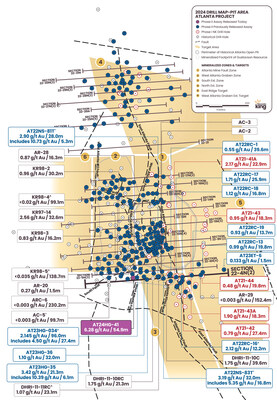
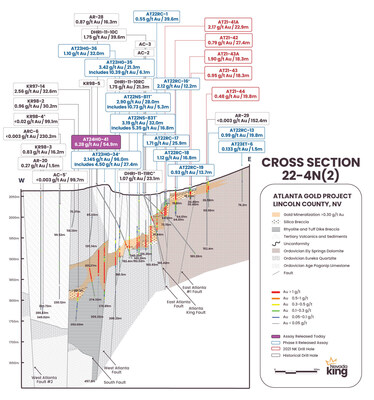
Hole No. | From (m) | To (m) | Interval (m) | Au (g/t) | Ag (g/t) |
AT23ET-6 | 13.7 | 15.2 | 1.5 | 0.13 | <0.5 |
AT23HG-34+ | 135.7 | 231.7 | 96.0 | 2.15 | 5.1 |
Includes | 202.7 | 231.7 | 27.4 | 4.50 | 13.3 |
AT23HG-35 | 134.1 | 155.5 | 21.3 | 3.42 | 9.3 |
Includes | 147.9 | 154.0 | 6.1 | 10.39 | 22.0 |
AT23HG-36 | 143.3 | 175.3 | 32.0 | 1.10 | 2.7 |
AT22NS-81T* | 101.8 | 129.9 | 28.0 | 2.90 | 8.1 |
Includes | 123.2 | 128.5 | 5.3 | 10.73 | 21.4 |
AT22NS-83T* | 96.6 | 128.7 | 32.0 | 3.19 | 14.6 |
Includes | 110.4 | 127.1 | 16.8 | 5.35 | 24.1 |
AT22RC-1 | 48.8 | 88.4 | 39.6 | 0.55 | 4.5 |
AT22RC-13 | 0.0 | 19.8 | 19.8 | 0.99 | 7.4 |
AT22RC-16+ | 6.1 | 18.3 | 12.2 | 2.12 | 10.5 |
AT22RC-17 | 33.5 | 59.5 | 25.9 | 1.71 | 20.7 |
AT22RC-18 | 9.1 | 25.9 | 16.8 | 1.12 | 10.3 |
AT22RC-19 | 9.1 | 22.9 | 13.7 | 0.93 | 11.3 |
AT21-41A | 38.1 | 61.0 | 22.9 | 2.17 | 33.7 |
AT21-42 | 9.1 | 36.6 | 27.4 | 0.79 | 3.3 |
AT21-43 | 10.7 | 29.0 | 18.3 | 0.95 | 10.0 |
AT21-43A | 10.7 | 29.0 | 18.3 | 1.90 | 18.6 |
AT21-44 | 4.6 | 24.4 | 19.8 | 0.48 | 4.1 |
Table 2. Previously reported holes used in previous releases along trace of Section 22-4N(2). AT23 series holes were drilled by
Hole No. | From (m) | To (m) | Interval (m) | Au (g/t) | Ag (g/t) |
KR98-2^ | 201.7 | 231.8 | 30.2 | 0.96 | 6.82 |
KR98-3^ | 202.9 | 219.1 | 16.2 | 0.83 | 0.9 |
KR98-4^ | 0.0 | 99.1 | 99.1 | <0.02 | <0.8 |
KR98-5^ | 0.0 | 138.7 | 138.7 | <0.035 | <1.0 |
KR97-14^ | 177.9 | 210.5 | 32.6 | 2.56 | 2.1 |
AR-20 | 114.3 | 115.9 | 1.5 | 0.27 | 0.1 |
AR-28^ | 130.4 | 146.7 | 16.3 | 0.87 | 6.2 |
AR-29 | 0.0 | 152.4 | 152.4 | <0.003 | <0.1 |
ARC-6 | 0.0 | 230.2 | 230.2 | <0.003 | <1.0 |
AC-5* | 0.0 | 99.7 | 99.7 | <0.003 | <1.0 |
DHRI-11-10RC | 108.2 | 129.6 | 21.3 | 1.75 | 10.6 |
DHRI-11-11RC^ | 88.3 | 111.4 | 23.1 | 1.07 | 5.1 |
DHRI-11-10C* | 74.7 | 114.3 | 39.6 | 1.75 | 23.1 |
Table 3. Historical holes used in Section 22-4N. KR97 and KR98 series holes were drilled by Kinross in 1997 and 1998. AR, ARC, and AC series holes were drilled by Goldfields in 1991. DHRI-11 series holes were drilled by Meadow Bay in 2011. True thickness of gold mineralization interpreted in today's release is
Discussion of South Quartzite Ridge Target:
The overall north-south trend to mineralization at
Hole AT23HG-37 along Section 22-4N was sited on the northern end of the SQRT in order to test for mineralization underneath the quartzite. The hole collared in massive quartzite and drilled out of largely barren quartzite and into mineralized felsic intrusive tuff and rhyolite at 175m depth, with mineralization continuing to 285m. The contact between intrusive tuff and unaltered Pogonip Limestone was hit at 430m depth. This stratigraphic sequence is seen reflected in the resistivity section shown in Figure 5 along CSAMT Line 10. Projecting the hit in AT23HG-37 southward onto Line 10, the hole would penetrate the gold zone 40m west of the West Atlanta Fault. This same stratigraphic profile is repeated southward past CSAMT Line 7 more than 400m south of AT23HG-37, which now opens up a large area along the anticlinal axis in which to pursue the type of thick mineralization penetrated in holes AT23HG-37 and AT23HG-34, and now in hole AT24HG-41, within a part of the property that has never been previously drill-tested.
QAQC Protocols
All RC samples from the Atlanta Project are split at the drill site and placed in cloth and plastic bags utilizing a nominal 2kg sample weight. CRF standards, blanks, and duplicates are inserted into the sample stream on-site on a one-in-twenty sample basis, meaning all three inserts are included in each 20-sample group. Samples are shipped by a local contractor in large sample shipping crates directly to American Assay Lab in
The PQ-diameter core was sampled in the Company's warehouse in
Qualified Person
The scientific and technical information in this news release has been reviewed and approved by Calvin R. Herron, P.Geo., who is a Qualified Person as defined by National Instrument 43-101 ("NI 43-101").
About Nevada King Gold Corp.
The Atlanta Mine is a historical gold-silver producer with a NI 43-101 compliant pit-constrained resource of 460,000 oz Au in the measured and indicated category (11.0M tonnes at 1.3 g/t) plus an inferred resource of 142,000 oz Au (5.3M tonnes at 0.83 g/t). See the NI 43-101 Technical Report on Resources titled "Atlanta Property,
Resource Category | Tonnes (000's) | Au Grade (ppm) | Contained Au | Ag Grade (ppm) | Contained Ag |
Measured | 4,130 | 1.51 | 200,000 | 14.0 | 1,860,000 |
Indicated | 6,910 | 1.17 | 260,000 | 10.6 | 2,360,000 |
Measured + Indicated | 11,000 | 1.30 | 460,000 | 11.9 | 4,220,000 |
Inferred | 5,310 | 0.83 | 142,000 | 7.3 | 1,240,000 |
Table 4. NI 43-101 Mineral Resources at the Atlanta Mine
Please see the Company's website at www.nevadaking.ca.
Neither the TSX Venture Exchange nor its Regulation Services Provider (as that term is defined in the policies of the TSX Venture Exchange) accepts responsibility for the adequacy or accuracy of this release.
Cautionary Statements Regarding Forward Looking Information
This news release contains certain "forward-looking information" and "forward-looking statements" (collectively "forward-looking statements") within the meaning of applicable securities legislation. All statements, other than statements of historical fact, included herein, without limitation, statements relating the future operations and activities of

 View original content to download multimedia:https://www.prnewswire.com/news-releases/nevada-king-intercepts-6-28-gt-au-over-54-9m-hosted-entirely-by-intrusive-rocks-extends-mineralization-underneath-the-south-quartzite-ridge-opening-up-extensive-new-target-areas-at-atlanta-302203745.html
SOURCE Nevada King Gold Corp.
FAQ
AI-generated questions and answers. How Rhea-AI works. Not financial advice.