
NEVADA KING SECURES FOURTH DRILL RIG TO ATLANTA, PROVIDES EXPLORATION DRILLING UPDATE
Nevada King Gold (TSXV: NKG, OTCQX: NKGFF) has secured a fourth drill rig, a second Rotary Air Blast (RAB) rig, for its 100%-owned Atlanta Gold Mine Project in southeast Nevada.
Sentiment and the balance of points
Rhea-AI Sentiment reads the wording of the document, how positive or negative its language is on a 1 to 5 scale. The balance of points shown with the takes weighs what the document actually discloses, so the two can disagree, for example when a trial that missed its main goal is described in upbeat language.
Rhea-AI Summary
Nevada King Gold (TSXV: NKG, OTCQX: NKGFF) has secured a fourth drill rig, a second Rotary Air Blast (RAB) rig, for its 100%-owned Atlanta Gold Mine Project in southeast Nevada. The additional RAB rig, expected on site in September, will complement two reverse circulation (RC) rigs and work outside the 40,000m Phase 4 RC program, which is about 20,000m complete.
Road construction at Atlanta South is now finished, enabling RC drilling to start, while equipment is moving to build access on East Ridge. This will allow RC drilling below the 30m depth limit of RAB holes in Q4. Nevada King has also outlined a new, undrilled Splay Zone target (about 500m by 300m) immediately north and east of the Atlanta pit, on strike with structures hosting the Company’s 1,020koz M&I oxide resource. Recent East Ridge RAB drilling returned intercepts including 4.68 g/t Au over 7.3m and 1.00 g/t Au over 26.8m, and the Company now interprets the Splay Zone, East Ridge Target, and Atlanta Resource Zone as parts of a single mineralizing system offset around an uplifted fault block.
Positive
- Fourth drill rig secured with a second RAB unit arriving by September, expanding total rigs to four
- 40,000m Phase 4 RC program approximately 50% complete (~20,000m drilled)
- New Splay Zone target defined with a 500m x 300m undrilled gold anomaly on strike with 1,020koz M&I resource structures
- High-grade East Ridge RAB intercepts of 4.68 g/t Au over 7.3m and 1.00 g/t Au over 26.8m, both bottoming in mineralization
- Atlanta South road network completed, providing RC rig access and enabling drilling to commence on this largely untested target
Negative
- None.
Details
News Market Reaction – NKGFF
On Aug 31, the day this news came out, NKGFF closed 2.12% below the previous close.
Data tracked by StockTitan Argus for the Aug 31 session.
AI-generated analysis. How Rhea-AI works. Not financial advice.




The Company has also identified a large, previously undrilled gold target located immediately north of the East Ridge Target, which is adjacent to the
Highlights
- Fourth drill rig secured: A second Rotary Air Blast ("RAB") drill has been contracted and is expected on site in September, bringing the total drill rig count to four, including the two reverse circulation ("RC") rigs. The more mobile RAB rigs are able to reach targets with more challenging access, such as East Ridge, that RC rigs cannot. The 40,000m Phase 4 drill program is comprised of RC drilling only and RAB drilling is additional.
- Atlanta South road construction complete: Upper, middle, and lower section roads at Atlanta South are now complete, providing the access needed to commence drilling on the largely untested target which will follow up on mineralized intercepts in Pogonip Limestone, which is
Carlin -type mineralization, on trend with the Atlanta Resource (see Figure 2). - East Ridge access next: The excavator will now move to the East Ridge, where road construction will allow an RC rig to reach the Splay Zone and East Ridge Target and test mineralization below the 30m maximum depth of the RAB drill in Q4.
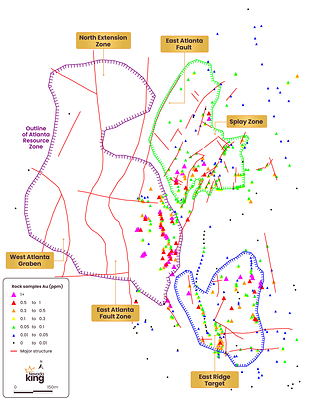
- New drill target in pipeline: Following recent high-grade, near-surface, oxide RAB results at the East Ridge Target, surface mapping and sampling have outlined a large, untested gold anomaly at the Splay Zone, spanning roughly 500m by 300m. This is a larger surface footprint than the East Ridge Target, and it has never been drilled.
Justin Daley, VP Exploration of
Road Construction and Drill Access
Road construction at Atlanta South is now complete with the upper, middle, and lower levels all finished (see Figure 2). The completed road network gives the Company's RC rigs access to the Atlanta South target, and RC drilling on the target is set to commence.
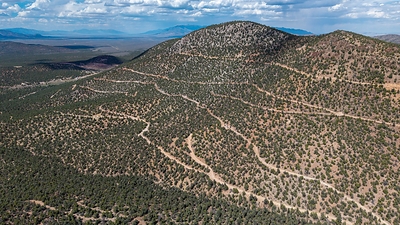
The excavator will now relocate to the East Ridge to begin constructing access onto the ridge. Both the East Ridge Target and Splay Zone sit on elevated ground that the RC rig cannot currently reach, which is the principal reason the Splay Zone was never drilled. Once East Ridge road construction is complete, an RC rig will be able to reach the targets and test mineralization below the 30m maximum depth of the RAB drill, with RC drilling at East Ridge anticipated in Q4.
Phase 4 Exploration and Rig Deployment
The Company has now completed ~20,000m of its 40,000m Phase 4 RC drill program. The two RAB rigs support the RC program as reconnaissance and target generation tools, allowing the Company to test through shallow cover at targets that the RC rigs cannot access, and to prioritize where deeper RC drilling is required. The addition of the second RAB rig means the Splay Zone can be drill-tested for the first time while the existing RAB rig continues reconnaissance elsewhere on the property.
Several surface samples in excess of 1.0 g/t Au (Figure 1) outline similar mineralization styles and controls to those in the ARZ and at the East Ridge Target, where RAB drilling in July returned intercepts of 4.68 g/t Au over 7.3m and 1.00 g/t Au over 26.8m, both bottoming in mineralization (see news release dated July 7, 2026).
The Splay Zone
The Splay Zone is a 500m by 300m area of partially outcropping, gold-bearing silicification that has never been drilled. It sits immediately north and east of the
The ARZ is characterized by dense silicification within the Silurian-age Laketown Dolomite Formation, the same unit that hosts gold mineralization at the Splay Zone. Across the 250m-wide East Atlanta Fault Zone (the "EAFZ"), which hosts the vein zone originally mined during the 1975-1985 open pit operation, a series of steeply dipping, northerly striking faults have down-dropped narrow wedges of Laketown Dolomite progressively to the west, in a pattern resembling a staircase descending from east to west. These faults served as conduits for shallow igneous intrusions and gold-bearing hydrothermal fluids that concentrated mineralization within favourable, gently northwest-dipping dolomitic beds. A very similar style of replacement-type mineralization and associated intrusive activity is present at the Splay Zone, within dolomitic beds dipping gently north and northwest.
Past operators discounted the Splay Zone, in part because of the difficulty of constructing roads onto the target and in part because the gold mineralization and silicification were interpreted to represent only a thin surface veneer with little potential. That interpretation was reinforced by the prevailing belief that gold mineralization at
Because the rock at the Splay Zone is so strongly altered at surface and obscured by thick scree mantles, the true thickness of the mineralized host cannot be determined from outcrop. The objective of the initial RAB drilling is to determine whether the same westerly down-dropped staircase seen across the ARZ repeats across the northeast-trending faults at the Splay Zone, and therefore whether the mineralized package continues below its surface expression. RAB drilling is the fastest and lowest-cost means of answering that question and will test to a maximum depth of 30 metres. Once the East Ridge road access is complete, deeper RC drilling is required to test the full thickness of the host horizon.
QA/QC Protocols
Surface rock samples collected at the Atlanta Project are described and bagged on site, with sample locations recorded by handheld GPS. Samples are shipped by a local contractor directly to American Assay Lab in
Qualified Person
The scientific and technical information in this news release has been reviewed and approved by
About Nevada King Gold Corp.
Nevada King is focused on advancing and growing its
Please see the Company's website at www.nevadaking.ca.
Neither the TSX Venture Exchange nor its Regulation Services Provider (as that term is defined in the policies of the TSX Venture Exchange) accepts responsibility for the adequacy or accuracy of this release.
Cautionary Statements Regarding Forward Looking Information
This news release contains "forward-looking information" and "forward-looking statements" within the meaning of applicable Canadian securities laws (collectively, "forward-looking statements"). Forward-looking statements are statements that are not historical facts and include, without limitation, statements regarding the Company's exploration plans, the timing, scope and objectives of current and future drilling, the contracting and mobilization of additional drill rigs and the anticipated timing of their arrival on site, the completion of the remaining metres of the Company's Phase 4 drill program, the anticipated follow-up of RAB drill results with RC drilling, the Company's ability to construct roads and drill pads and access additional drill sites, the potential significance of drill results, the potential for depth continuity, the potential for additional near-surface mineralization, the Company's geological interpretations and exploration model, and the future advancement of the Atlanta Gold Mine Project.
Forward-looking statements are often, but not always, identified by words and phrases such as "anticipates", "expects", "plans", "intends", "believes", "estimates", "potential", "possible", "prospective", "target", "suggests", "indicates", "may", "could", "would", "should", "will" and similar expressions. Forward-looking statements are based on the Company's current expectations, estimates, forecasts and assumptions, including, without limitation, assumptions regarding the accuracy and reliability of assay results, geological interpretations and exploration models; the continuity, grade and extent of mineralization; the Company's ability to obtain required permits, approvals and access rights on acceptable timelines; the availability of contractors, equipment, personnel, capital and other resources; the Company's ability to complete proposed exploration programs as currently contemplated; the absence of material adverse changes in regulatory, environmental, community, market or operating conditions; and the Company's ability to comply with applicable laws, including applicable securities laws, environmental laws and exchange requirements.
Forward-looking statements are subject to known and unknown risks, uncertainties and other factors that may cause actual results, performance or developments to differ materially from those expressed or implied by such statements. These risks and uncertainties include, without limitation, risks related to early-stage exploration results; the possibility that future drilling may not confirm the continuity, grade, geometry or economic significance of mineralization; risks that RAB drilling results may not be representative of broader mineralized zones or may not be replicated by RC or other follow-up drilling; risks relating to permitting; risks relating to access, topography, weather, road and drill-pad construction; risks inherent in mineral resource estimation and the possibility that mineral resources may not be expanded or converted as anticipated; risks that mineralization outside the current resource area may not ultimately be economic or mineable; risks relating to commodity prices, capital markets and the availability of financing; operational risks; environmental and reclamation risks; regulatory and title risks; reliance on third-party contractors and laboratories; and other risks generally associated with mineral exploration and development.
Although the Company believes that the assumptions and expectations reflected in the forward-looking statements are reasonable as of the date of this news release, forward-looking statements are inherently uncertain, are not guarantees of future performance, and no assurance can be given that such statements will prove to be accurate. Readers are cautioned not to place undue reliance on forward-looking statements. The forward-looking statements contained in this news release are made as of the date hereof, and the Company undertakes no obligation to update or revise any forward-looking statements, whether as a result of new information, future events or otherwise, except as required by applicable securities laws.
 View original content to download multimedia:https://www.prnewswire.com/news-releases/nevada-king-secures-fourth-drill-rig-to-atlanta-provides-exploration-drilling-update-302864469.html
SOURCE Nevada King Gold Corp.
FAQ
AI-generated questions and answers. How Rhea-AI works. Not financial advice.