
Nevada Organic Phosphate Reports Consistently Strong P2O5 Grades over 10% Across All 2025 Drill Holes at Murdock Mountain
Nevada Organic Phosphate (OTCQB:NOPFF) reported final P2O5 assay results from its 2025 Murdock Mountain drill program showing consistently strong grades in the Upper Phosphatic Zone.
Sentiment and the balance of points
Rhea-AI Sentiment reads the wording of the document, how positive or negative its language is on a 1 to 5 scale. The balance of points shown with the takes weighs what the document actually discloses, so the two can disagree, for example when a trial that missed its main goal is described in upbeat language.
Rhea-AI Summary
Nevada Organic Phosphate (OTCQB:NOPFF) reported final P2O5 assay results from its 2025 Murdock Mountain drill program showing consistently strong grades in the Upper Phosphatic Zone. Six holes returned between 10.23% and 11.89% P2O5 over 3.71–5.12 m (reported true thicknesses 3.70–4.61 m). A Lower Zone intercept in MM25-6 returned 17.47% P2O5 over 4.11 m and remains open to the west. The Upper Phosphatic Zone is reported as 3.4–7.6 m thick within the Meade Peak Member.
ALS conducted ME-XRF24 and ME-MS61 assays with NI 43-101‑style QA/QC; heavy metal assay results are pending.
Positive
- Six holes: 10.23%–11.89% P2O5 over 3.71–5.12 m
- Lower Zone 17.47% P2O5 over 4.11 m (MM25-6)
- 1.5 kilometres of consistent >10% P2O5 results along target
- Assays processed by ALS with stated ISO/IEC 17025 accreditation and QA/QC
Negative
- Heavy metal and contaminant assay results not yet released
- No mineral resource or tonnage estimate provided in release
Details
News Market Reaction – NOPFF
On Jan 5, the day this news came out, NOPFF closed 0.19% below the previous close.
Data tracked by StockTitan Argus for the Jan 5 session.
AI-generated analysis. How Rhea-AI works. Not financial advice.




Vancouver, British Columbia--(Newsfile Corp. - January 5, 2026) - Nevada Organic Phosphate Inc. (CSE: NOP) (OTCQB: NOPFF) ("NOP" or the "Company"), a B.C. based leader in organic sedimentary phosphate exploration, is pleased to announce that the final P₂O₅ assay results from its 2025 drill program at the Murdock Mountain Property in Elko County, Nevada, continue to reinforce the strength and consistency of phosphate mineralization across the Upper Phosphatic Zone. The latest results mark another meaningful step in advancing the Company's understanding of this sedimentary phosphate system.
The Company's exploration target, and the object of this drill program, is the Upper Phosphatic Zone, a 3.4 to 7.6 metre (11 to 25 feet) thick zone within the Meade Peak Member of siltstone and phosphorite.
Drill Results for Upper Phosphatic Zone
MM25-1:
10.23% P2O5 over 5.12 metres (4.61 metres, 15.12 feet true thickness)MM25-2:
10.7% P2O5 over 4.79 metres (4.31 metres, 14.14 feet true thickness)MM25-3:
11.2% P2O5 over 4.7 metres (4.23 metres, 13.87 feet true thickness)MM25-4:
10.64% P2O5 over 3.71 metres (3.70 metres, 12.14 feet true thickness)MM25-5:
11.01% P2O5 over 3.96 metres (3.90 metres, 12.79 feet true thickness)MM25-6:
11.89% P2O5 over 4.58 metres (4.44 metres, 14.56 feet true thickness)
Note: In addition to the primary target zone, drilling at MM25-6, the westernmost hole completed to date, intersected a notably strong phosphate interval in the Lower Zone at the base of the Meade Peak Unit. This interval returned a very strong
Assays for heavy metals and other potential contaminants are expected to be released in the coming weeks.
CEO Robin Dow commented: "the results continue to align with the Company's geological model and previously stated expectations, noting that grades in the 7–
Director and P.Geo Garry Smith added: "in addition to the 1.5 kilometres of consistently strong results over
P2O5 Drill Assay Intervals
| DDH | Sample | From m | To m | Length m | Lith | P2O5% | GRD%/m | |
| MM25-4 | 977208 | 62.48 | 63.49 | 1.01 | MP | 3.03 | ||
| MM25-4 | 977209 | 63.49 | 64.49 | 1.00 | MP | 6.65 | ||
| MM25-4 | 977211 | 64.49 | 65.53 | 1.04 | MP | 9.26 | 10.64/3.71 | |
| MM25-4 | 977212 | 65.53 | 66.54 | 1.01 | MP | 18.85 | ||
| MM25-4 | 977213 | 66.54 | 67.20 | 0.66 | MP | 6.28 | ||
| MM25-4 | 977214 | 67.20 | 68.28 | 1.08 | MP | 2.76 | ||
| MM25-5 | 977254 | 56.39 | 58.52 | 2.13 | MP | 3.10 | ||
| MM25-5 | 977255 | 58.52 | 59.44 | 0.92 | MP | 8.70 | ||
| MM25-5 | 977256 | 59.44 | 60.35 | 0.91 | MP | 11.80 | ||
| MM25-5 | 977257 | 60.35 | 61.11 | 0.76 | MP | 14.40 | 11.01/3.96 | |
| MM25-5 | 977258 | 61.11 | 62.48 | 1.37 | MP | 10.15 | ||
| MM25-5 | 1081159 | 62.48 | 63.86 | 1.38 | MP | 2.05 | ||
| MM25-6 | 1081198 | 35.05 | 36.11 | 1.06 | MP | 3.83 | ||
| MM25-6 | 1081199 | 36.11 | 37.18 | 1.07 | MP | 8.20 | ||
| MM25-6 | 1081201 | 37.18 | 38.10 | 0.92 | MP | 9.77 | ||
| MM25-6 | 1081202 | 38.10 | 39.10 | 1.00 | MP | 19.10 | 11.89/4.58 | |
| MM25-6 | 1081203 | 39.10 | 39.79 | 0.69 | MP | 5.03 | ||
| MM25-6 | 1081204 | 39.79 | 40.69 | 0.90 | MP | 15.70 | ||
| MM25-6 | 1081205 | 40.69 | 41.65 | 0.96 | MP | 1.72 | ||
| MM25-6 | 1081232 | 63.34 | 64.47 | 1.13 | MP | 0.64 | ||
| MM25-6 | 1081233 | 64.47 | 65.53 | 1.06 | MP | 9.61 | 17.47/4.11 | (Lower Zone) |
| MM25-6 | 1081234 | 65.53 | 68.58 | 3.05 | CFU | 20.20 | ||
| MM25-6 | 1081235 | 68.58 | 69.80 | 1.22 | CFU | 0.68 |
NOTE: A 3-Point solution for the top of the Upper Phosphatic Zone in the first 3 holes gave a dip to the unit of 26.1 degrees. However, core axis to bedrock angle measurements observed in the drill core are consistently 5-10 degrees, suggesting a flattening of the Zone.
Drill Hole Locations
| DDH | Pad | UTME m | UTMN m | Elev m | TD m | Dip d | Az d |
| MM25-1 | P4 | 724404 | 4568973 | 1949 | 82.60 | -90 | 0 |
| MM25-2 | P3 | 724767 | 4569272 | 1896 | 125.73 | -90 | 0 |
| MM25-3 | P7 | 724344 | 4568766 | 1987 | 71.32 | -90 | 0 |
| MM25-4 | P8 | 724100 | 4568690 | 2018 | 99.67 | -90 | 0 |
| MM25-5 | P8 | 724100 | 4568690 | 2018 | 92.96 | -65 | 120 |
| MM25-6 | P9 | 723830 | 4568439 | 2018 | 78.30 | -90 | 0 |
| 550.58 |
Note: Coordinates are in UTM WGS 84.
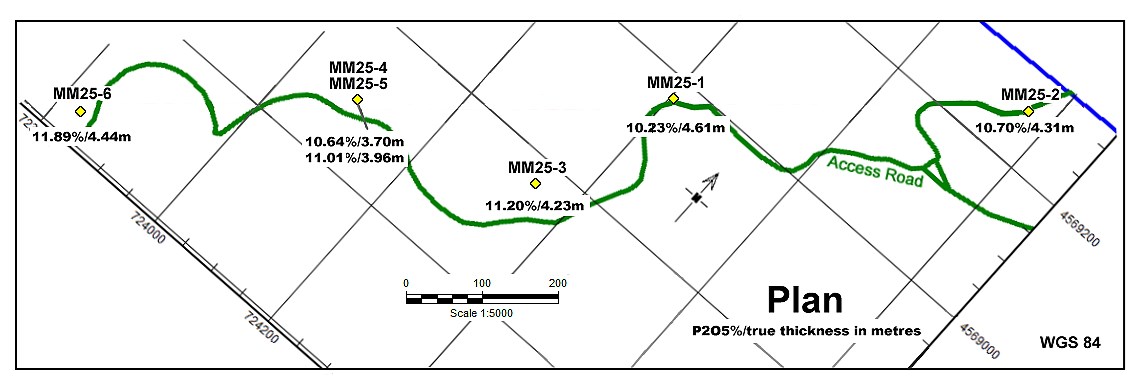
To view an enhanced version of this graphic, please visit:
https://images.newsfilecorp.com/files/9821/279420_39bc6166c4d6d897_001full.jpg
Please visit the Company's website here to view drill hole location maps.
Lab Assaying Methods & QA/QC
All sample preparation and analytical work was carried out by ALS Laboratories ("ALS"), an independent commercial laboratory accredited to ISO/IEC 17025:2017 for mineral analysis. Samples were delivered to the ALS Elko prep lab and then forwarded to ALS Vancouver for analysis. ALS operates under rigorous quality management systems and is regularly audited by recognized accreditation bodies, including the Standards Council of Canada (SCC) and the Canadian Association for Laboratory Accreditation (CALA).
Phosphate P2O5 assaying was by ME-XRF24 whole-rock analysis: Samples were fused with lithium borate and analyzed by X-ray fluorescence (XRF). This method provides high-precision determinations of major rock-forming oxides, including phosphorus, calcium, and silica, ensuring accurate characterization of phosphate mineralization.
Heavy metal assaying was by ME-MS61 trace element analysis: Samples were digested using a near-total four-acid procedure (HF-HNO₃-HClO₄-HCl) and analyzed by ICP-MS and ICP-AES. This technique delivers ultra-trace detection of a broad suite of elements, including deleterious or contaminant metals such as arsenic, cadmium, mercury, and lead, supporting environmental and processing assessments.
ALS maintains strict internal QA/QC protocols, including the insertion of certified reference materials, blanks, and duplicates with each batch of samples. These measures ensure that analytical results meet internationally recognized standards of accuracy and reliability, consistent with the requirements of NI 43-101 reporting.
Company Quality Assurance / Quality Control (QA/QC)
The Company implemented a rigorous QA/QC protocol consistent with NI 43-101 standards, including the insertion of blanks and certified reference materials into the sample stream.
Blanks: The Company regularly inserted a blank comprised of generically sourced sand every 11 samples (or
Certified reference materials ("CRM"): CRMs used in mineral exploration are used to assess analytical accuracy and are usually rock powders comprised of known concentrations of the metal(s) of interest. CRMs are usually obtained from commercial suppliers who provide the average of many analyses of the CRMs by multiple labs, which is referred to as the certified value, and a standard deviation of the analyses from which the certified value is determined. A typical criterion for accepting the analyses of CRMs in the mineral industry is that they should fall within a range determined by the certified (or "target") value ± three standard deviations ("3 STD"). Analytical accuracy was verified against BAM 826-1, a certified reference material for phosphate slags issued by Germany's Federal Institute for Materials Research and Testing (BAM). The Company inserted BAM 826-1 CRM standards every 22 samples (or
The Company is satisfied that the QA/QC results demonstrate the reliability of the assay data and support the integrity of the phosphate grades reported herein.
The Independent Qualified Person for this drill program is Kenneth N. Tullar, AIPG Certified Professional Geologist (CPG-11142), who has reviewed and approved the technical content of this release.
Nevada Organic Phosphate Inc.
NOP is a junior exploration company with an organic sedimentary raw rock phosphate bed, 6.6 kilometres long, in northeast Nevada. Additional applications extend the potential strike of rock phosphate to over 30 kilometres. This is believed to be the only known large-scale organic sedimentary phosphate project in North America. It is situated close to the main highway to Montello/Elko, Nevada, and near the rail head to California.
For More Information
Robin Dow, CEO
T: 604.355.9986
E: robin@dowgroup.ca
Neither the Canadian Securities Exchange nor its regulations services providers have reviewed or accept responsibility for the adequacy or accuracy of this release.
This news release may contain forward-looking statements and information ("FLSI") within the meaning
of applicable securities laws. FLSI may include expectations, anticipations, beliefs, opinions, plans, intentions, estimates, forecasts, projections, guidance or other similar statements and information that are not historical facts. All statements which are not historical statements are considered FLSI. All FLSI is based on assumptions, which may prove inaccurate, and subject to certain risks and uncertainties, including without limitation those risks and uncertainties identified in the Company's public securities filings, which may cause actual events or results to differ materially from those indicated or implied in FLSI. Accordingly, readers should not place undue reliance or value on FLSI. Although the Company believes that the expectations reflected in any FLSI in this news release are reasonable at the present time, it can give no assurance that such FLSI will prove to be correct. Any FLSI in this news release is made as of the date hereof and the Company undertakes no obligations to publicly update or revise any FLSI, whether as a result of new information, future events or otherwise, unless required by applicable securities laws. Any FLSI in this news release is expressly qualified in its entirety by this cautionary statement.

To view the source version of this press release, please visit https://www.newsfilecorp.com/release/279420
FAQ
AI-generated questions and answers. How Rhea-AI works. Not financial advice.